
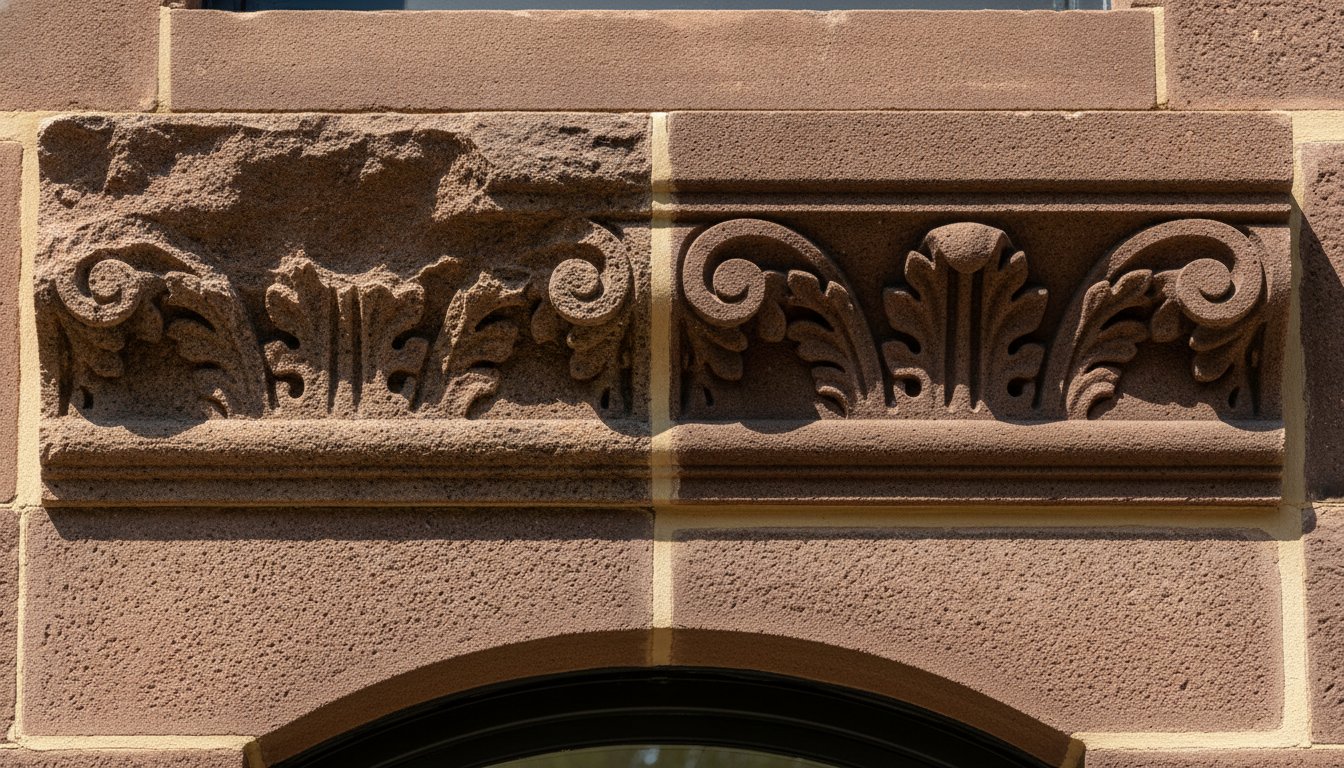
The most striking architectural details on a New York City brownstone are often the most vulnerable to weather and time. You’ve likely noticed the delicate scrolls and floral motifs on your facade beginning to flake or lose their sharp definition. It’s a common concern for owners who value history but fear the complexity of Landmarks Preservation Commission (LPC) regulations. Repairing intricate brownstone carvings in a landmarked building requires a balance of 19th-century artistry and modern technical precision.
This article outlines the specialized techniques and legal requirements necessary to restore your home’s historic character while ensuring long-term structural protection. We’ll examine the importance of using natural hydraulic lime mortar and how to navigate the LPC permit process. For expert guidance, contact Progressive Contracting NY Corp (License 2097623-DCA) at 347-341-3808 or 718-350-7388, or email ProgressiveContractingNY@yahoo.com to discuss your restoration needs.
Understanding the Decay of Historic Brownstone Carvings
Brownstone is a soft, porous sandstone formed in distinct sedimentary layers. While this material allowed 19th-century masons to create stunning architectural details, its geological structure makes it prone to exfoliation. This process occurs when water penetrates the stone’s bedding planes, causing the surface to peel away in thin sheets. Understanding Brownstone and its sedimentary nature is the first step in diagnosing why these facades fail over time.
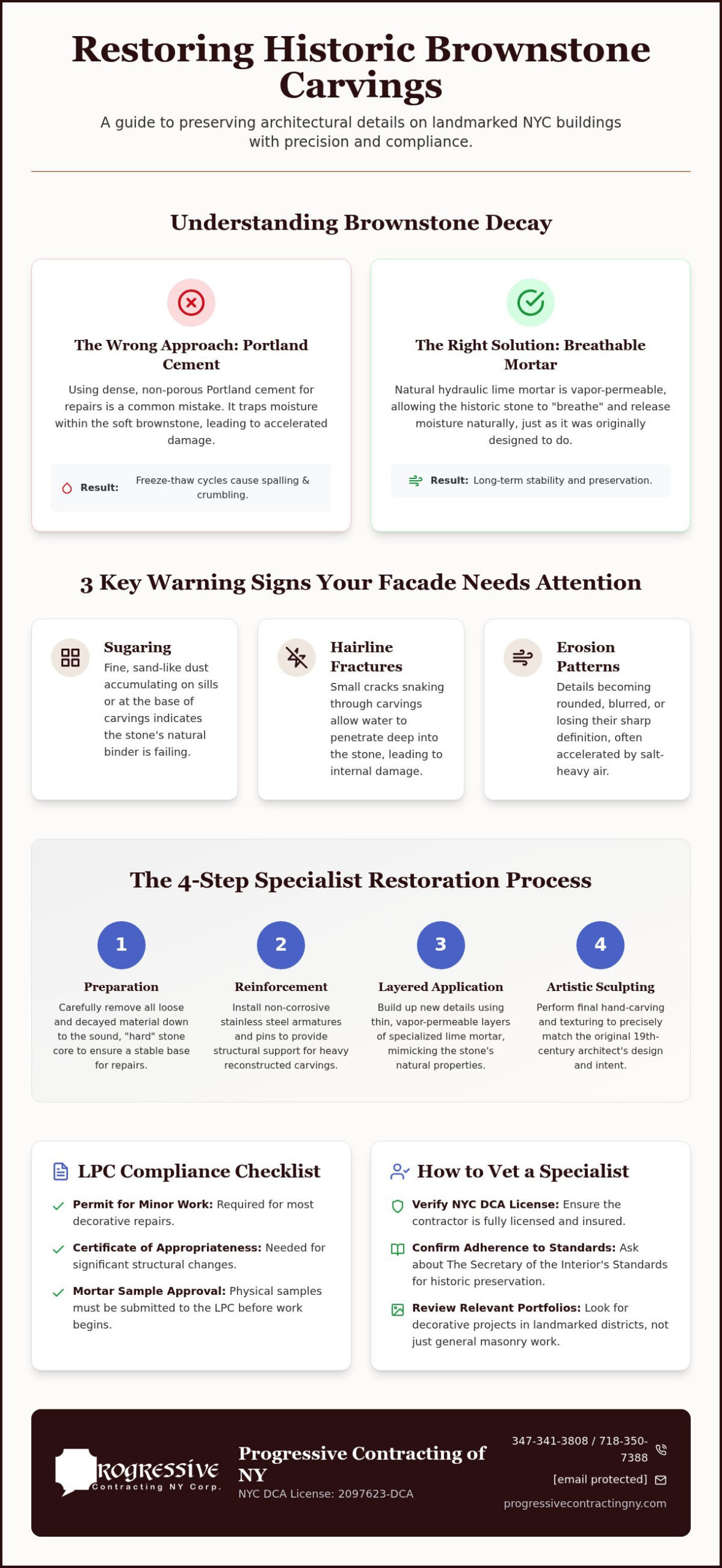
Many property owners find that past “quick-fix” repairs using Portland cement have actually accelerated the destruction. Cement is far too dense and non-porous for historic masonry. It traps moisture inside the stone, which then undergoes NYC’s aggressive freeze-thaw cycles. As trapped water expands, it exerts immense pressure on delicate foliated scrolls and acanthus leaves, eventually snapping them off or turning them to dust. For a deeper look at this process, see our guide on brownstone spalling repair.
Signs Your Landmarked Details Need Immediate Attention
Early detection is the most effective way to manage the costs of repairing intricate brownstone carvings in a landmarked building. You should regularly inspect your facade for these specific red flags:
- Sugaring: Fine brown dust or “sugar” accumulating on window sills or at the base of pediments indicates the stone’s natural binder is failing.
- Hairline Fractures: Small cracks that snake through the core of a carving allow water to reach the center of the stone.
- Erosion Patterns: In neighborhoods like Park Slope, salt-heavy air can accelerate the breakdown of decorative elements, leaving them rounded and blurred.
If you notice these signs, professional intervention is necessary to prevent the total loss of your building’s character. Progressive Contracting NY Corp (License 2097623-DCA) specializes in stabilizing these historic elements. You can reach our team at 347-341-3808 or 718-350-7388, or email ProgressiveContractingNY@yahoo.com to schedule a professional assessment.
The Restoration Process: Sculpting and Mortar Matching
Restoring a historic facade is a methodical sequence that prioritizes structural integrity. We begin by removing all loose, friable material until we reach the sound, “hard” stone core. This prevents new repairs from detaching due to the underlying decay discussed earlier. For heavy decorative elements, we install stainless steel armatures or pins. These provide the necessary reinforcement to support the weight of reconstructed carvings without causing further rust-related damage to the facade.
The actual process of repairing intricate brownstone carvings in a landmarked building involves building up details in thin, vapor-permeable layers. This technique mimics the natural breathability of the stone, as detailed in the NPS Preservation Briefs. Once the mortar reaches the proper consistency, our masons perform final hand-carving and texturing to match the original architect’s intent. This ensures the new work is indistinguishable from the 19th-century original. If your facade is losing its detail, reaching out to a brownstone contractor is the first step toward preservation.
Navigating LPC Requirements for Decorative Masonry
Working within NYC’s historic districts requires strict adherence to regulatory standards. Most decorative repairs fall under a “Permit for Minor Work,” while significant structural alterations may require a “Certificate of Appropriateness.” You must provide the LPC with physical mortar samples for color and texture approval before any work begins. A Brownstone specialist can manage these filings to ensure total compliance. For professional assistance, contact Progressive Contracting NY Corp (License 2097623-DCA) at 347-341-3808 or 718-350-7388, or email ProgressiveContractingNY@yahoo.com.
Vetting a Specialist for Intricate Landmark Restoration
General masonry contractors often excel at basic structural work, but they frequently lack the specialized sculpting skills required for fine detail. Repairing intricate brownstone carvings in a landmarked building is an artistic endeavor that demands a high level of craftsmanship. A contractor without experience in hand-carving might leave behind flat, lifeless patches that clash with the original 19th-century aesthetic. These “blind” repairs often fail to capture the depth and shadow lines that define historic New York architecture.
Trust is built through transparency and proper credentials. Always verify that your chosen firm holds a valid NYC DCA license, such as Progressive Contracting License #2097623-DCA. We follow The Secretary of the Interior’s Standards to ensure every restoration remains historically accurate and physically compatible with the original stone. When reviewing portfolios, specifically look for decorative projects in Manhattan or Brooklyn Heights. These landmarked neighborhoods require a level of precision that only a seasoned specialist can provide. For a clear, matter-of-fact discussion about your project, call us at 347-341-3808 or 718-350-7388.
Long-Term Maintenance of Restored Facade Details
Preserving your investment requires a proactive approach to moisture management. Proper brick pointing is essential, as it prevents water from seeping into the joints and eventually eroding the surrounding carvings. In historic districts like Bed-Stuy, where facades face varying environmental stressors, annual inspections are a critical safeguard against new decay. Small cracks caught early are far easier and less expensive to manage than large-scale failures. You can email us at ProgressiveContractingNY@yahoo.com to schedule a detailed facade assessment and ensure your building remains protected for decades to come.
Restoring the Historic Beauty of Your Facade
Preserving a landmarked property requires more than simple masonry patches. It demands a deep understanding of geological decay and a commitment to traditional hand-carving. Successfully repairing intricate brownstone carvings in a landmarked building ensures your home remains a source of pride while meeting NYC regulatory standards. By choosing a partner with expertise in Park Slope, Bed-Stuy, and Manhattan, you protect both the structural integrity and the financial value of your investment.
Protect your property’s heritage. Request a specialized carving restoration quote from Progressive Contracting
Progressive Contracting of NY (License #2097623-DCA) prioritizes transparency and craftsmanship. To discuss your project or schedule an assessment, call us at 347-341-3808 or 718-350-7388, or email ProgressiveContractingNY@yahoo.com. Your building’s history deserves a steady hand and meticulous attention to detail.
Frequently Asked Questions
Do I need a permit to repair small cracks in my brownstone carvings?
Yes, any exterior work on a designated landmark property requires a permit from the Landmarks Preservation Commission (LPC). Even small hairline cracks need oversight to prevent unauthorized repairs that lead to costly violations. For decorative repairs that don’t require a Department of Buildings permit, you typically need a Permit for Minor Work (PMW) to verify that all restoration materials are historically compatible.
How long does the restoration of an intricate lintel or pediment typically take?
The active construction time for restoring a single decorative element like a lintel or pediment typically takes two to three weeks. This includes the removal of decayed stone, the installation of structural armatures, and the curing time between mortar layers. However, the total elapsed time is often longer because the LPC permit review process for minor work can take between 45 and 60 days.
Can modern materials be used on a landmarked building facade?
Modern materials like Portland cement or synthetic coatings are prohibited on historic facades because they trap moisture and accelerate decay. Instead, we use natural hydraulic lime (NHL) mortars that are chemically and physically compatible with 19th-century stone. Using these breathable materials is a critical step when repairing intricate brownstone carvings in a landmarked building to prevent future spalling and structural damage.
What is the difference between patching and sculpting in brownstone restoration?
Patching is a basic masonry technique used to fill voids and create a flat surface. Sculpting is a specialized artistic process where a master mason reconstructs lost architectural details by hand to match the original design. For expert sculpting in Brooklyn or Manhattan, contact Progressive Contracting of NY (License 2097623-DCA) at 347-341-3808 or ProgressiveContractingNY@yahoo.com to ensure your building’s decorative features are accurately restored.