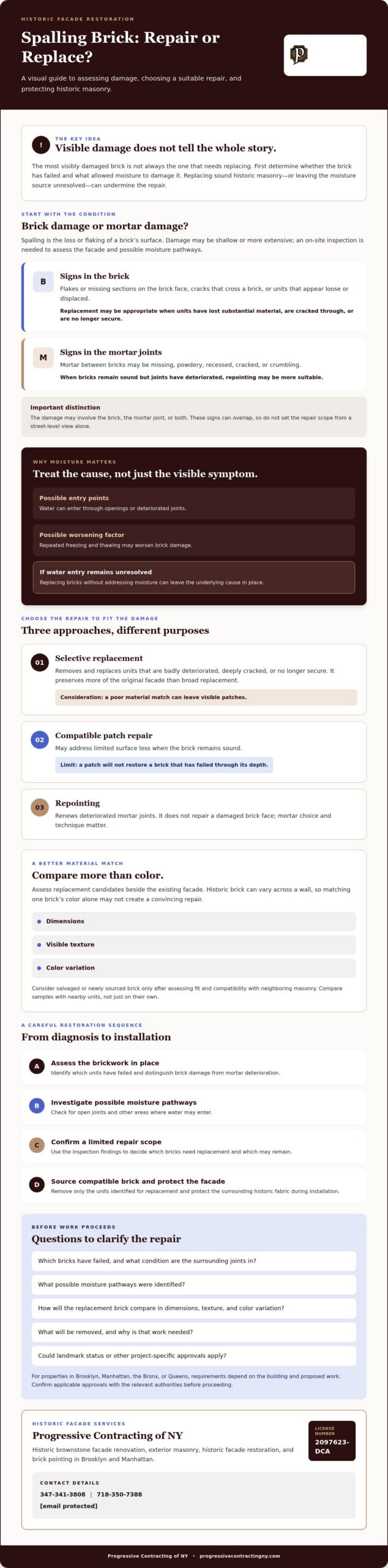
The most visibly damaged brick on a historic facade isn’t always the one that needs replacing. For brick replacement for spalling bricks on a historic facade, first determine whether the brick has failed and what allowed moisture to damage it. Replacing sound historic masonry or leaving the moisture source unresolved can undermine the repair.
It’s understandable to worry that new bricks will stand out or that surface damage signals a deeper problem. This guide explains when selective replacement may be appropriate, what to ask about matching original brick, and why checking for moisture matters before work begins. It also covers what a careful restoration process can involve on an older NYC facade. Progressive Contracting NY Corp provides historic brownstone facade renovation and exterior masonry services in Brooklyn and Manhattan. The company’s listed license number is 2097623-DCA. Contact details: 347-341-3808, 718-350-7388, and ProgressiveContractingNY@yahoo.com.
Table of Contents
Why Spalling Bricks on a Historic NYC Facade May Need Selective Replacement
Spalling is the loss or flaking of a brick’s surface. It may appear as a shallow chip, rough exposed material, or larger pieces breaking away. Visible damage alone does not show how much masonry needs repair. Water entering through openings or deteriorated joints can contribute to damage, and repeated freezing and thawing may worsen it. As a basic reference, what spalling is includes material breaking away through weathering processes. An on-site inspection is needed to assess a specific facade and identify possible moisture pathways.
Brick replacement for spalling bricks on a historic facade may be appropriate when individual units have lost substantial material, are cracked through, or are loose. If the bricks remain sound but mortar joints are recessed, cracked, or crumbling, repointing may be more suitable. Replacing bricks without addressing water entry can leave the underlying cause in place. The key distinction is whether the damage is in the brick itself, the mortar joint, or both.
How to tell damaged bricks from failing mortar joints
Look for flakes or missing sections on the brick face, cracks that cross a brick, or units that appear loose or displaced. Mortar deterioration is usually visible in the joints between bricks, where material may be missing, powdery, or cracked. These signs can overlap, so don’t set the repair scope from a street-level view alone. Photograph affected areas from consistent angles and note whether the damage appears in one localized area or across several parts of the facade. Seek an on-site assessment if damage is extensive or unclear. The Brownstone Spalling Repair article covers broader signs and causes of facade crumbling.
Progressive Contracting of NY provides historic facade restoration and brick pointing in Brooklyn and Manhattan. Contact the company at 347-341-3808 or 718-350-7388, or email ProgressiveContractingNY@yahoo.com. License number: 2097623-DCA.
How to Choose Between Brick Replacement and Repair on a Historic Facade
The right repair depends on the brick’s condition, not just how noticeable the damage looks. Before choosing brick replacement for spalling bricks on a historic facade, assess whether the unit is sound, how deeply it is damaged, how many bricks are affected, and whether moisture continues to reach the area. Ask for the proposed work to distinguish brick repairs from mortar work so you can understand what will be removed and why.
- Selective replacement removes and replaces units that are badly deteriorated, deeply cracked, or no longer secure. It preserves more of the original facade than broad replacement, but a poor material match can leave visible patches.
- Compatible patch repair may address limited surface loss when the brick remains sound. It has limits: a patch won’t restore a brick that has failed through its depth.
- Repointing renews deteriorated mortar joints. It won’t repair a damaged brick face, and mortar choice and technique matter. The National Park Service explains careful joint work in its guidance on repointing mortar joints.
What a suitable replacement brick should match
Compare candidates with the surrounding facade for dimensions, visible texture, and color variation. Historic brick often varies across a wall, so matching one brick’s color alone may not create a convincing repair. Consider how the sample looks beside nearby units, not just on its own. Salvaged or newly sourced brick may be considered, but its suitability requires assessment for fit and compatibility with neighboring masonry. For broader material and technique context, explore historic brownstone restoration guidance.
Progressive Contracting of NY provides brownstone facade renovation and brick pointing in Brooklyn and Manhattan. If you are comparing repair options, ask how the proposed method addresses the condition of the brick and surrounding joints. Contact 347-341-3808 or 718-350-7388, or email ProgressiveContractingNY@yahoo.com. License number: 2097623-DCA.
A Careful Brick Replacement Process for Brooklyn and Manhattan Facades
For brick replacement for spalling bricks on a historic facade, a careful project moves from diagnosis to installation in a clear sequence. First, assess the brickwork in place and identify which units have failed. Next, investigate possible moisture pathways, such as open joints or other areas where water may enter. Use those findings to confirm a limited repair scope before sourcing brick that suits the existing masonry. During installation, remove only the units identified for replacement and protect the surrounding historic fabric.
Brick used in older buildings may differ from modern materials, so consider more than appearance alone. The International Masonry Institute’s brick restoration guidance offers further context on historic brick and replacement. For a property in Brooklyn, Manhattan, the Bronx, or Queens, check whether landmark status or other project-specific approvals apply. The same care is relevant in historic neighborhoods such as Bedford-Stuyvesant and Park Slope. Requirements depend on the building and proposed work, so confirm them with the relevant authorities before proceeding.
Questions to ask before authorizing historic brick replacement
- How will you distinguish failed bricks from sound historic units, and limit removal to the damaged area?
- How will replacement brick be compared for size, texture, color, and compatibility with the existing wall?
- Could an unresolved moisture source contribute to further deterioration, and how will that possibility be assessed?
Clear answers help you understand the proposed scope before work begins. Progressive Contracting of NY provides brownstone repair and facade restoration in Brooklyn and Manhattan. Learn about its brownstone repair services, or contact the company to discuss the work: 347-341-3808, 718-350-7388, or ProgressiveContractingNY@yahoo.com. License number: 2097623-DCA.
Protect Your Historic Facade With a Careful Next Step
Spalling doesn’t automatically mean every affected brick needs replacement. A sound repair decision starts with assessing the brick and mortar, understanding possible moisture pathways, and limiting work to what the facade needs. When replacement is appropriate, checking material compatibility and using careful installation helps respect the building’s historic character. That’s the measured approach to brick replacement for spalling bricks on a historic facade.
Progressive Contracting of NY provides historic brownstone facade renovation and restoration for properties in Brooklyn and Manhattan. If you’re unsure what the damage calls for, an assessment can help clarify the condition and potential next steps. Contact the company at 347-341-3808 or 718-350-7388, or email ProgressiveContractingNY@yahoo.com. License number: 2097623-DCA.
With a clear scope and attention to the original masonry, you can move forward with greater confidence in your facade’s care.
Frequently Asked Questions
How do I know if spalling bricks on a historic facade need replacement?
A brick may need replacement when deterioration reaches beyond a stable surface and a patch won’t restore a sound unit. Deep face loss, cracks through the brick, or looseness can signal more extensive damage, but appearance alone doesn’t determine the repair scope. An on-site assessment should consider the brick, surrounding mortar, affected area, and possible moisture sources before recommending brick replacement for spalling bricks on a historic facade.
Can spalling bricks be repaired without replacing them?
Sometimes. A localized repair may suit a brick with limited surface damage that remains sound, while a severely deteriorated or cracked unit may need selective replacement. The assessment should also consider why moisture reached the masonry. If a contributing source remains unresolved, it may undermine the repair. Ask the contractor to explain why the proposed method fits the brick’s condition.
How do contractors match replacement bricks on a historic facade?
Contractors compare candidate bricks with the existing masonry, including dimensions, surface texture, color variation, and overall visual character. A precise visual match may not be available, so ask to review samples and discuss the proposed match before work begins. Salvaged or newly sourced brick should be assessed for suitability to the specific repair and compatibility with the surrounding historic masonry.
Do NYC historic facade repairs need approval before brick replacement?
Whether approval is needed depends on the property’s location, landmark status, and proposed work. Verify requirements with the relevant NYC authorities before authorizing repairs. Owners in Brooklyn, Manhattan, the Bronx, Queens, Bedford-Stuyvesant, and Park Slope should confirm what applies to their specific building. Progressive Contracting of NY provides historic brownstone facade renovation. Contact 347-341-3808, 718-350-7388, or ProgressiveContractingNY@yahoo.com. License number: 2097623-DCA.