
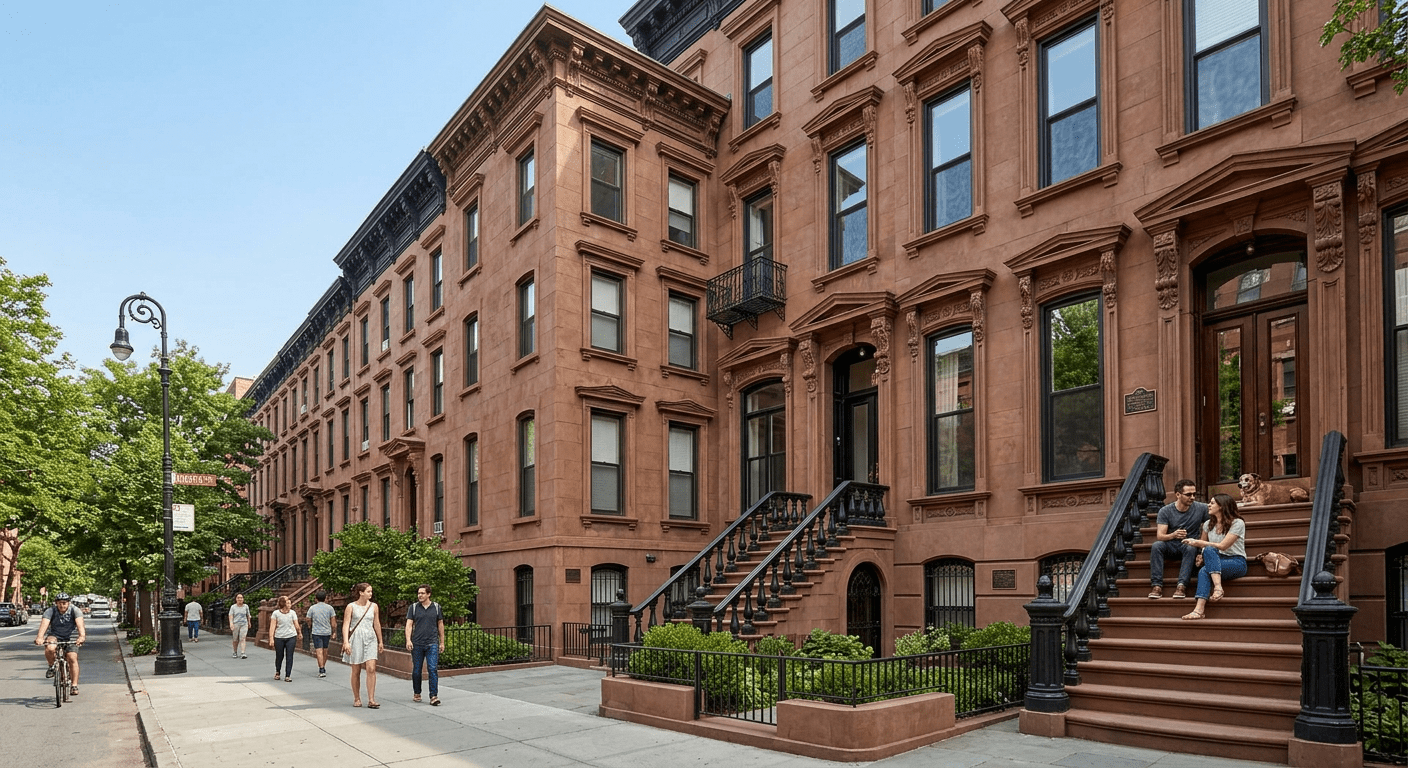
Brownstones NYC are more than just picturesque rowhouses; they are living history and cultural emblems of New York City.; they are a living history lesson and a cultural emblem. These residences form the backbone of neighborhoods in Brooklyn, Harlem, and Manhattan, and their distinctive facades and stoops have captured the imagination of architects, homebuyers, and television producers alike. This article explores what brownstones are, how they evolved, and why they remain highly coveted in the modern real estate market. Throughout this guide, you will see the focus keyword and its many variations – including brownstone homes NYC, new york city brownstones, and manhattan brownstones – to help you understand these homes from multiple angles.
What Is a Brownstone?
A brownstone is often described as a townhouse or row house clad in reddish-brown sandstone. In practice, many NYC brownstones are brick townhouses faced with a thin layer of brownstone veneer. Brownstone itself is a soft, close-grained Triassic sandstone that was originally quarried in Portland, Connecticut and parts of New Jersey, including the Hummelstown Quarry. Because of its warm color and malleability, builders in the mid-19th century fashioned thousands of façades from it. As the StreetEasy team notes, what most people call a brownstone is really a brick building with a stone façade; the sandstone’s softness makes it prone to cracking, so it is rarely used structurally.
Materials and Misconceptions
While the word “brownstone” evokes a romantic image of chocolate-colored facades lining leafy streets, it doesn’t necessarily describe the material used. Many rowhouses in New York City were built of limestone or brick and later painted or stained brown. Even among genuine brownstone buildings, the color varies dramatically – some appear reddish or purple, others gray – depending on the quarry source and weathering. The term has therefore come to denote an architectural type rather than a strict material. Real estate listings for brownstone homes NYC often include brick, limestone, and sandstone houses with similar stoops, proportions, and oversized windows. Nevertheless, the combination of brick walls with a brownstone veneer remains the most recognizable look.Why Are They Called Brownstones?
The popularity of brownstone façades emerged from practicality as much as aesthetics. In the 1840s, brownstone was relatively inexpensive compared with marble or granite. It could be quarried locally in the Northeast and easily carved into decorative elements. At a time when New York was expanding rapidly, developers used the material to build rows of houses quickly and affordably. This affordability allowed middle-class families to own stylish homes that looked more expensive than they really were. Over time, “brownstone” became synonymous with these stately townhouses and with the neighborhoods they defined, even if the underlying material varied.
A Brief History of New York City Brownstones
Origins and 19th-Century Growth
The New York City brownstone story begins in the late 18th and early 19th centuries. According to a 2024 feature in The Science Survey, New York’s love affair with these rowhouses began when brownstone quarried from New Jersey’s cliffs became a popular building material. Brownstone offered an affordable alternative to limestone and marble while still allowing builders to carve intricate details into stoops, cornices, and window frames. Charles Lockwood, an expert on brownstones, calls it a “soft, close-grained sandstone or freestone” that was initially used for entire buildings but later applied as a decorative face.
Brownstones gained momentum in the 1840s and 1850s as Romantic Classicism swept through American architecture. This movement idealized the natural world and inspired homeowners to embrace earthy colors and classical ornamentation. At the same time, the Industrial Revolution enabled workers to quarry and transport stone more quickly, reducing construction costs. The resulting homes – usually three to five stories tall, narrow but deep – provided vertical space on small urban lots and offered an air of grandeur. Many even featured decorative Juliet balconies, adding elegance to upper-story windows. By the mid-19th century, brownstone townhouses became status symbols for New York’s upper middle class.
Decline and Revival
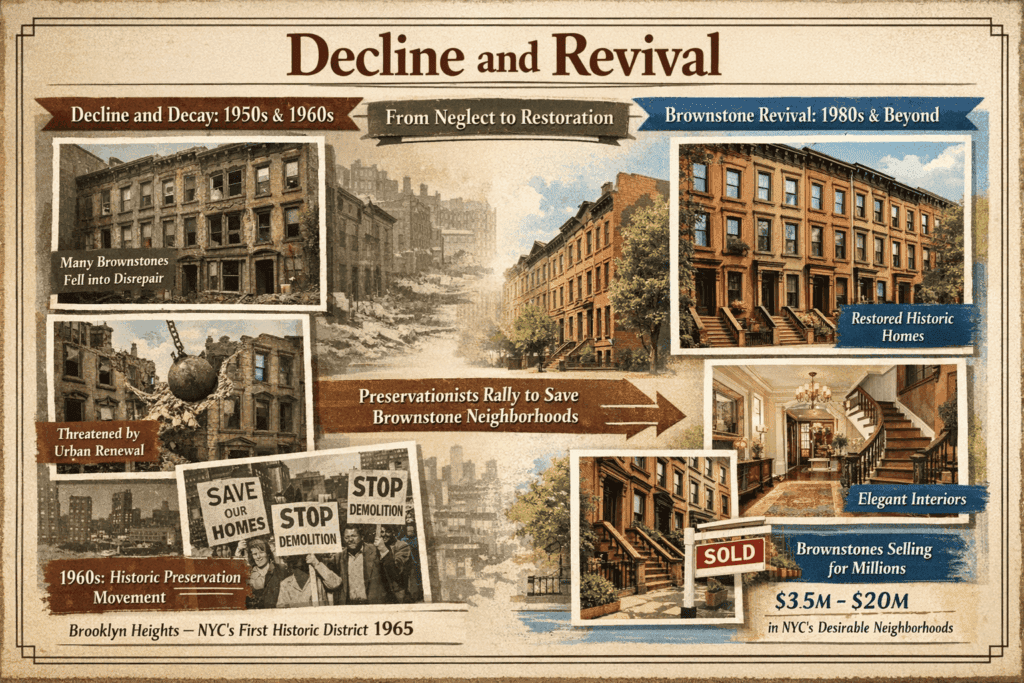
After the Gilded Age, tastes shifted toward Beaux-Arts and Art Deco designs, causing brownstones to fall out of fashion. Many were subdivided into apartments or left to decay during the 1950s and 1960s. The rise of car culture and suburban flight made urban rowhouses seem outdated. Robert Moses’s urban renewal projects even threatened to demolish entire brownstone neighborhoods, leaving much of their original interior design at risk.
The turning point came with the historic preservation movement of the 1960s; community activists fought demolition plans, leading to the designation of districts like Brooklyn Heights (New York City’s first historic district in 1965) that protected these buildings. A “brownstone revival” in the 1980s saw buyers restoring neglected rowhouses and treating them as valuable historic assets. Today, renovated brownstones in New York City often sell for millions of dollars, with restored homes in desirable neighborhoods commanding prices from $3.5 million to $20 million.
Architectural Features and Design
Exterior Design Elements
Brownstone buildings New York are distinguished by their façade materials and decorative details. The most iconic element is the stoop – a flight of stairs leading up to the parlor floor. Stoops provided practical benefits in the 19th century. Elevated entrances kept family living spaces above the filth of unpaved streets filled with horse manure. They also created a separate basement entrance for kitchens and servants’ quarters and helped keep snow from blocking the front door.
In some cases, stoops were adapted from Dutch architecture but quickly found their purpose in New York as protection from the sea of horse excrement. Today, stoops are beloved for socializing and for the sense of community they foster, making them a hallmark of NYC brownstone culture, with historic sites like the Isaac Hopper House nearby reflecting the neighborhood’s rich heritage, and interiors often featuring elegant details such as a glass chandelier.
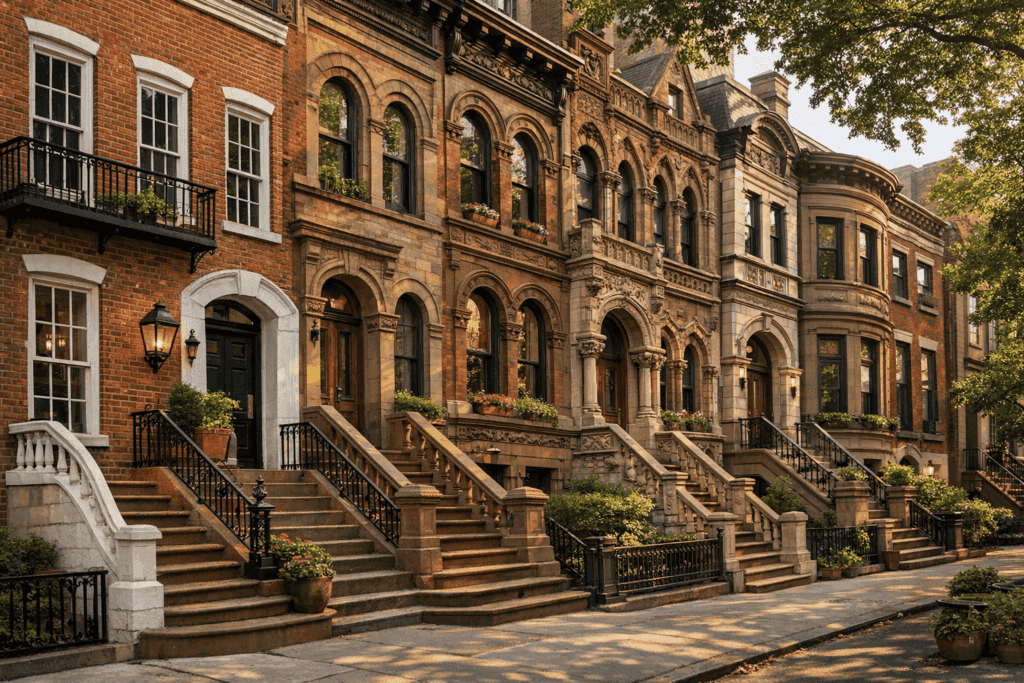
The façades themselves are typically made of brick covered with brownstone veneer. This veneer gave builders the ability to carve ornate cornices, window lintels, and iron railings. Many brownstones feature carved acanthus leaves, Corinthian columns, and wrought-iron balustrades. The MammothNYC design-build firm notes that brownstone façades were originally solid sandstone but later became more economical as decorative layers applied to brick. Ornamental details vary by architectural style:
Italianate brownstones show arched windows and delicate brackets, while Romanesque Revival homes display robust arches and rounded forms. These details give each brownstone house NYC a unique personality despite the uniformity of the rowhouse format, with landmarks like Grace Church nearby highlighting the architectural richness of the surrounding neighborhoods.
Interior Layout and Features
Inside, brownstone homes in New York City combine historic charm with vertical living. Traditional layouts include three to five floors with high ceilings, parlors on the main level, and bedrooms above. Kitchens were originally located in the basement or “garden level,” with servants using a separate entrance under the stoop. Noteworthy interior details include grand staircases, decorative plasterwork, marble fireplace mantels, and hardwood floors. Many brownstones also feature long hallways, bay windows, and pocket doors that allow natural light to filter through the narrow space.
Modern buyers value these homes for their architectural authenticity and the opportunity to blend historic character with updated systems. However, brownstones are not without challenges. The soft sandstone can deteriorate and requires expensive restoration. Water infiltration and freeze–thaw cycles cause spalling and cracking, and the original quarries are now largely exhausted. The vertical arrangement also means lots of stairs – a daily consideration when carrying groceries or raising children. Despite these quirks, the combination of high ceilings, ornate moldings, distinctive architectural elements, and private outdoor spaces keeps brownstone townhouse NYC homes in high demand.
Brownstone Neighborhoods and Architectural Diversity
One of the pleasures of exploring brownstone architecture New York is noticing how different neighborhoods put their own stamp on the style. Several boroughs, particularly Brooklyn and Manhattan, are renowned for historic brownstone districts, many of which feature the elegant Italianate style. The following table summarizes some key areas and their distinguishing traits:
| Neighborhood | Character & Style | Notable Brownstone Features |
|---|---|---|
| Brooklyn Heights | New York City’s first suburb and first historic district. Brownstones built mainly from the 1820s–1850s feature modest Greek Revival or Federal-style details. | Simple façades with understated ornamentation; stoops still prominent; frames for vintage brownstone houses. |
| Park Slope | Developed in the late 19th century; brownstones exhibit Italianate and Romanesque Revival styles. The neighborhood is famous for its tree-lined streets and proximity to Prospect Park. | Elaborate cornices, arched windows and carved panels; many Brooklyn brownstone apartments and single-family homes. |
| Harlem | Known for neo-Renaissance and neo-Gothic brownstones built in the 1880s–1900s. These homes housed wealthy white families before becoming hubs of African-American culture during the Great Migration. | Ornate stone carvings, grand stoops, and decorative lintels; many brownstone houses in Manhattan cluster here. |
| Upper West Side | Rowhouses blend brownstone with limestone and brick, reflecting Beaux-Arts influences. | Mixed materials and eclectic styles; remains a desirable area for Manhattan brownstone homes. |
Additional neighborhoods such as Greenwich Village, East Village, West Village, and the Harlem Renaissance areas have rows of historic brownstones with unique detailing, such as iron balconies and Dutch-style stoops. These neighborhoods are filled with a rich history of Federal architecture, Gothic-style architecture, and the craftsmanship of builders working with Triassic-Jurassic sandstone, also known as Portland Brownstone.
Conclusion
Brownstones remain some of the most coveted properties in New York City because they offer a combination of history, beauty, and community that is hard to replicate. Originating as affordable housing for the 19th-century middle class, they have become status symbols and cultural icons.
Their high stoops recall a time when horse manure lined the streets, while their ornamental facades and distinctive interior features tell stories of craftsmanship and artistic ambition. Although restoration and maintenance can be costly, Demand for New York City brownstone properties remains strong because they provide spacious layouts, charming details, long-term investment potential, and examples like Renwick Row that showcase the enduring appeal of these historic homes.
For buyers exploring brownstones in New York City, the combination of heritage, community, iconic ornate stoops, and decorative ornate ironwork is unmatched. Whether you type brownstone – New York, brownstone – New York, brown stone New York, or any other variation, you are ultimately searching for the same historic home. Understanding their history and quirks is the first step toward joining a community that cherishes its past while adapting to the future.