
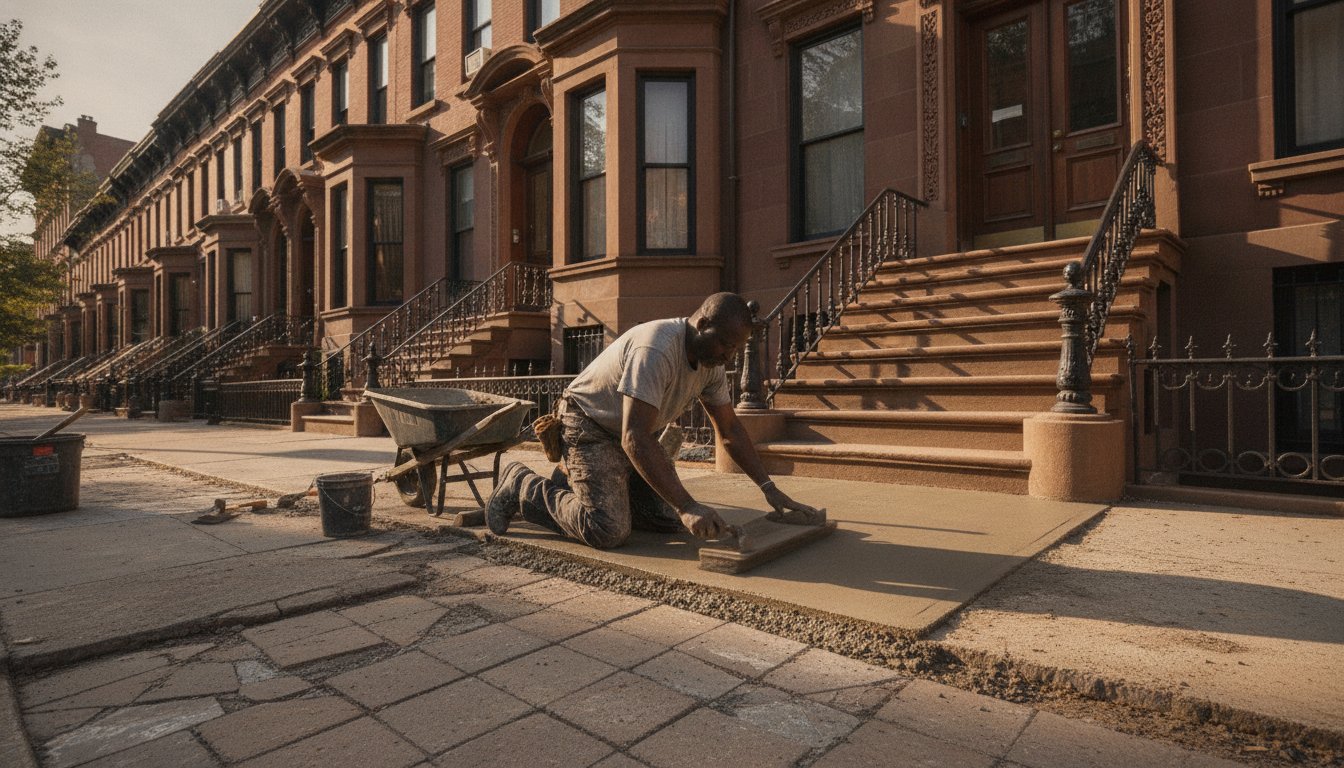
A single NYC DOT sidewalk violation notice can set off a chain of stress that most Brooklyn property owners aren’t prepared for: escalating fines, liability exposure from trip-and-fall claims, and a repair deadline that feels impossible to meet without the right help. If you’ve just received that notice, you’re not alone, and the situation is more manageable than it looks. Finding a qualified concrete sidewalk repair contractor in Brooklyn NYC who understands both structural repair and DOT compliance is the single most important step you can take right now.
You already know the stakes. A damaged sidewalk isn’t just an eyesore; it’s a legal and financial liability sitting directly in front of your property. What you need is a clear path forward, not more uncertainty. This guide covers exactly that: how sidewalk violations work in New York City, what the repair process looks like from inspection to city sign-off, and how experienced masonry specialists handle the added complexity of Brooklyn’s historic landmark districts. Whether you’re dealing with cracked concrete slabs, a failing vault beneath the sidewalk, or a DOT notice with a hard deadline, the following sections give you the knowledge to move forward with confidence. To speak with our team directly, call 347-341-3808 or 718-350-7388, or reach us at ProgressiveContractingNY@yahoo.com.
Professional Concrete Sidewalk Repair and DOT Violation Removal
Not every crack in a sidewalk triggers a DOT notice, but certain defects almost always do. The most common violations involve collapsed or sunken flags, vertical displacement of a quarter inch or more that creates a trip hazard, and improper cross-slope grades that fail drainage requirements. Tree root damage is another frequent culprit in Brooklyn, where mature street trees have had decades to buckle adjacent concrete panels. Each of these conditions puts the property owner on the clock the moment a DOT inspector documents them.
While urban landscaping often causes structural issues for city walkways, homeowners interested in more intentional greenery for their private garden paths can visit Bayside Pavers for guidance on selecting the best plants to grow between paver joints.
That clock matters. Once a violation notice is issued, property owners typically have a 45-day window to complete repairs before the city assigns its own contractor. Allowing the city to step in removes your control over cost, materials, and scheduling, and it adds a lien to your property. Acting within that window, with a qualified concrete sidewalk repair contractor in Brooklyn NYC, is the most direct way to protect your finances and your record.
Material selection is not a minor detail. Sidewalks in Brooklyn face freeze-thaw cycles, heavy pedestrian loads, and constant exposure to road salt. A high-strength concrete mix of 4,500 PSI or higher is the standard for work that holds up under those conditions. Understanding the basics of concrete sidewalk construction and maintenance makes clear why mix strength directly determines long-term durability. Cutting corners on the mix to reduce upfront cost almost always results in premature deterioration and a second violation.
The NYC DOT Sidewalk Violation Removal Process
The repair process follows a defined sequence, and knowing each step prevents costly delays:
- Step 1: Permit application. Your contractor files for a NYC DOT highway work permit before any excavation or demolition begins.
- Step 2: Saw-cutting and removal. Damaged flags are removed cleanly to avoid disturbing adjacent panels or underground utilities.
- Step 3: Sub-base preparation. The base is graded, compacted, and inspected to ensure proper drainage slope before new concrete is poured.
- Step 4: Concrete pour and curing. High-strength mix is placed, finished to DOT specifications, and allowed to cure fully before traffic is restored.
- Step 5: DOT inspection request. A professional contractor submits the inspection request directly to the DOT and coordinates the walkthrough to confirm the work meets code, clearing the violation from the city’s records.
- Step 6: Lien dismissal. Once the inspection passes, the violation is formally dismissed and any associated lien is removed from the property.
For a detailed breakdown of what this process costs, see the cost of sidewalk violation removal NYC guide, which provides current pricing context for property owners planning their budget.
Historic and Landmark Property Sidewalk Standards
Sidewalk repair in Landmark Preservation Commission districts adds a layer of requirements that most contractors aren’t equipped to handle. In neighborhoods like Park Slope and Bed-Stuy, the LPC may require tinted concrete or the use of traditional bluestone flags to maintain the historic character of the streetscape. Standard gray concrete is often not acceptable. Before any work begins in a designated historic district, LPC approval must be secured alongside the DOT permit, and the two processes run on separate timelines. A contractor who understands both agencies keeps your project moving without costly restarts. Pairing your sidewalk repair with a broader brownstone facade renovation is also an opportunity to ensure the finished sidewalk complements the material palette and character of your building’s exterior. To discuss your specific property and violation, call 347-341-3808 or 718-350-7388, or email ProgressiveContractingNY@yahoo.com.
Specialized Sidewalk Vault Repair and Structural Reinforcement
Beneath many of Brooklyn’s historic brownstones lies a structural element that most property owners don’t think about until something goes wrong: the sidewalk vault. A sidewalk vault is a below-grade enclosed space that extends under the public walkway, originally built to expand a building’s usable basement footprint, and it relies on a system of steel beams and concrete slabs to carry the load of everything above it. When that system begins to fail, the consequences reach well beyond a surface crack.
The structural risks are specific and serious. Steel I-beams corrode over decades of exposure to moisture that infiltrates through failed concrete and deteriorating waterproofing. As the steel loses cross-sectional strength, the concrete slab above it loses support. What begins as a hairline crack in the sidewalk surface can be the visible symptom of a much deeper structural compromise. Consulting the NYC DOT sidewalk repair requirements and violations page makes clear that property owners carry full responsibility for the structural condition of vaults beneath their frontage, not just the surface flags above.
Signs Your Brooklyn Sidewalk Vault Needs Repair
A sidewalk vault is a structural cavity beneath the public walkway that transfers pedestrian and vehicle loads through steel beams and reinforced concrete to the surrounding foundation walls. Warning signs that the system is failing include rust staining on the ceiling of the basement directly below the sidewalk, a hollow or deflecting sensation underfoot when walking across the surface, and visible sagging or cracking in the concrete slab. Any one of these conditions warrants an immediate structural assessment from a qualified concrete sidewalk repair contractor in Brooklyn NYC.
Structural Reinforcing and Waterproofing Solutions
Corroded steel I-beams can’t be patched. They need to be removed and replaced with new structural steel, after which a reinforced concrete slab is poured to restore full load-bearing capacity. That structural work is only half the solution. Without a properly installed waterproofing membrane, the new system will begin deteriorating on the same timeline as the old one. Modern waterproofing systems, applied at the slab surface and at all penetrations and joints, create a continuous barrier that prevents moisture from reaching the steel and protects the property’s lower levels from water intrusion.
For historic properties, vault repair also presents an opportunity to restore vault lights, the glass block pavers that were originally installed to bring natural light into basement spaces below. Replacing deteriorated vault lights with period-appropriate glass pavers maintains historic accuracy while restoring a functional feature of the original construction. It’s a detail that matters in LPC-designated districts, and it’s one that a knowledgeable masonry team handles alongside the structural work rather than as an afterthought.
If you’re seeing any of the warning signs described above, early action protects both your structure and your budget. Reach our team at 347-341-3808, 718-350-7388, or ProgressiveContractingNY@yahoo.com to schedule an assessment, or visit brownstonerepair.net to learn more about our structural masonry services across Brooklyn.
Why Choose Progressive Contracting for Your Brooklyn Masonry
Experience in this trade isn’t measured in years alone. It’s measured in the complexity of the work a contractor has successfully navigated: DOT violation dismissals coordinated on tight deadlines, structural vault repairs in occupied buildings, and historic masonry restoration in LPC-designated districts where material specifications and approval timelines leave no room for guesswork. Progressive Contracting has built its reputation across Brooklyn, Manhattan, and Queens by handling exactly that kind of work, consistently, and without shortcuts.
The framework that drives every project is straightforward: identify the problem precisely, execute a structured process, and deliver a result the property owner can verify. That means a thorough assessment before a single permit is filed, written clarity on scope and materials before work begins, and direct communication with the owners throughout. There are no layers of project managers between you and the people responsible for your property. That directness matters when a DOT deadline is approaching or an LPC approval needs to move quickly.
Whether the job is standard concrete flag replacement or a full structural vault rebuild with waterproofing and period-appropriate finish work, the same standard of craftsmanship applies. Compliance with NYC Department of Buildings construction regulations is built into the process from the first permit application, not treated as an afterthought.
Contact Our Brooklyn Sidewalk Specialists Today
If you’ve received a DOT violation notice or you’re seeing early warning signs of sidewalk or vault deterioration, don’t wait for the situation to escalate. Call 347-341-3808 or 718-350-7388 for an immediate consultation on your sidewalk, stoop, or structural masonry project. Property owners can also email photos of their violation notice or damaged sidewalk directly to ProgressiveContractingNY@yahoo.com for a faster initial assessment.
Serving Park Slope, Bed-Stuy, and Beyond
Brooklyn’s neighborhoods each carry their own architectural character and regulatory context. Park Slope’s brownstone-lined blocks, Bed-Stuy’s landmarked rowhouses, and the mixed-use corridors in between require a concrete sidewalk repair contractor in Brooklyn NYC who understands those distinctions and works within them. Visit brownstonerepair.net for a full overview of facade restoration, stoop repair, and masonry services tailored to Brooklyn’s built environment.
Take the Next Step Before the Deadline Does
A DOT violation notice has a fixed timeline, and the cost of inaction grows quickly. The core takeaways from this guide are straightforward: act within your repair window to stay in control of the process, verify that your contractor understands both DOT compliance and LPC requirements if your property sits in a historic district, and don’t treat surface cracks as surface-only problems when a sidewalk vault is part of your building’s structure.
Progressive Contracting brings all of that together as a licensed concrete sidewalk repair contractor in Brooklyn NYC, handling everything from permit filing to final DOT inspection sign-off. Specialization in DOT violation removal, expertise in historic landmark districts, and direct communication throughout every project are what set this team apart from a general concrete crew.
Call 347-341-3808 or 718-350-7388, or email ProgressiveContractingNY@yahoo.com to schedule your sidewalk inspection today. Your property deserves a contractor who treats the work with the same care you put into owning it.
Frequently Asked Questions About Sidewalk Repair and DOT Violations in Brooklyn
How long do I have to fix a sidewalk violation in NYC?
Once the NYC DOT issues a sidewalk violation notice, property owners typically have 45 days to complete repairs before the city assigns its own contractor to do the work. That city-assigned repair removes your control over cost, scheduling, and materials, and it results in a lien placed against your property. Acting quickly within that window is the most direct way to protect both your budget and your property record.
If your property is in a landmark district, start the process even sooner. LPC approval and DOT permitting run on separate timelines, and both need to be in place before work begins. Calling 347-341-3808 or 718-350-7388 as soon as you receive a notice gives you the best chance of meeting the deadline without rushing through the compliance steps.
Can I repair my own sidewalk in Brooklyn to save money?
Technically, property owners can apply for a DOT highway work permit and perform repairs themselves, but the practical barriers are significant. The work must meet DOT specifications for concrete mix strength, drainage slope, and flag dimensions. If the inspection fails, you’re back at square one with less time on the clock. Most property owners find that a failed DIY attempt ends up costing more than hiring a qualified contractor from the start, a standard of professional care also required for durable concrete driveways Newcastle NSW.
There’s also the permit filing process, sub-base preparation, and the DOT inspection coordination to manage. A licensed concrete sidewalk repair contractor in Brooklyn NYC handles all of that as a standard part of the job, including the final sign-off that formally clears the violation from your property’s record.
What is the average cost of concrete sidewalk repair in NYC?
Repair costs vary based on the number of flags being replaced, the depth of sub-base work required, and whether structural elements like a vault beneath the sidewalk are involved. Permit fees, material specifications, and the complexity of any landmark district requirements also affect the final figure. For a detailed breakdown of current pricing factors, the cost of sidewalk violation removal NYC guide is the most useful starting point.
The most accurate way to understand what your specific repair will cost is to have a contractor assess the actual conditions on-site. Email photos of your violation notice and the damaged area to ProgressiveContractingNY@yahoo.com for a faster initial review before scheduling an in-person assessment.
Do I need a permit for sidewalk repair in a landmark district?
Yes, and you’ll need two separate permits, not one. A NYC DOT highway work permit is required for any sidewalk repair regardless of location. In a Landmark Preservation Commission district, you also need LPC approval before work begins, and the LPC may require specific materials such as bluestone flags or tinted concrete rather than standard gray concrete. These two approval processes run independently and on different timelines.
Skipping the LPC step isn’t an option. Work done without LPC approval in a designated historic district can be ordered reversed, which means paying to redo the repair correctly. A contractor experienced with both agencies keeps both tracks moving simultaneously so the project doesn’t stall between approvals.
What happens if I ignore a NYC DOT sidewalk violation notice?
Ignoring a violation notice triggers a sequence of consequences that escalates quickly. After the repair window closes, the city assigns its own contractor to complete the work. The cost of that city-performed repair is then billed to the property owner at rates the owner has no input on, and a lien is placed against the property until the bill is paid. The lien affects your ability to refinance, sell, or transfer the property until it’s resolved.
Beyond the financial exposure, an unrepaired sidewalk defect continues to create trip-and-fall liability. In New York City, property owners are legally responsible for maintaining the sidewalk fronting their property, which means an active violation sitting in front of your building is an open liability risk for as long as it remains unaddressed.
How do I know if my sidewalk is actually a vaulted sidewalk?
The most reliable indicator is the age and type of your building. Brownstones and rowhouses built in the late 19th and early 20th centuries across neighborhoods like Park Slope and Bed-Stuy frequently have below-grade vaults that extend under the public sidewalk. If your basement has a ceiling area that sits directly beneath the sidewalk, there’s a strong chance a vault structure is present. Rust staining on that ceiling, a hollow sound underfoot on the sidewalk surface, or visible slab deflection are all warning signs.
A surface inspection alone won’t confirm vault condition. A structural assessment from a qualified contractor who works with these systems is the only way to know what you’re dealing with before committing to a repair scope. Call 347-341-3808 or 718-350-7388 to schedule that assessment, particularly if you’re seeing any of the physical warning signs described above.