
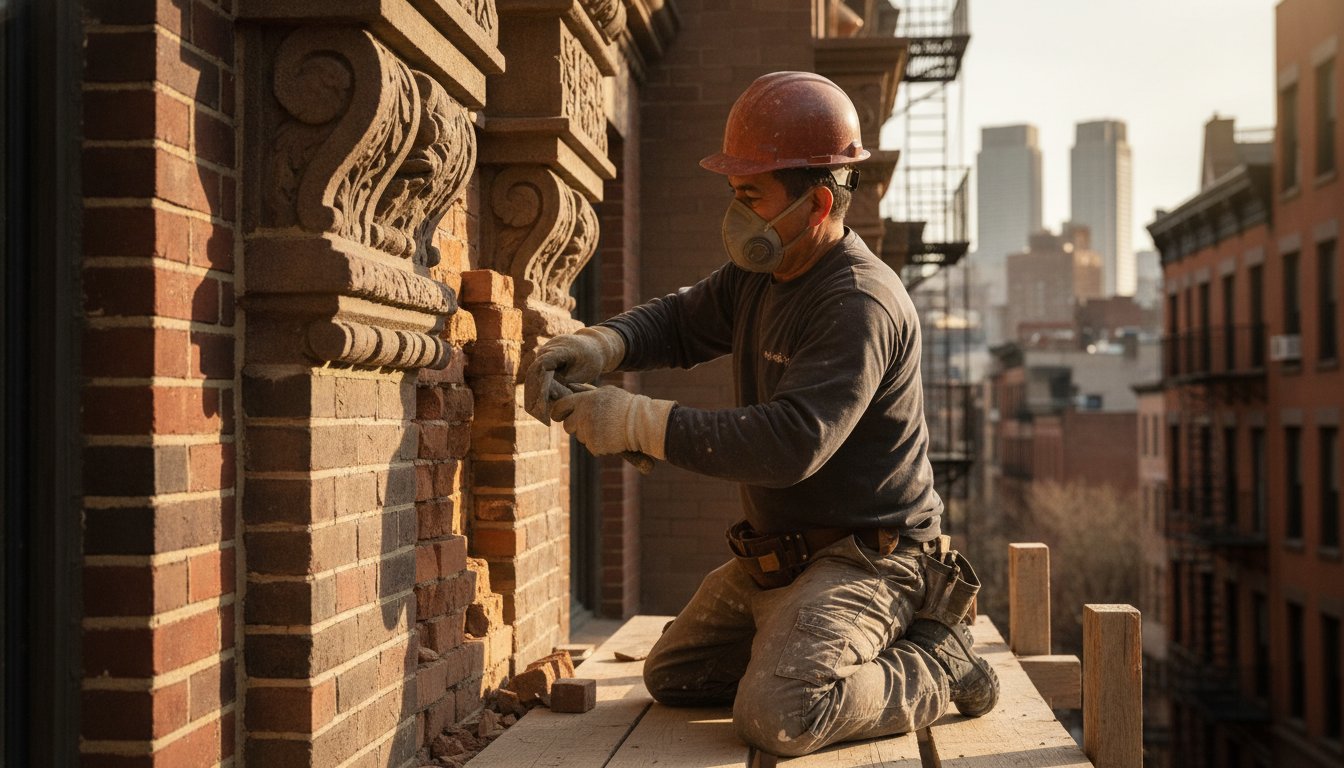
That crack running through your building’s facade isn’t just an eyesore — it’s a warning. In Manhattan, brickwork that’s spalling, bulging, or allowing water into your interior isn’t a cosmetic problem you can defer. It’s a structural failure that can escalate into NYC Department of Buildings violations, costly emergency repairs, and real safety hazards for anyone near your property. If you’ve been searching for reliable brick replacement services in Manhattan, you already understand the stakes.
You’re right to take this seriously. The anxiety that comes with watching your facade deteriorate, wondering whether a repair crew might make it look worse or trigger a Landmarks Preservation Commission dispute, is completely understandable. Manhattan’s historic building stock demands a level of precision that goes well beyond standard masonry work.
This guide will walk you through exactly how to identify when brick replacement is truly necessary versus when repointing is sufficient, what the professional restoration process looks like from assessment to completion, and how to ensure your project meets DOB and LPC requirements without disrupting your building’s historic character. You’ll leave with a clear, practical framework for protecting both the structural integrity and long-term value of your property.
Diagnosing Masonry Failure: When to Seek Brick Replacement Services in Manhattan
Not every crack demands a full replacement. But some do, and misreading the signs is where deferred maintenance becomes a structural crisis. Understanding the difference between cosmetic wear and genuine masonry failure is the first practical step toward protecting your building.
Three conditions consistently indicate that you’ve moved past routine maintenance and into territory that requires professional brick replacement services in Manhattan:
- Bulging or bowing walls: Outward displacement of the brick veneer signals that the wall ties anchoring the facade to the structural backup have failed or corroded. The brick is no longer bonded to the building; it’s simply resting against it.
- Stair-step cracking: Diagonal cracks that follow the mortar joints in a stair-step pattern indicate differential settlement or foundation movement. This pattern is distinct from hairline surface cracks and points to structural shifting beneath the facade.
- Severe spalling: When brick faces are flaking away in layers rather than showing surface pitting, the masonry unit itself has been compromised by freeze-thaw cycling. Brownstone spalling repair is often the precursor to this condition; left unaddressed, spalling accelerates until the brick loses structural integrity entirely.
Water infiltration is the common thread running through all three. Once moisture penetrates behind the brick veneer, it reaches the metal wall ties embedded in the mortar beds. Those ties corrode, expand, and exert pressure that physically pushes the brick outward. Understanding brick construction and material properties clarifies why historic brickwork is especially vulnerable: older, softer bricks are far more porous than modern units, absorbing water more readily and cycling through freeze-thaw damage season after season.
Brick Pointing vs. Full Replacement
Brick pointing NYC is the right intervention when the masonry units themselves are sound and only the mortar joints have eroded or cracked. If the brick is intact, dense, and firmly bonded, repointing restores the weatherproof seal without disturbing the facade. Full replacement becomes necessary when the unit itself is hollow, fractured through its core, or has lost face material. Professionals use a simple tap test to distinguish the two: a solid brick returns a sharp, resonant knock; a detached or hollow brick produces a dull, flat thud. That acoustic difference tells a trained mason exactly which intervention is warranted.
Common Causes of Manhattan Masonry Decay
New York City’s freeze-thaw cycles are relentless. Water enters porous historic brick, freezes, expands, and fractures the material from within, repeating this process dozens of times each winter. The damage compounds when previous repair crews used hard Portland cement mortars on soft historic brick. Portland cement is far stronger than the original lime-based mortar, so instead of the joint cracking under stress, the brick face itself fractures. This is one of the most common forms of accelerated deterioration seen in Manhattan’s aging rowhouses, and it’s entirely preventable with the right materials and methods.
If you’re seeing any of these conditions on your facade, a direct assessment is the only reliable next step. Reach out to Progressive Contracting of NY at 347-341-3808 or 718-350-7388, or send your inquiry to ProgressiveContractingNY@yahoo.com to schedule an evaluation.
The Restoration Process: Matching Historic Manhattan Brickwork
Restoring a historic facade requires a surgical approach. It’s not about just filling holes; it’s about maintaining the building’s DNA. When providing brick replacement services in Manhattan, we follow a disciplined four-step process to ensure the new work is indistinguishable from the old.
- Sourcing the Material: we locate salvage bricks from the same era or commission custom-fired units. This ensures the size, density, and color match the original Hudson River common or Roman bricks often found in local rowhouses.
- Mortar Analysis: we analyze the original mortar’s composition to match the aggregate size and lime-to-sand ratio. Following NPS guidelines for historic masonry restoration ensures the new mix is compatible with the old.
- Surgical Extraction: we remove damaged units using small hand tools or precision grinders. This prevents vibration damage to the sound bricks surrounding the repair area.
- Installation and Curing: new bricks are laid in dampened beds to prevent them from pulling moisture out of the fresh mortar. Proper curing ensures a watertight bond that lasts for decades.
This methodical progression is why property owners trust us with their most sensitive projects. If you’re noticing cracks or loose units, you can reach our team at 347-341-3808 or 718-350-7388 to discuss professional masonry restoration for your building.
The Importance of Mortar Compatibility
Using modern Portland cement on historic buildings is a common mistake that leads to irreversible damage. Modern mortar is often harder than 19th-century brick. When the building naturally expands and contracts, the hard mortar doesn’t give, causing the soft brick faces to pop off. We use lime-based mixes that allow the facade to breathe and shed moisture. This flexibility is essential for the long-term structural health of Manhattan’s aging facades.
Aesthetic Precision in Facade Restoration
A successful repair is one you can’t see. We match the original joint profile, whether it’s a grapevine, struck, or weathered joint, to maintain the facade’s shadow lines. This level of detail is a core part of our brownstone facade renovation services. For owners in Landmark districts, this precision is the difference between a smooth approval and a costly violation. Our goal is always a seamless finish that preserves the historic value of your property. For a detailed consultation, email your project photos to ProgressiveContractingNY@yahoo.com.
Hiring a Manhattan Masonry Specialist: Regulations and Logistics
Getting the restoration work right is only half the challenge. In Manhattan, the regulatory and logistical environment surrounding brick replacement services in Manhattan is a discipline in itself. A contractor who understands the craft but not the permitting process can leave you with a DOB violation, an LPC dispute, or a project stalled mid-facade. These aren’t hypothetical risks; they’re common outcomes when property owners hire crews without genuine local experience.
If your building sits within one of Manhattan’s 145 historic districts, any exterior work requires approval from the NYC Landmarks Preservation Commission regulations before a single brick is touched. The LPC review process evaluates whether proposed materials, mortar composition, and joint profiles are appropriate for the structure’s historic period. Submitting an incomplete application or using non-compliant materials can result in stop-work orders and mandatory removal of completed work at your expense. A contractor who has navigated this process repeatedly knows exactly what documentation the LPC requires and how to prepare a submission that moves efficiently through review.
Beyond the LPC, Manhattan’s street-level logistics demand their own expertise. Structural masonry work typically requires a sidewalk shed under DOB guidelines, and erecting one on a busy Manhattan block means coordinating a DOT permit, scheduling deliveries around street-access restrictions, and managing material staging in environments where space is genuinely scarce. These aren’t administrative formalities; they’re operational realities that affect your project timeline and your neighbors. A contractor who hasn’t managed this in New York City before will learn on your building.
- DOB compliance: Structural brick replacement must be performed by a licensed and insured contractor. Unlicensed work exposes property owners to violations, fines, and personal liability.
- Transparent phasing: Reputable contractors present work in sequential, clearly priced phases so you understand exactly what’s happening and when before any phase begins.
- Insurance verification: Require a current certificate of insurance before work starts. This protects you from liability for on-site injuries or property damage.
Vetting Your Manhattan Contractor
Ask directly about their experience with LPC submissions and DOB permit coordination. Request references from completed projects in Manhattan’s historic districts specifically. Verify their licensing with the NYC Department of Buildings and confirm their insurance coverage is current. A contractor with a decade of experience in neighborhoods like Park Slope and Manhattan’s historic rowhouse corridors will answer these questions without hesitation. Reluctance or vague answers are a reliable signal to keep looking.
Take the Next Step for Your Facade
A deteriorating facade doesn’t improve with time. If you’re seeing the warning signs, the most productive next step is a direct professional assessment. Contact Progressive Contracting of NY at 347-341-3808 or 718-350-7388 to schedule an evaluation of your building’s condition. You can also email your project details and photos to ProgressiveContractingNY@yahoo.com for a detailed consultation. Our team brings the regulatory knowledge, logistical experience, and masonry craftsmanship your property deserves. Learn more about our historic brownstone restoration services and take the first step toward a stable, compliant, and precisely restored facade.
Protect Your Facade Before the Next Freeze-Thaw Cycle Hits
Manhattan’s historic facades don’t give you unlimited chances to get restoration right. The key takeaways from this guide are straightforward: know the difference between mortar failure and brick failure before committing to a repair strategy, insist on lime-compatible mortars that won’t damage your original masonry, and work with a contractor who understands both LPC requirements and the street-level logistics of working in a dense urban environment.
When you’re evaluating brick replacement services in Manhattan, experience in historic neighborhoods isn’t a bonus, it’s a baseline requirement. Progressive Contracting of NY brings over a decade of hands-on restoration work across Manhattan and Brooklyn, with proven expertise in brownstone repair, expert NYC sidewalk violation removal, and facade projects that meet the full range of DOB and LPC standards.
Your building deserves a steady, skilled hand. Reach out to our team directly at 347-341-3808 or 718-350-7388, or email ProgressiveContractingNY@yahoo.com to schedule your facade assessment.
Request your comprehensive facade evaluation from Progressive Contracting of NY
The right assessment today prevents a far more costly repair tomorrow.
Frequently Asked Questions About Brick Replacement Services in Manhattan
How much does brick replacement cost per square foot in Manhattan?
Brick replacement pricing varies considerably based on the scope of damage, access requirements, material sourcing, and whether LPC review is involved. A project requiring custom-fired salvage bricks to match a 19th-century facade will carry different costs than a straightforward replacement on a non-landmarked building. Sidewalk shed installation, DOT permits, and Manhattan’s logistical constraints also factor into the final figure. The only reliable way to understand what your specific project will cost is through a direct on-site assessment.
Contact Progressive Contracting of NY at 347-341-3808 or 718-350-7388 to schedule an evaluation. You can also email project photos to ProgressiveContractingNY@yahoo.com for an initial consultation before committing to anything.
Do I need a permit from the Landmarks Preservation Commission for brick repair?
If your building sits within one of Manhattan’s designated historic districts, yes. Any exterior masonry work, including brick replacement services in Manhattan, requires LPC approval before work begins. The LPC evaluates proposed materials, mortar composition, and joint profiles to confirm they’re appropriate for the structure’s historic period. Minor repairs on non-contributing structures may qualify for a simpler Certificate of No Effect, but anything involving structural brick typically requires a full permit application.
Working with a contractor who has submitted LPC applications before is essential. An incomplete or non-compliant submission can result in stop-work orders and mandatory removal of finished work, entirely at the property owner’s expense.
How long does a typical brick replacement project take for a Manhattan townhouse?
A focused repair covering a localized area of damage, say a section of failing veneer on a single facade elevation, can often be completed within one to two weeks once permits are in place. Larger projects involving multiple elevations, extensive wall tie failure, or full LPC review naturally take longer. Permit timelines add variability that’s difficult to predict precisely, which is why experienced contractors build phased schedules that account for regulatory review before mobilizing on-site.
The honest answer is that the permitting process often takes longer than the physical work itself. A contractor with established familiarity with DOB and LPC workflows will give you a realistic timeline from the start, not an optimistic one that shifts after the contract is signed.
Can you match the color of 100-year-old bricks?
Yes, though it requires deliberate sourcing rather than a trip to a standard masonry supplier. Manhattan’s historic rowhouses were built predominantly with Hudson River common brick, a soft, handmade unit with a color range and texture that modern machine-made bricks simply don’t replicate. We source salvage bricks from the same era or work with specialty suppliers who fire custom units to match the original dimensions, color variation, and surface character of the existing masonry.
Color matching also depends on mortar selection and joint profile. Even a well-matched brick will look out of place if the mortar color or joint tooling differs from the surrounding facade. Getting all three elements right, brick, mortar, and joint profile, is what makes a repair genuinely invisible.