
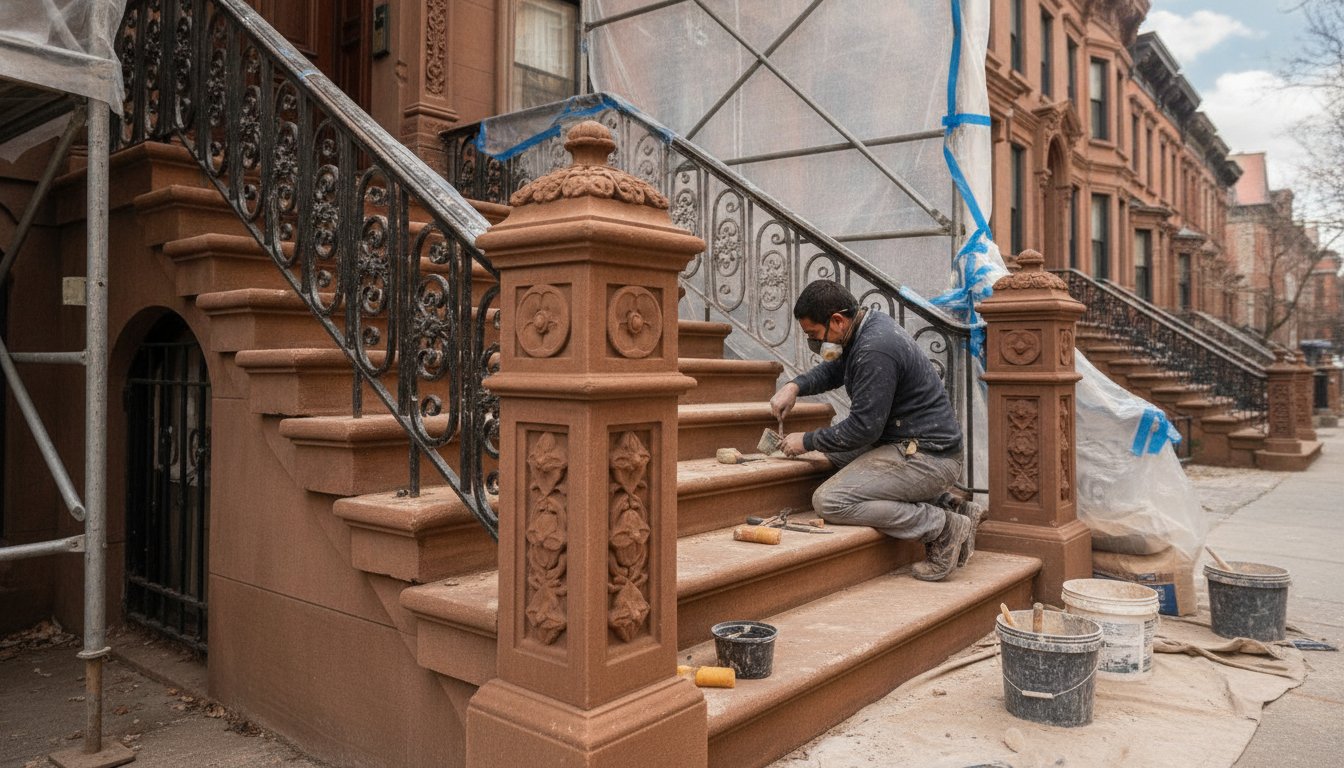
That crack running along your brownstone stoop isn’t just an eyesore. It’s an open invitation for water to work its way into the masonry, freeze, expand, and turn a manageable repair into a full structural replacement. If you’ve been putting off brownstone stoop repair in Brooklyn because you’re not sure who to trust or what the process actually involves, you’re not alone.
Most Brooklyn homeowners already know that brownstone is a finicky material. It’s porous, it’s historic, and it punishes shortcuts. The real concern isn’t just finding someone to patch the surface; it’s finding a specialist who understands that improper materials like Portland cement will trap moisture and accelerate the very damage you’re trying to fix. Add a loose or rusted railing to the picture, and you’ve got both a safety hazard and a liability.
This guide walks you through the complete restoration process, from diagnosing spalling and deteriorated joints to installing period-correct railings that meet today’s safety standards without compromising your home’s historic character. By the end, you’ll know exactly what a proper repair looks like, what questions to ask, and how to protect your investment for decades to come. To speak with a specialist directly, call 347-341-3808 or 718-350-7388, or reach out at ProgressiveContractingNY@yahoo.com.
Assessing and Preparing Your Brownstone Stoop for Repair
Before any restoration work begins, a thorough assessment separates a straightforward repair from a project that spirals into full structural replacement. As a brownstone building material, the Triassic-era sandstone used across Brooklyn’s historic rowhouses is naturally porous and sedimentary, which means water infiltration isn’t a surface problem. It’s a structural one.
There are three primary failure signs every Brooklyn homeowner should know how to identify:
- Spalling: Flaking or scaling on the stone surface, where layers peel away in sheets. This is often the first visible sign that moisture has been cycling through the stone during freeze-thaw periods.
- Deep structural cracks: Not hairline surface fractures, but cracks that run through the full depth of a tread or riser. These indicate that water has already worked behind the facade.
- Hollow sounds: Tap the stone firmly with a mallet. A solid knock means the material is intact. A hollow, drum-like resonance tells you the stone has delaminated from its substrate, and that section needs rebuilding, not patching.
The distinction between surface wear and structural instability matters enormously. Aesthetic wear is normal on any 100-year-old stoop. Structural instability, driven by water infiltration behind the facade, means the underlying substrate has been compromised. Patching over it without addressing the source is a repair that won’t last a single winter.
One of the most common mistakes made during brownstone stoop repair in Brooklyn is reaching for Portland cement as a patching material. It seems logical, but it’s a critical error. Portland cement is significantly harder and less permeable than the original brownstone. It traps moisture inside the stone rather than allowing it to breathe, which accelerates internal cracking and can cause surrounding stone to fail faster than if nothing had been done at all.
The correct approach relies on lime-based mortars and custom mixes that match the original stone’s porosity and compressive strength. This is where the Rammstein stoop restoration method becomes essential. Rather than applying a surface coating over damaged material, this technique involves rebuilding the stone layers from the substrate outward, using compatible materials that bond correctly and allow the assembly to move and breathe as a unified system. The result is a repair that integrates with the original structure rather than working against it.
The Role of Historic Accuracy in Brooklyn Stoop Restoration
Matching brownstone’s distinctive reddish-brown color and fine-grained texture requires custom mortar mixes, not off-the-shelf solutions. The goal is a repair that’s visually indistinguishable from the original stone. For homeowners in designated historic districts, this isn’t optional. The NYC Landmarks Preservation Commission (LPC) governs exterior alterations in neighborhoods like Park Slope, and stoop repairs in those areas may require a Certificate of Appropriateness before work begins. Verifying current LPC permit requirements directly with the commission before starting any project is essential. Progressive Contracting of NY has worked extensively throughout Park Slope and Bed-Stuy, and understands both the material and regulatory demands of brownstone stoop repair in Brooklyn. To schedule an assessment, call 347-341-3808 or 718-350-7388, or email ProgressiveContractingNY@yahoo.com.
The Step-by-Step Stoop Restoration and Railing Installation Process
Understanding what actually happens during a professional restoration changes how you evaluate contractors and their proposals. Most companies list services. Few explain the sequence of decisions that determines whether a repair holds for five years or fifty. Here’s what a proper brownstone stoop repair in Brooklyn looks like from start to finish.
Step 1: Full removal of compromised material. Nothing sound gets built on a failing base. Every loose tread, deteriorated riser, and rusted ironwork anchor gets removed until the crew reaches structurally intact masonry. This step is non-negotiable. Leaving even a small pocket of delaminated stone beneath a new finish coat creates a failure point that water will find.
Step 2: Core rebuilding and scratch coat application. Once the substrate is exposed and confirmed solid, the masonry core is rebuilt using compatible lime-based materials. A scratch coat follows, creating a mechanically bonded, level surface that accepts the finish layer without adhesion failure. This intermediate stage is where the geometry of the stoop gets corrected, ensuring treads drain properly and risers are plumb.
Step 3: Railing post installation, anchored into structural masonry. This is the step most contractors get wrong. Posts anchored only into the finish coat will loosen within a season. Proper brownstone stoop railing installation requires drilling through the finish and scratch coats entirely, setting posts deep into the structural masonry core. Depth and embedment matter. A railing that flexes under load hasn’t been installed correctly, regardless of how it looks on the day of completion.
Step 4: Finish coat and hand-tooled detailing. The final layer is applied in sections, then worked by hand to replicate the texture of the original 19th-century stone. This isn’t cosmetic. The surface profile affects how water sheds and how the material breathes over time.
Securing Your Stoop: Railing Anchorage and Waterproofing
Every railing post penetrates the stone, and every penetration is a potential water entry point. The standard professional approach uses lead caulking or a specialized flexible sealant packed around each post base to seal the annular gap completely. This prevents rust-jacking, the process where water enters, rusts the iron, and the expanding corrosion fractures the surrounding stone from the inside out. The sealant must remain flexible because iron and stone expand and contract at different rates through New York’s seasonal temperature swings. A rigid filler cracks. A flexible one moves with the assembly. Projects in designated historic districts should also reference the NYC Landmarks Preservation Commission guidelines for approved materials and methods before any anchorage work begins.
Finishing Techniques for a Seamless Facade
Brooklyn’s historic stoops carry two primary surface profiles: a combed texture created by dragging a toothed float across the wet finish, and a smooth-troweled surface burnished to a tight, fine-grained face. Matching the existing profile requires reading the original stone and replicating it by hand. Curing is equally critical. Lime-based finishes need consistent humidity and moderate temperatures to carbonate correctly. Work applied during a summer heat wave or a cold snap risks surface checking and premature failure. Timing the repair phases around NYC’s weather window isn’t optional; it’s part of the craft.
If you want a professional assessment of your stoop’s current condition, contact Progressive Contracting of NY directly at 347-341-3808 or 718-350-7388, or send an inquiry to ProgressiveContractingNY@yahoo.com. You can also learn more about their restoration approach at brownstonerepair.net.
Choosing a Specialized Brooklyn Masonry Contractor
The difference between a stoop that holds for decades and one that fails by spring often comes down to a single decision: who you hire. Brooklyn’s historic rowhouse stock demands contractors who work with brownstone daily, not occasionally. Neighborhoods like Bed-Stuy and Park Slope carry specific regulatory requirements, distinct stone profiles, and a density of landmark-designated properties that a generalist contractor simply isn’t equipped to navigate. Local experience here isn’t a selling point. It’s a prerequisite.
As Brooklyn brownstone renovation trends continue to draw attention from homeowners and investors alike, the contractor market has responded with a surge of general masonry companies positioning themselves as brownstone specialists. Many aren’t. Knowing how to identify the right firm protects both your property and your budget.
Watch for these red flags before signing any contract:
- Suggesting paint or coating as a solution: Any contractor who recommends painting over spalled or deteriorated stone doesn’t understand brownstone’s porosity. Coatings trap moisture and accelerate the underlying damage.
- No portfolio of Brooklyn stoop work: Ask to see completed projects in your neighborhood specifically. Brownstone in Park Slope behaves differently than bluestone or limestone. A contractor without local references can’t demonstrate material familiarity.
- Vague answers about materials: If they can’t tell you the composition of the mortar mix they’re using, that’s a problem. Compatible lime-based mortars aren’t interchangeable with standard masonry mixes, and the distinction matters enormously for long-term performance.
- No mention of substrate preparation: A contractor who jumps straight to finish work without discussing core rebuilding is skipping the steps that determine whether a repair lasts.
Vetting Your Contractor for Masonry and Ironwork
During any initial consultation, ask for a detailed breakdown of the mortar mix and the specific method used to anchor railing posts into structural masonry. These aren’t trick questions; a qualified contractor will answer them without hesitation. Also confirm that the contractor handles brownstone spalling repair as part of the stoop project scope, not as a separate engagement. Spalling and stoop deterioration share the same root causes, and treating them in isolation produces incomplete results.
Transparency in project timelines and material sourcing matters just as much as technical skill. A contractor who can’t explain where their materials come from or give you a realistic schedule isn’t running a professional operation. That clarity, from the first site visit through final curing, is what separates a specialist from a handyman with a trowel.
Progressive Contracting of NY has spent over a decade working on brownstone stoop repair in Brooklyn, with deep familiarity across Bed-Stuy, Park Slope, and Bedford-Stuyvesant. Their team handles the full scope of stoop restoration and railing installation, using materials and methods appropriate for historic masonry. To schedule a site evaluation, call 347-341-3808 or 718-350-7388, or send your inquiry to ProgressiveContractingNY@yahoo.com. Additional information about their restoration approach is available at brownstonerepair.net.
Protect Your Stoop Before the Next Winter Cycle
A deteriorating stoop isn’t a cosmetic problem you can defer indefinitely. Water infiltration compounds with every freeze-thaw cycle, and what starts as surface spalling can become full structural failure within a few seasons. The core takeaways from this guide are straightforward: compatible lime-based materials matter, railing posts must anchor into structural masonry, and the contractor you choose determines whether your repair holds for decades or fails by spring.
For brownstone stoop repair in Brooklyn, working with a specialist who understands historic masonry isn’t a luxury. It’s the only path to a result that actually lasts. Progressive Contracting of NY brings over a decade of focused experience across Park Slope, Bed-Stuy, and Bedford-Stuyvesant, with expertise in Rammstein stoop restoration techniques that treat the structure as a unified system, not a surface to be patched.
Ready to restore your historic entrance? Call 347-341-3808 or 718-350-7388, or email ProgressiveContractingNY@yahoo.com to schedule a professional site assessment.
Your stoop has already lasted more than a century. With the right team, it can last another.
Frequently Asked Questions About Brownstone Stoop Repair in Brooklyn
How long does a typical brownstone stoop repair take in Brooklyn?
Most brownstone stoop repairs take between three and seven business days, depending on the extent of structural damage and how much of the masonry core needs rebuilding. A straightforward tread and riser restoration on a well-maintained stoop moves faster than a project requiring full substrate removal and railing reinstallation. Weather holds matter too: lime-based finishes need adequate curing time, and a crew won’t rush that phase regardless of schedule pressure.
Larger projects involving complete stoop rebuilding, new railing post anchorage, and finish detailing across multiple flights can extend to two weeks. Your contractor should give you a phased timeline before work begins, not an estimate range that shifts once the job is underway.
Can I install new railings on an old brownstone stoop without a full restoration?
Yes, railing installation can be performed independently if the existing stoop is structurally sound. The critical factor is the condition of the masonry where posts will be anchored. If the stone at those locations is spalled, hollow, or delaminated, the posts won’t hold regardless of how well they’re set. A qualified mason needs to assess those anchor zones before any ironwork goes in.
If the surrounding stone is solid, posts can be drilled and set into the structural core without disturbing the rest of the stoop. That said, it’s worth having the full stoop evaluated at the same time. Identifying developing problems early costs far less than addressing them after new railings are already installed.
What is the best time of year to perform brownstone stoop restoration in NYC?
Late spring through early fall, roughly May through October, is the most reliable window for brownstone stoop repair in Brooklyn. Lime-based mortars and finish coats carbonate correctly within a moderate temperature range, generally between 50 and 85 degrees Fahrenheit, with stable humidity. Work applied during a summer heat wave or when overnight temperatures drop below freezing risks surface checking and adhesion failure that won’t show up until the following season.
Winter repairs aren’t impossible, but they require protective measures like heated enclosures and extended curing protocols that add complexity and cost. If your stoop is actively deteriorating heading into winter, a temporary protective measure may be appropriate while you schedule a full restoration for spring. Contact Progressive Contracting of NY at 347-341-3808 or 718-350-7388 to discuss timing for your specific project.
Do I need an LPC permit for stoop railing installation or minor repairs?
It depends on your property’s location and the scope of the work. Properties within NYC Landmarks Preservation Commission-designated historic districts, including large portions of Park Slope and Bed-Stuy, may require a Certificate of Appropriateness before exterior alterations proceed. Minor repairs that match existing materials in kind sometimes qualify for a simpler approval pathway, but “minor” has a specific regulatory definition that homeowners shouldn’t assume applies to their project.
The safest approach is to verify your property’s landmark status and current permit requirements directly with the LPC before any work begins. Requirements can change, and a contractor who skips this step puts you at risk of a stop-work order or forced removal of completed work. Progressive Contracting of NY has navigated LPC requirements across Brooklyn’s historic districts throughout their restoration work. Reach out at ProgressiveContractingNY@yahoo.com or call 718-350-7388 to discuss what approvals your project may require.