
That patch job you paid for two years ago is already crumbling. If that sounds familiar, you’re not dealing with bad luck. You’re dealing with the wrong repair method applied to a material that demands a surgical approach.
Most brownstone owners understand the anxiety all too well. You notice the spalling, you call someone, they fill it in, and within a season or two the facade looks worse than before. What’s happening beneath the surface is a breathability problem, and no amount of Portland cement or off-the-shelf filler will solve it. Learning how to repair crumbling brownstone correctly means understanding that this stone was quarried, shaped, and laid in a specific orientation, and any restoration that ignores that reality is just a slow-motion failure.
You’re right to take this seriously. Between NYC Department of Buildings violations, landmark preservation requirements, and the real structural risks that come with advanced spalling, the stakes are high for Brooklyn and Manhattan homeowners. This guide walks you through the professional masonry process that actually stops deterioration, restores your facade’s historic character, and keeps you compliant. If you’d prefer to speak with a specialist directly, Progressive Contracting of NY can be reached at 347-341-3808, 718-350-7388, or ProgressiveContractingNY@yahoo.com.
Understanding Why Your Brownstone Facade Is Crumbling (Spalling)
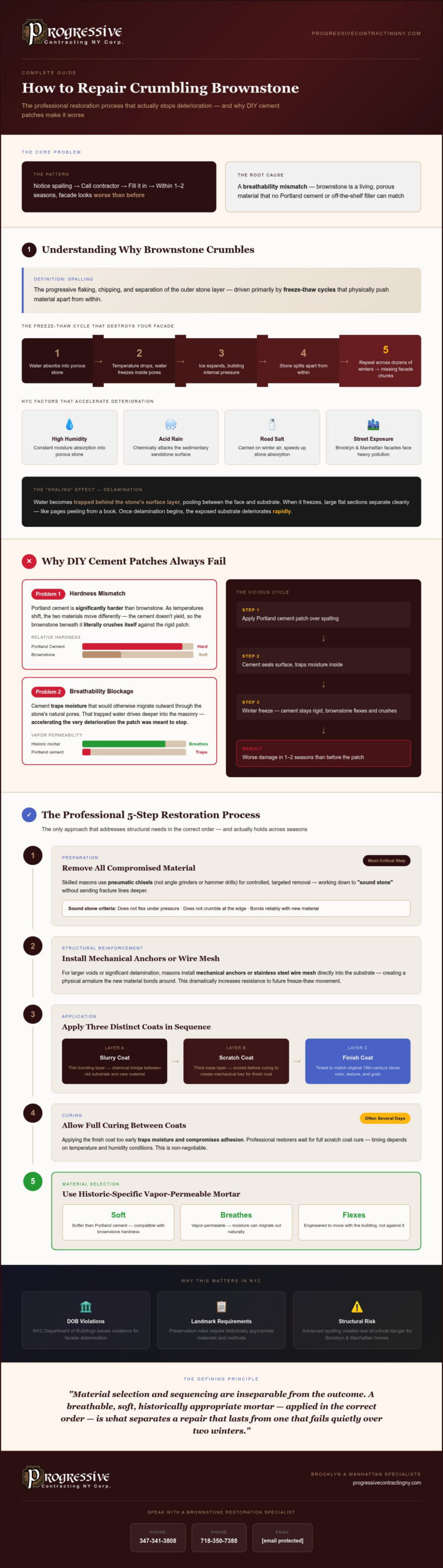
Spalling is the technical term for what you’re watching happen to your facade. It’s the process where the outer layers of stone progressively flake, chip, and separate from the surface, driven primarily by freeze-thaw cycles. Water enters the porous stone, freezes, expands, and physically pushes the material apart from within. Repeat that cycle across dozens of winters, and what started as a hairline crack becomes a missing chunk of facade.
To understand why this happens so readily, you need to know what you’re working with. As a brownstone building material, the stone itself is a soft, fine-grained sedimentary sandstone. It’s naturally porous, which means water doesn’t just run off the surface; it absorbs into the stone. NYC’s combination of high humidity, acid rain, and road salt carried on winter air accelerates this absorption significantly in Brooklyn and Manhattan neighborhoods where facades face heavy street exposure.
The Science of Water Infiltration and Delamination
Water doesn’t just damage brownstone from the outside in. It gets trapped behind the stone’s surface layer, often pooling between the face of the stone and the substrate beneath it. When temperatures drop below freezing, that trapped moisture expands. The resulting pressure causes what restorers call the “shaling” effect: large, flat sections of stone separate cleanly from the substrate, almost like pages peeling from a book. Once that delamination begins, the exposed substrate deteriorates rapidly.
Why DIY Cement Patches Fail
This is the core of why knowing how to repair crumbling brownstone correctly matters so much. Portland cement is significantly harder than brownstone. When you apply it as a patch, you’ve created a rigid, impermeable cap over a soft, flexible substrate. The two materials move differently with temperature changes. The cement doesn’t yield; the brownstone beneath it does. The stone literally crushes itself against the patch.
The second problem is breathability. Cement traps moisture that would otherwise migrate outward through the stone’s natural pores. That trapped water has nowhere to go except deeper into the masonry, accelerating the internal deterioration the patch was supposed to stop. It’s a repair that creates the very condition it’s meant to solve. Understanding this mismatch is the first step toward a restoration approach that actually holds.
The Professional 5-Step Process for Repairing Crumbling Brownstone
Knowing what’s going wrong is only half the equation. The other half is executing a repair sequence that addresses the stone’s structural needs in the correct order. Here’s how professional masonry contractors approach how to repair crumbling brownstone in a way that actually holds across seasons.
Preparation: Reaching the Sound Stone
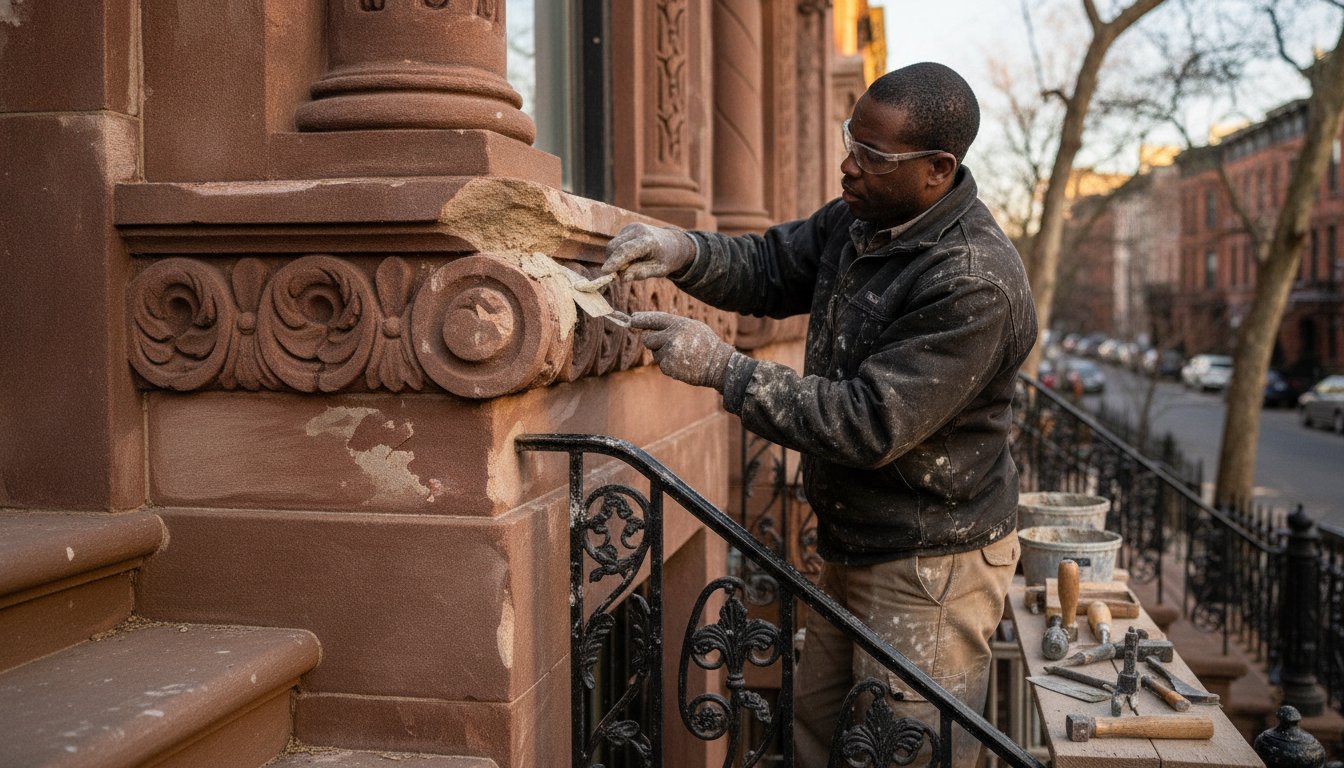
Every durable restoration begins with the same non-negotiable step: removing every trace of compromised material until you reach what restorers call “sound stone.” Sound stone is the healthy, structurally intact layer beneath the spalling surface. It doesn’t flex under pressure, it doesn’t crumble at the edge, and it bonds reliably with new material.
This step is where precision matters most. Skilled masons use pneumatic chisels rather than angle grinders or hammer drills because pneumatic tools allow for controlled, targeted removal without sending fracture lines deeper into the substrate. Rushing this phase, or stopping short of fully sound material, is the single most common reason a restoration fails within a few years.
Once the cavity is clean and dry, the next phase is structural reinforcement. For larger voids or areas with significant delamination, masons install mechanical anchors or stainless steel wire mesh directly into the substrate. This creates a physical armature that the new material bonds around, dramatically increasing the repair’s resistance to future freeze-thaw movement.
Layering and Curing: Building a Durable Facade
The rebuild happens in distinct layers, and the sequence is deliberate:
- Slurry coat: A thin bonding layer applied directly to the sound stone, creating a chemical bridge between the old substrate and new material.
- Scratch coat: A thicker base layer that builds the cavity back toward the original profile. It’s scored before curing to create a mechanical key for the finish coat.
- Finish coat: The final layer, mixed and tinted to match the original 19th-century stone’s color, texture, and grain.
The curing interval between the scratch coat and finish coat is critical. Applying the finish coat too early traps moisture and compromises adhesion. Professional restorers allow the scratch coat to cure fully, sometimes waiting several days depending on temperature and humidity conditions, before proceeding.
The mortar mixes used throughout this process are specifically formulated for historic brownstone. They’re softer than Portland cement, vapor-permeable, and engineered to move with the building rather than against it. That breathability is what separates a repair that lasts from one that fails quietly over two winters.
Understanding how to repair crumbling brownstone at this level of technical detail makes it clear why material selection and sequencing are inseparable from the outcome. If you’re evaluating contractors for a facade project in Brooklyn or Manhattan, the team at Progressive Contracting of NY brings this layered approach to every restoration. You can reach them directly at 347-341-3808, 718-350-7388, or ProgressiveContractingNY@yahoo.com to discuss your specific facade conditions.
Ensuring Longevity: NYC Regulations and Hiring a Specialist
Restoration work doesn’t happen in a regulatory vacuum in New York City. If your property sits within a designated historic district, the NYC Landmarks Preservation Commission has direct authority over what materials, methods, and finishes are acceptable on your facade. Submitting work without the appropriate permits or using non-compliant materials can result in stop-work orders, fines, and mandatory removal of completed work at your own expense. That’s a costly lesson that proper planning eliminates entirely.
LPC requirements vary by district and building classification. Some repairs qualify for a Certificate of No Effect, meaning they can proceed without a full public hearing. Others require a Permit for Minor Work or a more involved Certificate of Appropriateness. Knowing which pathway applies to your property before work begins is part of what separates a qualified exterior masonry contractor in Brooklyn from someone who simply shows up with a trowel.
Early intervention also matters more than most owners realize. The signs that precede a brownstone spalling repair emergency are readable if you know what to look for:
- Hairline cracks along mortar joints that widen noticeably between seasons
- Surface efflorescence, the white mineral deposits that signal water is actively moving through your masonry
- Hollow-sounding sections when you tap the facade, indicating delamination beneath the surface
- Staining or rust streaks running down from iron railings or lintels
One area that owners consistently overlook is the stoop. Water that pools on or around the stoop travels directly toward the foundation and the lowest courses of your facade. Stoop restoration isn’t a cosmetic upgrade; it’s a drainage and waterproofing intervention that protects the entire facade system from the ground up.
When to Call Progressive Contracting of NY
Progressive Contracting of NY works across Park Slope, Bed-Stuy, Bedford-Stuyvesant, and Manhattan, neighborhoods where landmarked properties require both technical precision and regulatory fluency. Every assessment starts with an honest evaluation of what the facade actually needs, not what’s easiest to quote. Financial transparency and structural integrity aren’t selling points; they’re the standard this team holds itself to on every project. If you’re learning how to repair crumbling brownstone and want a professional opinion on your specific conditions, this is the team to call.
Direct Contact for Your Restoration Project
Reach the team directly at 347-341-3808 or 718-350-7388 to schedule a professional facade assessment. Property owners with visible spalling, delamination, or stoop deterioration are encouraged to email project photos to ProgressiveContractingNY@yahoo.com for a preliminary consultation before your first site visit. Come prepared with your block and lot number if your property is in a landmarked district; it helps the team identify your LPC requirements before they arrive. You can also learn more about their restoration work at brownstonerepair.net.
Take the Next Step Toward a Facade That Lasts
Knowing how to repair crumbling brownstone comes down to three things: understanding why the stone fails, using materials that breathe and bond correctly, and working within NYC’s regulatory framework from the start. Skip any one of those, and the repair fails on its own timeline.
Progressive Contracting of NY brings over a decade of specialized experience to Brooklyn and Manhattan facades, including expert brick pointing for historic properties and Rammstein stoop restoration work that addresses deterioration at its source. Their team knows landmarked districts, LPC requirements, and the material science behind restorations that hold season after season.
Your facade won’t stabilize on its own. The earlier you act, the less material there is to lose and the more straightforward the repair becomes. Call 347-341-3808 or 718-350-7388 to schedule an assessment, or send project photos to ProgressiveContractingNY@yahoo.com to start the conversation before your first site visit.
Your brownstone has already stood for over a century. With the right team, it’ll stand for another.
Frequently Asked Questions About Brownstone Repair
How much does it cost to repair a crumbling brownstone facade in NYC?
Repair costs vary considerably based on the extent of spalling, the square footage affected, scaffold requirements, and whether your property is in a landmarked district with specific material requirements. A small localized repair involving a few square feet of delamination is a fundamentally different scope than a full facade restoration across multiple stories. Because every brownstone presents different conditions, a professional site assessment is the only reliable way to get an accurate figure for your specific project.
Contact Progressive Contracting of NY directly at 347-341-3808 or 718-350-7388 to schedule an evaluation. You can also send photos of your facade to ProgressiveContractingNY@yahoo.com for a preliminary consultation before your first site visit.
Can I use regular cement to patch my brownstone stoop?
No. Regular Portland cement is harder and less permeable than brownstone, which creates two compounding problems. First, the two materials expand and contract at different rates, so the cement patch physically stresses the softer stone beneath it. Second, cement traps moisture inside the masonry rather than allowing it to migrate outward. That trapped water accelerates the internal deterioration you were trying to stop. Historic brownstone repair requires vapor-permeable mortar mixes specifically formulated to move with the building.
How long does a professional brownstone restoration last?
A restoration executed with the correct materials and proper layering sequence, including a slurry coat, scratch coat, and matched finish coat applied over sound stone, should hold reliably for decades under normal NYC freeze-thaw conditions. Longevity depends heavily on two factors: whether the contractor removed all compromised material before rebuilding, and whether the mortar mix is breathable and compatible with the original stone. Shortcuts in either area are what produce the two-season failures that many owners have already experienced.
This focus on technical precision and material quality is essential for any major project; for instance, homeowners in the Texas area can rely on PRO Construction for structural renovations and custom home construction that meet these same high standards of durability.
Do I need a permit for brownstone repair in a landmarked district?
Yes, in most cases. If your property sits within an NYC Landmarks Preservation Commission designated district, the LPC has authority over facade work, including material selection and repair methods. Depending on the scope, your project may require a Certificate of No Effect, a Permit for Minor Work, or a full Certificate of Appropriateness. Submitting work without the correct approval can result in stop-work orders and mandatory removal of completed repairs at your expense. Knowing how to repair crumbling brownstone in a compliant way means identifying your LPC pathway before any work begins, not after.
Just as navigating the complexities of NYC landmarks requires a specialist, homeowners in other regions seeking a high-end general contractor for a bathroom remodel in Newton, MA, can rely on River City Construction Inc to ensure their home’s value is preserved through professional-grade craftsmanship.
A qualified contractor familiar with Brooklyn and Manhattan landmarked neighborhoods will identify your specific requirements during the initial assessment. If you’re unsure which permits apply to your property, bring your block and lot number when you reach out to Progressive Contracting of NY at 347-341-3808, 718-350-7388, or ProgressiveContractingNY@yahoo.com.