
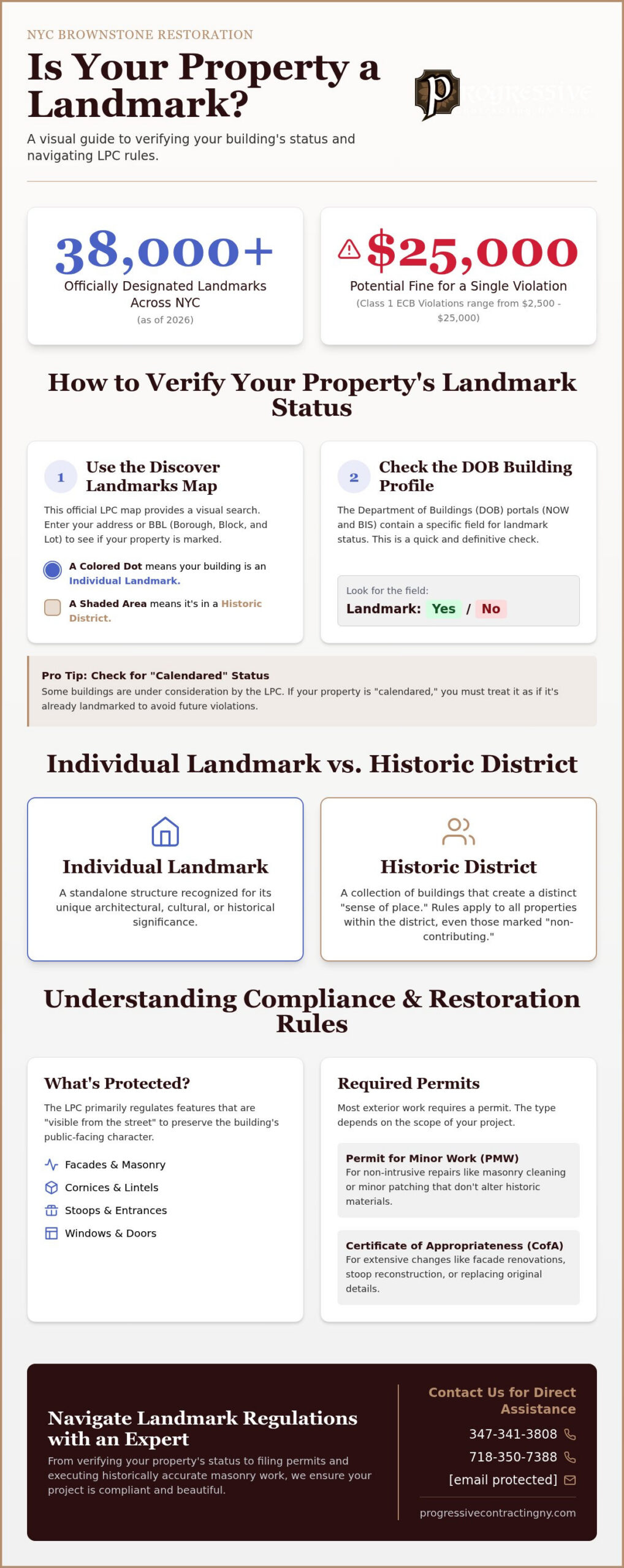
Did you know that as of 2026, over 38,000 properties across New York City are officially designated as landmarks? While owning a piece of history in neighborhoods like Park Slope or Bed-Stuy is a significant investment, it also brings a specific set of rules from the Landmarks Preservation Commission (LPC). You might find yourself asking, “is my brownstone a landmarked building” before you even pick up a hammer. It is a valid concern; a simple mistake can lead to Class 1 ECB violations with fines ranging from $2,500 to $25,000.
We understand that navigating NYC building codes feels overwhelming. You want to preserve your home’s character without getting stuck in a cycle of permits and penalties. This guide shows you exactly how to confirm your building’s status and what that means for your next restoration project. We will walk you through the current 2026 permit fees, explain the difference between historic districts and individual landmarks, and help you find a specialist who understands the precision required for historic masonry. For direct assistance with your facade or stoop, contact us at 347-341-3808 or 718-350-7388, or email ProgressiveContractingNY@yahoo.com.
Tools and Methods to Verify Your Property’s Landmark Status
Determining landmark status is a priority before you schedule any exterior masonry work. The New York City Landmarks Preservation Commission (LPC) regulates thousands of properties to ensure historic integrity. If you are asking, “is my brownstone a landmarked building,” you have several digital tools at your disposal to find a definitive answer. Knowing whether your property is protected allows you to plan your budget and timeline accurately. Beyond the LPC, you should also check the Cultural Resource Information System (CRIS) for New York State and National Register listings. Some buildings are “calendared,” which means the LPC is currently considering them for designation. If your property is calendared, you must act as if it is already landmarked to avoid legal complications.
Step-by-Step: Using the Discover Landmarks Map
The Discover Landmarks Map provides a visual representation of protected zones. Enter your borough, block, and lot (BBL) or street address into the search bar to locate your specific plot. If a colored dot appears on your building, it is an Individual Landmark. If your property sits within a shaded area, it is part of a Historic District. Once identified, download the official Designation Report. This document outlines the specific architectural features, such as cornices or stoops, that the city requires you to preserve. If you discover that your brownstone is a landmarked building, we can help you navigate the necessary paperwork and technical requirements.
Checking the DOB Building Profile
The NYC Department of Buildings (DOB) maintains the NOW portal and the Building Information System (BIS). These profiles contain a “Landmark” field that indicates “Yes” or “No.” If the status is positive, you need specialized permits for any facade renovation or sidewalk repair. Understanding what is a brownstone and its common protected materials helps you prepare for these requirements. For expert guidance on your building’s status or to start a compliant restoration, call us at 347-341-3808 or 718-350-7388. You can also email ProgressiveContractingNY@yahoo.com for a detailed inquiry.
Understanding Individual Landmarks vs. Historic District Designations
Identifying whether your property is an individual landmark or part of a historic district is a critical step in planning your renovation. Individual landmarks are standalone structures recognized by the Landmarks Preservation Commission for their unique architectural or cultural significance. In contrast, historic districts are collections of buildings that together create a specific “sense of place.” Neighborhoods like Park Slope and Bedford-Stuyvesant contain thousands of these homes. Even if your building is labeled as “non-contributing” within a district, you still need approval for exterior changes. This rule ensures that no single property disrupts the historic environment. When you ask, “is my brownstone a landmarked building,” the answer often dictates the technical specs of your project.
The distinction between these designations heavily impacts specialized maintenance like brick pointing NYC. For buildings in a historic district, the LPC requires that mortar color, texture, and joint profiles match the surrounding structures exactly. Using the wrong material can lead to costly violations and permanent damage to the masonry. If you are unsure about the specific requirements for your district, reach out to us at 347-341-3808 or 718-350-7388 for a professional assessment. We can help you determine the exact specifications needed for a compliant brownstone facade renovation.
Protected Features of a Brownstone Facade
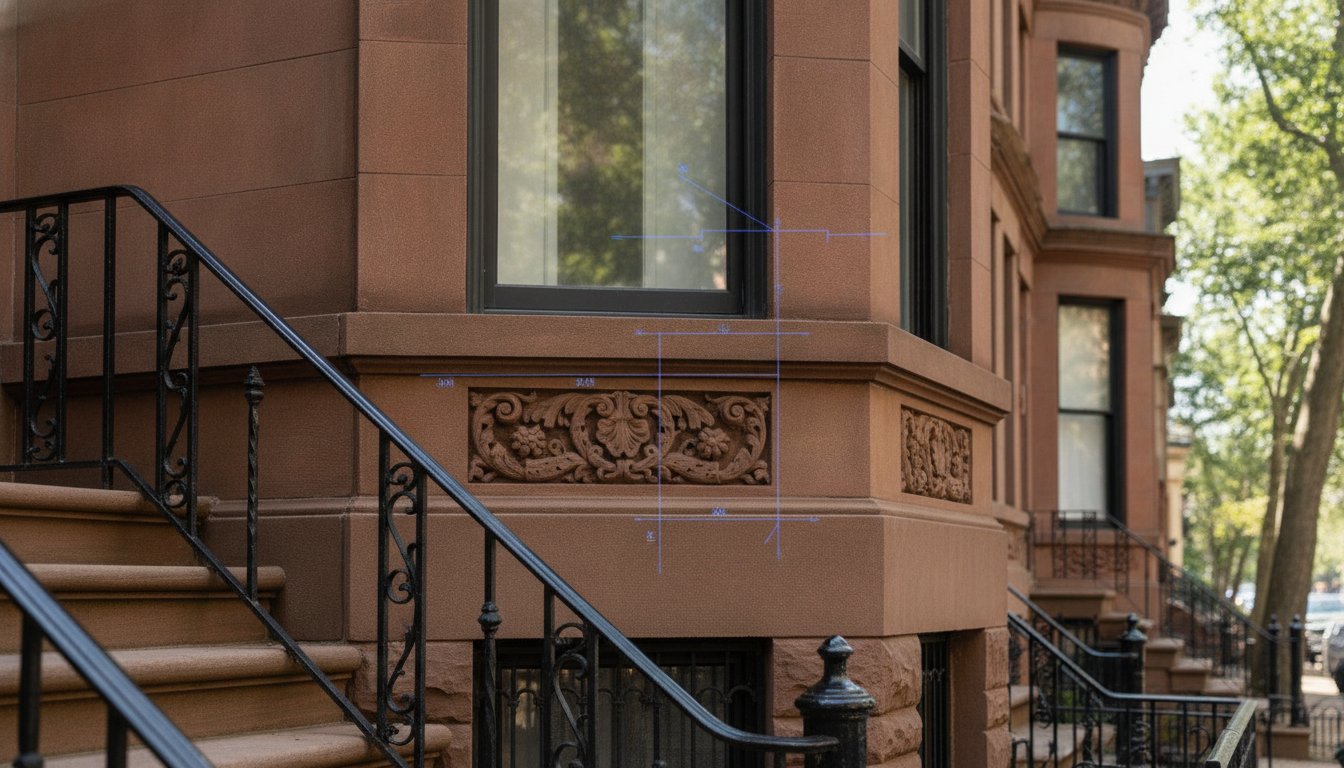
The LPC primarily focuses on features “visible from the street.” This includes your cornices, lintels, and stoops. Designation reports often cite these elements as defining characteristics of the property. Any restoration work on these features must use traditional methods to maintain the building’s historical integrity. Replacing original details with modern, mismatched materials is a common cause for DOB and LPC violations.
The Role of the Designation Report
A designation report acts as a technical blueprint for your home’s exterior. It provides a detailed architectural description that masonry contractors use to ensure material matching. Reading this report helps you understand which parts of your brownstone are legally protected. We use these reports to guide our restoration process, ensuring every detail meets city standards. For more information or to discuss your report, email us at ProgressiveContractingNY@yahoo.com.
Compliance and Restoration Rules for Landmarked Brownstone Facades
Confirming the answer to “is my brownstone a landmarked building” is only the first step toward a successful renovation. Once you know your status, you must navigate specific city protocols before any work begins. Most exterior projects require either a Permit for Minor Work (PMW) or a Certificate of Appropriateness (CofA). A PMW typically covers non-intrusive repairs like cleaning or minor masonry patches. A CofA is necessary for more extensive changes, such as a full brownstone facade renovation or stoop reconstruction. The city provides several Homeowner Resources to help you understand these filings. Progressive Contracting NY Corp handles the technical documentation and execution to ensure your project remains in full compliance with LPC standards.
High-quality restoration depends on precise material matching. Generic Portland cement is too rigid for historic brownstone; it causes the original stone to crack and deteriorate over time. We use specialized mortar mixes that mimic the breathability and color of the original material. This is especially important for brownstone spalling repair. If your facade is crumbling or flaking, we restore the surface using layers of natural stone-based patch that bonds correctly with the substrate. This process stops the decay without losing your landmark status.
Avoiding LPC Violations and Fines
If you’ve recently discovered that “is my brownstone a landmarked building” applies to your home, you need to understand the consequences of unpermitted work. Performing alterations on a landmarked facade without approval often results in a Class 1 ECB violation. Fines can reach $25,000 for serious infractions. If you already have a violation, you can remedy the situation through a professional restoration that meets historic standards followed by a retroactive filing. Progressive Contracting NY Corp has extensive experience resolving these issues for owners in Brooklyn and Manhattan.
Selecting a Qualified Restoration Contractor
A general contractor often lacks the specialized masonry skills required for landmarked properties. You need a partner who understands the nuances of historic preservation and traditional craftsmanship. Visit brownstonerepair.net to view our portfolio of approved projects. For a consultation on your landmarked property, call us at 347-341-3808 or 718-350-7388. You can also email us at ProgressiveContractingNY@yahoo.com to discuss your specific facade needs.
Secure Your Property’s Future with Expert Restoration
Owning a historic home in Park Slope or Bedford-Stuyvesant is a stewardship that requires the right technical partners. By verifying your status and following LPC guidelines, you protect your investment from legal setbacks and structural decay. Asking is my brownstone a landmarked building is the essential first step toward a successful facade renovation or stoop restoration. Taking this proactive approach ensures that every repair enhances both the beauty and the resale value of your property.
Progressive Contracting NY Corp brings over a decade of local expertise in historic masonry and Rammstein stoop restoration. We serve Brooklyn, Manhattan, and the surrounding areas with a focus on durability and landmark compliance. Whether you are dealing with a sidewalk violation or need a full facade overhaul, we provide the steady hand your project deserves. Reach our team at 347-341-3808 or 718-350-7388. You can also email us directly at ProgressiveContractingNY@yahoo.com.
Preserving the tradition of New York architecture starts with a commitment to quality. We look forward to helping you maintain your home’s legacy.
Frequently Asked Questions
Does landmark status mean I can never change my brownstone facade?
Landmark status does not prevent you from making changes; it ensures that alterations preserve the building’s historic character. If the answer to “is my brownstone a landmarked building” is yes, you can still perform a facade renovation or restore your stoop. The LPC requires you to use materials that match the original design. This protects the architectural integrity of neighborhoods like Park Slope while allowing for necessary structural repairs.
How long does it take to get LPC approval for brownstone repair?
Approval timelines vary depending on the scope of your project. A Permit for Minor Work (PMW) often takes two to three weeks for processing if the application is complete. More complex projects requiring a Certificate of Appropriateness (CofA) may take several months because they might involve public hearings. Planning ahead is essential. If you are asking “is my brownstone a landmarked building,” checking the status early prevents these timelines from delaying your restoration.
What happens if I start masonry work on a landmarked building without a permit?
Starting work without a permit leads to immediate “Stop Work” orders and Class 1 ECB violations. Fines for serious alterations can range from $2,500 to $25,000 as of 2026. The LPC also has the authority to mandate that you undo any unapproved work at your own expense. To avoid these penalties, contact us at 347-341-3808 or 718-350-7388 to ensure your masonry project follows all legal requirements.
Are interior renovations also restricted if my building is a landmark?
Most landmark designations only cover the exterior of the building. Interior renovations don’t require LPC approval unless your property is one of the 125 designated interior landmarks in NYC. However, you still need standard DOB permits for structural, plumbing, or electrical changes. If you have questions about your specific designation, email us at ProgressiveContractingNY@yahoo.com for guidance on how landmark rules apply to your property.