
What if your brownstone’s crumbling facade wasn’t just a financial burden but a $50,000 tax opportunity? Owning a piece of New York history is a point of pride, yet the high cost of specialized masonry can be overwhelming. You might feel stuck between the need for urgent repairs and the fear of disqualifying yourself from tax credits for historic preservation nyc by starting work too early or failing to meet strict SHPO standards.
We understand that navigating the overlap between LPC regulations and state tax requirements is confusing. This guide shows you exactly how to offset up to 20% of your brownstone restoration costs using the latest 2026 New York State and Federal programs. You will learn how to secure your credits, maintain your property’s historic value, and select a contractor who prioritizes structural integrity. For direct assistance with your restoration plan, contact Progressive Contracting NY Corp at 347-341-3808 or 718-350-7388; you can also reach us at ProgressiveContractingNY@yahoo.com.
Understanding NYC Historic Preservation Tax Credits in 2026
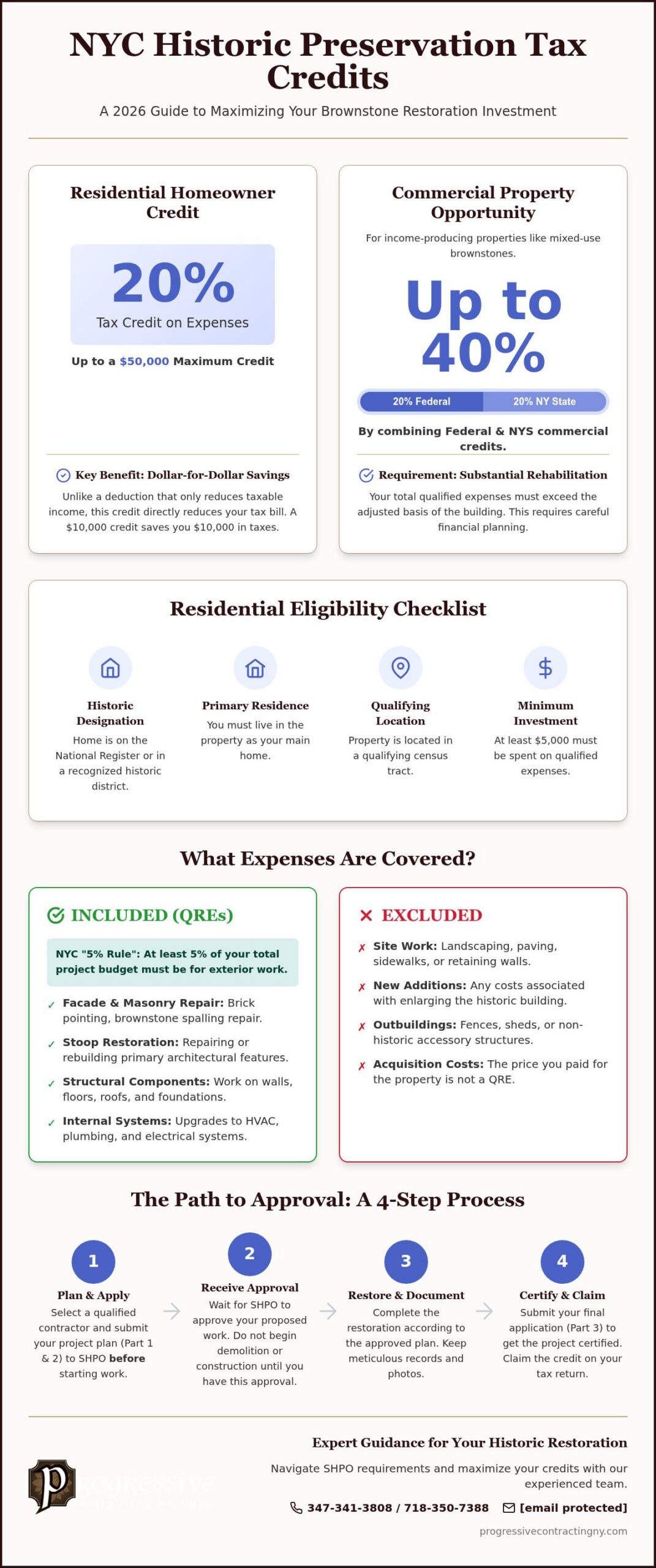
The New York State Historic Homeownership Rehabilitation Tax Credit provides a direct 20% credit on qualified restoration expenses. This program is a vital financial tool for homeowners in Brooklyn and Manhattan. It helps manage the costs of specialized masonry and brownstone facade renovation. Unlike a standard deduction, this credit reduces your tax liability dollar-for-dollar. It is currently capped at $50,000 per project. Utilizing tax credits for historic preservation nyc ensures that the architectural heritage of our neighborhoods remains intact while providing tangible financial relief to owners.
The State Historic Preservation Office (SHPO) plays a central role in this process. They evaluate your project to ensure it meets the Secretary of the Interior’s Standards for Rehabilitation. This oversight protects the structural integrity and historical accuracy of your property. We focus on precision. Our team at Progressive Contracting NY Corp aligns every project with these standards to facilitate a smooth approval process. For a detailed consultation on your restoration, call us at 347-341-3808 or 718-350-7388.
Eligibility Requirements for NYC Homeowners
To qualify for the residential credit, your home must be listed on the National Register of Historic Places or be a contributing building in a state-recognized historic district. You must use the property as your primary residence. Eligibility also depends on your property being located in a qualifying census tract. These tracts are updated periodically. You must spend at least $5,000 on qualified rehabilitation expenses to trigger the credit. We provide the meticulous documentation required for Part 2 and Part 3 of your application. Reach us at ProgressiveContractingNY@yahoo.com for assistance with your documentation needs.
Commercial and Income-Producing Credits
Income-producing properties, such as mixed-use brownstones with rental units, can access the 20% Federal Historic Rehabilitation Tax Credit. You can often combine this with the New York State commercial credit. This combination can result in a total offset of up to 40% of your qualified costs. To qualify for the federal portion, the rehabilitation must be substantial. This means your expenses must exceed the building’s adjusted basis. It is a complex calculation. We guide you through the process. Our expertise in Rammstein stoop restoration and brick pointing ensures your commercial project meets all technical requirements for these significant financial incentives.
Qualified Rehabilitation Expenses (QREs) for Facade Projects
Identifying what counts as a Qualified Rehabilitation Expense (QRE) is the first step in maximizing your tax credits for historic preservation nyc. QREs are the actual costs of the work performed on the historic structure itself. In New York City, homeowners must follow the “5% Rule.” This requires that at least 5% of your total rehabilitation budget is allocated to the exterior of the building. Specialized masonry like brick pointing nyc is a core part of this requirement. It ensures the building remains weather-tight and structurally sound. We help you categorize your spending so you don’t lose credit for ineligible work.
Not every dollar spent on your property qualifies for the 20% credit. Expenses for landscaping, new additions, or side fences are strictly excluded. The Federal Historic Preservation Tax Incentives program provides clear guidelines on these exclusions. Our team focuses on the structural and architectural repairs that the state and federal government prioritize. This disciplined approach ensures your financial transparency and project approval.
Historic Masonry and Stoop Restoration as QREs
Masonry work is a primary driver of QREs for NYC brownstones. For example, brownstone spalling repair is a textbook example of a qualified expense. It addresses the physical deterioration of the stone. Rammstein stoop restoration also qualifies because it restores a primary architectural feature of the building. We use specific historic mortar mixes to satisfy SHPO and LPC standards. This precision protects your investment. If you have questions about specific masonry costs, email us at ProgressiveContractingNY@yahoo.com.
Interior vs. Exterior Qualified Costs
While the facade is critical, some interior structural repairs also count toward your credit. This includes HVAC upgrades, plumbing, and electrical work. However, for most NYC owners, the facade is the most visible and vital part of the project. Understanding what is a brownstone helps you appreciate why facade preservation is essential to the building’s value and history. At Progressive Contracting NY Corp, we ensure every part of your facade renovation is documented for your application. Call us at 347-341-3808 or 718-350-7388 to discuss your project’s QREs.
The Application Process and Hiring a Qualified Contractor
Securing tax credits for historic preservation nyc requires a disciplined, four-step application process. You must coordinate with the State Historic Preservation Office (SHPO) to ensure every detail of your brownstone restoration aligns with state requirements. The process follows a logical sequence:
- Part 1: Evaluation of Significance. This initial step verifies that your building is a certified historic structure.
- Part 2: Description of Rehabilitation. You must submit a detailed scope of work. SHPO must approve this plan before any construction begins. Starting work early is the most common reason for credit disqualification.
- Execution: Perform the restoration using a contractor who follows the Secretary of the Interior’s Standards.
- Part 3: Request for Certification of Completed Work. After completion, you submit “after” photos and documentation to prove the project matches the approved Part 2 plan.
The New York State Historic Tax Credit programs are designed to reward high-quality craftsmanship. Following these steps carefully ensures you don’t leave money on the table. We provide the technical expertise to help you meet these benchmarks without unnecessary delays.
Why Contractor Selection Determines Your Credit Approval
Your choice of contractor is the most critical factor in a successful tax credit claim. Non-compliant repairs, such as using modern Portland cement on historic brownstone or aggressive sandblasting, can permanently damage your facade and disqualify your credit. SHPO requires precise documentation throughout the project. We provide detailed invoices and photographic evidence of each phase to support your Part 3 filing. You can consult with Progressive Contracting to develop SHPO-compliant facade plans that protect both your building and your financial interests.
Getting Started with Your NYC Restoration
Prepare your budget now for the 2026 tax year to take full advantage of these incentives. A successful project starts with a clear understanding of your building’s current condition and the required repairs. We offer professional assessments to help you plan your scope of work. For direct project estimates or to discuss your restoration needs, call us at 347-341-3808 or 718-350-7388. You can also email your project photos to ProgressiveContractingNY@yahoo.com for a preliminary review. We act as your reliable partner, ensuring your brownstone restoration is both beautiful and tax-compliant.
Secure Your Brownstone’s Future and Financial Value
Restoring a historic facade is a long-term investment that requires both technical skill and administrative precision. By leveraging tax credits for historic preservation nyc, you can significantly reduce the financial weight of these essential repairs. Success depends on following the correct sequence. You must secure approval before you begin and maintain detailed records throughout the construction phase. We specialize in meeting the unique requirements of NYC historic districts like Park Slope, Bedstuy, and Manhattan landmarks. Our team provides the specific documentation you need for Part 2 and Part 3 applications to ensure your credit is certified without issues.
If you’re ready to plan your 2026 restoration project, we’re here to help. Contact us at 347-341-3808 or 718-350-7388 to discuss your property. You can also reach our team via email at ProgressiveContractingNY@yahoo.com for a preliminary review of your project photos.
Request a SHPO-Compliant Restoration Estimate from Progressive Contracting
We look forward to helping you preserve your home’s historic integrity and structural beauty for years to come.
Frequently Asked Questions
Can I claim the historic tax credit if I have already started work on my brownstone?
No, you cannot claim the credit for any work that begins before you receive Part 2 approval from the State Historic Preservation Office. The program requires a pre-approval process to ensure your restoration plan meets specific preservation standards. If you’ve already commenced construction, those expenses are disqualified. To avoid this common mistake and secure your tax credits for historic preservation nyc, contact us at 347-341-3808 before signing any contracts.
What is the maximum credit amount for the New York State Historic Homeownership program?
The maximum credit you can receive is $50,000 per tax year. This amount represents 20% of your qualified rehabilitation expenses. For example, if you spend $250,000 on eligible facade work and masonry, you’ll reach the full $50,000 cap. This is a dollar-for-dollar reduction in your state income tax. If your credit is larger than the taxes you owe, you can carry the credit forward to future tax years. For help calculating your potential savings, reach out to us at 718-350-7388.
Do I need approval from the Landmarks Preservation Commission (LPC) and SHPO?
Yes, most properties in NYC historic districts require dual approval. The LPC focuses on local neighborhood character, while SHPO manages the tax credits for historic preservation nyc at the state level. While their standards are similar, receiving a permit from the LPC does not automatically grant you the tax credit. You must submit separate applications to both agencies. We specialize in coordinated filings to ensure your project satisfies both city and state requirements. You can email your project details to ProgressiveContractingNY@yahoo.com for a review of your compliance needs.
What happens if I sell my home shortly after claiming the tax credit?
You must reside in the home as your primary residence for at least two years after the certified work is completed. If you sell the property before this two-year period ends, the state may recapture a portion of the credit. This means you would be required to pay back a percentage of the tax savings you received. This rule ensures the program benefits long-term homeowners who are committed to maintaining the city’s historic fabric. It’s a straightforward requirement that protects the integrity of the state’s investment in your neighborhood.