

Last Tuesday, a Park Slope owner discovered that his recent facade work didn’t automatically qualify as a tax-deductible expense. He isn’t alone. Many owners feel overwhelmed by the cost of brownstone capital improvements vs repairs NYC, especially when facing the high price of historic masonry. While a minor patch might keep the water out, the IRS distinguishes these routine fixes from structural enhancements that add permanent value to your heritage property.
It’s natural to worry about missing out on significant tax savings when you eventually sell. We’re here to help you apply the IRS “BAR” test with the confidence of a seasoned professional. This guide explains how to classify your masonry projects to lower future capital gains tax and ensure your records meet audit standards. As a licensed contractor (License #2097623-DCA), we focus on providing the transparency you need to protect your investment for the 2026 tax year and beyond.
Defining Repairs vs. Capital Improvements for NYC Brownstone Owners
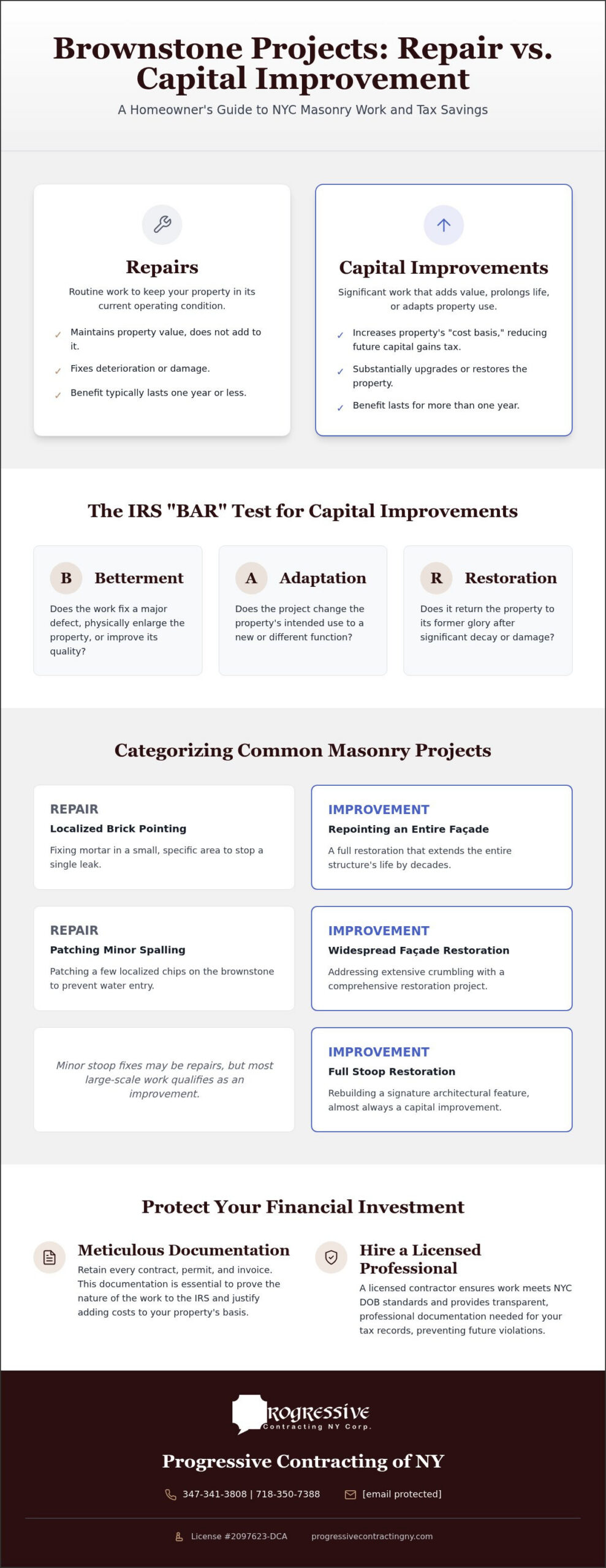
Distinguishing between maintenance and investment is the first step in managing your property’s financial future. Repairs keep the building in its current state. Improvements increase value or extend life. Understanding the cost of brownstone capital improvements vs repairs NYC starts with your cost basis. This figure represents your total investment in the property. By adding the cost of improvements to your basis, you lower your taxable profit during a future sale.
A solid foundation in understanding depreciation helps owners realize that improvements are long-term assets rather than immediate expenses. The IRS evaluates these projects using the BAR framework:
- Betterment: Does the work fix a major defect or enlarge the building?
- Adaptation: Does the project change the property’s intended use?
- Restoration: Does it return the property to its former glory after significant decay?
The Restoration Rule for Historic Facades
Restoring a historic facade often crosses the line from repair to improvement. Minor patching of small cracks is a simple repair. However, a full brownstone facade renovation is a restoration. The NYC Landmarks Preservation Commission (LPC) often requires historically accurate materials, such as specific lime-based mortars, which can expand the project scope. When you replace a significant portion of the facade’s surface, the IRS typically classifies it as a capital improvement. This distinction is critical for your 2026 tax strategy. As a licensed specialist (License #2097623-DCA), we provide the detailed documentation you need to support these basis adjustments effectively.
Categorizing Masonry Work: From Stoop Repairs to Facade Renovation
Applying tax logic to physical masonry requires a clear look at the project’s scope. For instance, brownstone spalling repair is often a gray area. If you’re simply patching a few localized chips to prevent water entry, the IRS views this as maintenance. However, when crumbling is widespread, a comprehensive facade restoration becomes a capital improvement. This work adds significant value to the property’s IRS definition of adjusted basis, helping you manage the total cost of brownstone capital improvements vs repairs NYC.
Similarly, localized brick pointing nyc to fix a single leak is a repair. In contrast, repointing an entire building face is a restoration that extends the structure’s life by decades. Projects like brownstone stoop restoration brooklyn almost always fall into the improvement category. These projects don’t just fix a step; they rebuild a signature architectural feature using historic methods. This distinction is a key factor when calculating the long-term cost of brownstone capital improvements vs repairs NYC.
Long-Term Asset Enhancement vs. Yearly Maintenance
The one-year rule is a helpful guide for owners. If the work provides a benefit lasting well beyond one year, it likely qualifies for capitalization. Consider the cost of sidewalk violation removal nyc. Grinding down a single trip hazard is a repair. Replacing the entire concrete path is a capital improvement. In 2026, professional facade construction serves as a long-term asset that preserves your home’s heritage. To ensure your documentation is audit-ready, consult with a licensed contractor (License #2097623-DCA) at 347-341-3808, 718-350-7388, or email ProgressiveContractingNY@yahoo.com.
Strategic Financial Planning: Documentation and Licensed Execution
Proper record-keeping is the bridge between a physical project and a significant financial gain. You must retain every contract, permit, and invoice related to your masonry work to prove its nature to the IRS. Without these documents, you can’t justify the cost of brownstone capital improvements vs repairs NYC when it’s time to sell. Off-the-books labor might seem cheaper during the construction phase, but it often leads to a higher tax bill later. The IRS won’t let you add unverified expenses to your property’s basis, which means you lose the ability to offset capital gains. We recommend consulting with a tax professional early in the project. They’ll help you organize the detailed documentation we provide to maximize your long-term savings.
Why Licensed Execution Protects Your Property Basis
Hiring a licensed professional is a matter of financial security and legal compliance. Progressive Contracting NY Corp (License #2097623-DCA) provides the transparent, professional documentation you need for your tax records. A licensed contractor ensures that every phase of work meets current NYC DOB standards. This prevents the risk of future violations or corrective repairs that drain your budget without adding value. Our process includes providing detailed descriptions of materials and methods, which helps clarify the restoration aspect of the BAR test discussed earlier. Visit Brownstone Repair for a specialized facade assessment and professional financial planning. You can also reach our team directly at 347-341-3808 or 718-350-7388. For specific project inquiries, email us at ProgressiveContractingNY@yahoo.com to ensure your brownstone remains a stable, documented asset.
Protecting Your Brownstone Investment for the Long Term
Managing a historic property requires balancing immediate maintenance needs with a clear financial strategy. You now have the tools to navigate the cost of brownstone capital improvements vs repairs NYC by applying the BAR framework and maintaining rigorous records. Every facade renovation or specialized Rammstein stoop restoration acts as a permanent enhancement to your home’s value. Partnering with a licensed contractor ensures your project meets the strict standards of Brooklyn and Manhattan historic districts while providing the audit-ready paperwork your tax professional requires.
As a licensed specialist (License #2097623-DCA), we’re committed to preserving your building’s integrity and your financial peace of mind. Your brownstone is a piece of New York history that deserves both precise craftsmanship and strategic care.
Frequently Asked Questions
Is brownstone facade renovation tax deductible for my primary residence?
A brownstone facade renovation on your primary residence isn’t a direct tax deduction like a business expense. Instead, it qualifies as a capital improvement that increases your property’s adjusted basis. This helps lower your future capital gains tax when you sell the home. By classifying the work correctly, you effectively manage the long-term cost of brownstone capital improvements vs repairs NYC.
Does brick pointing count as a capital improvement or a repair?
The classification of brick pointing depends on the project’s scale. Minor, localized repointing to fix a single leak is usually a repair. However, if you repoint the entire facade, the IRS often views this as a restoration that extends the building’s life. This makes it a capital improvement. Owners in historic districts like Park Slope should document the total area covered to support tax claims.
How do I document brownstone restoration for capital gains tax purposes?
Accurate documentation requires keeping all signed contracts, DOB permits, and itemized invoices from a licensed contractor. You should also save proof of payment, such as cancelled checks or bank statements. These records prove the work was a permanent restoration rather than routine maintenance. Professional documentation from a specialist (License #2097623-DCA) ensures your basis adjustments are defensible during an IRS audit.
Can I include NYC sidewalk violation removal costs in my property basis?
You can include sidewalk costs in your property basis if the work involves a full replacement or significant construction. Simple repairs, like grinding down a single trip hazard to remove a violation, are typically maintenance. A complete sidewalk overhaul adds to the property’s value and longevity. This distinction is vital for accurately calculating the total cost of brownstone capital improvements vs repairs NYC.