
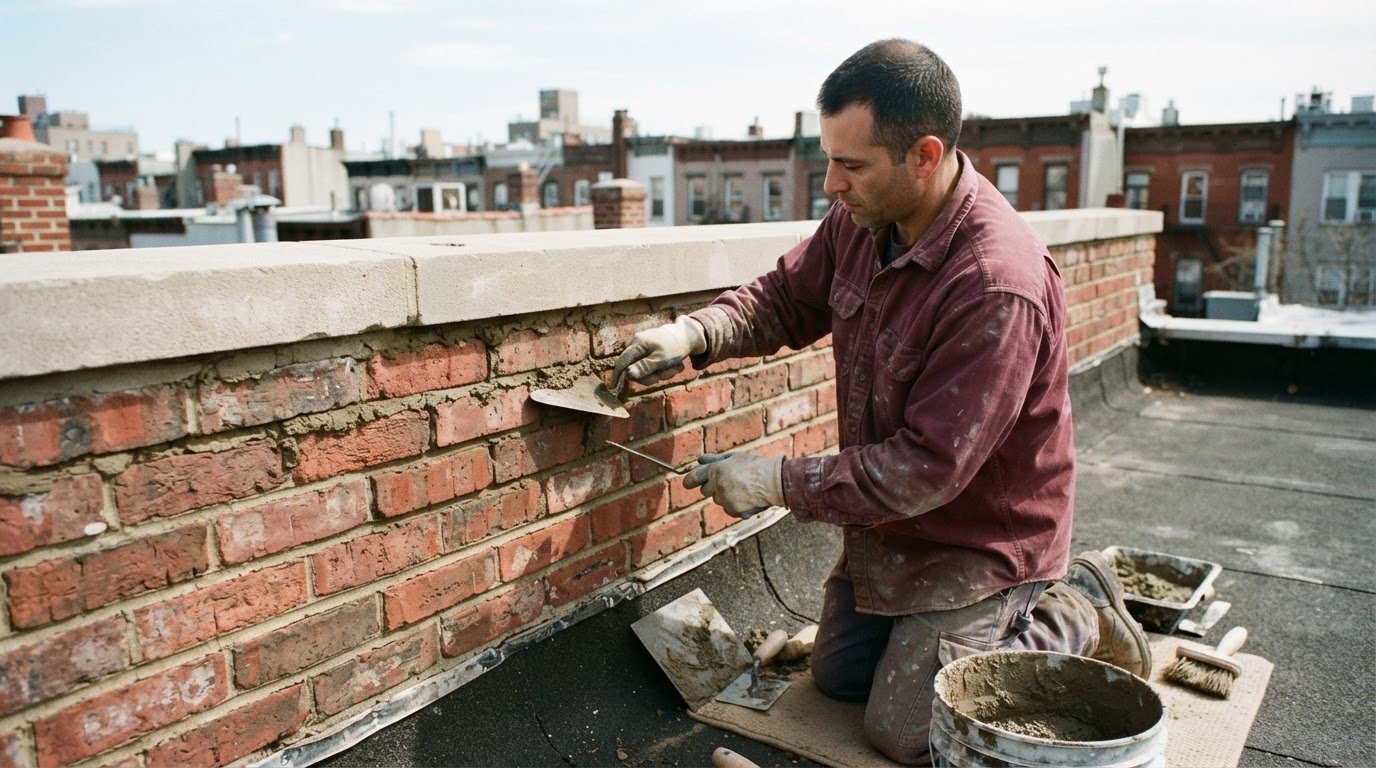
The nearest contractor is not always the best fit: service areas and distance filters can affect which masonry options are practical for your property. For brick pointing, look for a Masonry contractor who serves your address and can assess the brickwork, not simply the one who appears closest on a map.
It is reasonable to want a clear picture of the work before arranging repairs. This guide explains how brick veneer installation handles moisture, when structural masonry damage needs prompt attention, and how service areas and distance filters shape your options. You will also learn what a pointing project may involve and how to move from an initial concern to a focused repair plan for your building.
Chimney masonry needs attention when loose bricks or open joints could fall or let water into the structure. The work depends on the location and extent of deterioration. If repairs may disturb asbestos-containing material, the U.S. Environmental Protection Agency says the work must be done by a trained and accredited asbestos professional.
Dust control also matters during cutting, grinding, or mortar removal. CPWR-The Center for Construction Research and Training identifies silica as a potentially deadly occupational hazard in construction. A masonry contractor can explain how the work plan controls silica dust. A careful repair sequence protects sound masonry while restoring damaged joints and surfaces.
Contractor service areas and distance filters
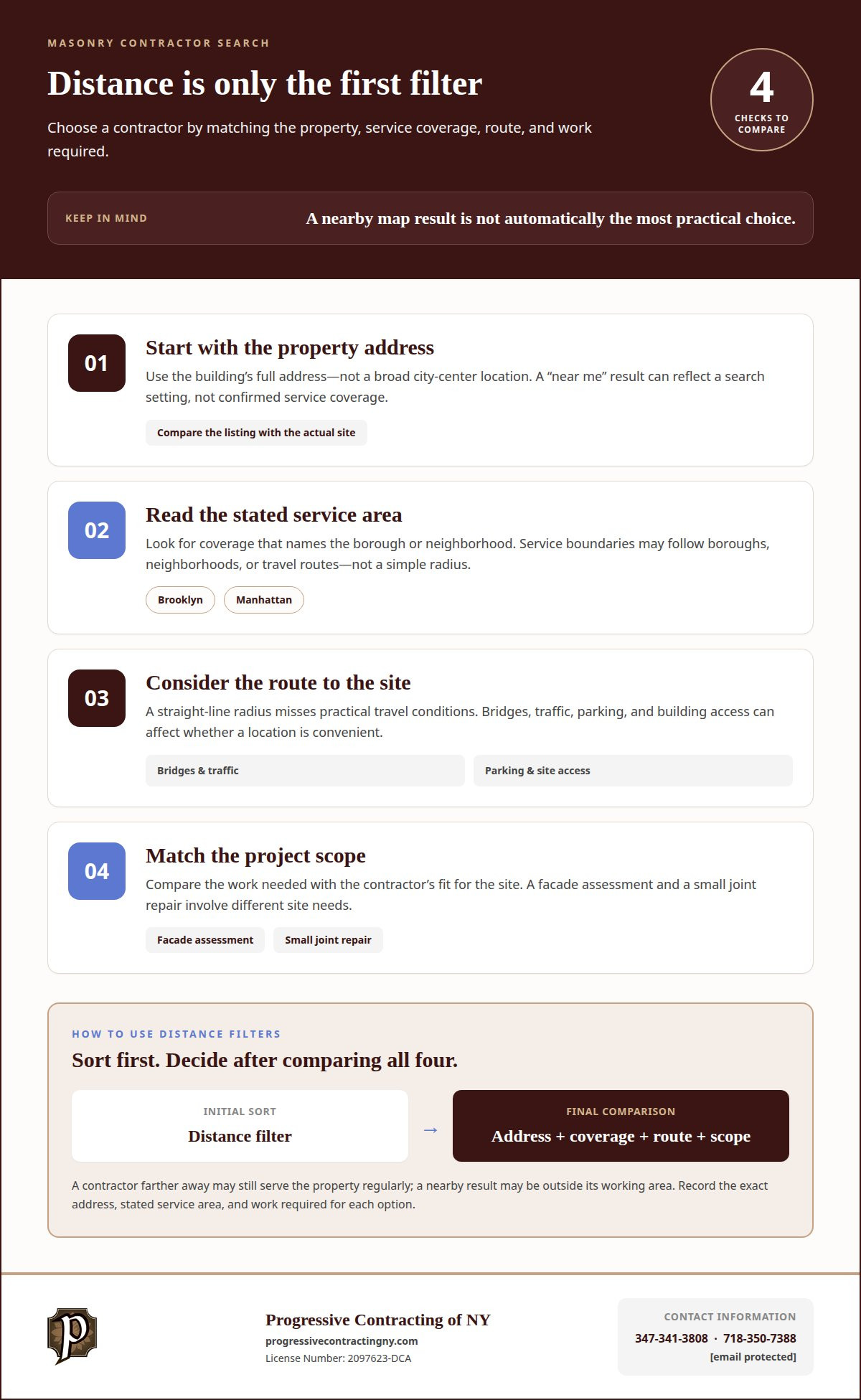
A map’s closest result is not automatically the most practical choice for a masonry project. Search filters often sort by distance, but a straight-line radius does not account for traffic, bridge crossings, parking, or building access. In New York City, Brooklyn and Manhattan properties may require different routes, even when they appear close on a map.
Start with the property’s full address, then compare it with the contractor’s stated service area and the route to the site. A result marked “near me” can reflect a search setting rather than a commitment to serve that location. For example, match a Crown Heights building to stated coverage for the neighborhood, rather than judging only by a pin near Downtown Brooklyn.
- Check the location setting: Use the building’s address, not a broad city-center location.
- Read the coverage description: Look for the borough or neighborhood, such as Brooklyn or Manhattan.
- Consider the site route: Bridges, traffic, and street access can affect practical travel.
- Match the project scope: A facade assessment and a small joint repair involve different site needs.
Use distance filters to sort results initially, not to make the final decision. A contractor farther away may still serve the property regularly, while a nearby result may be outside its working area. Service boundaries can follow boroughs, neighborhoods, or travel routes rather than a simple radius. In Bedford-Stuyvesant, for example, a listing’s distance alone may not show whether the address is covered.
For a useful comparison, record the exact address, the stated service area, and the work required. Assess each result against all three details. This keeps your search focused on contractors whose coverage and project scope fit the property, rather than on the shortest map distance alone.
What services does a masonry contractor provide?
A masonry contractor may work with brick, stone, block, and concrete on building exteriors. For brick pointing, deteriorated mortar is removed, the joints are prepared, and new mortar suited to the existing masonry is applied. This restores open joints without treating every crack as a surface-only issue. On a brownstone facade, repairs may also address damaged stone or worn exterior details.
Installation and repair work can include:
- Brick veneer: Installation includes moisture and drainage detailing to manage water behind the veneer.
- Retaining walls: Gravel backfill and weep holes help relieve soil pressure behind block walls.
- Stoops and facades: Repairs can address loose masonry, worn joints, and damaged exterior surfaces.
- Concrete and sidewalks: Work may include repairing cracked or deteriorated surfaces.
The right scope depends on the material and location of the damage. A retaining wall, for example, needs different drainage details from a brick facade being repointed. A stoop with loose masonry needs attention to the affected steps and adjoining structure. A masonry contractor assesses the full work area so repairs address related deterioration, not only the most visible spot.
Historic masonry repairs should respect the existing materials and appearance. A careful sequence starts by identifying the masonry type, mapping damaged areas, and choosing compatible repair materials. This distinguishes a small pointing job from broader facade restoration and clarifies when work beyond the mortar joints is needed.
Discuss your brickwork project
Progressive Contracting NY: Masonry contractor
Progressive Contracting NY Corp provides masonry contracting for property owners with exterior masonry concerns. Turn to the team when brickwork needs attention or a brownstone facade or stoop needs restoration. The team serves Brooklyn and Manhattan, including brownstone properties in neighborhoods such as Park Slope and Bedford-Stuyvesant.
Services include brownstone facade renovation and brownstone stoop restoration. A deteriorated facade and a damaged stoop need distinct repair scopes, even at the same property. A masonry contractor can assess the affected area and define the work needed for your brownstone project.
Contact Progressive Contracting NY Corp at 347-341-3808 or 718-350-7388, or email ProgressiveContractingNY@yahoo.com to discuss your masonry project.
Plan the next step for your masonry
Before arranging repairs, identify the outcome you need: sound joints, a stable exterior, or restored historic details. A masonry contractor can use that priority to assess visible damage and develop a repair scope for the building, rather than treating one symptom in isolation.
Progressive Contracting NY Corp provides brownstone facade renovation, stoop restoration, and architectural masonry care in Brooklyn and Manhattan. If your property needs this exterior work, share its location and describe the affected area when you get in touch. A free consultation is available to discuss the project and its repair needs.
A clear description of the property and its masonry concerns is a practical starting point. Progressive Contracting NY Corp offers a free consultation to discuss the repair work and a suitable plan.
Take the next step with confidence and give your masonry the attention it needs.
Frequently Asked Questions
How do I find and compare licensed masonry contractors near me?
Compare a contractor’s experience with your building and repair type, and verify credentials through the appropriate licensing authority. For a Brooklyn or Manhattan property, check whether the contractor works in that borough and handles the specific masonry involved. A brownstone facade, for example, calls for exterior restoration experience, while a brick joint repair requires familiarity with pointing.
What questions should I ask before hiring a masonry contractor?
Ask what the proposed work includes, which areas need repair, and how adjacent surfaces will be protected. Clarify how changes to the scope will be communicated and documented. For a brownstone facade, ask how the repair approach will account for existing materials and details. Request a written description of the planned work so expectations are clear before it begins.
How can I verify a masonry contractor’s license, insurance, and references?
Check the license number with the relevant licensing authority and confirm that its scope matches the work. Progressive Contracting NY’s stated license number is 2097623-DCA; the number itself does not establish current status or coverage. Request current proof of insurance and confirm its details with the insurer. For references, seek examples of comparable masonry projects, such as facade restoration or stoop work in Brooklyn or Manhattan.
How long do common masonry projects take?
In Grapevine, concrete is usually safe for foot traffic after 24-48 hours and ready for light vehicle traffic in about 7 days. It continues gaining strength for roughly 28 days.