
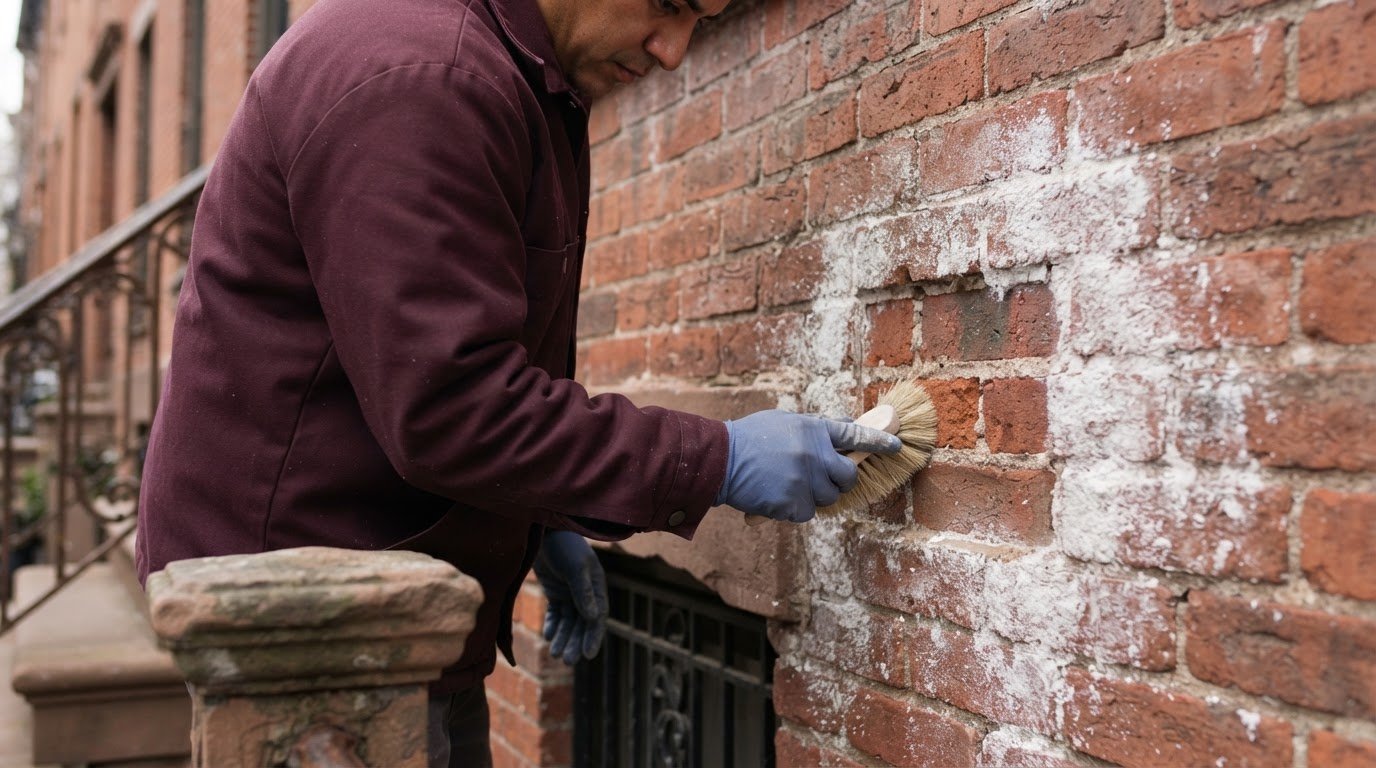
White salts on brick are often a sign of moisture movement, not just a surface stain. Removing efflorescence and mineral salts from a Brooklyn brick facade starts with identifying the deposit and tracing how water is reaching the masonry; a professional then selects a suitable cleaning method, from gentle mechanical removal to specialized treatment.
White residue on brick can be frustrating, especially when cleaning it away does not address why it appeared. This guide explains how masonry professionals identify common deposits, remove them while minimizing damage, and recognize when recurring moisture needs attention. It also explains why acid is not a default solution for colored brick and how careful assessment helps protect a facade’s surface and appearance.
Table of Contents
When to hire a professional cleaner or masonry specialist
Removing efflorescence and mineral salts from a Brooklyn brick facade starts with determining whether the deposits are isolated or recurring. Recurring residue, damp patches, cracks, or crumbling brick call for an assessment of the masonry and moisture patterns, not surface cleaning alone.
Facade cleaning, repairs, scaffolding, and sidewalk sheds can involve different NYC requirements, depending on the proposed work. For historic brick, permit or Landmarks Preservation Commission approval needs depend on the property and scope of work. There is no universal answer for every facade.
- Hire a masonry specialist for large, elevated, historic, or repeatedly wet brick areas. Brick that pops, crumbles, or sheds its outer layer needs evaluation before cleaning.
- For late gypsum efflorescence, professionals can use mechanical cleaning with very fine granulate to remove the gypsum layer. This may remove some surface sanding and slightly change brick color.
- Choose a cleaner suited to the masonry and test it on an inconspicuous area. Acidic products can react with mortar, alter brick color, etch nearby surfaces, and create runoff concerns. Removing efflorescence and mineral salts from a Brooklyn brick facade requires extra care on colored masonry, where a 2% muriatic acid solution may help reduce etching.
- Before acid treatment, professionals wet the wall with clean water and treat areas no larger than 4 ft 2 (0.37 m2). They wait about 5 minutes before scouring, then immediately flush the masonry thoroughly.
- After mechanical cleaning, professionals may apply a water-repellent treatment to help prevent late gypsum efflorescence from returning. Recurring deposits still require attention to moisture entering through cracks or joints.
How professionals determine dilute acid concentrations for colored masonry
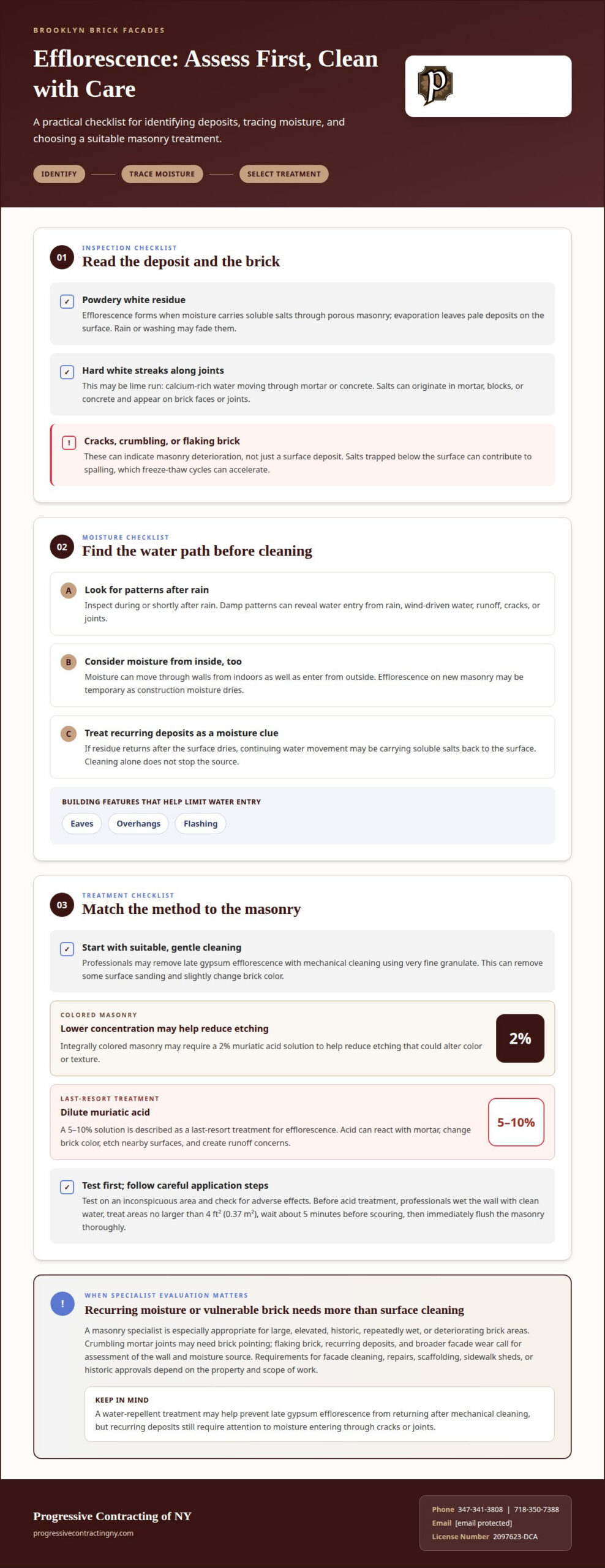
- Identify the deposit and affected material before selecting a cleaner. Salts can originate in mortar, blocks, or concrete, then appear on brick faces or along mortar joints. Hard white streaks may be lime run, where calcium-rich water moves through mortar or concrete.
- Match any acid treatment to the masonry’s color and condition. A 5 to 10 percent dilute muriatic acid solution is a last-resort treatment for efflorescence. Integrally colored masonry may require a 2 percent solution to help reduce etching that could alter its color or texture.
- Trace moisture before cleaning deposits. Rain and wind-driven water can enter from outdoors, while indoor moisture can also move through walls. Look for recurring damp patterns around cracks, joints, or areas exposed to runoff, since continuing moisture can carry soluble salts back to the surface.
- Address water entry as part of the repair plan. Eaves, overhangs, and flashing help limit water reaching masonry walls. A cleaner can remove visible residue, but persistent moisture can bring new deposits through mortar and brick.
- Choose the next treatment based on the wall, not just the stain. Acid can react with mortar, change brick color, etch nearby surfaces, and create runoff concerns. For an assessment of colored or historic masonry, consult a masonry contractor before choosing chemical cleaning.
Building plans can reduce water entry into masonry walls by including eaves, overhangs, and flashing. A highly alkaline masonry surface can be washed with a mild solution of H&C Concrete Etching Solution or muriatic acid.
Before using an acid solution on masonry, test it on a small, inconspicuous area and check for adverse effects before proceeding with cleaning.
What efflorescence is and how moisture carries salts to brick surfaces
Efflorescence forms when soluble salts, moisture, and porous masonry meet. Trace the moisture path, then distinguish a surface deposit from damage within the brick or mortar.
-
Recognize Efflorescence on Brick
Inspect the brick during or shortly after rain, when moisture patterns can reveal water entry. Water moves through porous brick, dissolves salts, and carries them outward; evaporation leaves pale, powdery deposits. The National Bureau of Standards describes this movement from masonry to the surface. Soluble salts in clay can also move outward with mixing water as brick dries, according to the U.S. Bureau of Standards. White residue may fade with rain or washing, but deposits that return point to ongoing moisture.
-
Distinguish Deposits from Masonry Damage
Check whether the white material is loose and powdery or hard and concentrated along mortar joints. Lime run can leave harder white streaks as calcium-rich water moves through mortar or concrete. Efflorescence is usually a surface deposit, while cracks, crumbling, or flaking brick faces suggest deterioration. Salts trapped below the surface can contribute to spalling, which freeze-thaw cycles can accelerate. Treat damaged masonry as more than a cleaning issue.
- Trace moisture to its likely source before planning more washing. Rain and wind-driven water can penetrate from outside, while moisture can also originate inside the building. Efflorescence on new masonry may be temporary as construction moisture dries. If deposits return after the surface dries, ongoing water movement matters more than the visible residue alone.
Efflorescence is more likely in cool, moist conditions, including condensation, rain, dew, or water on or beneath the surface.
Progressive Contracting NY Corp: Brick Pointing
Progressive Contracting NY Corp provides brick pointing and brownstone facade renovation when recurring deposits accompany deteriorated mortar or broader facade wear. Cleaning removes visible residue, but damaged joints may need repair to address weakened masonry. An assessment can distinguish surface deposits from mortar deterioration and identify whether brick pointing, facade renovation, or another restoration service suits the condition.
Turn to a masonry specialist when efflorescence keeps returning, mortar joints are crumbling, or the brick face is flaking. The right scope depends on the facade’s condition and the moisture source; repairing joints without addressing water entry may not prevent new deposits.
Contact Progressive Contracting NY Corp to discuss your brick facade.
Plan the Next Step for Your Facade
When removing efflorescence and mineral salts from a Brooklyn brick facade, consider whether the surrounding masonry needs attention beyond cleaning. A facade assessment can help define work suited to the building’s condition and exterior.
Progressive Contracting of NY provides brownstone facade restoration and renovation, along with Rammstein stoop restoration. These services can support property owners planning broader exterior work in Brooklyn and Manhattan, including Park Slope and Bedford-Stuyvesant.
Contact Progressive Contracting NY Corp at 347-341-3808 or 718-350-7388, or email ProgressiveContractingNY@yahoo.com.
A clear next step can help you move toward a restoration plan suited to your property.
Frequently Asked Questions
What is efflorescence?
Efflorescence is a pale, powdery residue left when water carrying soluble salts evaporates from porous material. It can appear on brick, concrete, or pavers, and may form beneath a sealer on sealed surfaces. Fresh masonry can show temporary deposits as construction moisture dries, while recurring residue can signal continued moisture movement through the wall.
How do masonry professionals safely remove efflorescence from exterior brick?
Professionals select a method that removes deposits without scarring brick or weakening mortar. Dry residue may be brushed away with a stiff brush and collected rather than rinsed into drains or landscaping. For wet cleaning, a low-pressure rinse with a wide spray pattern helps limit water penetration. Wire brushes and aggressive pressure washing can damage masonry.
How do masonry professionals decide whether dry brushing, water, or a masonry cleaner is appropriate for efflorescence?
Professionals consider whether the deposit is dry and loose, how the brick responds to moisture, and whether residue remains after gentle cleaning. Water can dissolve salts, but some may return to the surface as the wall dries. Test a brick-suitable cleaner on a few bricks, use it as directed, and never apply it with a pressure washer.
How can you choose a masonry specialist who uses cleaners appropriate for historic brick and mortar and avoids damaging acids or pressure-washing methods?
Choose a specialist who examines the brick and mortar before selecting a treatment, explains why it suits the surface, and tests any cleaner in an inconspicuous spot. For historic masonry, ask how the process limits damage to brick faces and joints. A careful approach avoids defaulting to acid or aggressive pressure washing.
How can a masonry specialist identify and address the moisture source causing recurring efflorescence?
A specialist can compare damp areas with visible deposits during or after rain, then inspect likely entry points such as roof details, gutters, downspouts, and masonry cracks. Moisture can also originate inside, including in kitchens, bathrooms, or laundry areas. Addressing the source may mean correcting water entry or indoor moisture rather than cleaning residue alone.