
A powerful wash can do more harm than good to historic brick. For brick facade cleaning to remove old sealants, treat the masonry and joints as separate parts of one restoration plan: clean sensitive brick with non-abrasive methods, then remove failed sealant before installing a compatible elastomeric replacement with the correct backer rod or bond-breaker.
It makes sense to want a clean facade and sound joints without risking the character of the masonry. This guide to brick facade cleaning to remove old sealants explains how professionals choose suitable cleaning methods, deal with stubborn stains, and renew failed sealant joints. You’ll also learn what affects the result and why the condition of the brick and mortar matters before restoration begins.
Table of Contents
1. Cleaning methods for historic masonry
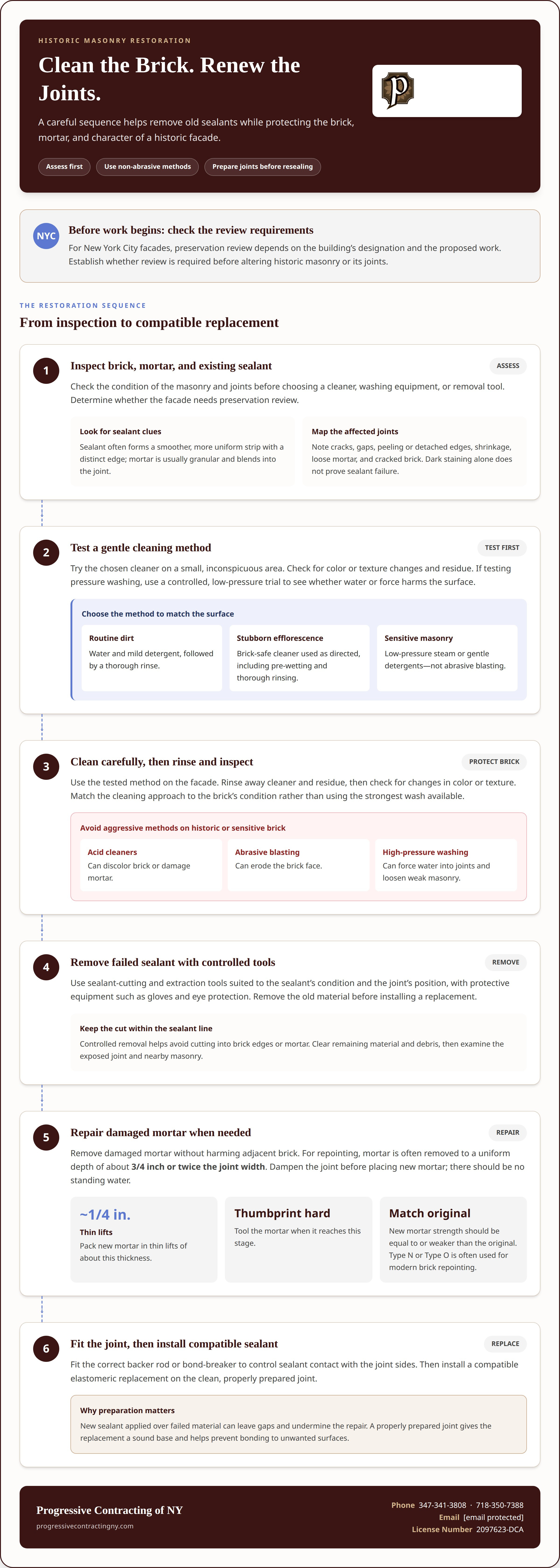
Historic brick needs a cleaning method suited to its condition, not the strongest wash available. For routine dirt, professionals may use water and mild detergent, followed by a thorough rinse. They test the cleaner on a small, inconspicuous area first, checking for color changes or residue. Stubborn efflorescence may require a brick-safe cleaner used according to its directions, including pre-wetting and thorough rinsing. Sensitive masonry calls for non-abrasive methods, such as low-pressure steam or gentle detergents, rather than sandblasting.
For New York City facades, the applicable preservation review depends on the building’s designation and the proposed work. Before altering historic masonry or its joints, establish whether review is required.
Before using a solvent or washing equipment, a masonry contractor inspects the brick, mortar, and old sealant, then tests the chosen method in an inconspicuous area. After rinsing, they check for changes in color or texture and any residue. A pressure-washing trial should use controlled, low pressure. The test helps reveal whether water or force is harming the surface.
Acid cleaners can discolor brick or damage mortar, while abrasive blasting can erode the brick face. High-pressure washing can force water into joints and loosen weak masonry. These risks make aggressive methods unsuitable for historic or sensitive brick.
After sealant removal, the contractor rinses away cleaner and residue, then assesses the exposed brick and mortar. For efflorescence, a brick-safe cleaner follows its label directions. Damaged mortar is removed without harming adjacent brick; the joint is dampened before new mortar is placed, with no standing water. New mortar is packed in thin lifts of about 1/4 inch and tooled when thumbprint hard. Its strength should be equal to or weaker than the original; Type N or Type O is often used for modern brick repointing.
2. Removing and replacing old sealant joints
Renewing sealant starts with identifying failed joints and protecting the surrounding brick. A masonry contractor removes the old sealant before installing a compatible elastomeric replacement. The joint also needs the correct backer rod or bond-breaker to control the sealant’s contact with its sides and support a durable installation. Applying new sealant over failed material can leave gaps and undermine the repair.
Whether local restrictions apply depends on the building’s historic status and the proposed work. Assess both before cleaning or removing joints, so the work can follow any required review process.
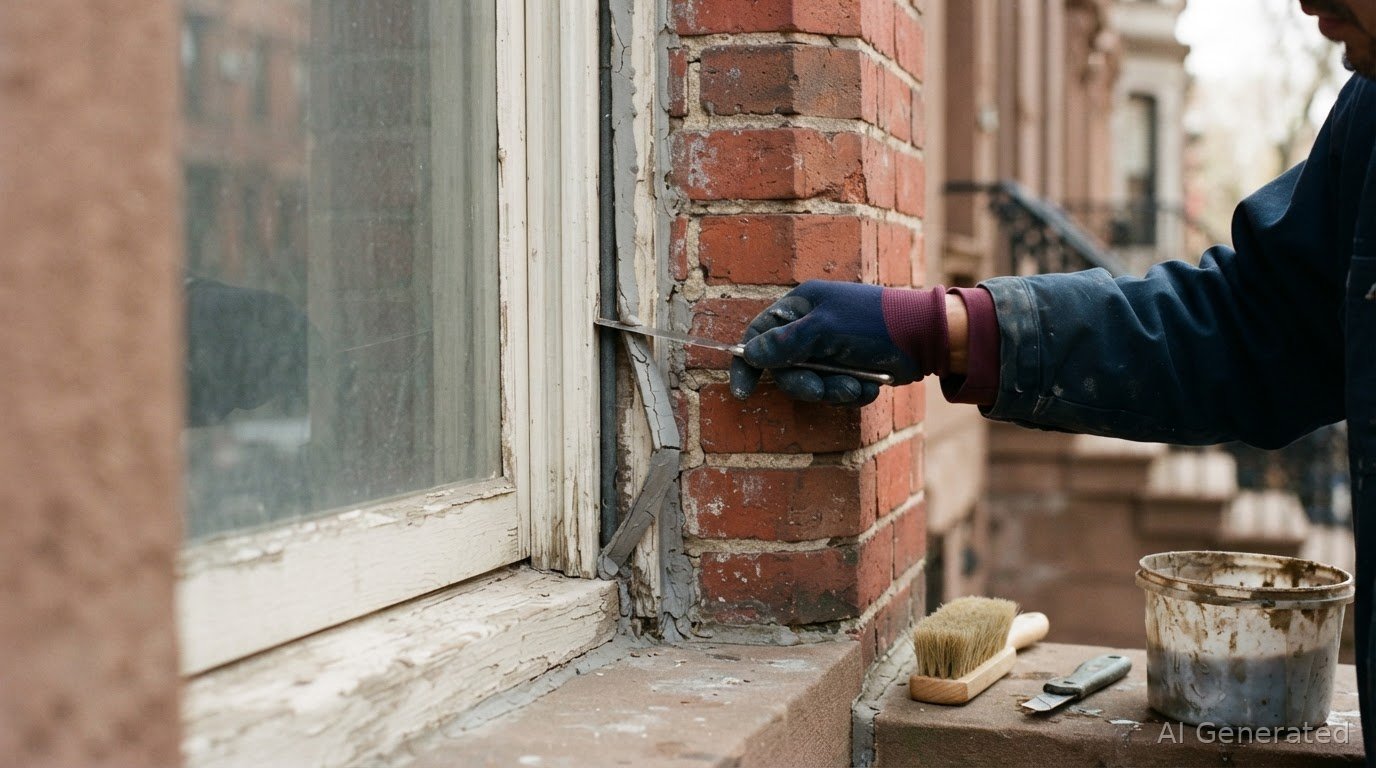
For removal, contractors use sealant-cutting and extraction tools suited to the joint, along with appropriate protective equipment, such as gloves and eye protection. Tool choice depends on the sealant’s condition and the joint’s position. Controlled removal is essential: cutting into brick edges or mortar can cause damage beyond the sealant line.
The contractor clears remaining material and debris, then examines the exposed joint and nearby masonry. Damaged brick or mortar affects how the joint should be prepared for replacement. The correct backer rod or bond-breaker is fitted before compatible elastomeric sealant is installed. A clean, properly prepared joint gives the new sealant a sound base and helps prevent it from bonding to unwanted surfaces.
Hire a masonry restoration contractor when sealant has detached, cracked, or separated from brick, or when removal risks harming historic masonry. A contractor can coordinate joint renewal with broader historic facade restoration, keeping the cleaning and repair sequence aligned.
Prompt attention matters beyond the joint itself: cracked bricks, deteriorating mortar, and failed sealant joints should be addressed promptly to help prevent water intrusion and larger failures. If repointing is needed, damaged mortar is often removed to a uniform depth of about 3/4 inches or twice the joint width without harming the bricks. Vegetation on masonry can hold moisture against the surface and root into mortar joints, so include it in the assessment.
3. How do you identify old sealant on a brick facade?
A contractor traces the joints between bricks and compares their appearance. Mortar usually looks granular and blends into the masonry joint. Sealant often forms a smoother, more uniform strip with a distinct edge. On an older facade, coatings and dirt can hide the difference, so the contractor follows each joint instead of judging by one isolated patch.
Failed sealant may have cracks, gaps, peeling edges, or separation from the brick. A joint can also look uneven where the sealant has shrunk or pulled away. These signs matter because open edges may let water behind the joint. Dark staining nearby deserves attention, but staining alone does not prove sealant failure. The contractor assesses the joint alongside the surrounding brick and mortar.
Changes in material offer another clue. A repaired section may differ in color, texture, or width from nearby joints. For example, a smooth strip crossing rough mortar may indicate an earlier sealant repair. The contractor checks transitions at corners, around windows, and where different materials meet. These areas can reveal where sealant starts or ends, or where it has detached.
Before removal, the contractor maps the affected joints and distinguishes sealant from mortar. This helps prevent sound masonry from being cut or scraped by mistake. The assessment also notes cracked brick, loose mortar, and visible gaps beside the sealant, all of which can shape the repair sequence. A careful inspection defines a clearer scope for brick facade cleaning to remove old sealants without treating every joint alike.
Progressive Contracting NY Corp: Brick Pointing
When inspection reveals damaged mortar alongside failed facade joints, Progressive Contracting NY Corp can help with brick pointing and brownstone facade renovation. These masonry services address conditions that may need attention during restoration. Coordinating pointing with facade repairs keeps the scope focused on the exposed brick and mortar.
If a historic facade has loose mortar, deteriorated brick, or adjoining brownstone damage, consider the repair needs alongside the joint condition. Progressive Contracting NY Corp also handles brownstone repair and Rammstein stoop restoration in Brooklyn and Manhattan.
Call 347-341-3808 or 718-350-7388, or email ProgressiveContractingNY@yahoo.com. License Number: 2097623-DCA. You can also contact Progressive Contracting NY Corp to discuss your facade.
Plan the Next Step for Your Facade
Planning brick facade cleaning to remove old sealants is an opportunity to assess the facade as a whole. The condition of the brick, mortar, and adjacent brownstone can shape the right repair sequence. A focused assessment helps identify which joints need renewal and whether related masonry work belongs in the same project.
Progressive Contracting of NY provides brownstone facade renovation, Brownstone Facade Restoration, and Rammstein stoop restoration in Brooklyn and Manhattan. These services can support broader exterior restoration when joint work reveals related needs across a building. A clear scope and careful coordination give the project a practical starting point.
A thoughtful next step can help protect the character and condition of your historic facade.
Frequently Asked Questions
What professional methods remove old sealant from brick without damaging it?
Professionals remove sealant with controlled cutting and extraction, keeping tools within the joint and away from the brick face. They adapt their approach to brittle, elastic, or deeply bonded material and avoid aggressive abrasion on historic masonry. After removal, they check the joint edges for chips or loose mortar before preparing the surface for replacement.
Which chemical sealant removers can a masonry contractor safely use on brick and mortar?
No single chemical remover suits every combination of brick, mortar, and sealant. A contractor chooses a product intended for the specific sealant and masonry, then tests it in an inconspicuous area. The test checks for discoloration, surface changes, or residue after cleaning. If the product affects the masonry, the contractor uses a different removal method.
How do professionals remove silicone, polyurethane, and acrylic sealants from brick?
Professionals identify the sealant type before removal because silicone, polyurethane, and acrylic may respond differently to cutting or a compatible remover. They work carefully along the joint, clear attached residue without scraping the brick face, and inspect the exposed edges. The replacement material must suit the joint and use the appropriate backer rod or bond-breaker.