
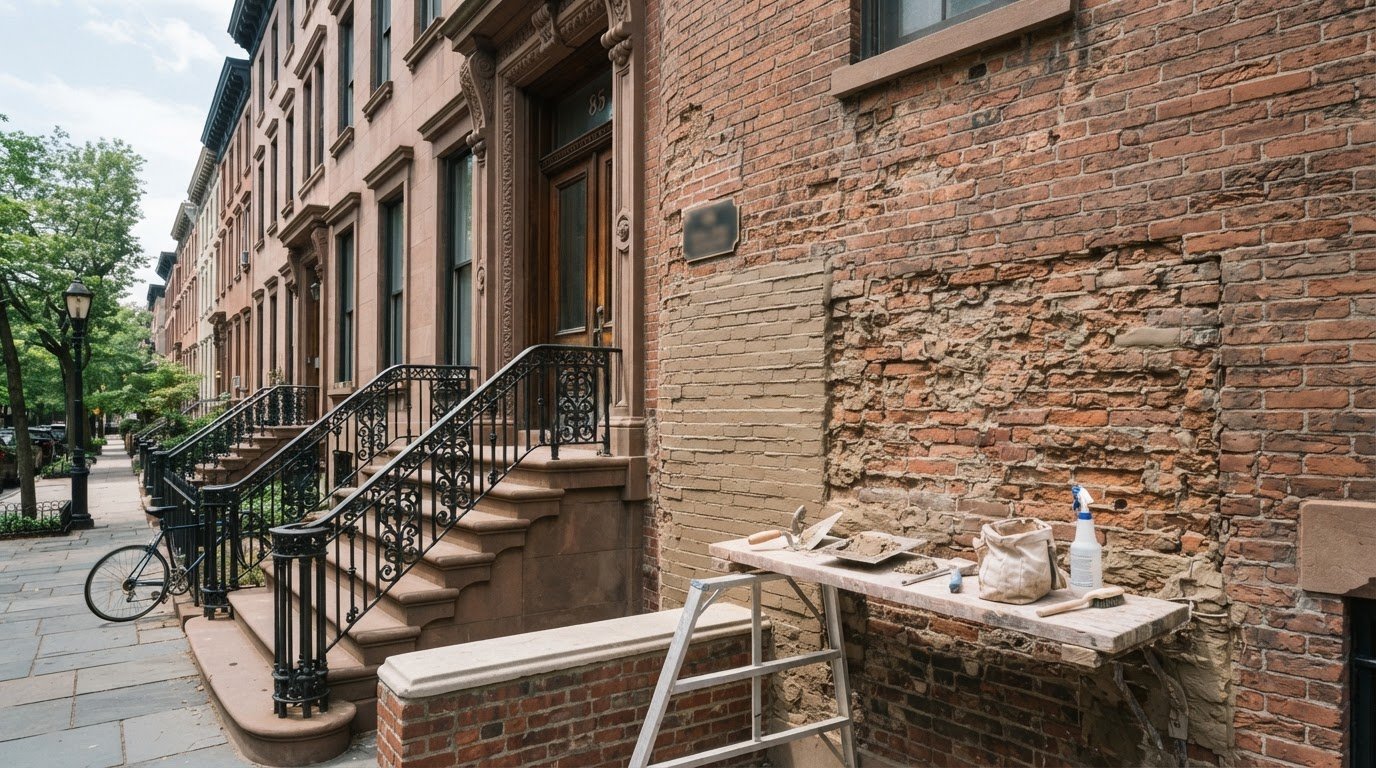
A Brooklyn brick facade doesn’t follow a fixed repointing calendar. Repointing a historic brick facade in Brooklyn is typically needed every 20 to 40 years, but cracking, crumbling, or eroding mortar can mean the work is due sooner. The right interval depends on the mortar’s condition and how well it protects the brick from moisture.
It makes sense to look beyond the joints themselves, especially on a Brooklyn Heights facade, where historic brick and brownstone details call for careful material matching. This article explains what signs point to repointing, what affects project costs, and why compatible mortar matters for older masonry. Project pricing depends on the case and is provided after a quote request; access needs, the extent of deterioration, and historic mortar matching affect the work involved.
Table of Contents
How Often Should Brick Be Repointed in Brooklyn?
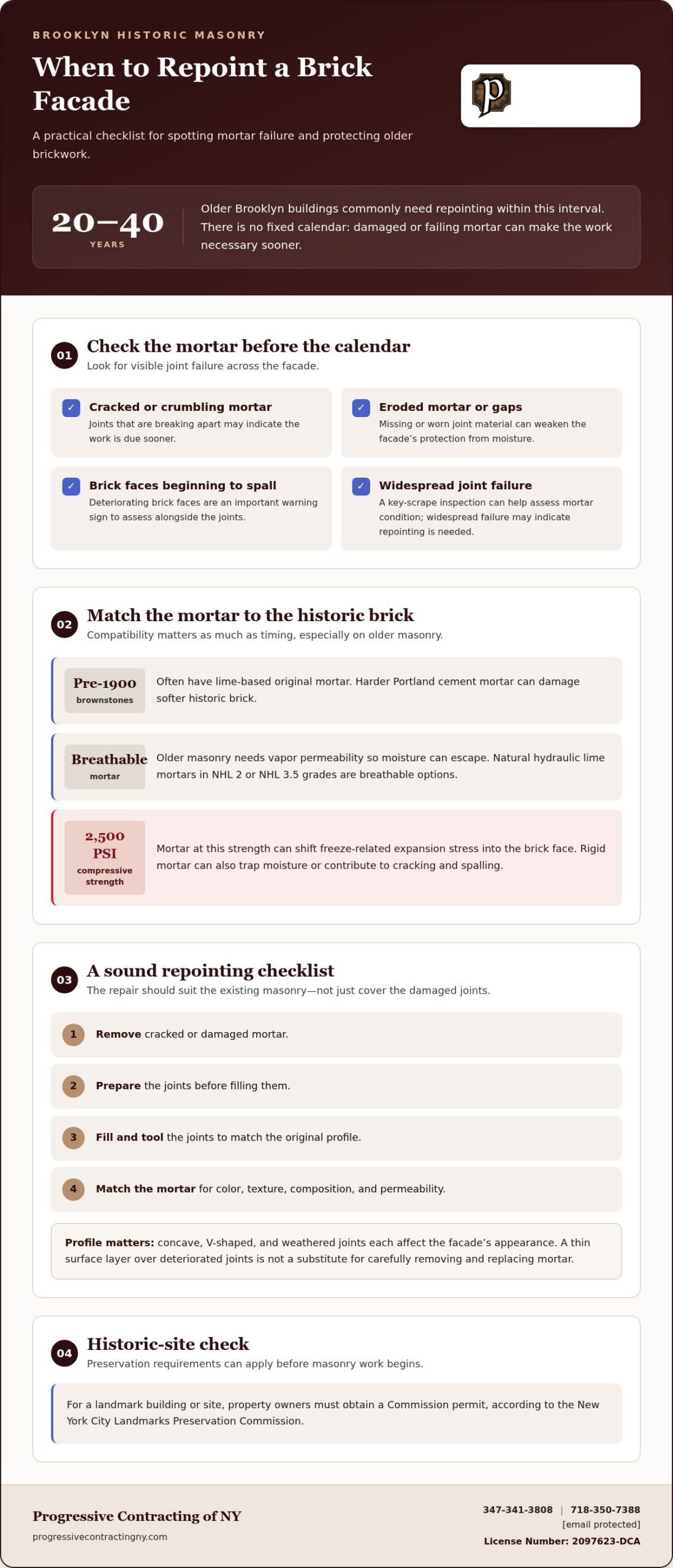
Older Brooklyn buildings commonly need repointing every 20 to 40 years, but visible joint failure can bring that work forward. A key-scrape inspection can help assess mortar condition, and widespread joint failure may indicate that repointing is needed. Look for cracked, crumbling, or eroded mortar, gaps, and brick faces beginning to spall.
For repointing a historic brick facade in Brooklyn, mortar compatibility matters as much as timing. Pre-1900 brownstones often have lime-based original mortar, and harder Portland cement mortar can damage softer historic brick. Older masonry needs vapor permeability so moisture can escape. Natural hydraulic lime mortars in NHL 2 or NHL 3.5 grades offer a breathable option; mortar with compressive strength of 2,500 PSI can shift freeze-related expansion stress into the brick face.
Repointing involves removing cracked or damaged mortar, preparing the joints, then filling and tooling them to match the original profile. A concave, V-shaped, or weathered joint changes the facade’s appearance. A compatible mortar mix can also be selected to match the original color, texture, composition, and permeability. These details support durable restoration while preserving the character of Brooklyn Heights properties.
Incorrect repointing can cause soft brick to crack, deteriorate, or spall if rigid mortar traps moisture or shifts stress into the brick. For a landmark building or site, property owners must obtain a Commission permit, according to the New York City Landmarks Preservation Commission.
When choosing a historic masonry contractor in Brooklyn, look for experience assessing original mortar and matching its permeability, texture, and joint profile. A sound approach includes carefully removing and replacing mortar that suits the existing brick, rather than covering deteriorated joints with a thin surface layer.
Brooklyn brick pointing and repointing costs
A cost estimate starts with the work area: a small ground-level patch differs from repointing an entire facade. The project price depends on the case and is provided after a quote request; the damaged area, access, mortar matching, and sidewalk protection shape the estimate. Measuring the affected masonry helps distinguish a limited repair from broader restoration.
Access can substantially change the scope. A ground-floor wall allows direct access, while a facade three or more stories high may require scaffolding and added site protection. In Brooklyn neighborhoods with narrow sidewalks or busy apartment entrances, planning must also account for pedestrian access and building use. These conditions affect labor and setup, not just the quantity of mortar.
Historic brickwork adds material considerations. Matching lime-based mortar to existing color, texture, and strength takes more care than using a standard mix. A 2,500-square-foot brownstone facade, for example, requires an assessment of joint condition across the full surface, plus review of parapets, corners, and areas exposed to weather. A written scope should separate those areas clearly.
Compare estimates by checking whether they specify mortar removal and replacement, joint finishing, access equipment, and protection. A parapet repair is not directly comparable to ground-level brick pointing because height changes access and safety planning. For an occupied apartment, ask how the work sequence will account for entrances and daily movement. Clear line items make differences in scope easier to understand and keep the restoration plan focused on the building’s needs.
Historic Brooklyn Heights brick and brownstone facades
Brooklyn Heights preserves buildings from different architectural periods, so a facade’s brickwork is not interchangeable. Some Federal-style houses dating to the 1820s use Flemish bond, with the short and long brick faces alternating. Plain running bond became common as Greek Revival spread through Brooklyn from the 1830s through the 1850s. Those patterns are part of each building’s character, not simply decoration.
Brick appearance also changed over time. During the last quarter of the 19th century, Brooklyn builders used a wider range of colors, textures, shapes, and patterns. In the 1890s, dark red, brown, orange, and yellow brick shaped streetscapes; paler gray and cream shades followed. Early 20th-century buildings added variegated brick and decorative clinker bricks. A repair that ignores these variations can leave an obvious patch across an otherwise unified facade.
Assess each elevation and its original details before planning repairs. A contractor should consider brick color, bond pattern, joint profile, and the boundary between brick and brownstone. Park Slope brownstones may share historic masonry concerns, but each facade has details that need to be assessed individually. Matching the existing composition helps protect both appearance and structural performance.
Brooklyn Heights is a protected historic district. Property owners must obtain a Commission permit for work on a landmark building or site, according to the New York City Landmarks Preservation Commission. That preservation review makes material choice and a documented repair scope especially relevant before work begins.
Explore historic facade project details
Progressive Contracting NY Corp: Brownstone facade renovation
Progressive Contracting NY Corp provides brownstone facade renovation and brick pointing for Brooklyn properties with deteriorating mortar or damaged facade details. Turn to the team when an inspection reveals crumbling joints, moisture exposure, or repairs that need to preserve the building’s existing character. For historic homes, the work addresses masonry condition while respecting the facade’s materials and appearance.
If the project includes a brownstone stoop, Progressive Contracting NY Corp also provides brownstone stoop restoration. A clear project scope connects visible damage with the appropriate exterior repair, whether the concern is brick joints, brownstone surfaces, or both.
Contact Progressive Contracting NY Corp at 347-341-3808 or 718-350-7388, email ProgressiveContractingNY@yahoo.com, or reference License Number 2097623-DCA to discuss your facade project.
Plan the next step for your facade
Repointing a historic brick facade in Brooklyn can prompt a broader look at the property. Consider whether adjacent brownstone surfaces or the stoop need attention too, so the work can be planned with the facade as a whole in mind.
Progressive Contracting NY Corp provides comprehensive brownstone facade renovation and specialized stoop restoration services. These services address distinct exterior elements, offering a practical path when brickwork sits alongside worn brownstone or stoop features. A clear project discussion helps define which surfaces need restoration and how the work can fit the building’s existing character.
Thoughtful planning helps protect the details that make Brooklyn homes distinctive.
Frequently Asked Questions
How Repointing Helps in Improving Structural Integrity?
Sound mortar joints help hold masonry units together and distribute loads evenly through a wall. Repointing can restore that connection when joints have deteriorated, helping reduce the risk of loose or displaced bricks. It does not correct foundation movement or other underlying structural problems, so cracks that cross bricks or continue to widen need broader assessment.
What Is Brick Pointing, Exactly?
Brick pointing is the mortar work that fills and finishes the joints between bricks. It shapes the joint surface and closes gaps that could let water enter the wall. For example, a mason may finish a joint with a concave profile to shed water and create a consistent appearance. Repointing refers specifically to renewing mortar in existing masonry.
What is repointing historic brick masonry, and how is it different from tuckpointing?
Repointing removes deteriorated mortar from existing brick joints and replaces it with new mortar. Tuckpointing can describe a decorative finish that uses a narrow contrasting line to create the appearance of especially fine joints. Because the terms are sometimes used loosely, a project description should clarify whether it covers mortar replacement, decorative joint treatment, or both.
How do you assess whether a historic brick facade in Brooklyn needs repointing?
Assess the facade systematically instead of judging it by one conspicuous crack. Examine each elevation, then look closely around window openings, sills, corners, and parapets, where water exposure and movement can differ. Record recurring gaps, loose mortar, or staining with location-specific photos. A pattern across several areas may indicate a broader issue than one isolated damaged joint.
What mortar types and mixes are appropriate for historic brick buildings in Brooklyn?
The right mortar mix depends on the existing brick and mortar, not simply the building’s age or facade color. A mortar sample can help identify aggregate and binder characteristics, while a small test panel lets homeowners compare the proposed mix’s cured color, texture, and joint finish. This review helps avoid a visually mismatched repair and supports compatibility with the masonry.