
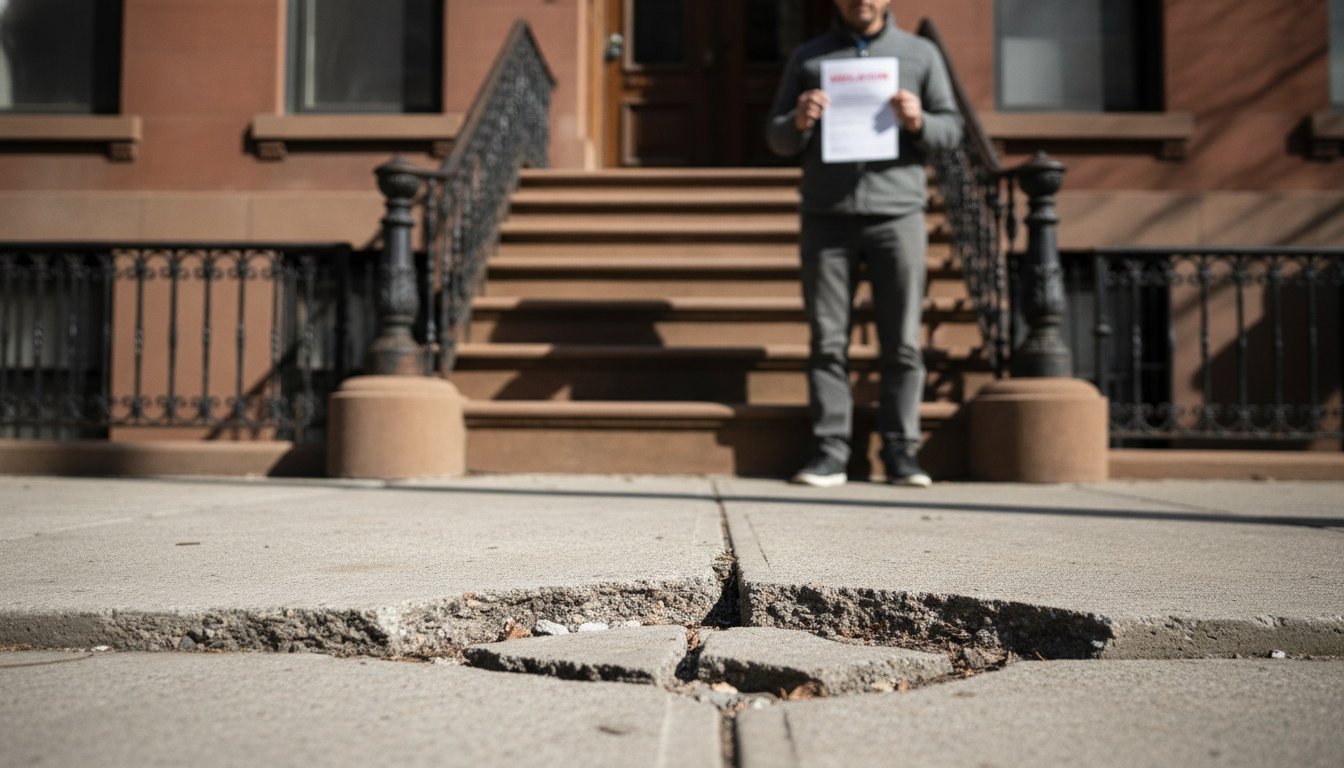
A NYC Department of Transportation sidewalk violation is not actually a fine, but it acts as a legal “cloud” on your property title that can stall a sale or refinance. Many owners feel an immediate sense of dread when they receive this paperwork, often struggling to understand how to read a sidewalk violation notice amidst the technical jargon and complex codes. We know that deciphering city bureaucracy feels like learning a second language, especially when you are facing a strict 75-day window to complete repairs before the City steps in with their own, often more expensive, contractors.
This guide will help you decode your notice, identify specific defects like hardware trips or collapsed flags, and understand the exact steps required for compliance. You will learn how to navigate the permit process and secure an official dismissal to protect your property’s value. If you have questions about a notice you just received, Progressive Contracting of NY is here to help at 347-341-3808 or 718-350-7388. You can also reach us at ProgressiveContractingNY@yahoo.com for a professional review of your sidewalk’s condition. We will walk through the timeline, the 4000 PSI concrete requirements, and the final inspection process to ensure your record is cleared.
Anatomy of an NYC DOT Sidewalk Violation Notice
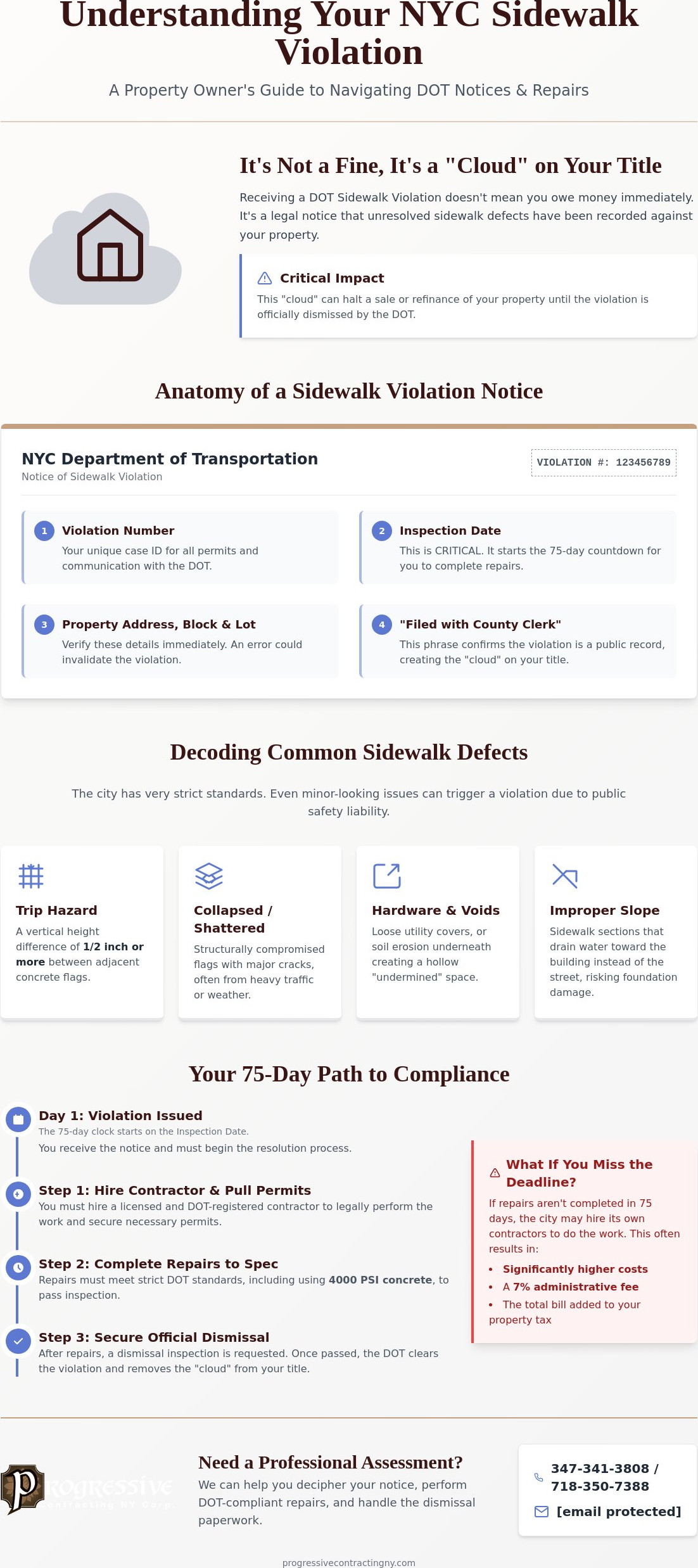
The document you received in the mail is a formal legal notice, but it is not an immediate bill. Understanding how to read a sidewalk violation notice starts with the header. This “Notice of Violation” serves as an official warning that your sidewalk failed a physical inspection. The legal burden for these repairs shifted to property owners largely due to the advocacy of the Big Apple Pothole and Sidewalk Protection Committee, which pushed for clearer liability standards. Because of this, the City tracks these issues against the land itself using the Block and Lot number rather than your name. If the Block or Lot is incorrect, the violation may be invalid, so verify these numbers against your deed immediately.
The Inspection Date is perhaps the most critical detail on the page. This date triggers a 75-day compliance window. If you don’t complete the necessary repairs within this timeframe, the City reserves the right to perform the work itself. This often results in significantly higher costs and administrative fees added to your property tax bill. Seeing the phrase “filed with the County Clerk” means the violation is now a matter of public record. It acts as a cloud on your title, meaning you cannot easily sell or refinance your home until the DOT issues a dismissal.
Key Information Fields to Check First
Locate the Violation Number at the top of the form. You’ll need this for every permit application and correspondence with the DOT. Next, double check the Property Address. It’s a common error for inspectors to tag the wrong lot, especially in areas with dense housing. If the address is wrong, you should contact the DOT to dispute the filing before the 75-day clock expires.
Why the County Clerk Filing Matters
An open violation is more than a repair list; it’s a financial hurdle. Banks and buyers typically refuse to move forward with a transaction if they see an unresolved filing. Progressive Contracting helps owners clear these records by performing repairs to DOT specifications and handling the dismissal paperwork. If you need help deciphering your notice, call us at 347-341-3808 or 718-350-7388. You can also send a scan of your notice to ProgressiveContractingNY@yahoo.com for a professional assessment.
Decoding DOT Defects: What the Inspector Found
The physical inspection report identifies specific structural failures that the City deems hazardous. Learning how to read a sidewalk violation notice involves looking past the legal language to the “Defect” column on your paperwork. The DOT uses a standardized set of criteria to determine if a sidewalk flag is safe for public use. You can find more detail on these specific standards through the NYC Sidewalk Violation and Repair Process portal. Common defects cited by inspectors include:
- Trip Hazards: Any vertical grade change of 1/2 inch or more between adjacent concrete flags.
- Collapsed or Shattered Flags: Structural cracks that compromise the entire flag, often caused by heavy vehicle traffic or severe weather cycles.
- Hardware and Voids: Loose coal hole covers or “undermined” conditions where soil has washed away beneath the concrete surface.
- Improper Slope: Sections that drain water toward the building foundation instead of the street gutter, which can lead to basement flooding.
The 1-Inch and 1/2-Inch Rules
The City’s tolerance for sidewalk damage is surprisingly low. A single hole just 1 inch in diameter can trigger a full violation. Similarly, even a slight 1/2-inch raise in a concrete flag is considered a significant liability. These small measurements matter because they are the leading causes of trip and fall incidents in NYC. If you aren’t sure if your sidewalk meets these standards, our team can provide a professional assessment to help you avoid city penalties.
Priority Repairs vs. Cosmetic Issues
Not every crack results in a violation. Minor hairline cracks are often considered cosmetic and might be ignored by an inspector. However, structural failures like “sunk” flags or “shattered” concrete require an immediate sidewalk repair. To see exactly which areas were flagged, look at the inspector’s map usually attached to the back of the notice. This diagram shows exactly where the defects are located relative to your property line. If you need help interpreting this map, call Progressive Contracting of NY at 347-341-3808 or 718-350-7388. You can also email a copy of your notice to ProgressiveContractingNY@yahoo.com for a detailed review.
The 75-Day Window: Your Path to Compliance
The 75-day clock begins on the inspection date listed on your notice. Once you understand how to read a sidewalk violation notice, you must act quickly to avoid city-mandated repairs. This timeframe is governed by the NYC Administrative Code for sidewalks, specifically section 19-152. If you miss this deadline, the City can perform the repairs and bill you through the Department of Finance. These bills often exceed private contractor rates and include a 7% administrative fee. To protect your property’s value, follow a structured path to compliance.
The resolution process follows three essential steps. First, you must hire a DOT-registered contractor to pull the necessary permits. Second, the masonry work must be completed to strict city specifications, including a 4-inch concrete thickness and 4000 PSI strength. Finally, you must call 311 to schedule a dismissal inspection. The violation remains as a cloud on your title until this final step is completed and the DOT officially closes the case in their system.
Scheduling the Dismissal Inspection
A violation does not disappear automatically once the concrete is poured. You must proactively request a final walk-through to clear the record. During this inspection, the DOT official verifies that the work meets all safety standards. They check for several specific factors:
- Correct grading and slope toward the street gutter.
- Uniform concrete thickness and proper 4000 PSI quality.
- Clean expansion joints between the new and old flags.
- The removal of all previous trip hazards or hardware voids.
Hiring a Professional for NYC Compliance
Success depends on hiring a contractor who understands the technical nuances of sidewalk violation removal nyc. We handle the entire workflow, from permit acquisition to the final dismissal inspection. For a professional assessment of your property, contact Progressive Contracting of NY at 347-341-3808 or 718-350-7388. You can also email your notice to ProgressiveContractingNY@yahoo.com to start the process of clearing your property’s title and restoring your peace of mind.
Secure Your Property Title and Ensure Compliance
Understanding how to read a sidewalk violation notice is the first step in protecting your property from liens and city-mandated repair costs. These documents are formal warnings, and the 75-day window is your opportunity to maintain control over the restoration. Identifying defects early and hiring a specialist ensures the work meets all NYC DOT standards the first time.
Progressive Contracting of NY specializes in navigating the bureaucracy of sidewalk violation removal. We manage every phase of the project, including permit filing, masonry work to 4000 PSI standards, and the final dismissal inspection. If you have any questions about your notice or the required repairs, reach out to us at 347-341-3808 or 718-350-7388. You can also email us at ProgressiveContractingNY@yahoo.com for a detailed assessment of your property.
Don’t let a sidewalk notice stall your property plans or lead to inflated city bills. Taking decisive action today ensures your sidewalk is safe for the community and your property title remains clear for the future.
Frequently Asked Questions
Is a sidewalk violation the same as a fine?
A sidewalk violation is not a fine; it’s a formal notice that your sidewalk is defective and requires repair. Unlike a parking ticket, you don’t owe the City money immediately upon receiving the document. However, it acts as a “cloud” on your title until the work is completed and officially dismissed. If you have questions about your specific notice, email us at ProgressiveContractingNY@yahoo.com for a professional review.
How long does a sidewalk violation stay on my property record?
A violation remains on your property record indefinitely until you take action to remove it. It doesn’t expire with time. To clear the record, you must complete the repairs and pass a DOT dismissal inspection. This is why knowing how to read a sidewalk violation notice is vital for owners who plan to sell or refinance their property in the near future.
Can I repair the sidewalk myself to remove the violation?
You shouldn’t attempt to perform the repairs yourself because the work requires specific DOT permits and must meet strict structural standards. New concrete must be at least 4 inches thick and meet 4000 PSI requirements. Hiring a registered contractor ensures the work passes the final inspection. Contact Progressive Contracting of NY at 347-341-3808 or 718-350-7388 for professional masonry services and compliance guidance.
What happens if I ignore the NYC DOT sidewalk notice?
Ignoring the notice beyond the 75-day window allows the City to perform the repairs using its own contractors. They will bill you for the work, typically at a higher rate than private firms, and add a 7% administrative fee. Under 2026 regulations, failure to comply can also lead to civil penalties of up to $5,000. It’s much more cost-effective to handle the repair privately before the deadline passes.