
Could the very mortar holding your Fort Greene home together actually be the thing destroying its historic brickwork? Most owners of 19th-century rowhouses understand that maintaining a facade requires more than just a quick patch job. It’s stressful to watch crumbling joints lead to interior water damage, especially when you’re worried about hiring a contractor who might use modern, high-strength cement that causes old bricks to crack and spall. You need a solution that balances structural integrity with the strict requirements of the NYC Landmarks Preservation Commission (LPC).
This article explains why specialized brick pointing fort greene is essential for preserving the value and safety of your property. We’ll show you how to achieve a watertight facade that looks original and stays compliant with local historic district regulations. You’ll learn about the technical necessity of “soft” lime-based mortars, the process for securing LPC approval, and how to identify a masonry contractor with the local expertise to handle a complex restoration project correctly from the start. Protecting your home requires a disciplined approach, and understanding these fundamentals is the first step toward a successful project.
Key Takeaways
- Understand why specialized brick pointing fort greene is vital for preserving the structural integrity of 19th-century Greek Revival and Italianate homes.
- Learn the precise five-step restoration workflow, from hand-raking mortar joints to selecting historically accurate materials that prevent brick spalling.
- Find out how to meet NYC Landmarks Preservation Commission (LPC) requirements to ensure your facade remains compliant and aesthetically authentic.
- Get a practical checklist for vetting masonry contractors, including specific licensing and portfolio requirements for Brooklyn’s historic districts.
- Identify the signs of mortar failure early to prevent costly interior water damage and increase your property’s long-term market value.
What is Brick Pointing and Why Does Fort Greene Masonry Need It?
Brick pointing, technically known as repointing, is the systematic process of removing aged, weathered mortar from the joints between bricks and replacing it with fresh material. If you’re wondering What is Brick Pointing, it’s essentially the wall’s first line of defense against the elements. For those maintaining a historic home, brick pointing fort greene requires a deep understanding of 19th-century materials. The neighborhood’s architectural identity relies heavily on 19th-century Italianate and Greek Revival brickwork, which is far more delicate than modern construction.
To better understand the precision required for this task, watch this helpful video demonstrating the restoration process:
Water infiltration is the primary enemy of masonry in Brooklyn. When mortar joints fail, water enters the wall and expands during freeze-thaw cycles. This leads to spalling, where the face of the brick literally breaks off. In a properly constructed wall, the mortar is designed to be “sacrificial.” It’s softer than the brick, meaning it absorbs the stress of building movement and moisture first. When evaluating brick pointing fort greene homeowners should prioritize contractors who understand that mortar must be sacrificial to protect the more expensive brick units from structural instability.
Signs Your Fort Greene Home Needs Repointing
You can often spot early failure through a simple visual inspection. Look for crumbling mortar, vegetation growing in joints, or a hollow sound when you tap the wall. Use the “Penny Test” to check the depth of loss; if you can insert a penny into a joint and the depth exceeds 1/4 inch, the wall is likely compromised. Inside your home, keep an eye out for peeling paint or damp spots near windows and along the base of the facade.
The Dangers of Delayed Masonry Maintenance
Ignoring small cracks today creates massive expenses tomorrow. When joints are left open, water penetrates deep into the substrate, causing brick displacement and significant brownstone spalling. The financial trade-off is clear. A routine maintenance project is far more manageable than a full-scale facade reconstruction, which often costs ten times more than timely pointing. Addressing these issues early ensures your brownstone restoration remains a manageable investment rather than a structural emergency.
The Professional Brick Pointing Process: 5 Steps to Longevity
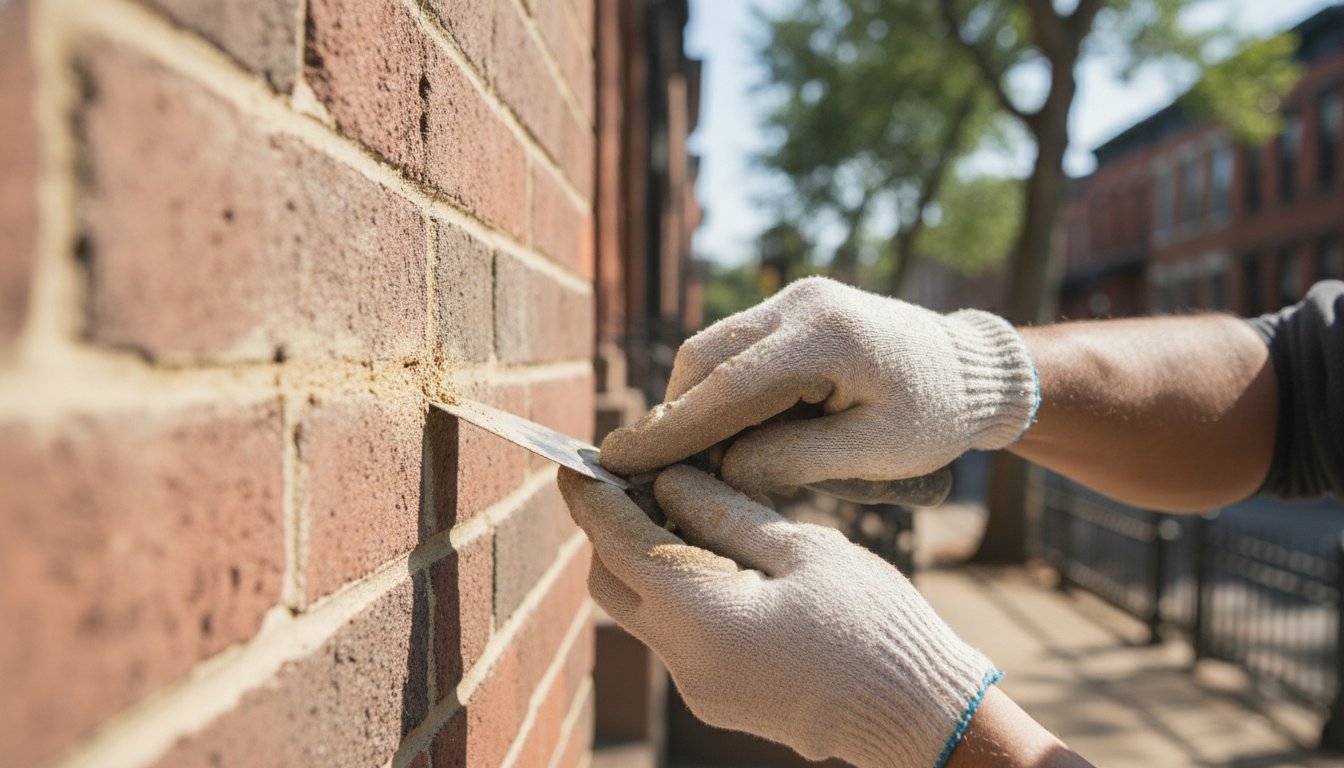
Effective brick pointing fort greene requires a methodical approach that respects the building’s age and material composition. The process begins with careful preparation. We remove damaged mortar to a precise depth, usually 3/4 inch, using hand tools or specialized low-impact grinders. This depth is critical because it provides enough space for the new mortar to grip the brick securely. Rushing this stage or using aggressive tools can permanently damage the edges of historic bricks.
Next, we clean the joints. Removing dust and debris ensures a strong mechanical bond between the old masonry and the new material. Without this step, even the highest quality mortar will eventually pull away from the wall. The Professional Brick Pointing Process dictates that the substrate must be damp but not saturated before application. This prevents the dry brick from sucking the moisture out of the new mortar too quickly, which would cause it to become brittle and crack.
We then apply the mortar in “lifts.” Instead of filling a deep joint all at once, we build it up in thin layers. This technique prevents shrinkage and ensures a dense, watertight finish. If you’re planning a brownstone facade renovation, this attention to detail is what separates a temporary fix from a decades-long solution. Each layer is allowed to reach a certain level of firmness before the next is applied, creating a unified and durable joint.
Mortar Matching for Historic Brooklyn Bricks
Matching mortar isn’t just about color; it’s about chemistry. Historic Fort Greene bricks are typically “soft” and require lime-based mortars. If a contractor uses modern Portland cement, the mortar becomes harder than the brick itself. When the building shifts or temperatures change, the hard mortar won’t give, causing the historic brick to crack or spall. Maintaining the visual continuity of brick pointing fort greene means using custom pigmenting to ensure new joints blend perfectly with the existing streetscape.
Tooling and Finishing Techniques
The final look depends on “tooling,” or shaping the joint profile. In Fort Greene, we often see concave, weathered, or flush joints that match the original 19th-century aesthetic. Once the mortar is thumbprint hard, we strike the joint to compact the material and seal the edges. We finish with a gentle wash to remove any mortar haze, leaving the brick face clean and the structural integrity restored. If you’re ready to secure your home’s exterior, you can request a detailed facade assessment from our team.

Choosing a Masonry Contractor in Fort Greene: A Homeowner’s Checklist
Selecting the right partner for brick pointing fort greene is a decision that impacts your property’s structural health for decades. You need a contractor who treats your facade as a historic artifact rather than a simple construction site. Start by verifying local expertise. A qualified contractor should provide a portfolio featuring successful projects on specific blocks in Fort Greene or Clinton Hill. This local experience ensures they understand the specific clay compositions and weathering patterns unique to this area’s 19th-century architecture.
Professional accountability is non-negotiable. Always verify that the contractor holds a current NYC Department of Buildings (DOB) license and carries comprehensive insurance, including general liability and workers’ compensation. This protects you from financial liability in the event of an accident. Additionally, insist on a transparent bidding process. A professional estimate must detail the exact square footage of the work, the specific mortar composition used, and the depth of the joint preparation. Avoid vague “lump sum” quotes that don’t specify materials.
Navigating the Landmarks Preservation Commission (LPC)
Because much of the neighborhood sits within the Fort Greene Historic District, most exterior work requires official approval. A permit is mandatory for any brick pointing that changes the appearance of the facade. A qualified Brooklyn masonry contractor simplifies this process by handling the LPC permit application for you. They understand how to submit mortar samples and mock-ups that comply with the 2025 LPC Permit Guidebook, ensuring your project doesn’t face costly delays or fines.
Questions to Ask During the On-Site Consultation
Use the on-site meeting to gauge the contractor’s technical discipline. Ask specifically what type of mortar they recommend for your brick type. If they suggest a high-strength Portland cement without mentioning lime-based alternatives, they likely don’t understand historic masonry. Inquire about their site protection plan. They should explain how they will protect your windows, air conditioning units, and neighboring properties from the dust generated during the grinding process. To ensure your restoration meets these high standards, book a comprehensive facade consultation with our specialists today.
Progressive Contracting NY Corp: Fort Greene’s Historic Restoration Specialists
Progressive Contracting NY Corp brings over a decade of hands-on experience to every brick pointing fort greene project. We recognize that Brooklyn’s historic districts require more than basic masonry; they demand a deep respect for 19th-century craftsmanship. Our team utilizes traditional materials and methods to ensure every repair aligns with the original integrity of your building. This grounded approach has established us as a reliable partner for homeowners who prioritize both structural durability and historical accuracy.
Our team provides a total envelope seal for your property. A facade remains vulnerable if you only address one component, so we examine the entire exterior. We don’t just fill joints; we address stoops, lintels, and sills to ensure water cannot find alternative paths into your home. This holistic strategy protects your investment and prevents the recurring cycles of damage that often plague poorly executed repairs.
Local accountability defines our service model at Progressive Contracting NY Corp. Because we live and work in the community, we maintain transparent and steady communication throughout the project’s lifecycle. You’ll work with a seasoned professional who understands the specific challenges of Fort Greene’s architecture. We manage every phase, from the initial assessment to the final cleanup, providing the peace of mind that comes from working with a disciplined expert.
Beyond Pointing: Comprehensive Exterior Solutions
Many restoration projects require a multi-faceted approach to achieve the best results. We often integrate brownstone facade renovation brooklyn with our brickwork services to create a unified aesthetic. This can include Rammstein stoop restoration to return your home’s entrance to its original grandeur. By coordinating these specialized services, we ensure that textures and colors remain consistent across your entire facade.
Get Your Fort Greene Masonry Assessment
Don’t wait for visible leaks to signal a problem. We recommend booking a professional masonry assessment before the winter freeze-thaw cycles begin. Identifying failing joints early allows for proactive maintenance that prevents the need for a full-scale reconstruction later. Our “master of the craft” approach ensures your home remains a neighborhood landmark for decades. Contact us today to secure your property’s future with expert brick pointing fort greene.
Secure the Future of Your Historic Facade
Maintaining the structural integrity of a Brooklyn rowhouse requires a disciplined approach to masonry. You’ve learned that using the correct lime-based mortar is essential to prevent permanent damage to historic bricks and that navigating LPC requirements is a critical step for any project in the district. Proactive maintenance doesn’t just stop water infiltration; it preserves the architectural heritage and market value of your home for the next generation.
Progressive Contracting provides the local expertise needed for precise brick pointing fort greene. As a fully licensed NYC Masonry Contractor specializing in Fort Greene Historic District restorations, we take the guesswork out of complex projects. We handle the technical details of mortar matching and the administrative hurdles of LPC permit navigation so you don’t have to. Our master of the craft approach ensures your home remains a neighborhood landmark.
Request a Professional Masonry Assessment from Progressive Contracting to ensure your facade remains watertight and historically accurate. We look forward to helping you protect your property with the meticulous attention to detail it deserves.
Frequently Asked Questions
How much does brick pointing cost in Fort Greene?
The cost of a project depends on the facade’s current condition, the building’s height, and the specific material requirements of the Landmarks Preservation Commission. Factors such as scaffolding permits and the depth of the existing mortar damage significantly influence the final estimate. A thorough on-site inspection is the only way to provide an accurate quote that accounts for the unique architectural details of your historic property.
How long does a typical brick pointing project take for a Brooklyn brownstone?
A standard facade project usually takes between one and three weeks to complete from start to finish. This timeline includes the preparation phase, layering the mortar in lifts, and the final cleaning process. Weather conditions and the complexity of the building’s ornamental details can extend this duration. We provide a clear schedule before work begins to ensure you know exactly what to expect throughout the restoration.
Can I do brick pointing myself or do I need a professional?
Professional expertise is essential for historic homes, especially those located within the Fort Greene Historic District. DIY attempts often involve incompatible mortars that can permanently damage old bricks. Hiring a specialist for brick pointing fort greene ensures the work meets NYC Landmarks Preservation Commission standards and preserves the building’s structural integrity. Professionals also have the specialized tools required for safe dust control and precise joint preparation.
What is the best time of year to perform masonry repairs in NYC?
Spring and autumn are the ideal seasons for masonry restoration in New York City. Mortar requires moderate temperatures, typically between 40 and 90 degrees Fahrenheit, to cure properly without cracking or becoming brittle. Performing repairs during these windows avoids the extreme heat of summer and the freezing temperatures of winter. Planning your project for these seasons ensures the most durable and watertight finish for your facade.
Will my new brick pointing match the rest of my historic facade?
Yes, we use custom mortar matching to ensure the new joints blend seamlessly with your existing masonry. This process involves analyzing the color, texture, and aggregate of the original material. For brick pointing fort greene projects, we often provide a physical mock-up for approval before proceeding with the full facade. This meticulous approach ensures that the repair is virtually indistinguishable from the historic streetscape while providing modern protection.