
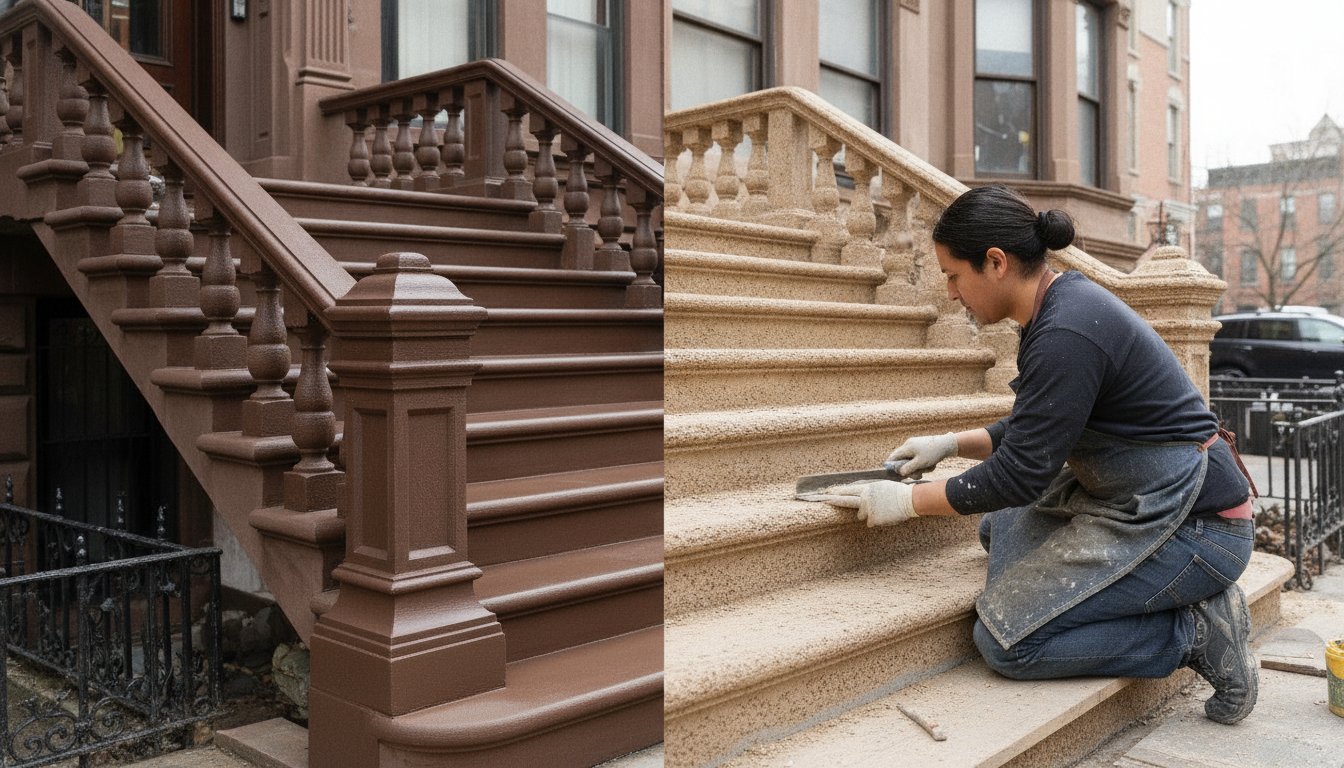
That standard cement patch you applied last year isn’t failing because of the weather; it’s failing because it was never designed to bond with 19th-century masonry. Most NYC brownstone owners have felt the frustration of watching a fresh coat of paint peel or seeing new cracks spiderweb across their steps just months after a repair. It’s exhausting to spend money on cosmetic fixes that simply don’t last while worrying about potential LPC violations and fines.
You need to understand what is Rammstein stoop restoration to break this cycle of constant maintenance. This specialized, multi-layered masonry process doesn’t just hide the damage. It restores your stoop to its historic glory with permanent results. By addressing the structural integrity of the stone rather than just the surface, we provide a solution that stands up to the elements and the scrutiny of landmark inspectors. It’s a disciplined approach to craftsmanship that prioritizes durability over a quick fix.
In this guide, we’ll explain how this structural re-skinning process works, why it’s the gold standard for landmark compliance, and how it protects your property’s curb appeal and long-term value.
Key Takeaways
- Learn what is Rammstein stoop restoration and how this multi-layered masonry technique provides a permanent solution for crumbling brownstone steps.
- Understand why precision demolition of failed previous repairs is necessary to reach a healthy stone core before applying new materials.
- Discover how the application of a cementitious scratch coat creates the mechanical bond needed for long-term structural integrity.
- See why a multi-layered approach handles New York’s freeze-thaw cycles more effectively than standard surface-level patches.
- Evaluate the long-term benefits of historical accuracy for both landmark compliance and your property’s overall market value.
Defining the Rammstein Stoop Restoration Method
Identifying what is Rammstein stoop restoration requires looking beyond the surface of your steps. While many homeowners opt for a quick cosmetic fix, this method is a comprehensive, multi-step masonry technique designed specifically for historic soft-stone facades. It prioritizes structural bonding over mere aesthetics. In neighborhoods like Park Slope, Bedstuy, and the Upper West Side, this approach has become the standard for preserving architectural integrity.
Standard “patch-and-paint” methods often fail within 12 to 24 months because they don’t account for the unique expansion and contraction of sandstone. This guide for NYC brownstone owners highlights how Rammstein restoration solves this by creating a permanent mechanical bond with the building’s core. It is a process that respects the material’s history while utilizing modern engineering to ensure the results last for decades.
To see the scale of precision and coordination required in complex projects, watch this time-lapse video:
The Origin of the Method
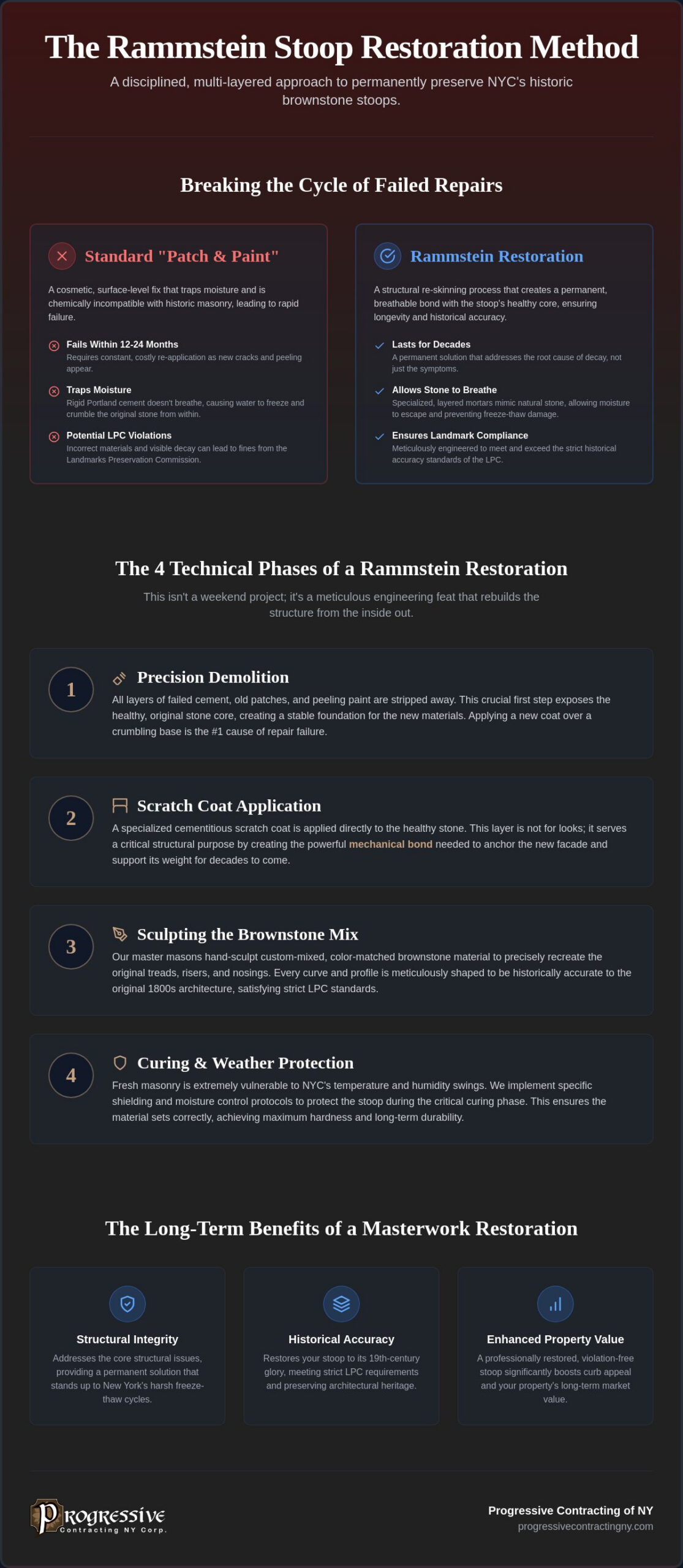
Historic masonry in New York relied on softer, breathable mortars. Modern Rammstein standards evolved to correct the damage caused by the mid-20th-century use of Portland cement. Portland cement is the primary enemy of historic brownstone because it is chemically incompatible. It is too rigid and non-porous, which traps moisture behind the patch. This moisture eventually freezes, causing the original stone to crumble and shear away. Rammstein techniques use specialized, breathable layers that mimic the natural properties of the stone.
Why “Rammstein”? Understanding the Reputation
In the masonry trade, the name “Rammstein” signals durability and precision engineering. It isn’t an official building code term, but it serves as a shorthand for a “masterwork” level of restoration that goes far beyond a simple repair. Rammstein is the industry benchmark for historic stoop longevity and structural reliability. Choosing this method means you are investing in a permanent solution rather than a temporary mask for underlying decay.
The Technical Phases of a Rammstein Restoration
Executing a Rammstein restoration involves a disciplined, sequential workflow. To fully grasp what is Rammstein stoop restoration, one must look at the four distinct phases of execution. This process isn’t about covering up problems; it’s about rebuilding the structure from the inside out to ensure it survives the harsh New York climate.
- Phase 1: Precision Demolition. We strip away every layer of failed cement and peeling paint to reach the healthy, original stone core. Applying new material over old, crumbling patches is the primary reason most standard repairs fail.
- Phase 2: Scratch Coat Application. Once we expose the healthy stone, we apply a cementitious scratch coat. This specialized layer creates the mechanical bond necessary to support the weight of the new facade.
- Phase 3: Sculpting the Brownstone Mix. Our masons hand-sculpt the mix to recreate treads and risers. We match the original 1800s profiles exactly, ensuring every curve is historically accurate.
- Phase 4: Curing and Weather Protection. NYC’s humidity and temperature swings can ruin fresh masonry. We use specific shielding and moisture controls to ensure the material sets correctly.
Understanding the technical phases of a Rammstein restoration helps property owners appreciate why this isn’t a weekend project. It is a meticulous engineering feat that requires time, patience, and specific environmental conditions to succeed.
Custom Mortar and Color Matching
Matching the specific hue and texture of Brooklyn brownstone is a science. We don’t use off-the-shelf products. Instead, we mix custom mortars that replicate the mineral composition of the original stone. Breathability is the most critical factor here. If the mortar is too dense, it traps water, leading to future spalling and water entrapment. For homeowners dealing with peeling surfaces, a professional brownstone repair consultation can identify the exact mortar mix required for your specific block.
LPC Standards and Historic Accuracy
The Rammstein method is specifically designed to satisfy the strict requirements of the Landmarks Preservation Commission (LPC). This goes beyond color. It includes profile matching, which is the exact reproduction of the stoop’s curved edges. When you understand what is Rammstein stoop restoration, you see it as a path to total landmark compliance. It ensures your property remains a protected piece of New York history while avoiding costly fines. This high level of precision is what differentiates a professional restoration from a temporary patch job.
Why Rammstein Restoration is the Standard for NYC Homes
Choosing a restoration method is a financial decision as much as an architectural one. When homeowners ask what is Rammstein stoop restoration, they are often looking for a way to stop the cycle of recurring repair costs. The multi-layered approach handles the aggressive freeze-thaw cycles of New York winters far better than simple brick pointing or surface patching. By creating a unified structural skin, the stoop expands and contracts as a single unit. This prevents the internal pressure that causes standard cement patches to pop off after just one season.
A perfectly restored stoop significantly impacts the appraisal of townhouses in Manhattan and Brooklyn. Curb appeal is the first detail a valuer or buyer sees. A crumbling entryway suggests underlying neglect, while a Rammstein finish signals a well-maintained, historically accurate property. This investment protects your equity and eliminates the liability of crumbling treads. Cracked steps are dangerous trip hazards that can lead to costly legal issues or Department of Transportation (DOT) sidewalk violations if debris spills onto the public walkway.
As a leading brownstone specialist, we ensure every project meets these high standards of safety and value. We focus on long-term stability rather than temporary cosmetic fixes.
Preventing Spalling and Water Infiltration
The Rammstein method creates a superior water-shedding surface. By directing moisture away from the porous core of the building, we protect the foundation from water infiltration. This technical precision is explored further in our Brownstone Stoop Restoration Brooklyn: The Complete Guide. Preventing spalling at the source is the only way to avoid deep structural decay over time. It keeps the stone dry and the interior of your home protected from dampness.
Choosing a Specialized Masonry Contractor
General contractors often lack the specific tools and custom mortar mixes required for a true Rammstein finish. They might use high-strength concrete that actually accelerates brownstone decay by trapping moisture. Truly understanding what is Rammstein stoop restoration requires a deep knowledge of local neighborhood architecture in Park Slope and Bedstuy. You need a partner who understands the local stone variations and the specific environmental stressors of your block. We bring that local expertise to every project, ensuring your home remains a landmark of the neighborhood for decades.
Secure Your Brownstone’s Structural Legacy
Restoring a historic stoop is more than a routine maintenance task; it’s a vital investment in your home’s longevity and value. By understanding what is Rammstein stoop restoration, you can finally move past the cycle of temporary patches and recurring cracks. This disciplined approach ensures your property stands up to the elements while meeting the rigorous aesthetic standards of the Landmarks Preservation Commission. A properly restored stoop provides peace of mind by eliminating trip hazards and preventing deep water infiltration into your building’s foundation.
We provide specialized expertise across Brooklyn and Manhattan historic districts, handling everything from LPC permit assistance to the final hand-tooled finish. Our process utilizes custom color-matched mortar mixes that respect the chemical composition of original sandstone. This level of precision is what makes a restoration permanent rather than just cosmetic. We take accountability for every layer of the project, ensuring your entryway reflects the historic character of your neighborhood.
Don’t let another winter season cause further decay to your masonry. Get a Professional Rammstein Stoop Evaluation to start your project with a reliable partner. Your brownstone is a piece of New York history, and we have the tools to preserve it for the next generation.
Frequently Asked Questions
How long does a Rammstein stoop restoration typically take in Brooklyn?
A typical project takes between two to four weeks to complete from the initial demolition to the final curing phase. This timeline depends heavily on the complexity of the original profiles and current weather conditions. Since the process requires specific temperature and humidity windows for the masonry to set correctly, we plan the schedule to ensure the structural integrity of each layer isn’t compromised by the elements.
Is Rammstein restoration more expensive than a standard cement patch?
The initial investment is higher than a cosmetic patch because it involves a total structural re-skinning of the masonry. When you consider what is Rammstein stoop restoration, you’re looking at a permanent solution rather than a temporary fix. Standard cement patches often fail within 12 to 24 months in New York’s climate, leading to recurring costs. Rammstein restoration eliminates this cycle by providing a durable finish that lasts for decades.
Do I need an LPC permit for Rammstein stoop restoration?
Yes, any exterior work on a brownstone within one of NYC’s 150 historic districts requires prior approval from the Landmarks Preservation Commission. New York City has more than 37,000 landmarked properties where compliance is strictly enforced. A Certificate of No Effect for minor repairs can take a few weeks for approval, while more significant alterations typically require four to twelve weeks for a full review. We help navigate these requirements to ensure your project meets all legal standards.
What happens if I ignore the crumbling on my brownstone stoop?
Ignoring the decay allows water to penetrate deep into the porous stone, which eventually leads to foundation damage and safety hazards. In 2023, the NYC Department of Buildings issued 127,000 violations, with 65% of them linked to maintenance failures. Beyond the risk of city fines, crumbling treads become trip hazards that increase your liability as a property owner. Addressing the issue early prevents the need for a more expensive full-scale facade restoration later.