
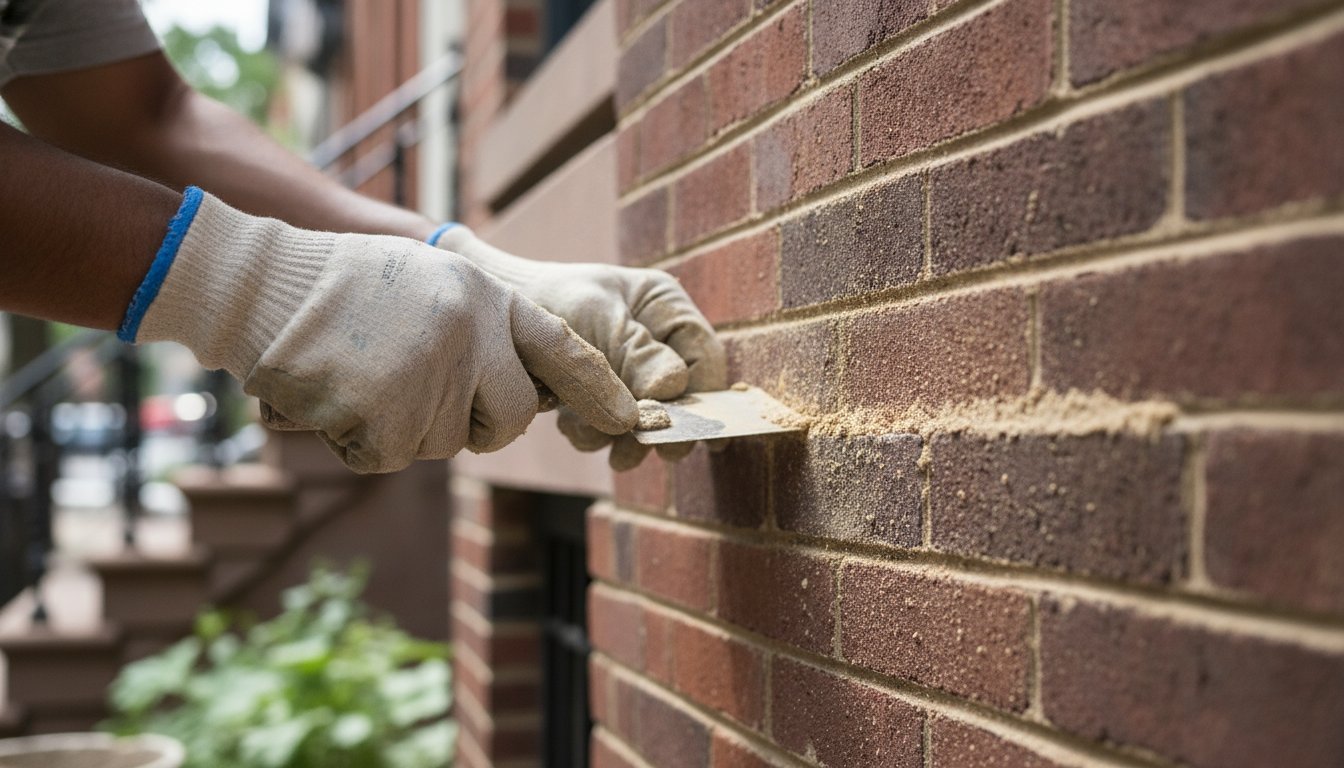
Most homeowners believe that the strongest, hardest mortar is the best choice for a crumbling facade. In reality, applying modern Portland cement to a 19th-century building is one of the fastest ways to destroy it. This “steel patch” traps moisture and eventually forces the face of your historic brick or brownstone to pop off. Finding the right approach to lime mortar repointing for historic homes nyc is not just about aesthetics; it’s about the physical survival of your property.
You want your home to be watertight and look its best, but the fear of choosing the wrong contractor or violating complex landmark regulations is a heavy burden. It’s stressful to watch your facade spall while wondering if a repair will cause permanent damage. This guide will show you why lime mortar is the only safe choice for NYC’s historic structures and how to avoid the destructive mistakes of modern masonry. We’ll preview the 2025 LPC permit requirements and the technical steps necessary to achieve a waterproof, breathable facade that preserves your home’s legacy and value.
Key Takeaways
- Understand the “sacrificial principle” and why mortar must be more permeable than masonry to protect historic brickwork from internal moisture.
- Learn the specific steps for lime mortar repointing for historic homes nyc to meet strict Landmarks Preservation Commission (LPC) standards for color and composition.
- Identify the risks of the “steel patch” effect, where hard modern cement causes irreversible surface damage to soft brownstone and brick.
- Distinguish between general masonry work and expert restoration to ensure your project uses the correct materials and traditional techniques.
The Science of Breathability: Why Lime Mortar is Essential for Historic NYC Masonry
Lime mortar is a traditional construction material composed of lime and sand. For centuries, masons used this simple mixture to build the world’s most enduring structures long before the invention of modern Portland cement. When performing lime mortar repointing for historic homes nyc, we prioritize the Science of Breathability. This characteristic allows moisture to migrate through the mortar joints instead of being forced through the face of the brick. Capillary action is the specific mechanism that draws liquid water out of historic brownstone and into the mortar joints where it can safely evaporate into the air.
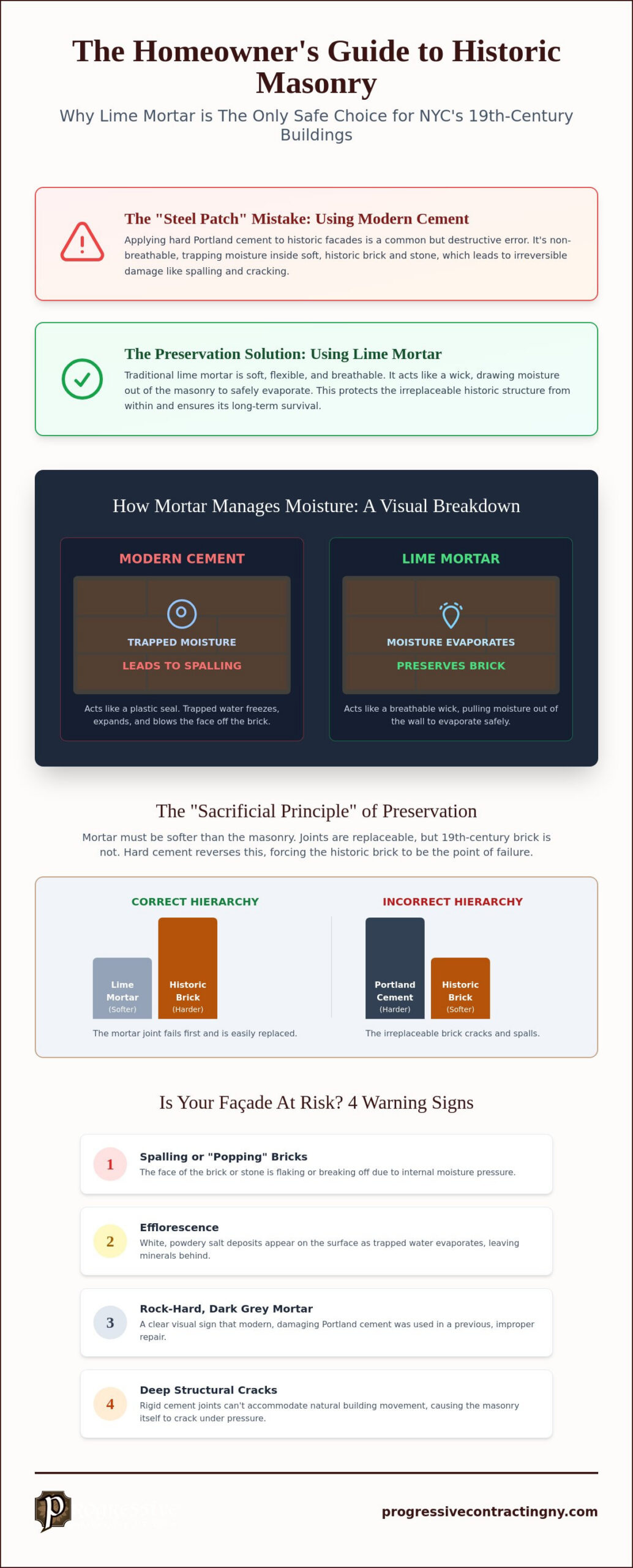
Modern cement acts like a plastic wrap, sealing the building and trapping moisture inside the walls. This leads to internal rot and structural instability over time. Lime mortar acts more like a wick. It manages water vapor effectively, ensuring that the interior of the masonry stays dry even after heavy NYC rainstorms. This vapor permeability is the primary reason why historic buildings have survived for over a century without the need for modern waterproofing chemicals.
To better understand how these materials work in practice, watch this helpful video:
The Sacrificial Principle in Historic Restoration
Mortar should always be softer and more permeable than the surrounding masonry. This is the “Sacrificial Principle.” We design the mortar to be the first part of the wall to fail because joints are replaceable, but 19th-century brick is not. When contractors use high-strength cement, they create a “reversed durability” situation. The mortar outlasts the brick, causing the soft historic masonry to crush itself against the rigid joints during natural settling or thermal cycles.
Flexible Joints and Building Movement
NYC’s climate creates significant thermal stress as buildings expand in the summer and contract in the winter. Rigid mortars cannot accommodate this movement, leading to deep structural cracks. Lime mortar offers a degree of elasticity that modern mixtures lack. It can even “self-heal” small fissures through a process called autogenous healing, where migrating moisture reacts with unhydrated lime to seal gaps. Using the correct mix for lime mortar repointing for historic homes nyc ensures the building moves without suffering structural damage. This flexibility is a core requirement for any successful brownstone facade renovation.
Portland Cement vs. Lime Mortar: Avoiding the “Steel Patch” on NYC Brownstones
Using modern Portland cement on a historic facade creates what preservationists call a “steel patch.” Because this material is much harder than 19th-century brick or brownstone, it turns the building material itself into the weakest link. When the structure naturally shifts, the rigid cement joints don’t budge. Instead, the pressure transfers to the soft historic units, causing them to crack or crush. This is why Expert Lime Mortar Repointing is required to maintain the structural integrity of your home.
The freeze-thaw cycle is the primary driver of damage in NYC. Modern cement is impermeable, meaning it traps water behind the joint. When winter temperatures drop, this trapped moisture freezes and expands. This pressure eventually “blows off” the face of the brick, a process known as spalling. It’s essential to distinguish between “pointing,” which is the aesthetic finish of the joint, and “repointing,” which involves the careful removal of old mortar and the structural renewal of the entire joint. For a complete Brownstone facade renovation, both aesthetic and structural needs must be balanced.
Identifying Spalling and Facade Crumbling
NYC homeowners should look for “popping” brick faces or white, powdery salt deposits known as efflorescence. These are clear signs that moisture is trapped within the wall. If you see dark grey, rock-hard mortar in your joints, it’s likely a modern mix that’s already causing damage. This material prevents the natural evaporation described in the previous section, leading to accelerated decay. Identifying these issues early allows for a more straightforward repair process.
The Hidden Costs of Modern Mortar Mixes
“Stronger” is not “better” in historic masonry. While a bag of standard cement is cheap, the financial risk of partial wall reconstruction is immense. Proper lime mortar repointing for historic homes nyc protects your investment by avoiding the catastrophic cost of replacing spalled brownstone or rebuilding structural brick piers. Investing in a Brownstone specialist ensures the job is done correctly the first time. If you suspect your home has been repaired with the wrong materials, you should seek a professional facade restoration assessment to prevent further structural loss.
Expert Lime Mortar Repointing: LPC Compliance and Aesthetic Matching
Restoration isn’t just about fixing cracks; it’s about following the law and respecting the history of your building. In New York City, the Landmarks Preservation Commission (LPC) has strict regulations for any exterior work. Current rules mandate that new mortar must match the original historic material in both physical and aesthetic characteristics. Following the NPS Preservation Brief on repointing historic masonry is the baseline for our work, ensuring that the mortar remains softer and more permeable than the stone or brick it protects.
Many homeowners hire a general masonry contractor for a quick fix, but neighborhoods like Bed-Stuy and Park Slope require a restoration specialist. A generalist often uses standard grey cement, which clashes with the rich, iron-oxide hues of NYC brownstone. Achieving a seamless look for lime mortar repointing for historic homes nyc requires custom blending. We focus on the unique pigments and aggregate sizes that define the 19th-century aesthetic, ensuring the repair is invisible to the naked eye.
Navigating NYC Landmarks Preservation Commission (LPC) Permits
If your home is in a historic district, you almost always need a permit for repointing. As of 2025, the LPC requires all permit applications to be submitted through Portico, their online portal. We handle the technical specifications and mortar analysis required for approval, preventing costly stop-work orders or violations. This level of compliance is equally critical for a Brownstone stoop restoration Brooklyn project, where the stoop and facade must present a unified, historically accurate appearance.
Custom Mortar Matching for Brooklyn and Manhattan Facades
We don’t use “off-the-shelf” products because they rarely match the texture or color of aged NYC masonry. Our process involves taking physical samples of the original mortar to analyze the sand grain size and pigment ratios. This precision prevents the patchy, mismatched look that ruins the character of a Rammstein stoop or a historic facade. By replicating the original mix, we ensure the structural and aesthetic integrity of your property for decades to come. To ensure your building remains a local landmark, Contact Progressive Contracting of NY for a specialist facade evaluation.
Protecting Your Home’s Legacy with Traditional Craftsmanship
Your historic property is a significant investment that requires a specialized approach to maintenance. We have detailed how breathable materials prevent the destructive “steel patch” effect and protect your facade from NYC’s harsh freeze-thaw cycles. Professional custom matching ensures your home remains LPC-compliant while maintaining its original 19th-century character. This methodical approach preserves both the structural integrity and the financial value of your building.
Executing lime mortar repointing for historic homes nyc correctly is the most vital step in preventing permanent masonry decay. Progressive Contracting brings disciplined expertise to Brooklyn and Manhattan landmarked properties. Our team specializes in Rammstein stoop restoration and uses custom mortar matching to achieve authentic brownstone preservation. We provide the steady hand and technical precision your project needs to succeed.
Request a Historic Facade Assessment from Progressive Contracting to ensure your restoration meets the highest standards of craftsmanship. With the right materials and a reliable partner, your home will continue to stand as a beautiful piece of New York history for another century.
Frequently Asked Questions
What is the difference between pointing and repointing?
Pointing is the visible outer layer or aesthetic finish of a mortar joint. Repointing is the structural process of removing old, decayed mortar to a depth of roughly one inch and replacing it with new material. While pointing is a surface-level cosmetic touch-up, repointing is a comprehensive restoration that ensures the masonry remains watertight and structurally stable for decades.
How do I know if my NYC home needs lime mortar specifically?
Your home requires lime mortar if it was built before 1930 using historic brick or brownstone. These materials are naturally soft and porous, meaning they must breathe to manage moisture effectively. Choosing lime mortar repointing for historic homes nyc ensures that the mortar remains the sacrificial element, preventing hard modern cement from trapping water and crushing your building’s irreplaceable masonry units.
Does lime mortar repointing require an LPC permit in Brooklyn?
Yes, almost all repointing projects within Brooklyn’s historic districts require a permit from the Landmarks Preservation Commission. The LPC mandates that new mortar matches the original historic mix in color, texture, and composition. Performing this work without an approved permit often results in stop-work orders and significant fines, so we handle the technical specifications and filing through the Portico portal for you.
How long does lime mortar take to cure compared to cement?
Lime mortar takes significantly longer to cure than modern Portland cement. While cement sets through a quick chemical reaction with water, lime mortar hardens through carbonation, which involves absorbing carbon dioxide from the air. This process can take several weeks or even months to reach full strength, requiring a disciplined approach to moisture management and protection from the elements during the initial setting phase.