
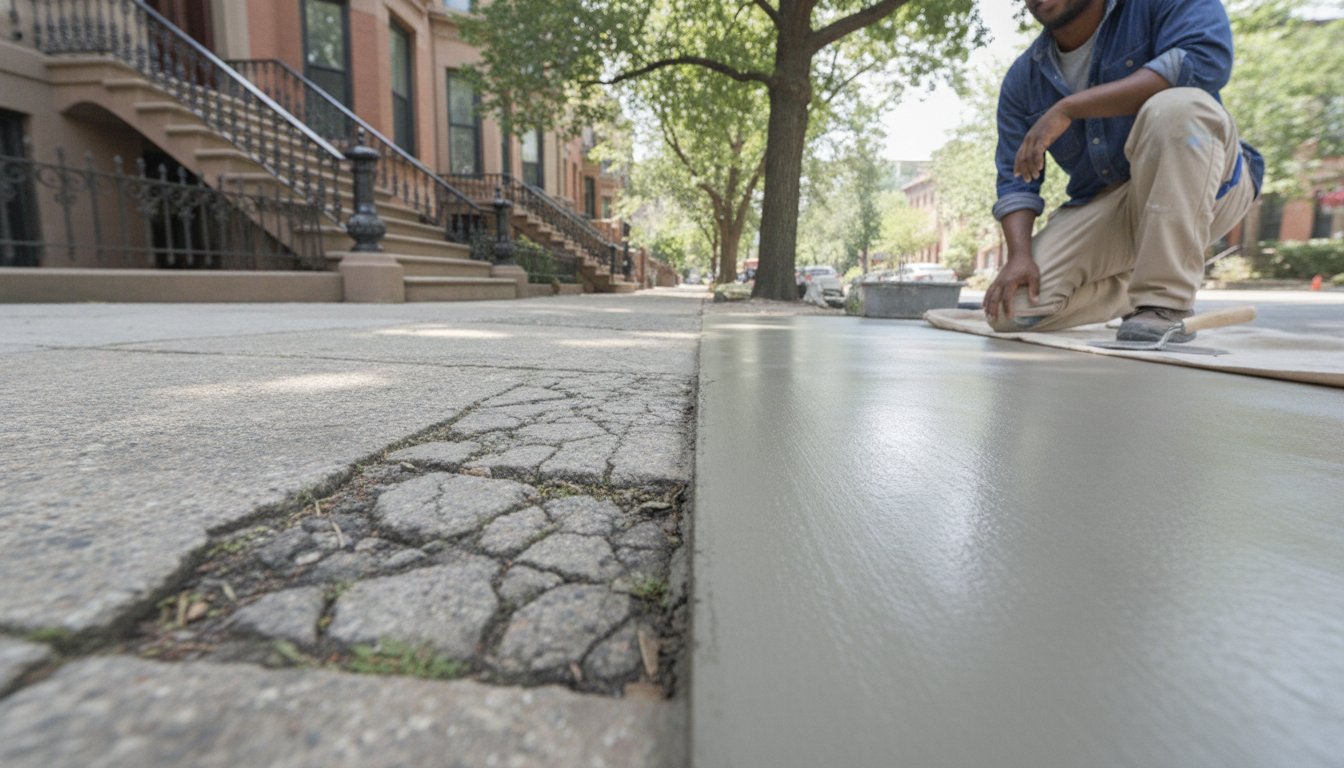
Brooklyn property owners currently hold the record for the highest number of DOT sidewalk violations across the entire city. Receiving that official notice often feels like a sudden weight on your property title, especially when you’re trying to maintain the character of a historic brownstone. If you’ve discovered a “Notice of Violation” on your property, you aren’t alone. Successfully handling a sidewalk repair brooklyn project requires more than just pouring concrete. It involves meeting specific NYC Administrative Code requirements and ensuring your masonry meets high-density standards to protect your home’s long-term value.
We know that the 75-day window to correct these defects feels short when you’re also dealing with DOT permit fees and the complexities of large street trees. It’s a stressful process, but it’s also a chance to enhance your home’s curb appeal while clearing your title of potential legal encumbrances. This guide provides a clear path through the NYC DOT compliance process. You’ll learn exactly how professional masonry restoration resolves violations, what the latest 2026 permit regulations require, and how to ensure your property passes its final dismissal inspection.
Key Takeaways
- Understand your legal obligations under NYC Administrative Code Section 19-152 and how to identify the specific trip hazards that trigger DOT inspections.
- Learn why high-PSI concrete and steel reinforcement are non-negotiable standards for a sidewalk repair brooklyn that withstands the local freeze-thaw cycle.
- Discover the critical role of the NYC DOT permit in protecting your liability and ensuring your repair work is officially recognized by the city.
- Master the sequential process of violation removal to successfully clear legal encumbrances from your title and restore your property’s curb appeal.
Understanding Sidewalk Repair in Brooklyn: Why DOT Compliance Matters
Section 19-152 of the NYC Administrative Code is the foundation of property ownership in the five boroughs. It dictates that the maintenance of the walkway adjacent to your lot is your personal responsibility. While the sidewalk is public land, the city shifts the burden of safety and repair onto the homeowner. This legal framework has deep roots in the history and legal responsibility of sidewalks, ensuring that pedestrian paths remain navigable without exhausting municipal budgets.
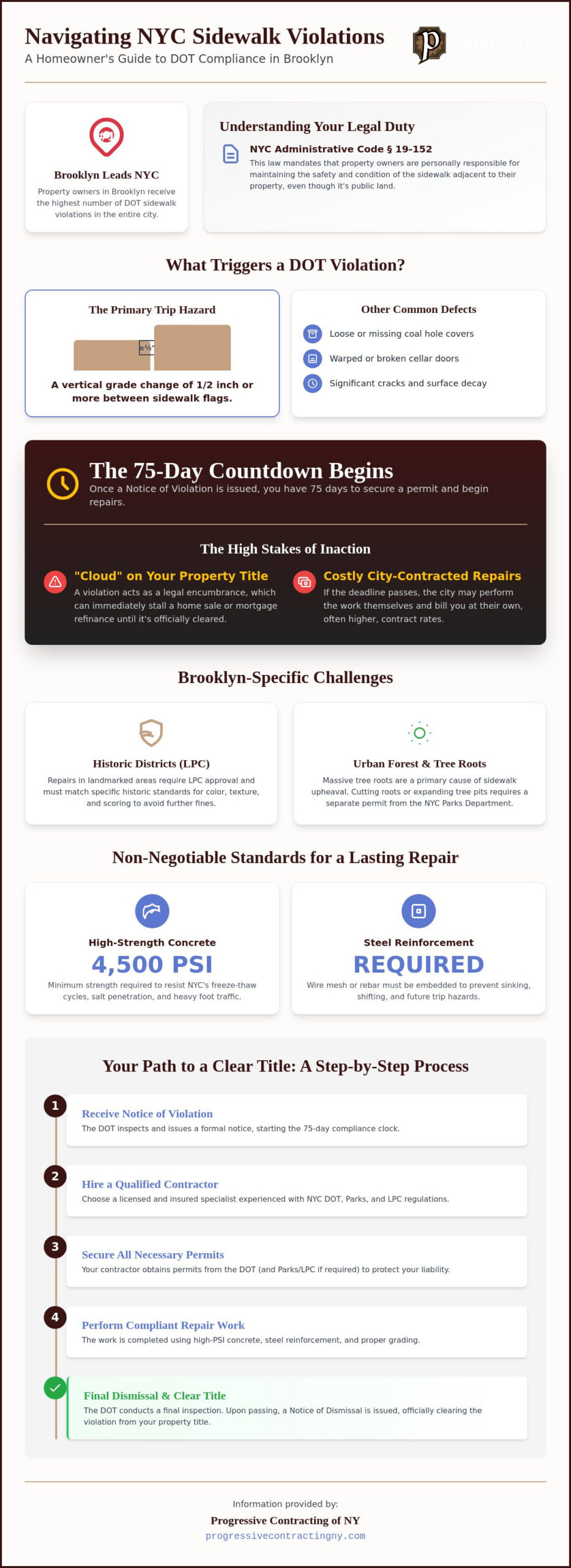
Ignoring a defect isn’t just a safety risk; it’s a financial one. The NYC DOT actively patrols neighborhoods to identify trip hazards, which they define as any vertical grade change of half an inch or more. They also look for hardware issues, such as loose coal hole covers or warped cellar doors. If an inspector finds these flaws, they issue a Notice of Violation. This starts a 75-day countdown. If you haven’t secured a permit for sidewalk repair brooklyn within this window, the city may perform the work themselves and bill you at their own contract rates.
To better understand this concept, watch this helpful video:
A common misconception is that a violation is a simple ticket you can pay and forget. In reality, a sidewalk violation acts as a cloud on your property title. It will appear during any title search, which can immediately stall a home sale or a mortgage refinance. Lenders and buyers typically require these encumbrances to be cleared before closing. Taking proactive steps with a qualified Brownstone repair specialist ensures your title remains clean and your property stays marketable.
The Impact of Brooklyn’s Urban Forest and Tree Roots
Brooklyn’s lush canopy is a point of pride, but it’s also the primary cause of sidewalk upheaval. In neighborhoods like Park Slope and Bedstuy, massive root systems from street trees can lift entire concrete flags. You can’t simply cut these roots; doing so often requires a permit from the NYC Parks Department. In many cases, the city may require a tree pit expansion to accommodate the growth. Expansion joints serve as the primary defense against future root-related cracking by allowing the concrete to shift slightly without breaking.
Historic Districts and Landmark Preservation Commission (LPC) Rules
If your home sits within a designated historic district, the rules change. The Landmarks Preservation Commission (LPC) has specific requirements for the color, texture, and scoring of concrete to maintain the neighborhood’s historic character. A standard patch job won’t suffice here. You need a contractor who understands how to match the aesthetic of 19th-century streetscapes while meeting modern safety codes. Failing to meet these standards can result in additional fines beyond the initial DOT violation.
Choosing the Right Materials and Methods for Brooklyn Sidewalks
The concrete mix isn’t just a recommendation; it’s a structural requirement. Brooklyn winters subject walkways to constant freeze-thaw cycles that can shatter low-grade masonry. To prevent rapid deterioration, all new sidewalk repair brooklyn projects must utilize concrete rated at a minimum of 4,500 PSI. This high-density mix resists salt penetration and surface scaling much better than standard residential blends often used in less demanding climates.
Structural integrity also depends on what stays hidden beneath the surface. We use wire mesh or rebar reinforcement to create a unified structure that resists sinking and shifting. In areas with unstable soil or heavy foot traffic, these reinforcement techniques prevent the uneven settlement that creates the very trip hazards the DOT penalizes. A well-built sidewalk should remain level for decades, not just until the next season change.
Aesthetics often get overlooked in municipal repairs, but they shouldn’t. A new sidewalk should offer visual synergy with your brownstone facades and historic stoops. We focus on matching the texture and tint of the surrounding masonry to ensure the repair feels like a natural extension of your property’s original design. This attention to detail preserves the neighborhood’s character while satisfying modern safety codes.
Proper pitch is the final piece of the technical puzzle. We carefully grade the surface to ensure water flows toward the curb rather than pooling near your foundation. This drainage planning prevents basement leaks and protects the structural health of your home. If you’re concerned about how these materials affect your specific property, consulting a professional masonry contractor can provide a clear path forward.
Standard Concrete vs. High-Performance Masonry
Residential sidewalks typically require a 4-inch thickness, while driveways need 7 inches to handle vehicle loads without cracking. The difference between a lasting repair and a temporary fix often comes down to curing time. Rushing the process leads to flaking and spalling after the first frost. For a deeper look at material requirements and structural standards, read this Concrete Contractor Brooklyn: A Guide to Sidewalks, Stoops, and NYC Compliance.
The Violation Removal Process: From DOT Notice to Clear Title
Resolving a city-issued notice requires a disciplined approach to both paperwork and physical labor. The process begins with securing a valid NYC DOT permit. You should never hire a contractor who suggests working without one. The permit serves as official proof that the work is authorized; it also triggers the city’s tracking system for eventual violation removal. A licensed contractor handles this filing to ensure all site-specific requirements are met before the first jackhammer hits the ground.
Once the permit is in hand, professional demolition begins. This phase involves removing damaged concrete and hauling away debris according to city environmental codes. We then prepare the sub-base, ensuring the ground is compacted and level to prevent future cracking. Standard sidewalk repair brooklyn requires a 4-inch thickness for pedestrian areas, while driveways must reach 7 inches to support vehicle weight. This ensures the structural integrity discussed in previous sections remains intact under heavy use.
After the pour and finish, the most critical administrative step remains: requesting the DOT dismissal inspection. You must submit the proper certification to the DOT to prove the work meets their standards. The city does not automatically remove a violation just because the work looks finished. You must proactively request the inspection to close the case. Without this final sign-off, the violation remains active on your property record, regardless of how much you spent on the repair.
Clearing DOT Liens and Protecting Property Value
After the work is completed and inspected, you can verify the status through the NYC Open Data portal. It typically takes several weeks for the system to reflect the dismissal. Removing these legal encumbrances is essential for protecting your home’s financial standing. A clean title ensures a smooth transaction during a sale or refinance. Professional masonry doesn’t just satisfy the city; it adds tangible ROI by preserving the structural integrity of your property’s entry. For a deeper look at the administrative side, read our guide on How to Remove a Sidewalk Violation in New York: The 2026 Property Owner’s Guide.
Securing Your Property’s Future and Legal Standing
Managing a DOT notice involves more than just a quick fix; it’s about protecting your home’s title and long-term market value. We’ve seen how the right materials and a methodical permit process can turn a legal burden into a lasting asset. By prioritizing high-grade 4,000 PSI concrete and following the city’s strict dismissal protocols, you ensure your walkway remains safe and compliant for years to come. A successful sidewalk repair brooklyn project provides peace of mind that your property is free of liens and structural defects.
We specialize in navigating the unique masonry requirements of NYC DOT violation removal, particularly within the sensitive historic districts of Park Slope and Bedstuy. Our team manages every phase of the project, starting with the initial permit filing and ending with the critical dismissal inspection. Don’t let a sidewalk violation linger on your property record or diminish your home’s historic curb appeal. Take the first step toward a clear title and a safer, more durable walkway today.
Get a Free Estimate for Your Brooklyn Sidewalk Repair
Frequently Asked Questions
How much does sidewalk repair in Brooklyn typically cost?
Total costs depend on the square footage of the flags replaced and the specific concrete thickness required for your property. Standard sidewalk flags are 4 inches deep, while driveway sections must be 7 inches deep to support vehicle weight. You should also account for the $70 NYC DOT permit fee, which covers up to 300 linear feet of sidewalk for a single property.
Can I fix a NYC sidewalk violation myself?
You cannot legally perform a sidewalk repair brooklyn project as a DIY task. New York City law mandates that only contractors licensed by the Department of Consumer and Worker Protection (DCWP) can obtain the necessary DOT permits. Working without a licensed professional and the proper permits will prevent you from clearing the violation and may result in additional city fines.
How long does the DOT violation removal process take?
The administrative removal of a violation usually takes between four and eight weeks after the physical work is finished. While the demolition and pour might only take a few days, the DOT must process your dismissal request and perform a final inspection. It’s vital to act within the initial 75-day window provided in your Notice of Violation to avoid city-assigned contractors and higher costs.
What happens if a city tree is lifting my sidewalk flags?
If roots from a city-owned tree are exclusively lifting your sidewalk, you should contact the NYC Parks Department for an inspection. Owners of 1, 2, and 3-family homes may be eligible for a city-funded repair through the Trees & Sidewalks program. However, if the damage is caused by a combination of roots and standard wear, the legal responsibility for the repair typically remains with the property owner.