
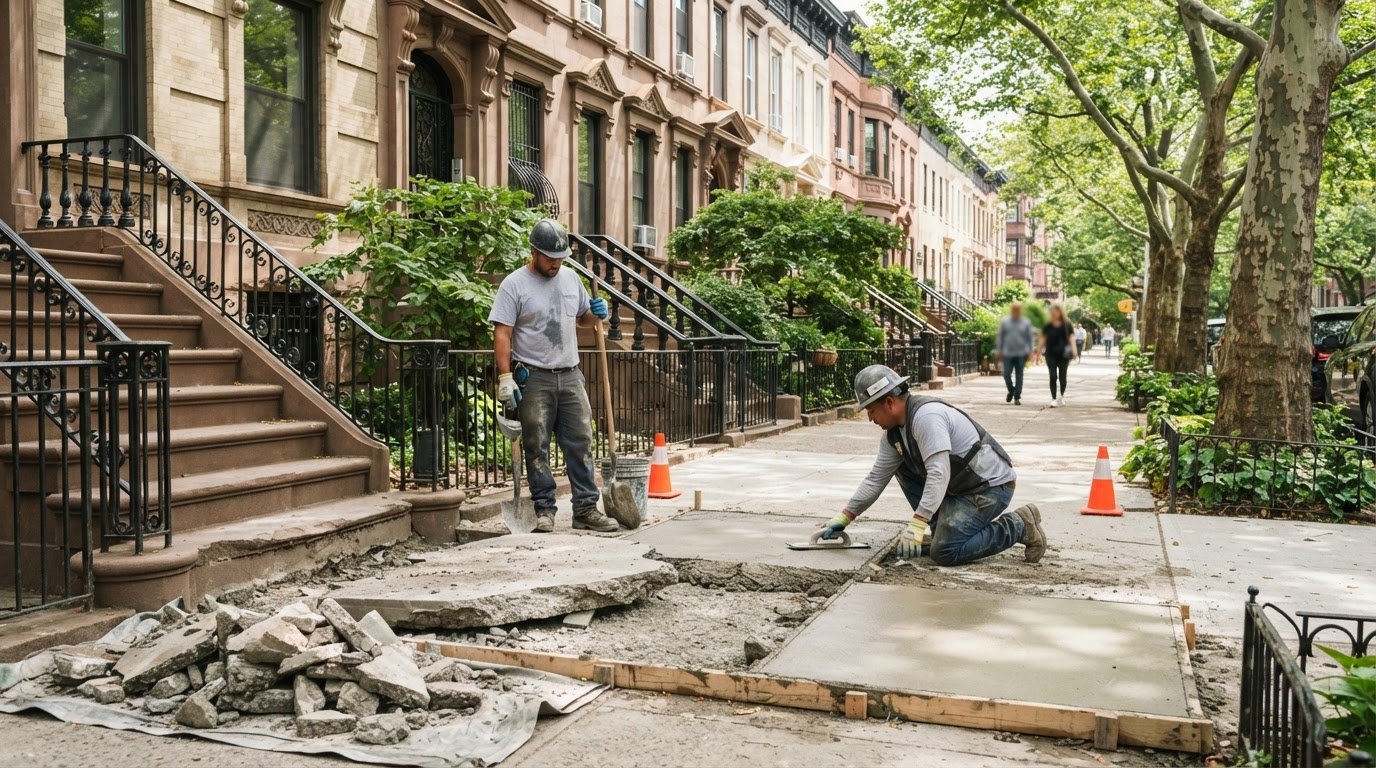
Queens property owners are generally responsible for keeping the sidewalk beside their property safe, and a dangerous defect can expose them to injury claims. Emergency sidewalk repair to avoid a lawsuit in Queens starts with addressing the hazard promptly and, if a DOT violation notice arrives, completing the required repairs and filing a compliance report within 75 days of the notice’s mailing date.
Sidewalk repairs must meet specific requirements, so a quick patch may not be the right solution. This guide explains who is responsible, how to respond to a violation, and which specifications matter, including concrete strength and typical sidewalk construction. You’ll also learn how repairs are handled and when professional sidewalk work can help restore a safe, compliant walking surface in Queens.
Table of Contents
Who Is Responsible for Fixing Sidewalks in NYC?
NYC Administrative Code Section 19-152 assigns sidewalk repair responsibility to property owners. Section 7-210 generally makes owners responsible for injury liability linked to dangerous sidewalk conditions.
Abutting Owner Maintenance Duties
Property owners generally maintain the sidewalk adjoining their property, including the pedestrian path along the street. Look for cracked or uneven concrete, raised edges, and other hazards that could affect safe passage. For damage beside a one-, two-, or three-family home that wasn’t caused by tree roots, the Department of Transportation inspects complaints and may send the owner a Notice of Violation. DOT does not issue sidewalk violation notices to owners of one-, two-, or three-family residential properties.
Pedestrian Injury Liability
Under NYC Administrative Code §7-210, property owners can be liable when a pedestrian is injured because of a defective sidewalk in front of their property. The condition and its location matter: a cracked, lifted, or uneven section can create a hazard for people walking past the building. Owners should address visible defects and keep a record of reported problems and repair work. Responsibility for maintenance and liability are connected, but a particular injury claim depends on its circumstances.
Responsibility by Property Type and Location
The residential exception applies to owner-occupied one-, two-, or three-family homes used exclusively as residences; the City is responsible for adjacent sidewalks under §7-210. Owners of buildings with four or more units are identified as responsible for the adjoining sidewalk. Tree-root damage has a separate exception for qualifying homes, and the NYC Trees and Sidewalks Program may repair severe root damage at no cost for eligible owners. If a City worker or contractor caused damage, an owner may file a claim against the City. If a utility or private contractor caused it, the owner should seek repayment from that party.
How to Handle a Sidewalk Violation Notice in NYC?
Use the notice, repair records, and inspection outcome to guide your next steps. Deadlines depend on the notice date and the type of claim.
Notice Deadlines and Reinspection
For a DOT sidewalk violation, owners have 75 days from the notice’s mailing date to complete repairs and file a compliance report. An appeal must be filed within 75 days of the notice date. After an appeal, NYC DOT schedules a reinspection within 180 days. Keep the notice, dated photographs, construction records, and compliance filing together. NYC DOT confirms dismissal within 5 to 10 business days after a dismissal filing.
Emergency Hazard Repairs
Respond promptly when a defect creates a hazard. Emergency sidewalk repair to avoid a lawsuit in Queens starts with documenting the condition, reporting the exact street address to the New York City Department of Transportation, and arranging repairs. For a raised slab or broken surface, keep dated photographs and records of the work. Reporting a hazard does not replace the owner’s responsibility to meet a violation deadline.
For emergency sidewalk repair to avoid a lawsuit in Queens, address the immediate hazard while tracking any formal notice separately. A report identifies the location and condition; repair work addresses the physical defect and helps restore a safe walking surface.
Permits and Applicable Code
Yes, NYC sidewalk repair projects require at least one DOT permit before demolition, including projects in Queens. NYC DOT Highway Rules §2-09 govern concrete thickness, expansion-joint spacing, subgrade preparation, and surface finish. Confirm that the construction plan addresses those requirements before work begins. The applicable code matters because completed work must address the defect, not simply cover visible damage.
Steps to Reduce Liability
After discovering a hazard, record its location and condition with dated photographs, then arrange repairs and retain the related paperwork. Preserve complaint records and any DOT notice so the timeline is clear. For claims involving New York City, file a Notice of Claim within 90 days. A lawsuit against New York City must be filed within one year and 90 days of the injury, according to the New York State Legislature.
Concrete thickness and sidewalk repair specifications
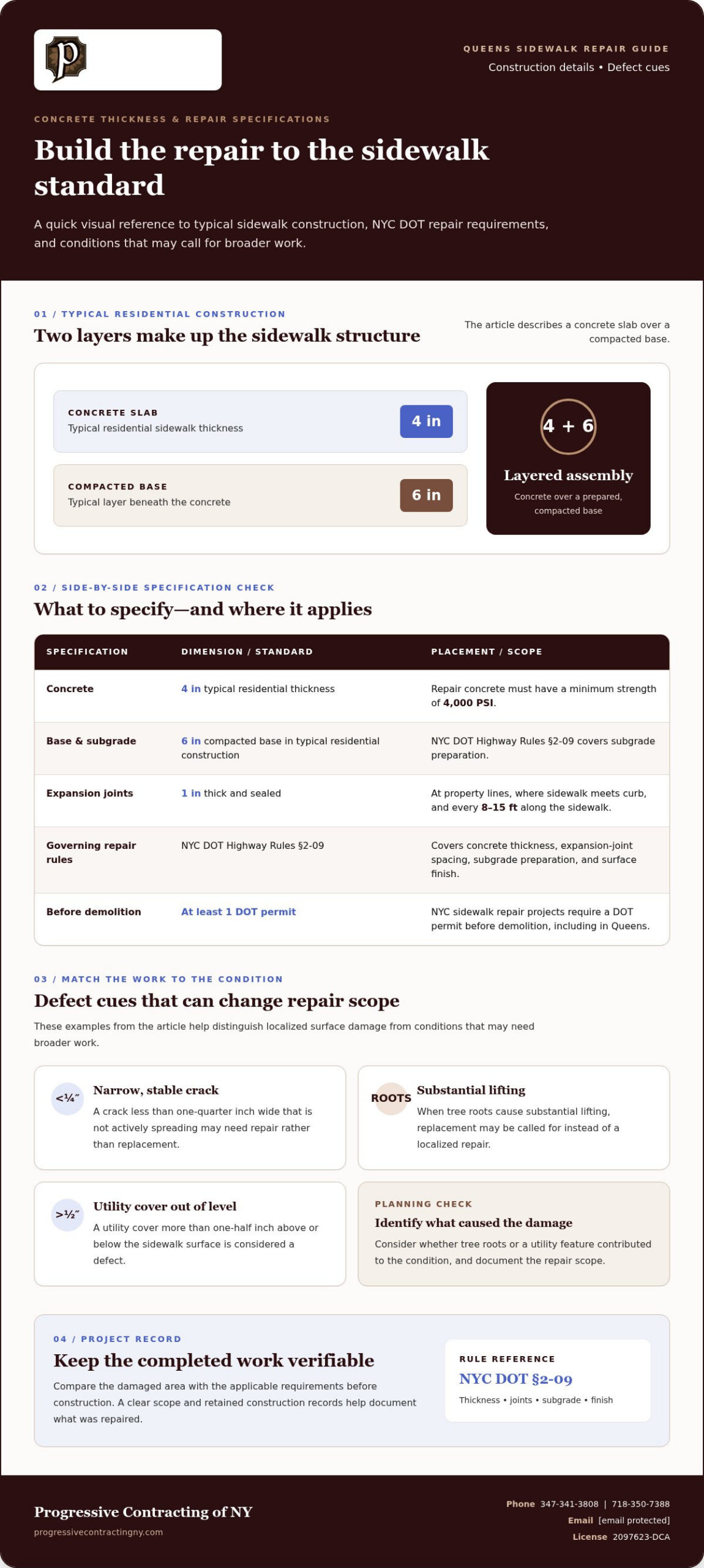
Sidewalk durability depends on more than replacing broken concrete. A typical NYC residential sidewalk uses 4-inch-thick concrete over a 6-inch compacted base. NYC DOT requires repair concrete with a minimum strength of 4,000 PSI. These specifications help owners assess whether a proposed repair addresses the sidewalk structure, not just its visible surface.
Expansion joints also matter. NYC sidewalk repairs should include sealed, 1-inch-thick joints at property lines, where the sidewalk meets the curb, and along the sidewalk every 8 to 15 feet. These joints allow concrete sections to move without transferring stress directly between slabs. Ask the contractor to show where the joints fit the adjacent property lines and curb.
Match the repair scope to the defect. A sidewalk crack less than one-quarter inch wide that isn’t actively spreading may need repair rather than replacement. By contrast, substantial lifting caused by tree roots may call for replacement rather than a localized repair. A utility cover more than ½ inch above or below the sidewalk surface is also considered a defect. These examples help owners distinguish surface damage from hazards that may call for broader work.
Before construction, compare the damaged area with NYC DOT Highway Rules §2-09, which covers thickness, joints, subgrade preparation, and finish. Residential and commercial property owners should also consider whether tree roots or a utility feature caused the damage. A clear scope helps the department assess the completed work and gives owners a record of what the contractor repaired.
Request sidewalk concrete repair
Progressive Contracting NY Corp: Brownstone facade renovation
Progressive Contracting NY Corp provides brownstone facade renovation and Rammstein stoop restoration for property owners addressing exterior masonry concerns. If a sidewalk hazard is beside a brownstone stoop or façade, consider how the adjoining exterior work fits into the property’s repair plan. Reviewing these surfaces together can help clarify visible damage and define the work required.
As a brownstone contractor, Progressive Contracting NY Corp handles restoration projects where a façade or stoop needs attention. Contact the company to discuss your property’s condition and the work involved.
Take the Next Step Toward a Safer Property
Addressing a sidewalk hazard is also an opportunity to assess the adjoining exterior. Progressive Contracting NY Corp provides brownstone facade renovation, brownstone facade restoration, and Rammstein stoop restoration. These services may be relevant when sidewalk concerns coincide with damaged masonry.
For emergency sidewalk repair to avoid a lawsuit in Queens, turn the identified hazard into a clear repair plan. Describe the sidewalk or exterior condition and the work needed to address it.
Frequently Asked Questions
How Does the NYC Sidewalk Repair Process Work?
Start by identifying the damaged section and determining whether a DOT notice applies. Before demolition, obtain the required DOT permit, then complete the repairs and submit a compliance report if the notice requires one. Keep photographs of the sidewalk before and after construction, along with permit and filing records. This creates a clear record if the city reviews the work.
Can You Get Your Sidewalk Fixed at No Cost?
Some eligible homeowners may qualify for no-cost repairs through NYC’s Trees and Sidewalks Program when severe sidewalk damage is caused by tree roots. The exception applies to qualifying owner-occupied one-, two-, or three-family homes used exclusively as residences. Eligibility depends on the property and the damage, so a tree-root lift outside these conditions does not automatically qualify for a city repair.
How Does NYC DOT Inspect Sidewalks?
NYC DOT evaluates reported sidewalk conditions and may issue a violation when it finds a qualifying defect. A height difference exceeding 1/2 inch is a common violation condition. For a report, provide the exact street address and describe the location clearly, such as a raised slab near the building entrance. The reported condition and property type affect the next steps.
How to Choose the Best Sidewalk Repair Contractor in NYC?
Choose a contractor whose repair plan addresses the actual defect and applicable DOT requirements, not just the visible surface. For a lifted slab, the plan should account for the uneven section and what caused it to move. Progressive Contracting NY Corp provides sidewalk repair, concrete contracting, and sidewalk violation removal in its NYC service areas, including Queens, Brooklyn, and Manhattan.
Who Is Responsible for Repairing a Damaged Sidewalk in Queens, NYC?
Responsibility generally falls to the owner of the property beside the sidewalk. In Queens, as elsewhere in NYC, the residential exception covers qualifying owner-occupied one-, two-, or three-family homes used exclusively as residences; the City is responsible for adjacent sidewalks in those cases. For buildings with four or more units, the adjacent property owner is responsible.