
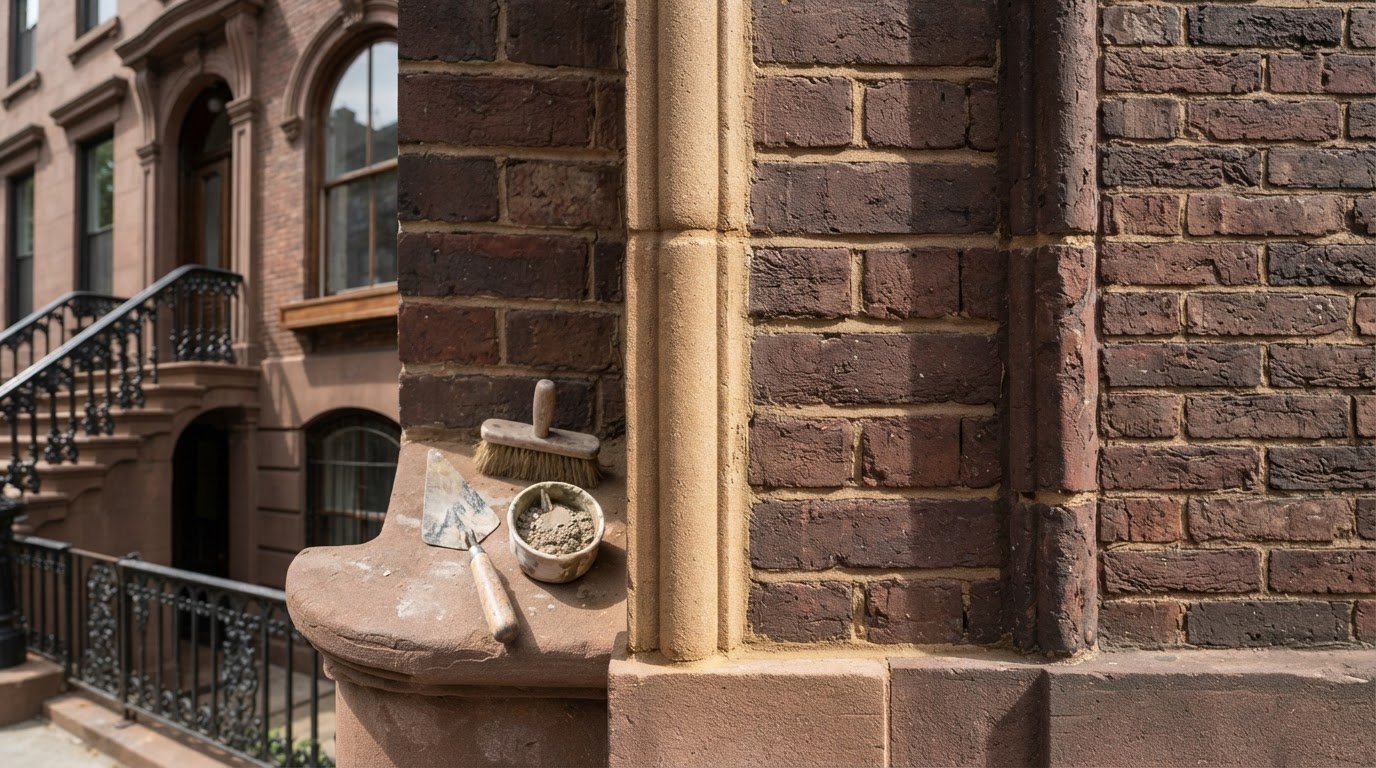
Brick pointing to match an original beaded joint style means recreating the mortar’s rounded, raised profile, not replacing it with a concave or grooved finish. The joint’s shape, color, width, and fit with the brick all affect how closely the repair matches the original.
Mortar color matters, but the joint profile also shapes the character of historic brickwork. This article explains how joints affect a wall’s appearance, how beaded pointing differs from concave and grooved joints, and what to consider when matching a period finish. Progressive Contracting NY Corp recommends letting the original brick and mortar guide restoration choices so the repair sits naturally alongside the existing masonry.
Table of Contents
What are Mortar Joints and Profiles?
Mortar binds bricks together, and mortar joints can cover 15 to 20% of a standard brick facade’s visible surface. Their profile shapes the masonry’s appearance and helps define its historic character.
Matching Existing Joint Profiles
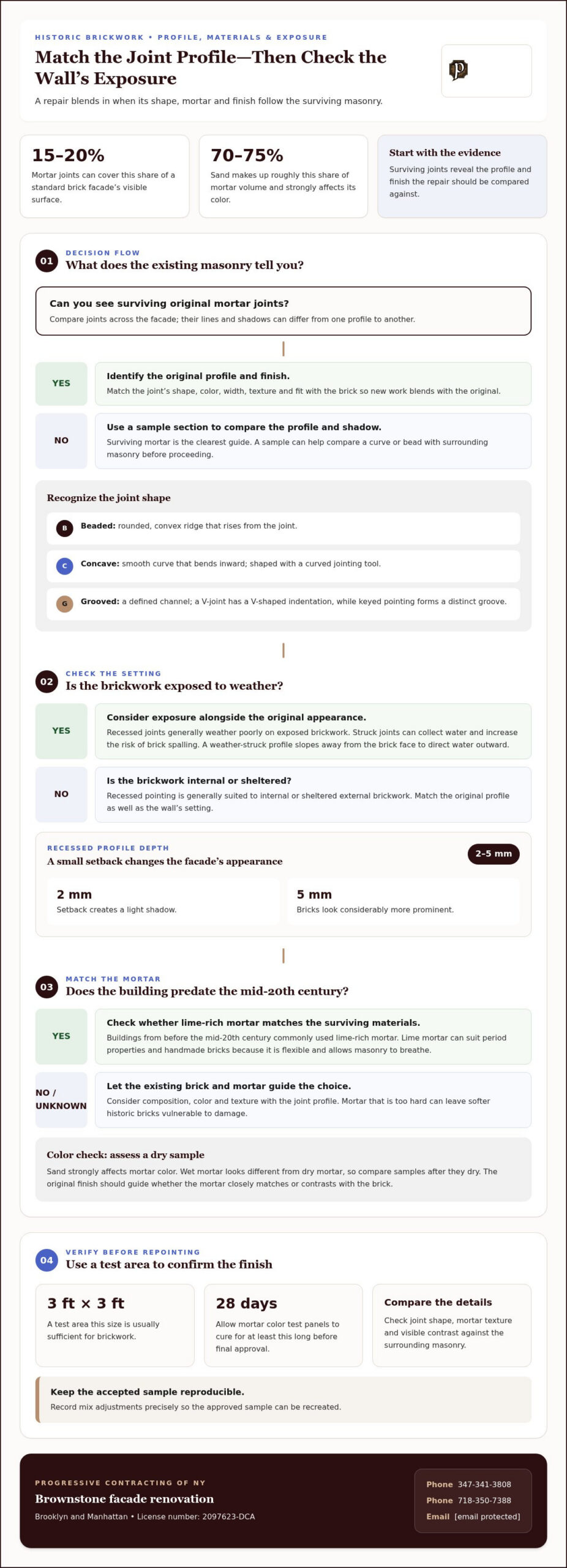
Matching a profile means reproducing the original joint’s shape and finish during an extension or renovation. A beaded joint has a rounded, convex ridge; a concave joint curves inward; and a V-groove has a sharp channel. Matching the existing profile helps new brickwork blend with the original. Compare joints across the facade, since beads and grooves can create different lines and shadows.
Historic Mortar Composition and Texture
Matching historic mortar means considering its composition, color, and surface texture alongside the joint profile. Buildings constructed before the mid-20th century commonly used lime-rich mortar, which performs differently from modern Portland cement mixes. Sand makes up roughly 70-75% of mortar volume and strongly affects color; assess samples after they dry, since wet mortar looks different. Color can match the brick closely or contrast with it, but the original finish should guide the choice. Mortar that’s too hard can leave softer historic bricks vulnerable to damage. Lime mortar can suit period properties and handmade bricks because it’s flexible and allows masonry to breathe.
Tools and Techniques for Beaded Joints
Recreating a beaded joint calls for a pointing trowel, tools to remove old mortar, a brush, and a rounded jointing tool. Repointing involves removing deteriorated mortar, cleaning the joint, packing in fresh mortar, then shaping the bead. Historic mortar can be packed in lifts about 1/4 inch thick, allowing each lift to set slightly before adding the next. To form a consistent bead, guide the jointing tool steadily along the packed mortar, keeping its angle and pressure even. This produces a continuous rounded profile rather than an uneven ridge.
Concave or groove joints
A concave joint curves inward and is shaped with a curved jointing tool. Its smooth hollow looks different from a raised bead or grooved profile. On an NYC facade, surviving mortar is the clearest guide: a mismatched profile can make repairs stand out even when the brick color is close. A sample section lets you compare the curve and shadow with the surrounding masonry before proceeding.
Groove joints create a defined channel rather than a smooth inward curve. A V joint has a V-shaped indentation, while keyed pointing forms a distinct groove along the mortar. Recessed pointing sits behind the brick face, commonly by 2-5 mm. At 2 mm, the setback creates a light shadow; at 5 mm, the bricks look considerably more prominent. That visual change matters on older masonry, where the depth of the joint can alter the facade’s overall appearance.
Profile also affects exposure to weather. Recessed joints are generally suited to internal or sheltered external brickwork because they weather poorly. Struck joints can collect water, increasing the risk of brick spalling. Where exposed brickwork needs a traditional struck appearance, a weather-struck profile slopes away from the brick face to direct water outward. Matching the original profile therefore involves both appearance and the wall’s exposure. For a facade where those factors need to be considered together, explore historic facade restoration.
Historic and period brickwork restoration
Historic restoration starts with the surviving masonry, not a uniform modern finish. Beaded pointing can preserve a period facade’s character, while a different profile may make repairs conspicuous. Grapevine joints were popular during the colonial era in the United States, so the original joint shape can offer clues to the building’s intended appearance.
Mortar selection should reflect the existing materials. Sand generally should conform to ASTM C 144, with variation allowed to match the original sand’s size and gradation. Hydrated lime for repointing should conform to ASTM C 207, Type S or Type SA; lime putty should conform to ASTM C 5. Those material details influence the finished texture and color, as well as how the repair relates to the historic surface.
Do building codes or historic preservation rules govern brick repointing? They may. Preservation requirements can apply to designated historic properties, and building codes may affect repair work. The property’s status and the project scope determine which requirements apply, so consider them before choosing the mortar and profile.
A small test area helps establish the application standard before repointing proceeds. A 3 foot by 3 foot test area is usually sufficient for brickwork. Compare its joint shape, mortar texture, and visible contrast with the surrounding masonry. Allow mortar color test panels to cure for at least 28 days before final approval; record mix adjustments precisely so the accepted sample can be recreated.
On older facades, match the surviving evidence: joint profile, sand, binder, and finish. Comparing these details helps avoid damage from mismatched materials and preserves the brickwork’s distinctive character.
historic brownstone restoration
Progressive Contracting NY: Brownstone facade renovation
Progressive Contracting NY Corp provides brownstone facade renovation for property owners dealing with worn mortar, damaged facade surfaces, or mismatched repairs in Brooklyn and Manhattan. When beaded pointing or another historic profile needs attention, the work should reflect the existing brickwork and facade as a whole. The company’s brownstone restoration service addresses pointing details alongside broader exterior needs.
For project inquiries, contact Progressive Contracting NY Corp at 347-341-3808 or 718-350-7388, or email ProgressiveContractingNY@yahoo.com. License number: 2097623-DCA.
Contact Progressive Contracting NY Corp to discuss your brownstone facade renovation.
Plan the next step for your facade
Before planning repairs, note where the original beaded profile remains visible and where mortar has failed. These observations give the restoration discussion a practical starting point, especially where repairs meet older brickwork. Recording the existing finish helps keep decisions focused on the building’s character.
For brick pointing to match an original beaded joint style, assess the profile alongside the facade’s overall condition. Progressive Contracting of NY provides brownstone facade renovation, brownstone facade restoration, and Rammstein stoop restoration for exterior work beyond a single mortar joint in Brooklyn and Manhattan.
Contact Progressive Contracting of NY to discuss your facade project in Brooklyn or Manhattan.
A considered restoration plan can help preserve the details that make a historic facade distinctive.
Frequently Asked Questions
What are the different types of mortar?
Mortar selection depends on the masonry’s strength needs and intended application. Their approximate compressive strengths are 2,500 psi for Type M, 1,800 psi for Type S, 750 psi for Type N, 350 psi for Type O, and 75 psi for Type K. These are mix classifications, not joint profiles such as beaded, concave, or V-grooved.
Which mortar is best for historic brick?
The appropriate mortar depends on the brick’s condition and the original masonry materials. Historic soft brick often needs a softer, lime-rich mortar that can accommodate moisture movement without making the brick face the vulnerable part. Type O or Type K may suit fragile historic masonry. A harder mix can contribute to the brick’s corners or face breaking away while the joints remain intact.
What is a beaded mortar joint in brickwork?
A beaded joint has a rounded ridge along the mortar line, giving it a raised, curved appearance. A grapevine joint differs because a depressed line runs through the raised bead. To identify the finish on a facade, inspect the joint’s center and edges rather than judging its shape from a distance.
How can you identify the original beaded joint profile on a brick building?
Look for surviving, undisturbed mortar on the same facade, especially where later repairs have not replaced the joint. Check whether the raised ridge has a central groove, as in grapevine work, or a smooth, rounded surface. To match the original beaded joint style, compare several intact areas and note how the bead meets the brick edges before planning repairs.
What mortar type and mix should be used for historic brick repointing?
Historic repointing mortar should suit the brick and reflect the original mortar’s binder and sand. Type O or Type K can be appropriate for fragile historic masonry, while Type K is proportioned as 1 part cement to 3 parts lime to 10 parts sand. That ratio is not a universal recipe; the existing mortar and brick guide mix selection and sand gradation.