
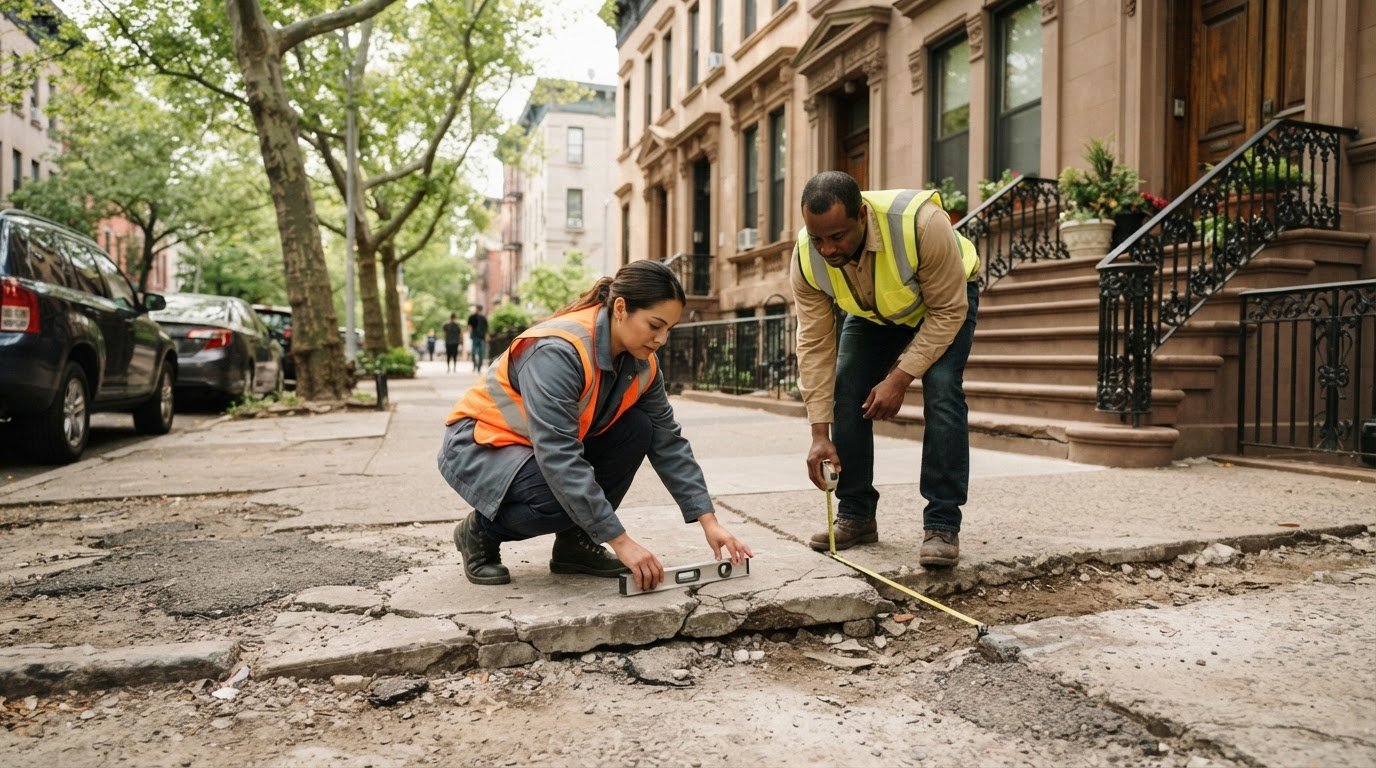
A utility crew may cause the damage, but that does not automatically remove the property owner’s responsibility for the sidewalk. Sidewalk repair for damage from utility work in Queens generally remains the adjacent owner’s responsibility, while the utility or contractor that caused the damage may be responsible for the cost. A raised section that creates a ½-inch trip hazard can count as a defect.
It is understandable to want a clear answer about who should act and what the repair may involve. This guide explains what can qualify as a sidewalk defect, how utility-related damage and Queens violations are handled, and what affects repair costs. The price depends on the damaged area, sidewalk condition, site access, and repair scope, and is provided after a quote request.
Table of Contents
Who Is Responsible for Maintaining Sidewalks in New York City?
Responsibility depends on the property beside the sidewalk and the cause of the damage. Utility work may identify another responsible party, but it does not automatically remove the adjacent owner’s sidewalk maintenance duties.
City Work and Sidewalk Hazards
The City may be responsible for hazards it creates during construction or inspection work. Property owners generally maintain adjacent sidewalks, while the City maintains sidewalks beside City-owned property. This distinction matters if a violation notice arrives after City work damages the surface. For severe damage caused solely by a City tree, NYC Parks’ Trees & Sidewalks Program covers eligible owner-occupied one-, two-, or three-family homes that are not used commercially.
Claims for Damage from City Workers
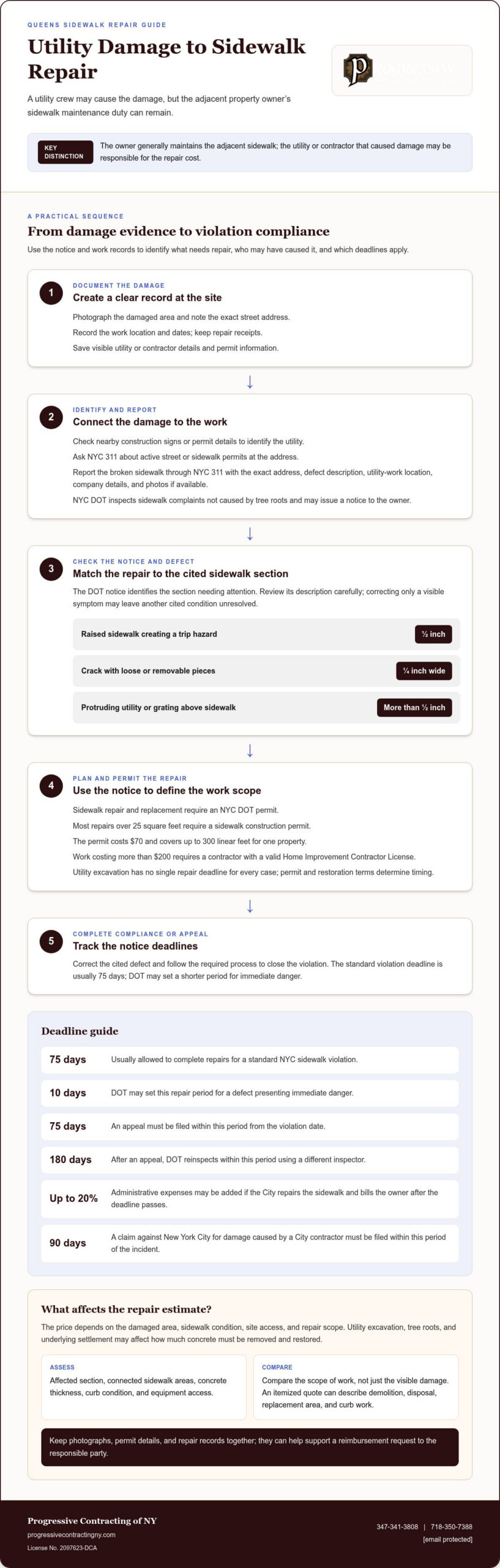
A claim can seek recovery when City workers or a City contractor caused sidewalk damage. Photograph the damaged area, record the work location and dates, and keep repair receipts. A claim against New York City for damage caused by a City contractor must be filed within 90 days of the incident. These records help connect the construction activity to the damaged sidewalk and support the claim.
Utility Work and Sidewalk Repairs
Utility excavation can leave cracked, uneven, or unsettled sidewalk sections. No single repair deadline applies to every excavation; the permit and restoration terms for the work determine the required timing. To identify the utility, check construction signs or permit details near the site, and ask NYC 311 about active street or sidewalk permits at the address. A private contractor that caused damage may also be responsible, although the property owner’s maintenance duty can remain.
Reporting Utility-Related Damage
Report a broken sidewalk through NYC 311 with the exact street address and a clear description of the defect. Include where the utility work occurred, visible company or contractor details, and photographs if available. NYC DOT inspects sidewalk complaints not caused by tree roots and may send the owner a notice of violation if warranted. The address and work records help identify the location and clarify which party may have caused the damage.
How do I remove a sidewalk violation in Queens?
Removing a violation means correcting the defect cited in the notice and completing the compliance process. For sidewalk repair for damage from utility work in Queens, review the notice carefully and match the repair scope to the specific area it identifies.
DOT Inspections and Violations
NYC DOT inspects sidewalks and may issue a violation after finding an unsafe condition. The notice identifies the adjacent sidewalk section that needs attention, helping distinguish the cited area from nearby broken concrete. Residential and commercial property owners should use its description to guide the work. Correcting only a visible symptom may leave another cited condition unresolved.
Defects That Trigger Violations
A raised sidewalk that creates a ½-inch trip hazard can qualify as a defect. A crack at least a quarter inch wide with loose or removable pieces may also be cited. NYC lists protruding utilities or gratings more than half an inch above the sidewalk surface as defects. These measurements help explain why a small-looking lift or broken edge may appear in an inspection notice.
Violation Removal and Compliance Repairs
Correct the defect described in the notice, then follow the required process to close the violation. Sidewalk repair and replacement require an NYC DOT permit; most repairs over 25 square feet require a sidewalk construction permit. The permit costs $70 and covers up to 300 linear feet for one property. Work costing more than $200 requires a contractor with a valid Home Improvement Contractor License. For sidewalk repair for damage from utility work in Queens, the notice still guides the repair scope.
Inspection and Repair Deadlines
For a standard NYC sidewalk violation, owners usually have 75 days to complete repairs. DOT may set a 10-day repair period for a defect presenting immediate danger. If the deadline passes, the City may repair the sidewalk and bill the owner, with administrative expenses up to 20 percent. An appeal must be filed within 75 days of the violation date. After an appeal, DOT reinspects within 180 days using a different inspector.
Sidewalk repair costs in Queens
A Queens sidewalk estimate depends on the damaged area, repair method, and site conditions. A crack limited to one section may need different work from a raised or uneven sidewalk that requires replacement. Compare the scope of work, not just the visible damage. Utility excavation, tree roots, and underlying settlement can affect how much concrete must be removed and restored.
Consider the full repair area, including connected sections that may need matching work. Concrete thickness, equipment access, debris removal, and curb condition can all affect the project scope. If a utility contractor caused the damage, keep photographs, permit details, and repair records together. These documents can help support a reimbursement request to the responsible party.
Damage can become clearer after excavation. A small cracked edge may conceal loose or uneven concrete nearby, while a raised section can extend beyond the original work area. Tree roots may contribute to lifting, so identifying the cause matters when planning repairs. An inspection helps pinpoint the affected surface and clarify whether the work involves a small section, several sidewalk flags, or broader replacement.
The Department of Transportation’s violation notice can define what must be corrected, but the repair estimate depends on the site and required scope. Request an itemized quote that describes demolition, disposal, replacement area, and any curb work. The price depends on the specific case and is provided after a quote request. This helps property owners understand what the estimate covers before scheduling sidewalk work.
Request a sidewalk repair quote
Progressive Contracting NY: Brownstone facade renovation
Progressive Contracting NY Corp provides brownstone facade renovation and stoop restoration for property owners addressing exterior masonry needs. When evaluating sidewalk repair for damage from utility work in Queens, property owners should treat sidewalk repairs and facade or stoop restoration as distinct parts of the project. A qualified contractor can address facade or stoop conditions that need restoration alongside the necessary concrete work.
For project inquiries, contact Progressive Contracting NY Corp at 347-341-3808 or 718-350-7388, or email ProgressiveContractingNY@yahoo.com. License number: 2097623-DCA.
Contact Progressive Contracting NY Corp to discuss brownstone facade or stoop restoration for your property.
Plan the Next Step for Your Property
For sidewalk repair for damage from utility work in Queens, keep the next decision focused on the affected property: separate sidewalk work from any brownstone restoration needs, then plan each scope clearly. Progressive Contracting NY Corp offers sidewalk repair alongside brownstone facade renovation, Brownstone Facade Restoration, and Rammstein stoop restoration. If utility excavation has affected the sidewalk and your facade or stoop also needs attention, a clear scope can help organize the project.
Share the property location, describe the visible damage, and provide any violation notice or utility-work records when discussing the work with Progressive Contracting NY Corp. Clear details help establish what needs repair and which exterior work is relevant. Choose the scope that fits your property.
A well-defined repair plan is a practical first step toward restoring your property’s exterior.
Frequently Asked Questions
What Counts as a Sidewalk Defect?
A sidewalk defect creates a hazard, not merely a cosmetic blemish. In Queens, note whether slabs rock, edges are broken, or metal covers sit unevenly against the concrete. A broad patch may also conceal a change in height. Photograph the full sidewalk section and a close-up to make the location and condition clear.
How much does sidewalk repair cost in Queens, NY?
There is no single total for every Queens sidewalk repair; the project scope determines the estimate. Treating a small crack differs from replacing several sidewalk sections or repairing a curb. The quote should account for the damaged area, slab thickness, site access, demolition, and disposal. Request a written scope that identifies each repair area, materials, and related work.
What to Do If Your Sidewalk Is Damaged by Others?
If another party caused the damage, document the site before work changes it. Take dated photos, note the address, and preserve utility markings or permit details. Keep communications, repair invoices, and receipts together. Notify the apparent utility or contractor in writing and request reimbursement for costs related to its work. These records can help support your account if responsibility is disputed.
When Is the City Liable?
New York City may be liable when its construction or inspection activity creates a sidewalk hazard. A City contractor that negligently damages a sidewalk during a public project must repair it at no cost to the property owner. Causation matters: document the work area and damage, and connect the hazard to City activity rather than assuming nearby work caused it.
Who is responsible for repairing a Queens sidewalk damaged by utility work?
The adjacent property owner generally remains responsible for sidewalk maintenance, even if utility excavation caused the damage. The utility company may also be responsible for damage it caused. Keep the owner’s repair responsibility separate from any reimbursement effort. Identify the utility through work signage or permit records, then preserve photographs and invoices to support a reimbursement request.