
Most Bay Ridge homeowners expect their masonry to last a lifetime, but the wrong mortar mix can turn a major investment into a crumbling mess in under a decade. It’s frustrating to watch mortar fall out in chunks or find water leaks through your facade just a few years after a repair. You want a home that stays waterproof and maintains its historical value without the fear of high recurring maintenance costs. As an experienced brick pointing contractor, we understand that the difference between a 15-year patch and a 50-year restoration lies in the precision of the craft.
In this guide, you’ll discover the factors that determine if your masonry lasts 15 years or 50 and learn exactly when to schedule your next inspection. If you need a professional assessment, reach us at 347-341-3808, 718-350-7388, or ProgressiveContractingNY@yahoo.com. We’ll explore how material compatibility and NYC’s unique environmental stresses dictate the future of your facade.
Understanding the Lifespan of Professional Brick Pointing
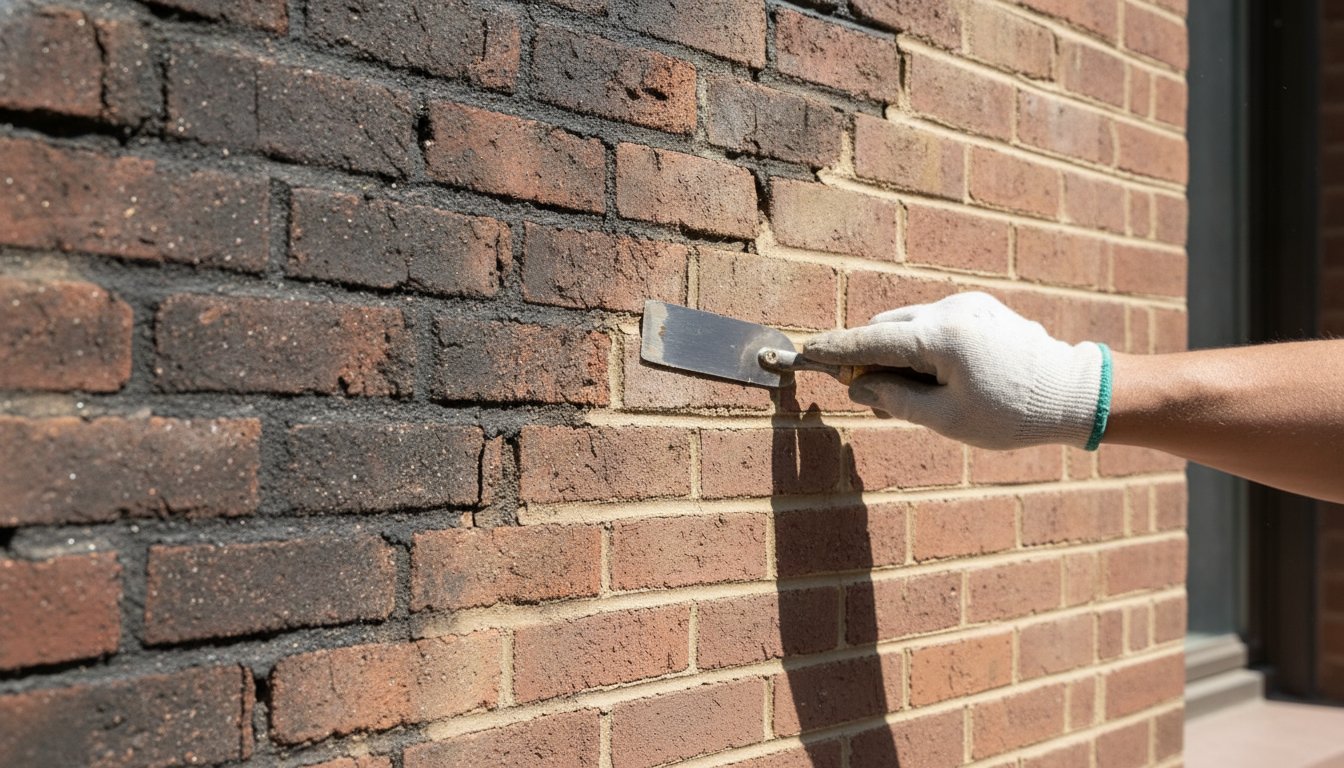
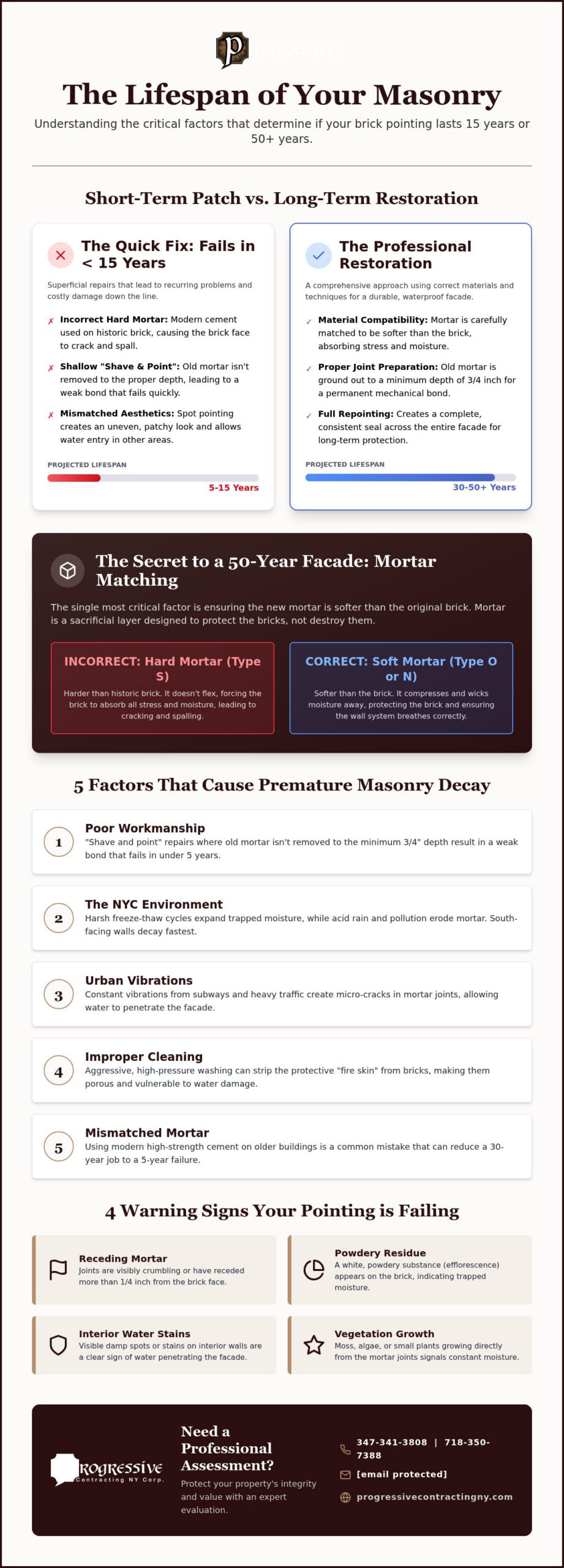
Brick pointing is the meticulous process of renewing the external portion of mortar joints to safeguard a building’s structural health. When you engage a qualified brick pointing contractor, the industry standard for a high-quality application typically lasts between 20 and 30 years. Understanding Brick Pointing helps property owners realize that mortar serves as a sacrificial layer; it’s designed to weather away so your bricks don’t have to. While some homeowners opt for ‘spot pointing’ to address visible gaps, this remains a temporary fix that often leads to mismatched aesthetics and recurring leaks. A full repointing provides a comprehensive, long-term seal for the entire facade.
For historic brownstones in neighborhoods like Bay Ridge, the success of the work depends on the softness of the new mortar relative to the original brick. If a contractor uses modern, hard cement on soft historic brick, the masonry will eventually spall and crack. We prioritize matching the physical properties of the materials to ensure the mortar remains the flexible component of the wall system. Working with an experienced brick pointing contractor ensures that these technical details aren’t overlooked during the restoration process.
Average Durability: What to Expect from Your Mortar
In the masonry industry, lifespan is defined as the period before the mortar loses its primary water-shedding capability. Standard Portland cement offers high strength for modern buildings, while lime-based mortars provide the necessary breathability for older structures. Choosing the wrong material can reduce a 30-year job to a 5-year mistake. High-quality brick pointing NYC projects require a deep understanding of these chemical compositions. If you’re concerned about your facade, call us at 347-341-3808 or 718-350-7388. You can also email ProgressiveContractingNY@yahoo.com for a professional assessment of your property.
5 Critical Factors That Determine How Fast Your Masonry Decays
Your building’s orientation plays a major role in its preservation. South-facing walls in Bay Ridge face intense sun and driving rain, which accelerates chemical breakdown. Urban vibrations from nearby subways or heavy truck traffic on the Belt Parkway also stress mortar joints over time. A seasoned brick pointing contractor recognizes that these micro-cracks allow water to seep in, eventually leading to structural instability if left unaddressed.
Previous workmanship often dictates current decay. Many buildings suffer from ‘shave and point’ repairs where old mortar isn’t removed to the proper depth. This shortcut fails in under five years because the new layer cannot bond effectively. Adhering to standards for Historic Masonry Preservation requires cutting back mortar to at least twice the width of the joint. Hiring a reliable brick pointing contractor ensures your facade receives this level of technical precision.
The NYC Effect: Weather, Pollution, and Historical Integrity
NYC’s harsh freeze-thaw cycles turn trapped moisture into ice, which expands and causes brownstone spalling. Acid rain and urban soot further erode the binder in older lime mortars. Be cautious with high-pressure washing; it often strips the protective ‘fire skin’ from bricks, leaving them porous. If you notice these issues, call us at 347-341-3808 or 718-350-7388. You can also visit our homepage for more information on restoration.
Watch for these signs that your pointing is failing prematurely:
- Mortar joints receding more than 1/4 inch from the brick face.
- Vegetation or moss growing directly in the cracks.
- Powdery white residue on the brick surface.
- Visible water stains on interior walls.
For a detailed consultation, email ProgressiveContractingNY@yahoo.com to protect your property’s integrity and value.
Maximizing Longevity: Choosing the Right Contractor and Materials
Longevity begins with rigorous joint preparation. If a brick pointing contractor fails to grind out old mortar to a minimum depth of 3/4 inch, the new material will lack the mechanical bond required to withstand NYC’s climate. This depth ensures that the new mortar sits securely within the joint rather than just ‘painting’ the surface. Once the joints are clean, the selection of materials becomes the next critical phase in protecting your property’s structural integrity.
Vetting your professional is equally vital. You should prioritize specialists in brownstone facade renovation who have a documented history in historic districts like Bay Ridge. After the pointing is complete, consider applying a breathable water repellent. These silane or siloxane-based treatments allow vapor to escape while preventing liquid water from entering, which significantly extends the life of the repair work.
Why Mortar Matching is the Key to 30-Year Results
Mortar serves a sacrificial purpose; it must be softer than the surrounding brick to absorb stress and moisture. In historic Brooklyn and Manhattan properties, using modern, high-strength Type S mortar often leads to spalling, where the brick face actually breaks off. We typically utilize Type O mortar for older, softer masonry or Type N for mid-century structures to maintain this essential balance. This technical precision ensures your facade remains waterproof for decades rather than years.
A professional assessment is the best way to determine the specific needs of your building. Reach out to Progressive Contracting NY Corp at 347-341-3808 or 718-350-7388 to schedule a site visit. You can also email us at ProgressiveContractingNY@yahoo.com for expert guidance on your next restoration project.
Securing the Future of Your Brooklyn Property
Preserving a historic home requires more than just a surface-level fix. Proper mortar matching and deep joint preparation are the foundations of a facade that lasts for decades. By understanding the unique environmental stressors in Bay Ridge, you can address decay before it leads to water leaks or structural instability. Choosing a specialized brick pointing contractor ensures these technical standards are met with precision. Our team brings deep expertise to the historic districts of Brooklyn and Manhattan, utilizing specialized techniques to protect your property’s integrity. We provide the stability needed for complex restoration projects, ensuring your investment remains secure. For direct assistance, email us at ProgressiveContractingNY@yahoo.com. It’s time to give your home a waterproof facade that stands the test of time.
Frequently Asked Questions
How do I know if my brickwork needs repointing or just cleaning?
You can identify the need for repointing by looking for physical deterioration like deep cracks or mortar that crumbles when touched. If you can easily scrape mortar away with a screwdriver or if the joints have receded more than 1/4 inch, cleaning won’t solve the problem. A professional brick pointing contractor can perform a scratch test to determine if the binder has failed or if the issue is purely aesthetic.
Can I use waterproof sealant to make my brick pointing last longer?
You should only use breathable water repellents rather than standard non-breathable sealants. Traditional sealants often trap moisture inside the masonry, which leads to internal rot and facade failure during NYC’s winter freeze-thaw cycles. Breathable silane treatments allow vapor to escape while blocking liquid water from entering. For expert material recommendations, call our team at 347-341-3808 or 718-350-7388.
Is brick pointing the same thing as tuckpointing?
Pointing and tuckpointing are distinct techniques with different goals. Pointing is the functional process of filling mortar joints to restore a building’s water-tight seal. Tuckpointing is a decorative finish that uses two contrasting mortar colors to create the illusion of perfectly thin joints. Most residential projects in Brooklyn focus on standard pointing to ensure the structural integrity of the facade remains the primary priority.
What happens if I ignore crumbling mortar for too long?
Neglecting crumbling mortar leads to significant water infiltration and high repair costs. When mortar fails, water seeps behind the bricks and causes the metal wall ties to rust, which can lead to the facade bulging or “bowing” outward. This eventually creates a safety hazard with falling masonry. Reach out to ProgressiveContractingNY@yahoo.com to schedule a professional assessment before minor erosion turns into a major structural emergency.