The salvaged brick that looks closest to your facade may not be the best replacement. With brick replacement with salvaged historic bricks NYC, age and appearance matter, but compatibility with the existing wall matters more. It’s understandable to worry that a repair will stand out or that a reclaimed brick may be too weathered for exterior use.
This guide explains how salvaged brick compares with carefully reused original units and new matching brick. You’ll learn what to assess in brick dimensions, color, surface condition, mortar, and wall exposure, and why it’s important to identify the source of damage before replacing units. That way, the repair can address more than the visible symptom.
Progressive Contracting NY Corp provides historic brownstone facade renovation and masonry restoration for properties in Brooklyn and Manhattan. For project inquiries, call 347-341-3808 or 718-350-7388, or email ProgressiveContractingNY@yahoo.com. License number 2097623-DCA.
Table of Contents
When Does Brick Replacement With Salvaged Historic Bricks Make Sense in NYC?
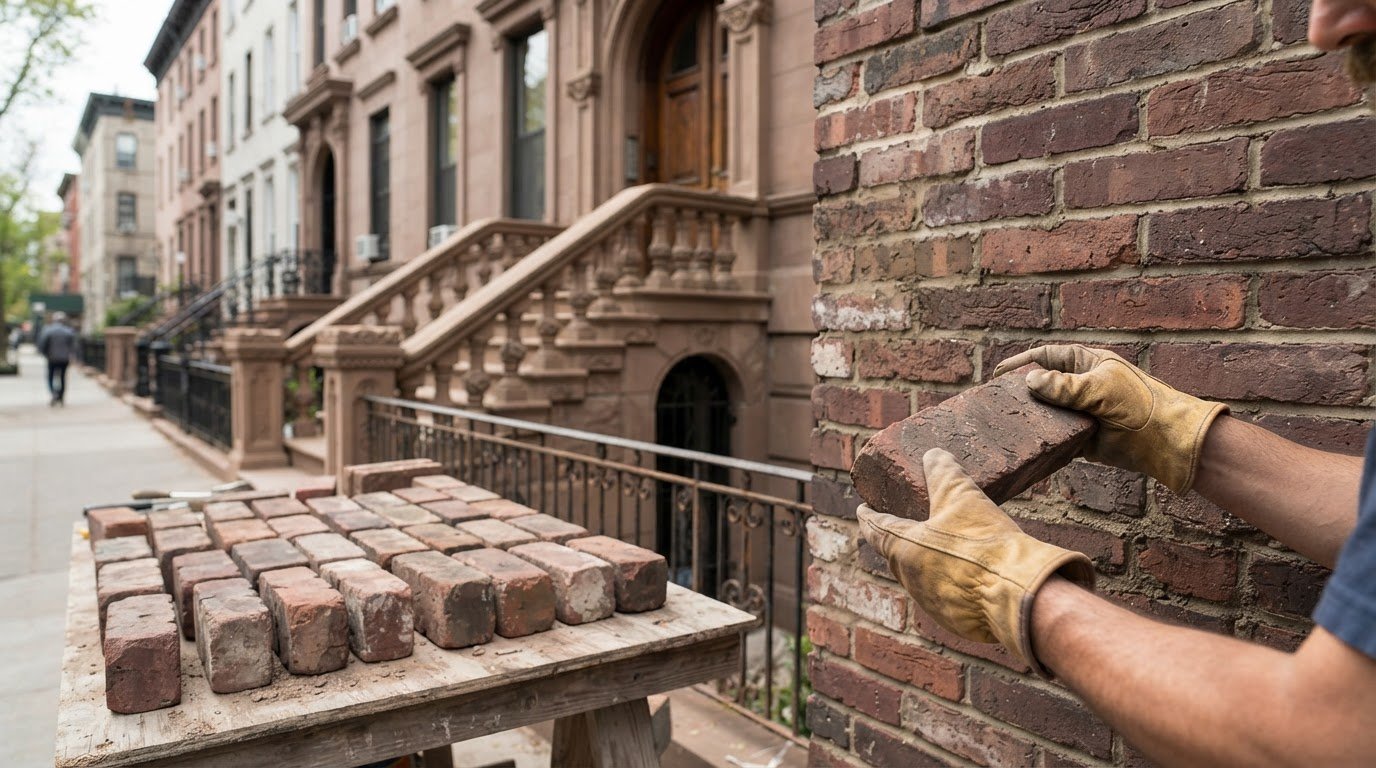
Salvaged historic brick is brick recovered from an older building or other structure for reuse. Its age can help preserve a wall’s historic character, but it doesn’t prove that a particular unit suits your facade. Compatibility depends on the existing masonry, not age alone. For brick replacement with salvaged historic bricks NYC, start with the wall that needs repair, not the reclaimed label.
Replacing an isolated unit may make sense when damage is limited and the surrounding brickwork and mortar remain sound. Repeated cracking, loose mortar, widespread surface loss, or recurring dampness can point to a broader masonry or facade problem. White deposits on the brick, for example, may also be a reason to look more closely at moisture conditions. Replacing individual bricks without understanding why they failed may leave the cause in place. Assess the affected area and the facade as a whole before settling on a repair.
How do you tell whether salvaged brick suits an older NYC wall?
Compare candidate units with nearby brick: dimensions, face texture, color, and natural variation. Look for visible cracks, crumbling edges, and other signs of deterioration, but don’t treat appearance alone as proof that a brick is sound enough for exterior use. A reclaimed label doesn’t guarantee a close match or suitability for the wall’s exposure. Building restoration also involves preserving historic integrity, which makes the surrounding masonry essential context. That principle matters on brownstone properties, where brickwork contributes to the facade’s architectural character. Progressive Contracting of NY’s historic brownstone facade restoration work considers repairs within that broader preservation context.
How to Compare Original, Salvaged, and New Brick for a Historic NYC Replacement
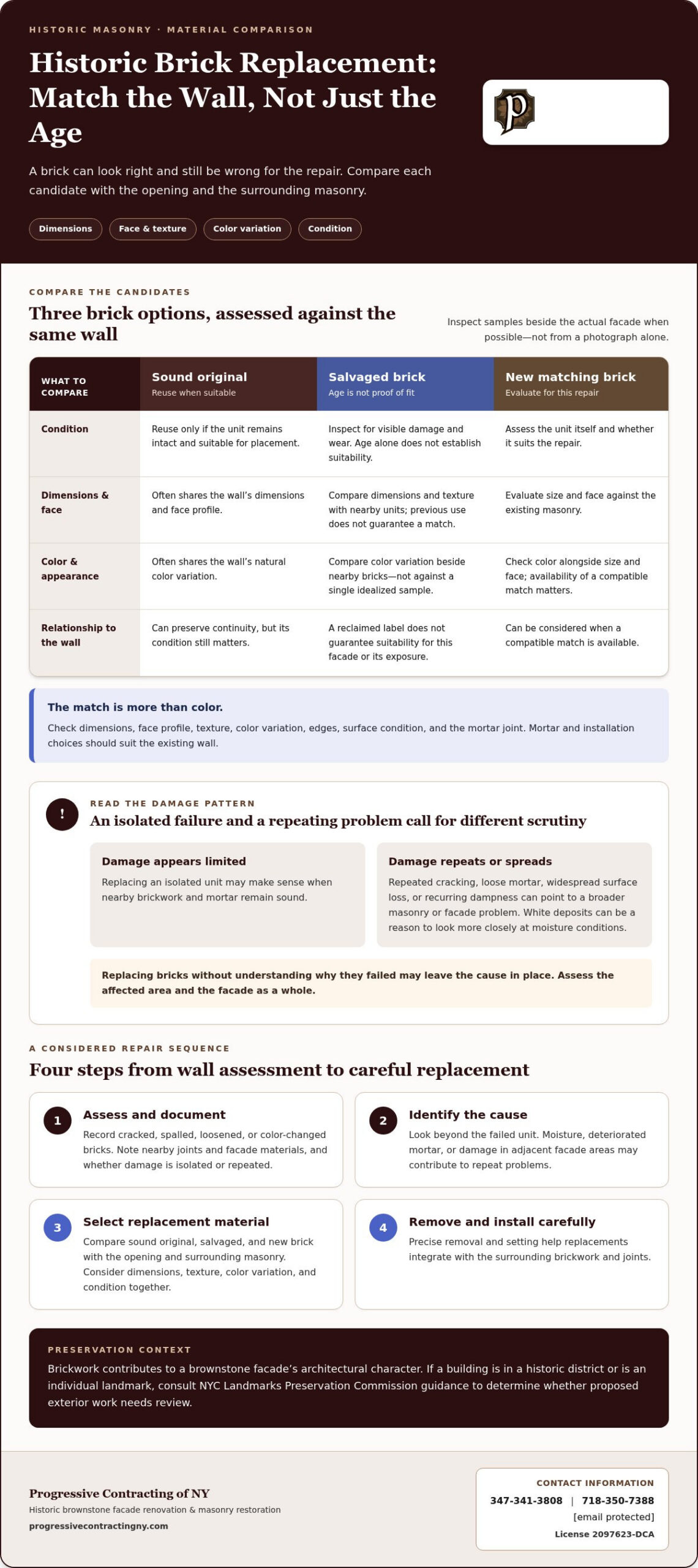
Compare each option against the specific opening and surrounding courses, not an idealized sample. A sound original brick may offer the closest fit, while salvaged and new units each need careful evaluation. Check dimensions first, then compare the face, color variation, and visible condition beside the existing wall.
| Option |
Condition |
Fit and appearance |
Relationship to the wall |
| Sound original brick |
Reuse only if the unit remains intact and suitable for placement. |
Often shares the wall’s dimensions, face profile, and natural color variation. |
Can preserve continuity, though its condition still matters. |
| Salvaged brick |
Inspect for visible damage and wear; age alone doesn’t establish suitability. |
Compare dimensions, texture, and color variation with nearby units. |
Its previous use doesn’t guarantee a match for this facade. |
| New matching brick |
Assess the unit itself and its suitability for the repair. |
Evaluate size, face, and color against the existing masonry. |
Can be considered where a compatible match is available. |
A successful match balances appearance with physical compatibility, because a brick must relate to the wall in both ways. For brick replacement with salvaged historic bricks NYC, assess dimensions alongside color before selecting units. A brick that looks close in a photograph may read differently beside the actual facade, so compare samples in place when possible.
What should a brick match include beyond color?
Check the face profile and texture, then compare color variation across several nearby bricks rather than relying on one sample. Look at the edges and surface condition too, since visible wear can make a replacement stand out even when its color is similar. The mortar joint also shapes the finished appearance and how the replacement sits within the masonry. Mortar and installation choices should suit the existing wall; the National Park Service Preservation Brief on Repointing Historic Masonry explains why historic joints need careful treatment. For related context, explore Progressive Contracting of NY’s brick pointing and facade restoration work. A methodical facade assessment keeps material selection tied to the character and condition of the wall.
What to Expect From Historic Brick Replacement on a NYC Property
A lasting repair follows a clear sequence. The goal is not simply to conceal a damaged spot, but to understand the wall, choose a fitting material, and carry out the replacement with care.
How does a careful NYC brick replacement project proceed?
- Assess and document the wall. Record where bricks have cracked, spalled, loosened, or changed color. Note the condition of nearby joints and facade materials, and whether the damage is isolated or repeated across the wall.
- Identify the cause. Look beyond the failed unit. Moisture, deteriorated mortar, or damage in adjacent facade areas may contribute to repeat problems. The repair plan should address the underlying condition where possible.
- Select replacement material. Compare sound original units, salvaged brick, and new matching brick with the opening and surrounding masonry before removal. Consider dimensions, face texture, color variation, and condition together.
- Remove and install carefully. An experienced masonry restoration contractor can remove failed units with precision and set replacements to integrate with the surrounding brickwork and joints.
For brick replacement with salvaged historic bricks NYC, this order helps avoid choosing material based on appearance alone, then discovering it doesn’t suit the repair. If brick damage sits alongside broader cracking, failing joints, or deterioration of brownstone elements, the scope may need to address the facade as a whole. Progressive Contracting of NY provides brownstone facade renovation and masonry restoration, including brownstone facade repair.
Property-specific preservation review also matters. If a building is in a historic district or is an individual landmark, consult NYC Landmarks Preservation Commission guidance to determine whether the proposed exterior work needs review. The property’s designation and the scope of work inform that next step.
Plan a Thoughtful Repair for Your Historic Facade
Treat the repair as part of the building’s ongoing care. A considered plan can help protect historic character while responding to the wall’s actual condition. With brick replacement with salvaged historic bricks NYC, the right choice is the one that fits the masonry and the needs of the property, not simply the one that looks oldest or closest at first glance.
Progressive Contracting of NY provides historic brownstone facade renovation and masonry restoration for properties in Brooklyn and Manhattan. Whether your property is in Park Slope, Bedford-Stuyvesant, the Bronx, or Queens, a focused discussion can help establish a clear starting point for your exterior masonry repair.
For a thoughtful plan for your historic facade, call 347-341-3808 or 718-350-7388, or email ProgressiveContractingNY@yahoo.com. License number 2097623-DCA.
Frequently Asked Questions
Can salvaged historic bricks be used to replace damaged bricks in a NYC facade?
Yes, salvaged brick can be considered if its condition and physical characteristics suit the existing masonry. A reclaimed label alone doesn’t establish that it’s sound or compatible. For a facade in Brooklyn, Manhattan, the Bronx, Queens, Park Slope, or Bedford-Stuyvesant, the decision should reflect the specific wall and repair. Brick replacement with salvaged historic bricks NYC calls for a project-specific assessment, not a blanket recommendation.
How do you match salvaged brick to an existing historic wall?
Compare a sample with the wall, considering dimensions, face texture, visible condition, and natural color variation. Look at it beside adjacent bricks and mortar joints, since the joint’s width and appearance affect how the unit reads in place. A sample comparison can guide selection, but it can’t promise an invisible or exact match. Judge the brick in the context of the facade, not on its own.
Is salvaged brick better than new brick for historic brick replacement?
Neither is automatically better for every property. Salvaged units may retain surface character that relates well to an older facade, while new brick may offer dimensions or an appearance that suits the opening. For example, a salvaged unit with worn edges may be a poor fit beside crisp surrounding brick. Base the choice on the condition and materials of the particular wall.
Does NYC require approval before replacing brick on a historic building?
Approval needs can depend on the property’s designation and the scope of the proposed work, so don’t assume one rule applies to every NYC building. Before work begins, use NYC Landmarks Preservation Commission guidance to check requirements for the specific property and repair. This is especially relevant when planning an exterior change to a building in a historic district or an individually designated landmark.