
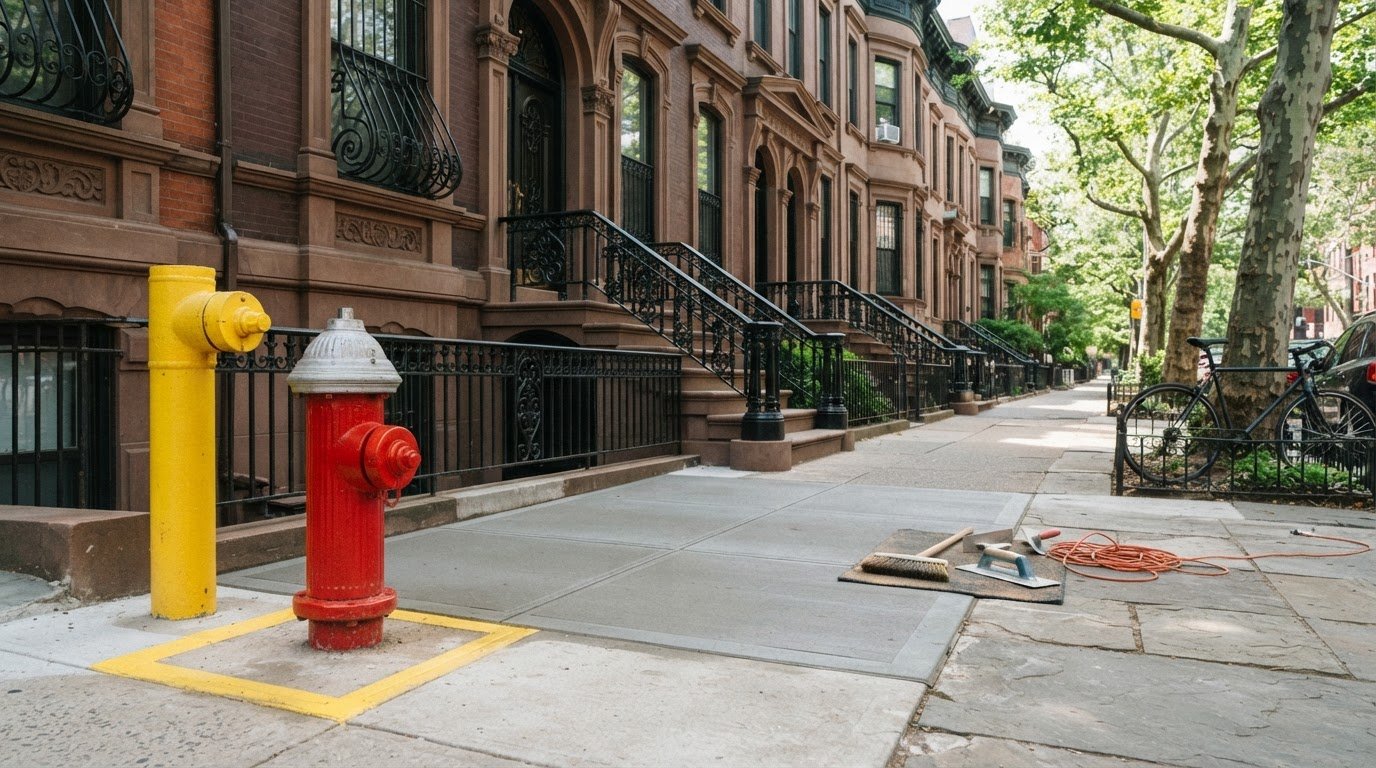
What if sidewalk repair is completed properly, but the work makes a fire hydrant harder to reach? NYC sidewalk repair requirements and hydrant access are separate considerations. Understanding the sidewalk repair adjacent to a fire hydrant NYC rules before work begins helps property owners define the concrete work, protect access, and identify which city guidance applies.
This guide covers practical steps for planning sidewalk repair near a hydrant. Progressive Contracting NY Corp provides sidewalk repair and violation-removal services in Brooklyn and Manhattan, including areas such as Bedford-Stuyvesant and Park Slope. Keep hydrant access in view as you plan the repair, and use current city guidance to confirm the requirements for your site.
Sidewalk Repair Beside a Fire Hydrant in NYC: What Rules Apply?
Repairing the sidewalk beside a hydrant does not authorize anyone to cover, alter, or obstruct it. Treat the concrete repair and the hydrant as separate parts of the site. Before scheduling work, review current city guidance for the sidewalk and for maintaining hydrant access. The sidewalk repair adjacent to a fire hydrant NYC rules depend on the work and site, so do not rely on a clearance measurement remembered from another project.
Which NYC agencies should a property owner check?
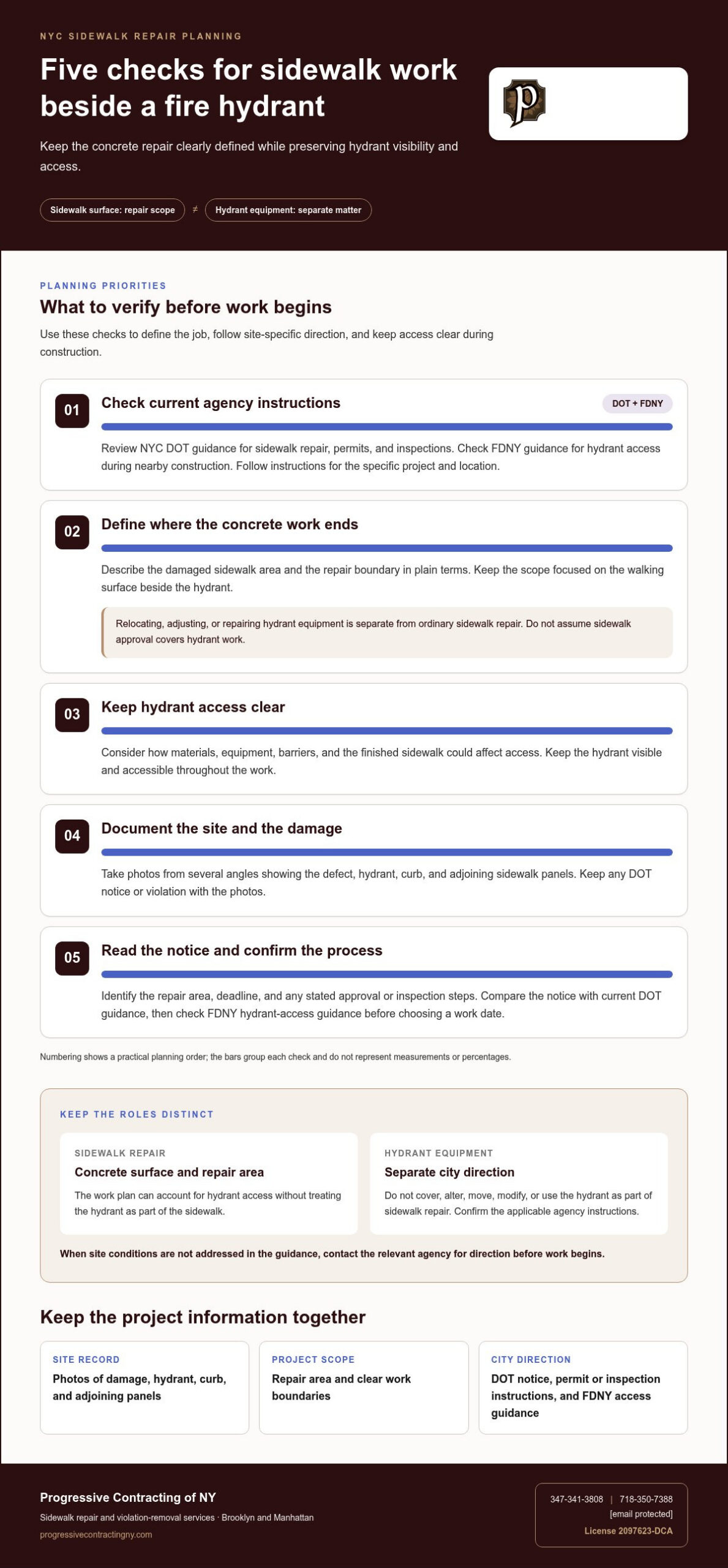
Review NYC DOT guidance for sidewalk repair, permits, and inspections that apply to the planned work. Check FDNY guidance for hydrant access during nearby construction. Read the instructions for your specific project and location, especially if a notice identifies a repair area or process. If agency guidance does not address your site conditions, contact the relevant agency for direction before work begins.
A hydrant must remain visible and accessible. The general Fire Hydrant Overview provides background, but it does not replace NYC requirements. Consider how materials, equipment, barriers, and the finished sidewalk could affect access. Keep the repair scope limited to the sidewalk surface. Do not move, modify, or use the hydrant as part of the work.
Sidewalk work repairs the walking surface; work on the hydrant itself is a separate matter that must follow the appropriate city direction. A crew may need to work close to a hydrant without treating it as part of the sidewalk repair. Before work starts, confirm the relevant DOT and FDNY instructions, then plan the work area so access remains clear while the work is underway.
How to Plan NYC Sidewalk Repair Near a Hydrant
Start by documenting the sidewalk and the hydrant’s position in relation to the damaged area. Take photos from several angles that show the defect, the hydrant, and nearby features such as the curb and adjoining sidewalk panels. Keep any DOT notice or violation with those photos. Then review current agency instructions before choosing a work date. The sidewalk repair adjacent to a fire hydrant NYC rules should guide what you verify, but official instructions take precedence.
What to confirm before work begins
Read any notice carefully. Identify the repair area, deadline, and any stated approval or inspection steps. Compare those details with current NYC DOT guidance, including its NYC DOT Sidewalk Regulations. Review FDNY guidance for protecting hydrant access during nearby construction. Approval for sidewalk work does not, by itself, authorize changes to hydrant equipment.
Define the work in plain terms: which damaged sidewalk area needs repair, and where does the work area end? Replacing or repairing concrete beside a hydrant is sidewalk-surface work. Relocating, adjusting, or repairing the hydrant involves the hydrant itself, so do not include that work in an ordinary sidewalk repair or assume the same approval covers both. Keep the sidewalk repair scope distinct from any instructions that apply to hydrant equipment.
Before scheduling, gather the DOT notice or violation, the proposed repair scope, and any permit or inspection instructions. Check current NYC DOT sidewalk guidance and FDNY hydrant-access guidance. During construction, keep hydrant access clear and follow the applicable instructions for setting up the work area. Progressive Contracting of NY handles the sidewalk repair scope, while the responsible city agencies provide official requirements and direction.
For a defined repair scope, Progressive Contracting of NY sidewalk repair service can help move the concrete work forward.
Getting NYC Sidewalk Repair Near a Hydrant Completed
A practical repair starts with a site review. The damaged surface, repair boundaries, and nearby hydrant should be considered together when planning the concrete work. If the city has issued a notice, include it in the review so the proposed work can be compared with the stated issue and current city instructions. The repair plan can account for access without treating the hydrant as part of the sidewalk.
What to expect from a local sidewalk repair contractor
Progressive Contracting of NY provides sidewalk repair and sidewalk violation-removal services. The work focuses on the concrete: reviewing the damaged surface, defining the repair area, and planning the repair with hydrant access in mind. City agencies determine applicable requirements and approvals. A contractor’s work plan does not replace official city direction.
If you have received a sidewalk notice, keep it available when discussing the repair scope and next steps. Review its details rather than assuming every sidewalk repair follows the same process. For additional context on violation-related expenses, see this NYC sidewalk violation removal cost guide. Use it as a reference, not as a quote for your project.
Make the site discussion specific: share the notice and photos, point out where the damaged concrete meets the hydrant area, and keep the relevant city instructions on hand. Progressive Contracting of NY can complete sidewalk repair and violation-removal work in Brooklyn and Manhattan, including Bedford-Stuyvesant and Park Slope. Owners in the Bronx and Queens can also use the same planning steps to distinguish sidewalk work from hydrant-related requirements.
Move Forward With a Clear Repair Plan
Before work is scheduled, make sure the scope reflects current city guidance for the site. The sidewalk repair adjacent to a fire hydrant NYC rules can affect how work is planned, so keep the repair focused on the sidewalk and maintain hydrant access throughout the project.
Progressive Contracting of NY provides sidewalk repair and sidewalk violation removal. Sharing the sidewalk condition, relevant photos, and any notice helps establish the physical repair scope and organize the next steps.
For sidewalk repair or violation-removal work in Brooklyn or Manhattan, contact Progressive Contracting of NY at 347-341-3808 or 718-350-7388, or email ProgressiveContractingNY@yahoo.com. License number 2097623-DCA.
With the repair scope clearly defined, you can move ahead with a practical plan to restore the sidewalk while keeping hydrant access in view.
Frequently Asked Questions
Does a sidewalk repair permit authorize work on a fire hydrant?
No. Do not treat a sidewalk repair permit as authorization to relocate, adjust, or repair hydrant equipment. Check the current permit scope and relevant agency instructions for sidewalk repair adjacent to a fire hydrant in NYC. If proposed work extends beyond the concrete surface, pause and seek direction from the responsible city agency before proceeding.
Who should I contact if a fire hydrant is damaged during sidewalk repair?
Contact FDNY through its current official reporting channel if the hydrant is damaged, and notify the contractor or site supervisor promptly. If the damage also affects the sidewalk, check with NYC DOT about the sidewalk issue. For an active leak or immediate danger, use NYC’s emergency reporting channels without delay. Record the location and take photos only if it is safe.
How can I check whether my NYC sidewalk has an active violation?
Use NYC DOT’s official sidewalk violation lookup or contact 311 to ask how to check the status for the property address. Keep any notice you received nearby so you can compare its details with the city’s record. This step is useful for owners in Brooklyn, Manhattan, the Bronx, Queens, Bedford-Stuyvesant, and Park Slope who need to determine whether a property has an existing notice to address.