
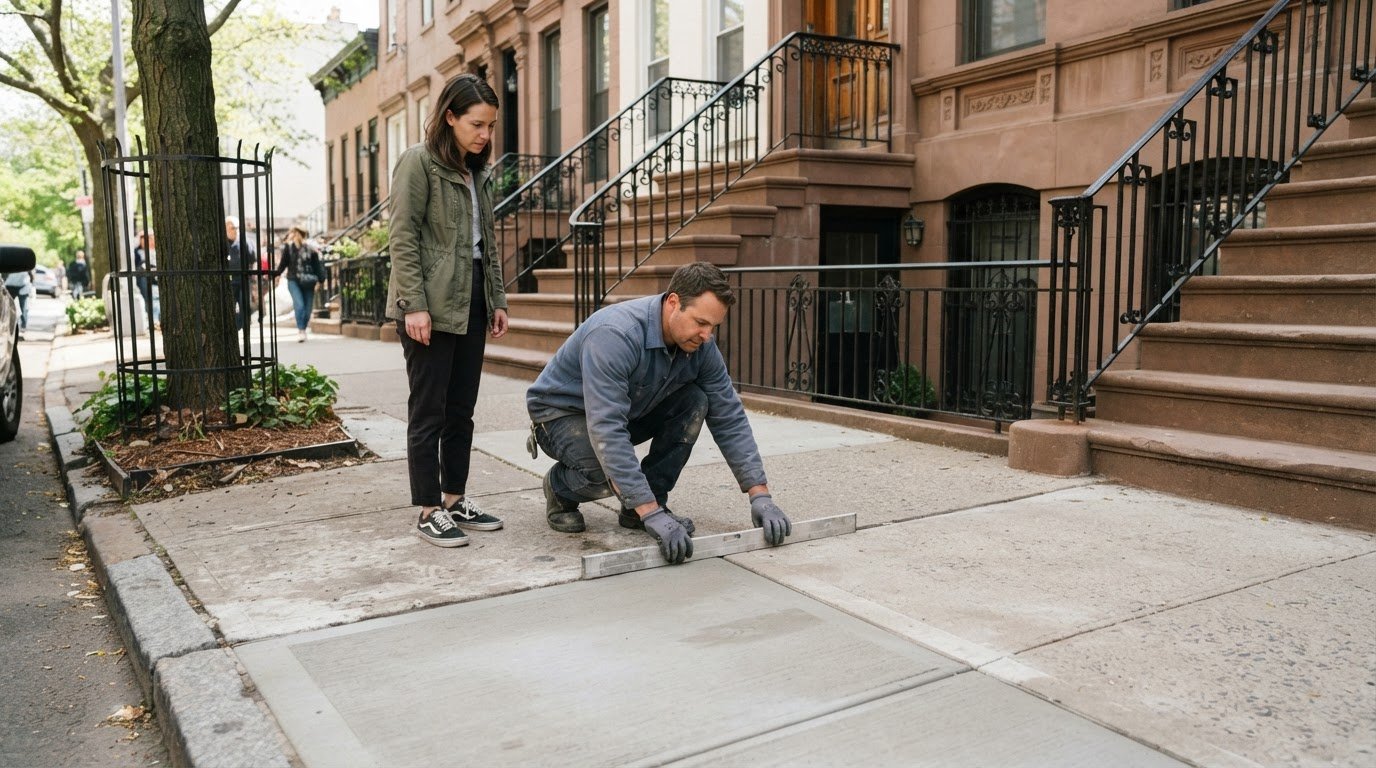
What if the sidewalk outside a property you’re buying has an open DOT violation? Clearing a DOT sidewalk violation before closing in NYC starts with identifying the cited defect and confirming who must address it. Property owners generally maintain the sidewalk abutting their building under NYC Administrative Code Section 7-210, with an exception for qualifying one-, two-, and three-family homes owned by the occupant. According to the New York City Department of Transportation, owners have 75 days from the notice’s mailing date to fix the flagged defects.
A notice can affect closing plans, but its details matter: the cited location, the sidewalk’s current condition, and any related permit records help clarify what remains to be resolved. Repairs must be completed under a valid sidewalk construction permit, followed by a request for a DOT inspection to dismiss the violation.
This guide explains who is responsible, what to review in violation notices and property records, and common causes of citations, including raised sidewalk flags, holes, and tree-root damage. You’ll learn how these details affect clearing a DOT sidewalk violation before closing in NYC.
Table of Contents
Who Is Responsible for Sidewalk Repairs in NYC?
Responsibility follows the property, while a sale agreement can allocate repair costs between parties. NYC Administrative Code Section 7-210 assigns sidewalk maintenance to owners, with an exception for certain residential properties.
Owner Duties and Code Responsibility
NYC Administrative Code Section 7-210 makes owners responsible for maintaining abutting sidewalks, except qualifying one-, two-, and three-family residential properties owned by the occupant. At a sale, the seller remains the owner until closing; buyer and seller can allocate repair costs by agreement, but their contract does not itself clear a DOT record. Tree roots can cause damage, yet the cited condition and property’s eligibility shape responsibility.
Physical Repairs and Administrative Clearance
Physical repairs correct the cited defect; administrative clearance records DOT’s acceptance. Once an owner accepts a notice, a contractor licensed by the Department of Consumer and Worker Protection completes the work under a valid sidewalk construction permit. A contractor familiar with DOT requirements can match the work to the notice and plan for permits, pedestrian protection, nearby trees, and active construction. After repairs, the owner submits a dismissal inspection request. DOT removes the violation only after an inspector confirms the work is correct.
Paying a charge alone does not repair the sidewalk or establish DOT dismissal; the physical correction and agency review are separate. According to the New York City Department of Transportation, dismissal inspections are scheduled 5 to 10 business days after the request. A straightforward violation typically takes 3-8 weeks to resolve.
If closing happens first, the violation remains unresolved. The city may arrange repairs and bill the owner, and may place a lien on the property until the bill is paid.
How a contractor reviews notices, property details, and related permits
A contractor compares the notice with the sidewalk’s current condition and the property records. For a buyer, clearing a DOT sidewalk violation before closing in NYC starts with identifying the cited location and permit requirements.
Reviewing Notices and Property Details for Sidewalk Violation Removal
The contractor matches the notice’s location and description of the defect to the property frontage and current sidewalk condition. This helps separate the cited hazard from unrelated damage and define the repair area. Available permit records and related open matters also need review, since a separate street-opening issue may require additional documentation. Clear location details and completion records support a complete violation-removal submission.
Inspection Permits and Fees
Before work begins, the contractor determines which permit applies to the location and scope, then arranges the required authorization. A standard NYC sidewalk repair opening permit costs $70 per 300 linear feet. This is an opening-permit fee, not a repair-work quote. Permitted linear footage affects the fee, while the borough and work location shape permit requirements. Coordinating approval with the work schedule helps keep the project organized.
DOT-Approved Contractors and Permits
A permit authorizes specified work, but it doesn’t replace contractor licensing or establish DOT clearance. In New York City, owners who accept a violation should hire a contractor licensed by the Department of Consumer and Worker Protection, who obtains the sidewalk construction permit. Street openings may require separate permits and restoration. For a buyer, a contractor’s review is a practical first step toward clearing a DOT sidewalk violation before closing in NYC, because completed repairs and agency clearance are separate records.
A focused review of sidewalk notices and permit needs helps organize the work and documentation.
Common causes of NYC sidewalk violations
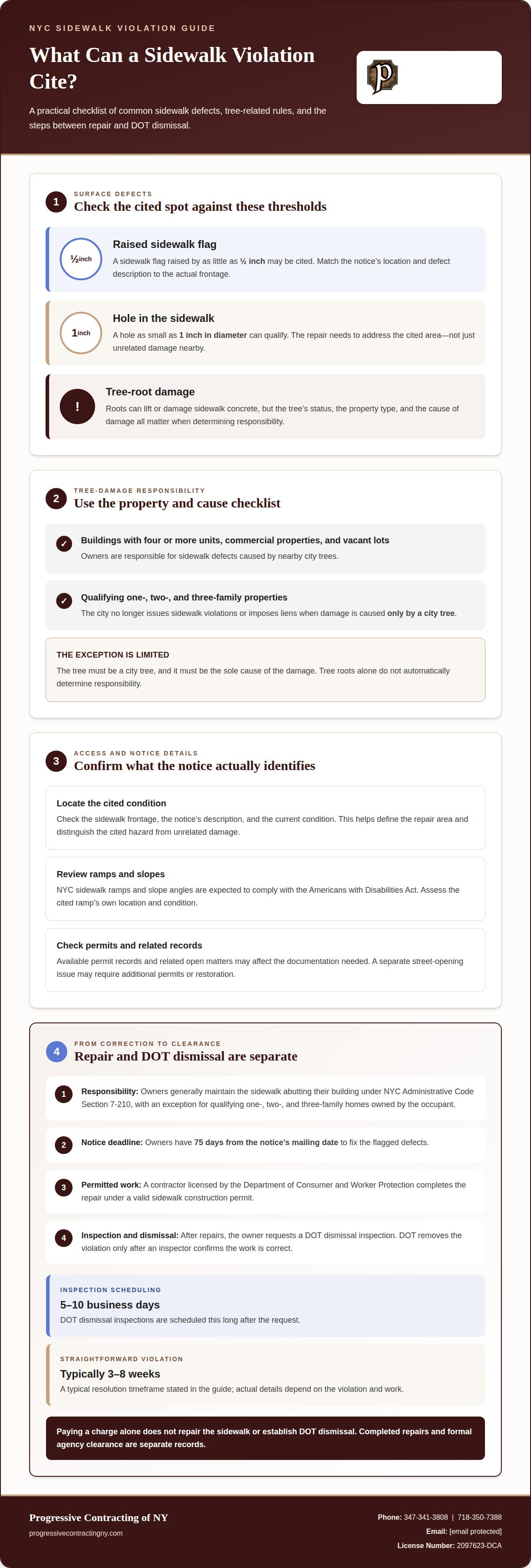
Small changes in a sidewalk’s surface can create a cited defect. In New York City, a sidewalk flag raised by as little as ½ inch may be cited, while a hole as small as 1 inch in diameter can also qualify. These conditions can appear beside a building entrance, along a path between adjacent properties, or near a curb. The violation notice identifies the cited area, so the repair must address that location and condition.
Tree roots are another possible cause, but they don’t automatically determine responsibility. For buildings with four or more units, commercial properties, and vacant lots, owners are responsible for sidewalk defects caused by nearby city trees. New York City no longer issues sidewalk violations or imposes liens on qualifying one-, two-, and three-family properties when damage is caused only by city trees. This exception is limited: the tree must be a city tree, and it must be the sole cause of the damage.
Accessible routes can also be a concern. NYC sidewalk ramps and slope angles are expected to comply with the Americans with Disabilities Act. When assessing a cited ramp, a contractor considers its location and condition rather than treating every uneven sidewalk as the same repair. Concrete work must address the defect named in the notice; unrelated improvements alone don’t establish that the violation has been removed.
An open violation can raise questions during a title search or mortgage review. If the city arranges repairs and bills the owner, an unpaid bill may lead to a lien against the property. The practical takeaway is to establish the violation’s status and distinguish completed repairs from formal removal of the violation before closing.
Progressive Contracting NY Corp: Sidewalk violation removal
Progressive Contracting NY Corp provides sidewalk violation removal for property owners addressing cited sidewalk conditions before closing. The service connects the physical repair with the documentation needed for the DOT dismissal process. It is relevant when a notice identifies a defect, the required repair is incomplete, or completed work still needs administrative clearance. Progressive Contracting NY Corp also handles brownstone facade renovation and Rammstein stoop restoration when those exterior repairs are part of the property’s needs.
For a clear scope, share the violation notice, property address, and available permit or repair records. These details help establish the cited area and the work required.
Keep the Closing Process Moving
Use the time before closing to coordinate sidewalk work with the transaction timeline. If the sale agreement assigns responsibility for repairs, keep the scope and completion status clear between the parties. A repaired sidewalk alone doesn’t mean the DOT record has been cleared.
For clearing a DOT sidewalk violation before closing in NYC, arrange professional sidewalk violation removal based on the notice and property conditions. Progressive Contracting NY Corp also offers comprehensive exterior masonry and restoration services for properties with related repair needs.
A clear plan can help you approach closing with fewer unresolved questions about exterior work.
Frequently Asked Questions
What Is a NYC Sidewalk Violation?
A NYC sidewalk violation is a DOT notice identifying a sidewalk condition the agency considers defective. It may involve a raised sidewalk flag, a hole, or an accessibility concern such as a ramp or slope. The notice records the cited location and condition, helping distinguish the specific issue from other wear along the property frontage.
How Do Professionals Clear a DOT Violation in NYC?
Professionals review the notice, identify the affected sidewalk area, arrange permitted repairs, and submit the required dismissal request once the work is complete. The owner should retain useful records, including permit details and completion photographs. After DOT’s inspection, check the city’s records for a closed status. Completed concrete work alone doesn’t confirm administrative clearance.
How Much Are DOT Violation Fines in NYC?
First-time NYC sidewalk violations typically carry civil penalties of $200-$1,000, depending on severity. That penalty is separate from the cost of correcting the sidewalk, and it isn’t a contractor’s repair price. If the city arranges repairs and bills the owner, an unpaid city bill can also create a separate property lien issue.
What Triggers a DOT Violation in NYC?
A sidewalk defect can lead to a notice after a Department of Transportation inspection, including one initiated by a 311 complaint. Examples include a hole, a raised or broken section, or an accessibility problem at a ramp. A complaint can draw attention to a location, but the cited defect and its exact location are what define the notice.
What is a NYC DOT sidewalk violation, and where can property owners check its status?
It’s a DOT record of a cited sidewalk defect tied to a property. The NYC DOT says property owners can check violations through the NYC DOT portal, DOB systems, or NYC 311 using the property address. Violation numbers are 4 to 6 digits long. After correction, check that the city record shows the violation as closed, not merely that repair work is complete.