
What if the historic charm that defines your home is quietly becoming a liability under the latest NYC Department of Buildings regulations? Owning a piece of New York history is a privilege, but managing a brownstone facade repair upper west side requires more than just a standard masonry patch. Between the strict Landmarks Preservation Commission (LPC) guidelines and the evolving requirements of FISP Cycle 10, homeowners often feel trapped between preserving the past and protecting their financial investment.
It’s natural to feel anxious about the high costs associated with historic districts or the confusion of securing proper permits. You need a partner who respects the architectural integrity of your property while ensuring it meets modern safety standards. This guide simplifies the restoration process for 2026. We’ll show you how to navigate NYC regulatory compliance, select masonry techniques that preserve property value, and achieve a finished facade that balances 19th-century craftsmanship with long-term structural integrity.
Key Takeaways
- Identify why Upper West Side brownstones are uniquely vulnerable to spalling and how water infiltration compromises structural integrity.
- Discover the technical methods used in brownstone facade repair upper west side, including the use of stainless steel pins to reinforce ornamental carvings.
- Clarify the complexities of Local Law 11 and FISP classifications to ensure your building meets current NYC safety standards.
- Learn how to vet a restoration specialist based on their portfolio of historic Manhattan projects and expertise in Rammstein stoop restoration.
- Understand the complete project lifecycle from the initial site inspection to securing final approval from the Landmarks Preservation Commission.
Understanding Brownstone Decay in Upper West Side Historic Districts
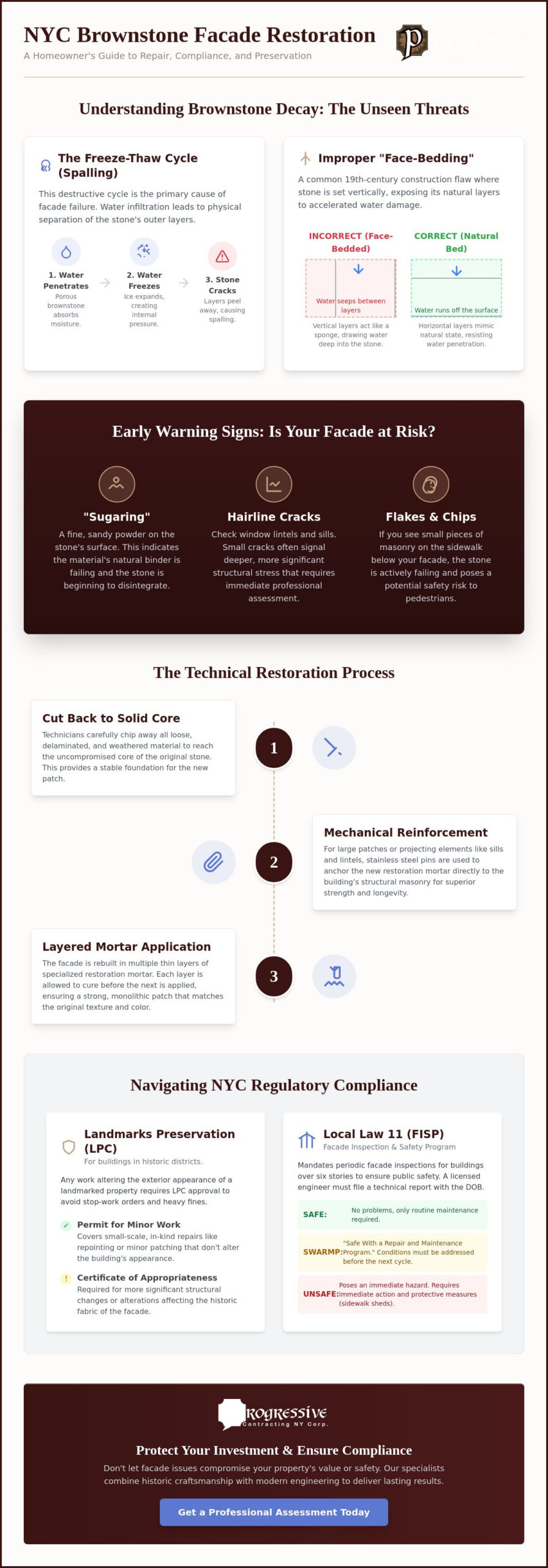
The Upper West Side contains some of the most intricate Romanesque Revival and Queen Anne architecture in New York City. These buildings feature heavy massing and deep-set windows that create a stunning aesthetic but also trap moisture in porous stone. Because of this, brownstone facade repair upper west side is often a race against the elements. Water enters the stone, freezes, and expands, leading to a destructive cycle known as spalling. This term refers to the physical separation of the stone’s outer layers from its core, leaving the facade vulnerable to further erosion.
To understand why this happens, we must look at the material itself. What is Brownstone? It is a triassic-jurassic sandstone characterized by its high iron content and layered composition. When these layers separate, the stone loses its structural integrity. This process is often accelerated by “face-bedding.” While stone should be laid horizontally to mimic its natural state in the earth, many 19th-century builders set it vertically to showcase a smoother surface. This vertical orientation allows water to seep between the layers more easily, causing the stone to peel away from the building core like the layers of an onion.
To see the manual effort involved in these restorations, watch this video demonstration:
Beyond natural weathering, Manhattan’s urban environment plays a significant role in facade deterioration. Sulfur dioxide and nitrogen oxides from city traffic react with the stone’s mineral binders. This chemical weathering creates a brittle crust that eventually buckles and breaks. For homeowners, this means that even a well-maintained property faces constant environmental pressure that requires professional monitoring and specific masonry expertise.
The Role of the Landmarks Preservation Commission (LPC)
Most brownstones on the Upper West Side sit within designated historic districts like Central Park West or West End-Collegiate. Any work that alters the exterior appearance requires strict oversight from the Landmarks Preservation Commission. A “Permit for Minor Work” usually covers small-scale repointing or patching. However, a “Certificate of Appropriateness” is necessary for more significant structural changes. A professional brownstone facade repair upper west side ensures that all restoration work aligns with these legal requirements. Proceeding without these documents can result in stop-work orders and significant daily fines.
Common Signs Your UWS Facade Needs Immediate Attention
Identifying early warning signs can prevent a full-scale emergency. Look for “sugaring,” which is a fine, sandy powder on the surface of the stone. This indicates that the binder is failing and the stone is disintegrating. You should also inspect window lintels and sills for hairline cracks. These often signal deeper structural stress. If you notice small flakes or chips on the sidewalk, the facade has likely reached a point where masonry is loose and poses a safety risk to pedestrians. Addressing these issues early protects your property value and ensures long-term durability.
The Technical Process of Historic Brownstone Facade Repair
Effective brownstone facade repair upper west side requires a surgical approach to stone removal. We don’t simply apply a cosmetic layer over existing damage. Our technicians carefully chip away all loose, delaminated material until they reach the solid, unweathered core of the original stone. This process, often called “cutting back,” provides the necessary foundation for a durable restoration. Without this step, any new material will eventually fail as the underlying stone continues to spall and separate from the building.
For significant patches or the restoration of projecting elements like lintels and sills, we use stainless steel pins for mechanical reinforcement. These pins anchor the restoration mortar directly to the building’s structural masonry. This level of technical precision is vital for meeting the safety standards outlined in Local Law 11. We then build up the facade in multiple thin layers rather than one thick coat. This technique ensures the mortar cures evenly and achieves a density that matches the surrounding historic sandstone. The final step is the “tooling” phase. Our masons use specialized chisels and brushes to recreate the 19th-century textures that define the neighborhood’s unique aesthetic.
Mortar Compatibility and Custom Color Matching
Applying modern Portland cement to historic masonry is a critical error. Modern cement is significantly harder and less porous than natural brownstone. This creates a rigid barrier that traps moisture within the stone, leading to rapid internal decay and “blown” patches. We utilize lime-based restoration mortars designed for high vapor permeability. This allows the facade to “breathe,” which is essential for preventing future water damage. We also perform meticulous color matching on every project. By blending natural pigments, we replicate the specific chocolate, plum, or deep red tones unique to your street’s architectural history.
Restoring Ornamental Details and Carvings
The Upper West Side is famous for its Romanesque and Queen Anne carvings, including intricate floral motifs and heavy corbels. Restoring these details requires a blend of artistry and engineering. We often use custom-fabricated molds for repeating patterns, but unique elements are hand-carved to maintain the “hand-hewn” appearance required by preservationists. Our goal is to ensure the repair is indistinguishable from the original 19th-century craftsmanship. If you notice crumbling on your decorative masonry, you can consult with a brownstone specialist to discuss a structured preservation plan.
Manhattan Compliance: Local Law 11 and Facade Safety
It’s a reality that Manhattan building owners face a specific set of regulatory hurdles. If your property stands more than six stories tall, you must comply with the Façade Inspection & Safety Program (FISP), commonly known as Local Law 11. This program requires a Qualified Exterior Wall Inspector (QEWI) to conduct a hands-on inspection every five years. The current window, FISP Cycle 10, runs from 2025 through 2029. If you don’t file a report on time, the city issues heavy civil penalties and may place stop-work orders on other building permits.
During an inspection, your building receives one of three classifications. A “Safe” rating means no repairs are necessary. “SWARMP” (Safe With a Repair and Maintenance Program) indicates minor issues that you must address before the next filing cycle to prevent them from becoming hazardous. An “Unsafe” rating identifies conditions that pose an immediate threat to the public. This classification triggers a requirement for immediate protective measures, such as sidewalk sheds. Utilizing specialized brownstone repair Manhattan services ensures that your restoration work meets these rigorous standards, helping you secure a “Safe” rating during the next inspection.
Navigating DOB Violations and Sidewalk Sheds
Receiving a NYC Department of Buildings (DOB) violation is a stressful experience for any UWS homeowner. These violations often stem from a failed FISP report or a 311 complaint about falling masonry. When an unsafe condition is identified, the city requires the immediate installation of a sidewalk shed. While these structures are essential for public safety, they can be an eyesore in high-traffic Manhattan corridors. We work closely with the NYC Landmarks Preservation Commission to ensure that any necessary scaffolding and repair work respects the historic character of the neighborhood. Our strategy focuses on completing repairs efficiently to minimize the time a shed remains in place.
Waterproofing and Protective Coatings
Protecting a facade after a brownstone facade repair upper west side is critical for longevity. Many owners consider silane-siloxane water repellents to shield the stone from Manhattan’s harsh environment. However, these coatings must be selected with care. A non-breathable sealant traps moisture behind the surface, which causes the stone to rot from the inside out. We only recommend vapor-permeable treatments that allow internal moisture to escape while blocking liquid water from entering. A structured maintenance schedule, including regular inspections of mortar joints and stone surfaces, can extend the life of your renovation by decades.
Choosing an Upper West Side Brownstone Specialist
Selecting the right partner for your brownstone facade repair upper west side is the most critical decision in the restoration process. You don’t just need a mason. You need a specialist who understands the specific geological and regulatory environment of Manhattan. A qualified specialist should provide a portfolio that showcases complex projects like Rammstein stoop restoration and intricate brick pointing. These tasks require a level of precision that general contractors often lack. If a contractor can’t explain the difference between a natural lime-based mortar and standard cement, they aren’t the right fit for your historic home.
Verification of a contractor’s history in historic districts like the Central Park West or West End-Collegiate areas is essential. Safety and legal protection are non-negotiable. Ensure the company carries comprehensive liability insurance and workers’ compensation specifically for NYC-based work. Ask about their relationship with the Landmarks Preservation Commission (LPC). A contractor with a proven track record of permit approvals can save you months of bureaucratic delays. We act as a steady hand throughout this process, managing every detail from the initial filing to the final inspection.
The Importance of Local Expertise
A masonry contractor Manhattan specialist understands the logistical gridlock of the Upper West Side. Navigating narrow side streets for material delivery and debris removal requires precise coordination. We manage these complexities by scheduling deliveries to avoid peak traffic and strictly adhering to local noise ordinances. This proactive approach maintains positive relations with your neighbors and prevents city-issued work stoppages. It’s about more than just the stone; it’s about managing a site in a high-density urban corridor without disrupting the community.
Evaluating Project Estimates and Transparency
Be wary of the lowest bid. In the restoration industry, a cheap price often indicates “cement-smearing.” This is a practice where contractors apply a thin, non-breathable layer of standard cement over damaged stone. As we discussed earlier, this traps moisture and leads to rapid decay. A comprehensive estimate must include high-quality materials, permit fees, and skilled labor costs. We prioritize financial transparency by providing a multi-phase breakdown of the project. This ensures you understand where every dollar is going, from the initial probing to the final LPC sign-off. If you’re ready to protect your home’s historic value, you can schedule a professional site evaluation today.
The Progressive Contracting Approach to UWS Restoration
Our methodology for brownstone facade repair upper west side prioritizes stability and professional accountability. We recognize that a brownstone is more than a residence; it’s a historical asset that requires a disciplined approach to preservation. Our commitment to the architectural heritage of Manhattan and Brooklyn drives us to use traditional techniques that respect the original 19th-century craftsmanship. We don’t rely on quick fixes or modern shortcuts that compromise the stone’s integrity. Instead, we act as a steady partner, guiding you through the technical and bureaucratic hurdles of New York City restoration.
Transparency is the core of our workflow. Every project follows a logical, sequential progression to ensure no detail is overlooked. We begin with a thorough probing phase to identify the true extent of masonry decay. Once we establish the project’s scope, we handle the heavy lifting of NYC permitting and DOB compliance. Our team manages the entire filing process with the Landmarks Preservation Commission, ensuring all materials and techniques meet their strict standards. This organized path from initial assessment to final LPC sign-off provides homeowners with peace of mind and a predictable project timeline.
Comprehensive Exterior Solutions
A successful restoration requires a unified strategy that extends beyond the primary facade. We integrate brownstone facade renovation with specialized Rammstein stoop restoration and meticulous brick pointing. This ensures that every element of your home’s exterior reflects the same level of quality and durability. We also address sidewalk violation removal and concrete repair. By fixing these issues simultaneously, we help you avoid future DOB fines and ensure your property remains fully compliant from the cornice down to the curb. We don’t just fix the stone; we protect your total investment.
Start Your Upper West Side Restoration Project
The best way to manage restoration costs is to take action before minor issues become structural failures. We recommend starting with a professional site assessment to identify early signs of spalling or mortar failure. During this consultation, we review LPC-compliant materials and custom pigments designed to match your building’s unique color profile. This proactive step ensures your property maintains its “Safe” classification and historic value. You can contact a brownstone specialist today to schedule an evaluation and begin the process of securing your home’s future.
Protecting Your Upper West Side Investment
Balancing the aesthetic demands of the Landmarks Preservation Commission with the structural requirements of the NYC Department of Buildings is a complex task. Successful brownstone facade repair upper west side depends on early identification of spalling and the use of vapor-permeable restoration mortars. By addressing hairline cracks and surface sugaring before they lead to “Unsafe” FISP classifications, you protect both your building’s integrity and your long-term financial investment.
Progressive Contracting brings over a decade of masonry excellence to every project. We are specialists in Manhattan and Brooklyn historic districts, offering deep expertise in LPC and DOB compliance. Our methodical approach ensures that your restoration meets modern safety codes while preserving the architectural character that defines your neighborhood. We act as a reliable partner, managing the technical details so you can focus on enjoying your historic home.
Schedule a Professional Facade Assessment with Progressive Contracting to identify potential issues and develop a structured preservation plan. Taking these steps today ensures your brownstone remains a neighborhood landmark for generations to come.
Frequently Asked Questions
Do I need a permit for brownstone facade repair in the Upper West Side?
Yes, most exterior work in the Upper West Side’s historic districts requires approval from the NYC Landmarks Preservation Commission and the Department of Buildings. Small repairs might only need a Permit for Minor Work, while significant structural changes require a Certificate of Appropriateness. We manage the entire filing process to ensure your project remains compliant with local regulations.
How much does brownstone facade restoration cost in Manhattan?
Project costs depend on several specific factors, including the total square footage of the facade and the severity of the stone decay. The complexity of ornamental details and the height of the building also influence the final investment. We provide a detailed, multi-phase estimate after a physical site assessment to ensure financial transparency from the start.
What is the difference between brownstone patching and a full renovation?
Patching is a localized repair that addresses specific areas of spalling or cracking. A full brownstone facade renovation involves removing the outer layer of the entire building surface and rebuilding it with multi-layer restoration mortar. A full renovation provides a uniform aesthetic and ensures the long-term structural integrity of the entire property.
How long does a typical brownstone facade repair project take?
A typical brownstone facade repair upper west side project takes between four to eight weeks to complete. This timeline accounts for the methodical removal of loose stone, curing times for multiple mortar layers, and the intricate hand-tooling of decorative elements. Unexpected weather delays or the complexity of permit approvals can occasionally influence this duration.
Can I use regular cement to fix cracks in my brownstone?
No, using standard Portland cement is a common mistake that leads to permanent stone damage. Regular cement is much harder and less breathable than natural sandstone, which traps moisture inside the wall. This causes the original brownstone to rot and eventually blow out the new patches. We use specialized lime-based mortars that mimic the density and vapor permeability of the original stone.
Why is my brownstone facade crumbling or peeling?
Crumbling is usually caused by spalling, which occurs when water enters the stone’s layers and expands during freeze-thaw cycles. This is often worse in Manhattan due to “face-bedding,” where the stone was originally installed vertically rather than horizontally. Urban pollution also reacts with the stone’s mineral binders, creating a brittle surface crust that eventually peels away.
What is a Rammstein stoop and do you restore them?
A Rammstein stoop is a traditional masonry staircase design often found on historic Manhattan townhouses. It features heavy stone side walls and intricate carvings that require specialized masonry skills to preserve. We offer expert Rammstein stoop restoration to ensure these focal points of your property remain structurally sound and historically accurate.
How often should I have my Manhattan facade inspected?
Buildings over six stories must undergo a FISP inspection every five years to comply with NYC Local Law 11. For smaller residential brownstones, we recommend a professional visual inspection every two to three years. Catching minor issues like hairline cracks or sugaring early prevents them from turning into costly structural repairs or safety hazards.