
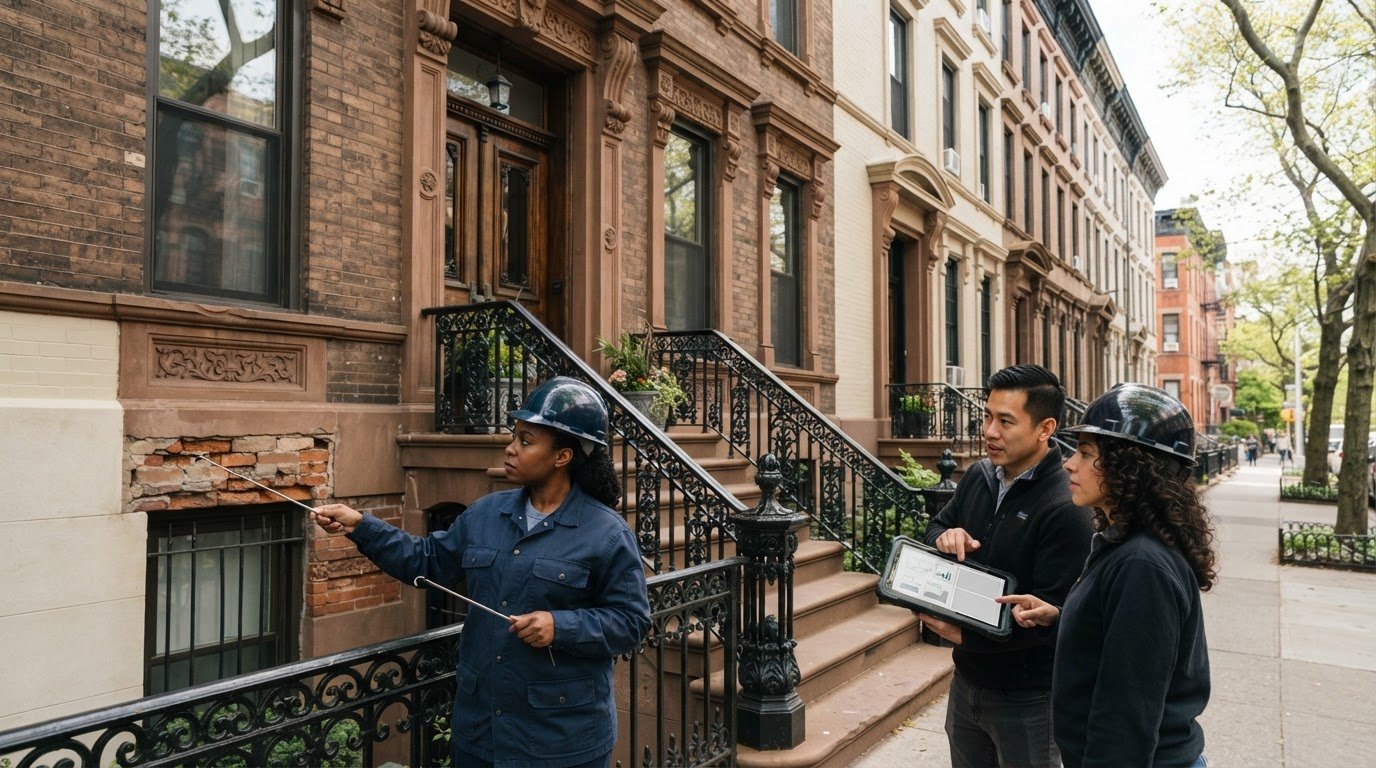
What if the same cracked brick could point to more than one repair, and a broad estimate didn’t explain which one your building needs? For owners considering historic brick facade restoration NYC, uncertainty about the cause and extent of damage can make contractor recommendations difficult to compare. A useful survey turns visible symptoms into documented findings and a clearer starting point for planning restoration.
This article explains what a brick facade assessment can record, how to compare findings and proposed work, and what to ask a contractor before agreeing on a scope. Progressive Contracting NY Corp specializes in exterior masonry and historic brownstone facade renovation. A formal survey or written report should not be assumed as part of its services. Contact: 347-341-3808, 718-350-7388, ProgressiveContractingNY@yahoo.com. License number: 2097623-DCA.
Historic Brick Facade Restoration in NYC: Why Start With a Condition Survey?
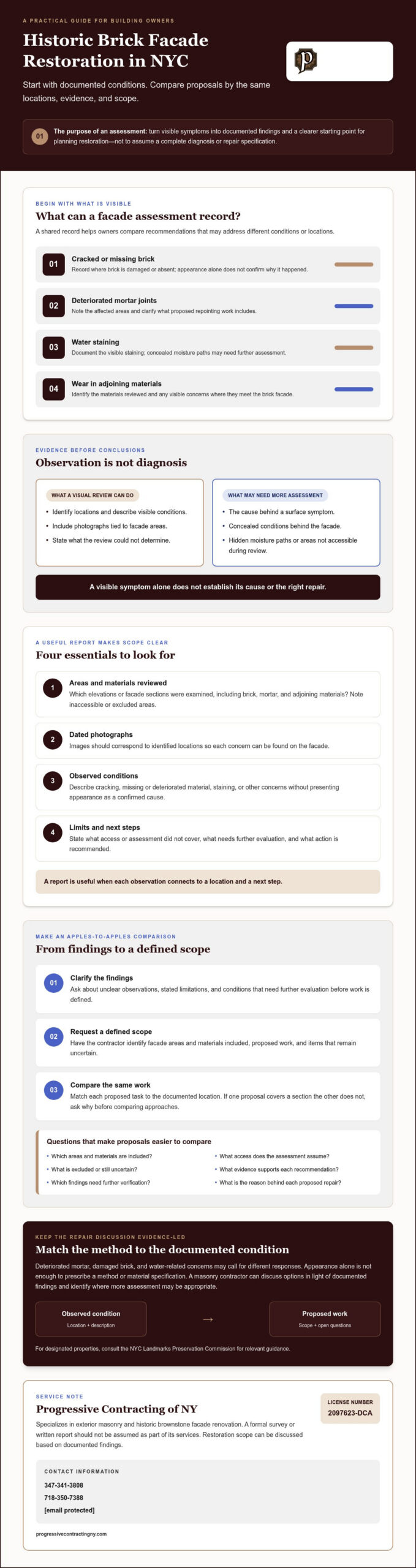
Before comparing restoration proposals, establish what each one addresses. A facade survey records observed conditions, but it is not automatically a complete diagnosis or repair specification. For historic brick facade restoration NYC, documenting where brick is cracked or missing, mortar joints are deteriorated, water staining appears, or adjoining materials show wear gives owners a shared reference for discussing scope.
This record can help distinguish proposals that address the same locations and visible concerns from those that assume different work. For example, one contractor may recommend renewing mortar joints while another proposes replacing damaged brick. Understanding the repointing process can help owners ask what the mortar work includes. A visible symptom alone does not establish its cause or the right repair.
What can an initial brick facade assessment establish?
A clear initial assessment can identify locations, describe visible conditions, include photographs, and state what the review could not determine. It should separate observations from recommendations. An initial visual assessment records what can be seen; further investigation may be needed to understand concealed conditions. Don’t treat a surface appearance as proof of the underlying cause. Hidden moisture paths or conditions behind the facade may call for additional assessment before a repair approach is set.
If you’re seeing crumbling masonry, see “Brownstone Spalling Repair: How to Stop and Fix Facade Crumbling in 2026” for related guidance. Progressive Contracting of NY specializes in exterior masonry and historic brownstone facade renovation and can discuss restoration scope based on documented findings. Formal survey or report services should not be assumed. Contact: 347-341-3808, 718-350-7388, ProgressiveContractingNY@yahoo.com. License number: 2097623-DCA.
What Should a NYC Brick Facade Survey and Report Include?
A useful report makes the assessment’s scope clear and gives owners evidence they can compare. For historic brick facade restoration NYC, look for these basics:
- Areas and materials reviewed: Identify the elevations or facade sections examined, including brick, mortar, and adjoining materials. Check whether any areas were inaccessible or excluded.
- Dated photographs: Images should correspond to identified locations, so owners can tell where each concern appears.
- Observed conditions: Describe visible cracking, missing or deteriorated material, staining, or other concerns without presenting appearance alone as a confirmed cause.
- Limits and next steps: State what access or assessment did not cover, what needs further evaluation, and what action is recommended.
A report is useful when owners can connect each observation to a location and a next step. Compare assessments by checking whether they cover the same areas, include supporting evidence, explain the stated urgency, and distinguish observations from items needing verification. Look for a reason behind each recommendation, not just a repair label.
Questions to ask before comparing facade assessments
Ask which areas and materials are included, what access the assessment assumes, and what it excludes. Clarify which recommendations are based on visible observations, which need further verification, and what photographs or notes support them. If mortar condition is a concern, “Brick Pointing NYC: The Complete Guide to Masonry Preservation in 2026” offers related context. For designated properties, consult the NYC Landmarks Preservation Commission for relevant guidance.
Once findings are documented, a masonry contractor can discuss restoration options that address the recorded scope. Progressive Contracting of NY handles exterior masonry and historic brownstone facade renovation. Owners can discuss facade restoration scope. Contact: 347-341-3808, 718-350-7388, ProgressiveContractingNY@yahoo.com. License number: 2097623-DCA.
From Facade Findings to Historic Brick Restoration in Brooklyn and Manhattan
Once you have the findings, use them to shape a clear contractor conversation. For historic brick facade restoration NYC, work through three steps:
- Clarify the findings. Ask about unclear observations, stated limitations, and conditions that need further evaluation before the work is defined.
- Request a defined scope. Have the contractor identify the facade areas and materials included, the proposed work, and any items that remain uncertain.
- Compare the same work. Match each proposed task to the documented location. If one proposal includes a section the other doesn’t, ask why before comparing the approaches.
Repair methods depend on the observed condition and the materials present. Deteriorated mortar, damaged brick, and water-related concerns may call for different responses, but appearance alone isn’t enough to prescribe a method or material specification. A contractor can discuss options in light of the documented findings and identify where more assessment may be appropriate.
How to move from a report to a contractor conversation
Share the report or photographs, note the assessment’s limitations, and explain which concerns you want addressed first. Ask the contractor to connect proposed work to specific locations and separate the defined scope from questions that remain open. Progressive Contracting of NY specializes in exterior masonry and historic brownstone facade renovation in Brooklyn and Manhattan. Contact the company to discuss restoration scope and confirm what assessment options are available. Formal survey or report services should not be assumed.
For a restoration discussion, contact Progressive Contracting of NY at 347-341-3808 or 718-350-7388, or email ProgressiveContractingNY@yahoo.com. License number: 2097623-DCA.
Use Clear Findings to Plan Your Next Restoration Step
A useful survey records what was observed, where it appears, and what may need further evaluation. Use that documentation to compare proposals by location, evidence, and defined scope. Then discuss repair options without assuming visible damage points to only one solution. This gives owners a steadier starting point for historic brick facade restoration NYC.
Progressive Contracting of NY specializes in exterior masonry and historic brownstone facade renovation. The company serves property owners in Brooklyn and Manhattan and has operated for more than a decade. Share your documented concerns when discussing project scope, and confirm what assessment options are available. Its local work includes neighborhoods such as Bedford-Stuyvesant and Park Slope.
Contact: 347-341-3808, 718-350-7388, or ProgressiveContractingNY@yahoo.com. License number: 2097623-DCA.
With clear findings and a defined scope, you can move forward with greater confidence and care for your building.
Frequently Asked Questions
What should a brick facade survey report include?
A report should identify the areas and materials reviewed, include dated photographs, describe observed conditions, state its limitations, and outline recommended next steps. Each observation should connect to a specific facade location. For historic brick facade restoration NYC, this record helps owners see what was reviewed and identify concerns that may need further evaluation before repair scope is set.
Can a visual facade assessment identify hidden brick damage?
No. A visual assessment can document visible conditions, but it can’t confirm what lies behind the facade or establish the cause of every symptom. If staining, cracking, or deteriorated mortar raises questions, ask whether further assessment is recommended and what it would clarify. Treat the initial observations as a useful record, not a complete diagnosis of concealed conditions.
How do I compare brick facade restoration proposals in NYC?
Compare each proposal against the documented locations, materials, photographs, and stated urgency. Ask contractors to explain differences in scope and separate observed conditions from items that still need verification. Don’t compare totals without checking what work each includes. If your property is in Brooklyn, Manhattan, the Bronx, Queens, Bedford-Stuyvesant, or Park Slope, confirm the contractor serves that location.
Do historic buildings in NYC need special review before facade restoration?
Some properties may be subject to preservation review, but age alone doesn’t establish what applies. Check the property’s designation and contact the NYC Landmarks Preservation Commission to confirm any review or approvals before planning exterior work. Progressive Contracting of NY specializes in exterior masonry and historic brownstone facade renovation. Contact: 347-341-3808, 718-350-7388, ProgressiveContractingNY@yahoo.com. License number: 2097623-DCA.