What if the most familiar sidewalk color isn’t the best match for a historic Brooklyn block? A historic district sidewalk replacement Brooklyn project calls for more than a durable surface: the material and finish should suit the surrounding streetscape, and applicable city reviews should be considered before work begins.
It can be hard to choose between standard gray concrete, tinted concrete, and matching existing historic paving. The right option depends on the sidewalk’s setting, condition, and the work planned.
This guide explains how to compare color and material options, document the site, and plan for review requirements that can vary by location and scope. These steps can help property owners in Brooklyn, Manhattan, the Bronx, and Queens make informed decisions before construction starts.
Progressive Contracting NY Corp provides sidewalk repair and concrete contracting, including sidewalk violation removal. The company’s license number is 2097623-DCA. For project inquiries, call 347-341-3808 or 718-350-7388, or email ProgressiveContractingNY@yahoo.com.
Table of Contents
Historic District Sidewalk Replacement in Brooklyn: Start with the Site and Review Context
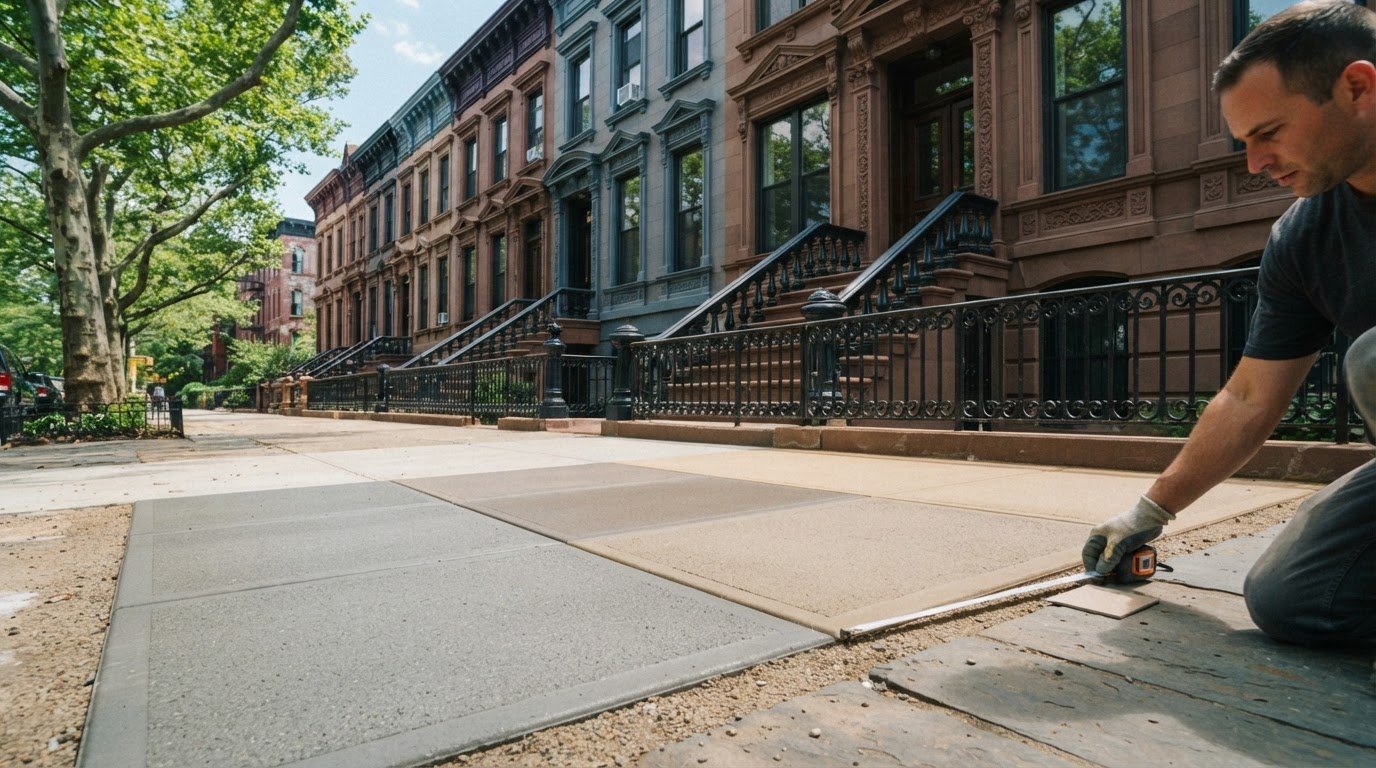
A sidewalk is part of the block’s visual fabric. Before planning a historic district sidewalk replacement in Brooklyn, look beyond the damaged section. Existing paving, color, scoring, neighboring sidewalk panels, stoops, and the block’s overall character can all help guide the replacement. A finish that looks suitable on its own may stand out beside historic stone or an established paving pattern.
Start by recording the conditions at the property:
- Note the existing material, visible color, surface condition, and any distinctive scoring or joints.
- Photograph the sidewalk beside adjacent paving and nearby building features.
- Record the work location on the block, including nearby intersections or changes in paving.
These observations give you and the project team a practical basis for comparing materials and discussing streetscape fit. They are more useful than choosing a color from a small sample alone.
What should Brooklyn owners establish before choosing a replacement?
Base your planning on the property itself, not on what happened at another address. A New York YIMBY report described LPC review of a proposal at 43 Sterling Place in Park Slope to replace bluestone with tinted concrete, and noted differing agency responses in that case. It is an example of a site-specific review, not a rule or approval precedent for every Brooklyn sidewalk.
For your address, consult current NYC Landmarks Preservation Commission (LPC) and NYC Department of Transportation (DOT) guidance. Identify the property’s designation and determine whether the paving or proposed work triggers district-specific steps. The 43 Sterling Place review does not determine your requirements; current guidance and the details of your project do.
Approval requirements depend on current, verified guidance for the specific property and proposed work. Establishing that context early helps align material selection, streetscape fit, and review planning.
Compare Concrete Sidewalk Color Options for a Brooklyn Historic District
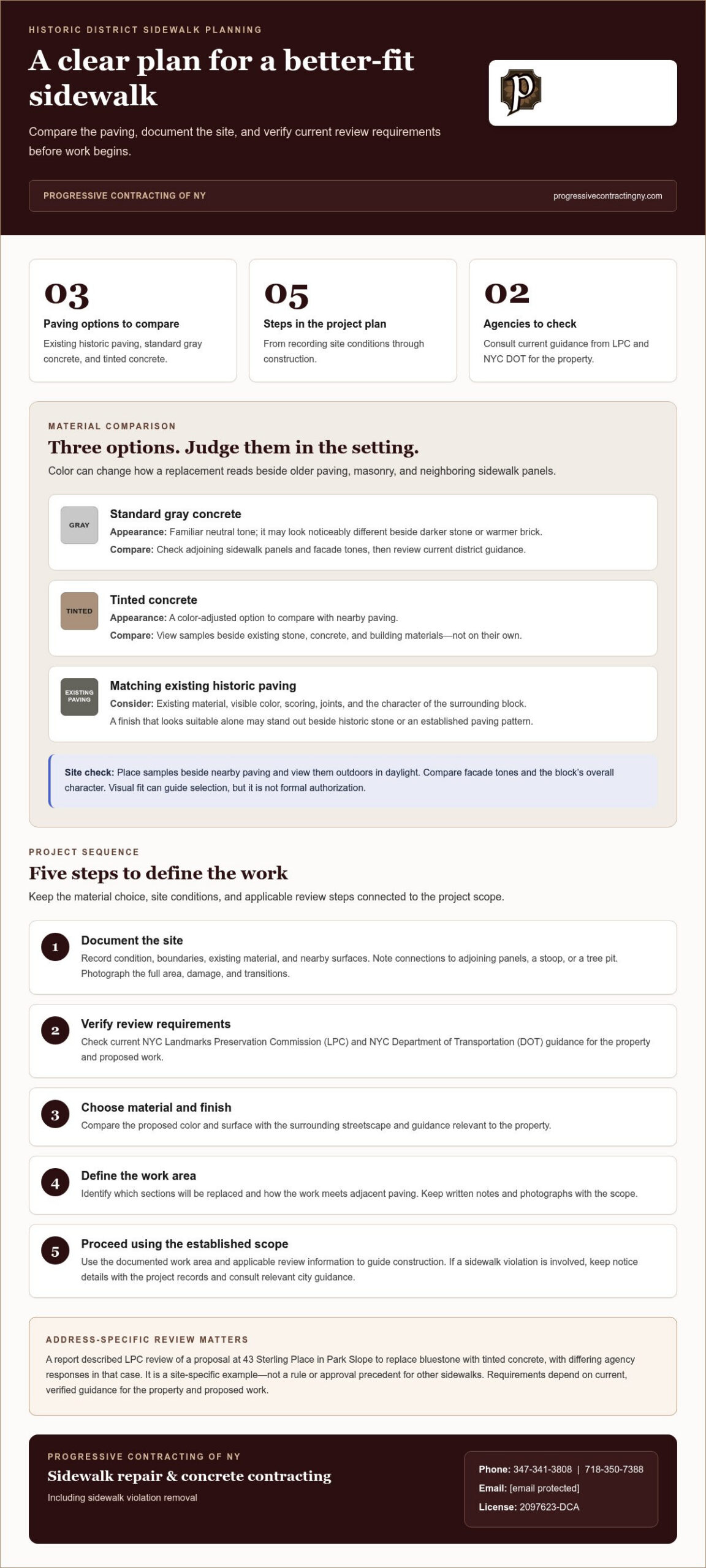
Color affects how a replacement sidewalk looks beside older paving and masonry. For historic district sidewalk replacement Brooklyn projects, compare gray and tinted concrete as visual options, not as indicators of what will automatically be accepted. The appropriate choice depends on the block and the current guidance for the property.
Standard gray concrete
Appearance: A familiar neutral tone that may look noticeably different beside darker stone or warmer brick. Compare: Look at adjoining sidewalk panels and facade tones. Next step: Review current district guidance for any applicable material or color direction.
Tinted concrete
Appearance: A color-adjusted option that can be compared with nearby paving. Compare: View samples beside existing stone, concrete, and building materials rather than judging a small sample alone. Next step: Review whether current LPC or DOT guidance addresses the proposed finish at that location.
How can owners judge whether a concrete color fits the block?
Place samples beside existing paving and neighboring sidewalk sections, then view them outdoors at the site in daylight. Compare the sample with facade tones and the street’s overall character. Note whether it appears markedly lighter, darker, or warmer than its surroundings. A sample viewed indoors may not show how the color relates to the block.
Visual compatibility can guide color selection, but it does not provide formal authorization for the work. Consider the preferred shade alongside any applicable preservation review or approval. Check current LPC and NYC DOT guidance for the specific property before settling on a finish. A choice that suits one block may not suit another.
Progressive Contracting of NY provides sidewalk repair and concrete work, considering the project conditions and surrounding streetscape. The company serves property owners in Brooklyn and Manhattan, including historic Brooklyn neighborhoods such as Park Slope and Bedford-Stuyvesant.
Plan a Brooklyn Historic Sidewalk Replacement with a Clear Project Scope
A clear scope connects the sidewalk’s condition to the material choice and review steps that apply to the address. For historic district sidewalk replacement Brooklyn projects, use an orderly process: document the site, verify current requirements, choose a suitable material, define the work area, and plan construction around the established scope.
- Document the site. Record the sidewalk’s condition, boundaries, existing material, and nearby surfaces. Note where the replacement meets adjoining panels, a stoop, or a tree pit.
- Verify review requirements. Use current official LPC and NYC DOT guidance for the property’s location. Follow agency-specific steps based on that guidance, not another address’s review.
- Choose the material and finish. Compare the proposed concrete color and surface with the existing streetscape and the guidance relevant to the property.
- Define the scope. Identify which sections will be replaced and how the work meets adjacent paving. Clear boundaries help keep the project aligned with the site assessment.
- Proceed with construction. Use the documented scope and applicable review information to guide the work.
What information helps define the replacement work?
Photographs and written notes can make the scope more precise. Capture the full affected area, close views of damage, transitions to neighboring surfaces, and the existing material. If the project relates to a sidewalk violation, keep the notice details with these records and consult the relevant city guidance.
Progressive Contracting of NY provides sidewalk repair and concrete contracting, including sidewalk violation removal. For project inquiries, call 347-341-3808 or 718-350-7388, or email ProgressiveContractingNY@yahoo.com. License number: 2097623-DCA. Discuss sidewalk and concrete work as part of a clearly documented project scope.
Move Forward with a Well-Planned Sidewalk Project
A thoughtful plan gives your sidewalk project a clear starting point: document the site, understand the review context, and shape the work around the block. For historic district sidewalk replacement Brooklyn, turn those observations into a practical scope that respects the property’s setting and the guidance that applies to it.
Progressive Contracting of NY provides sidewalk and concrete services for property owners in Brooklyn, Manhattan, the Bronx, and Queens. A clear project scope connects the site conditions with the work you plan, without assuming a particular material or approval outcome in advance.
Document the conditions, review the applicable guidance, and define the work before construction begins.
Frequently Asked Questions
Does a Brooklyn historic district sidewalk replacement always require LPC approval?
No. LPC review isn’t automatically the same for every Brooklyn address; location and proposed work can affect the review path. The Sterling Place report describes one Park Slope proposal and its agency responses, not a citywide decision. For another property, identify its designation and consult current LPC guidance for that address before setting the construction sequence.
Can tinted concrete be used to replace a historic sidewalk in Brooklyn?
Tinted concrete may be considered, but the reported Park Slope proposal doesn’t establish blanket permission. For a historic district sidewalk replacement Brooklyn project, record the proposed tint and how it relates to existing paving, then review the guidance that applies to the address. A color that looks compatible on a sample may still require review, so appearance alone is not authorization.
Is bluestone the only suitable sidewalk material in a Brooklyn historic district?
No. The Park Slope report mentions bluestone and tinted concrete, but doesn’t establish that either is required at every Brooklyn property. If original paving remains, note its material and condition separately from later repairs. This gives the project team clearer context for comparing replacement options with the block, rather than assuming one material suits every property.
How long does approval take for a historic sidewalk replacement in Brooklyn?
There’s no reliable single timeline for every address. Review can vary with the proposed work and agencies involved, so the Sterling Place report shouldn’t be used to predict a schedule for another Brooklyn or NYC property. Before arranging construction, check current agency instructions for the address and account for any applicable review period in project planning. To discuss a sidewalk project in Brooklyn, Manhattan, the Bronx, or Queens, call Progressive Contracting of NY at 347-341-3808 or 718-350-7388, or email ProgressiveContractingNY@yahoo.com.