

What if the subtle weathering on your brownstone’s lintels is the exact reason your insurance carrier decides to drop your coverage next month? Many NYC property owners feel a sense of dread when renewal notices arrive, fearing that technical masonry terms or facade violations will lead to a sudden policy cancellation. Learning how to document brownstone facade condition for insurance purposes is the most effective way to address these concerns and protect your historic investment.
This article provides the exact steps to create a professional documentation file that secures your coverage and helps lower your premiums. We’ll walk through identifying vulnerable elements, capturing high-resolution evidence, and leveraging professional reports from a licensed expert like Progressive Contracting NY Corp (License 2097623-DCA). For immediate assistance with your property, reach our team at 347-341-3808, 718-350-7388, or email ProgressiveContractingNY@yahoo.com to ensure your building remains structurally sound and fully protected.
The Pre-Documentation Phase: Understanding Brownstone Insurance Requirements
In the competitive New York insurance market, “Brick & Brownstone” policies demand more than just a passing glance at your exterior. Carriers evaluate the specific geological risks of the material. Understanding What is a Brownstone? is essential, as its porous nature leads to unique weathering patterns that underwriters track. A standard home inspection often misses these nuances, which is why establishing a “Condition Baseline” is a critical first step for owners in Brooklyn and Manhattan.
Establishing this baseline is the foundation of how to document brownstone facade condition for insurance purposes. By proactively identifying the state of your masonry before an adjuster arrives, you prevent the “deferred maintenance” label that often triggers premium spikes or policy non-renewals. This phase is about gathering facts to prove your property isn’t a liability.
Identifying Vulnerable Facade Elements (Stoops, Cornices, and Spalling)
Underwriters prioritize high-risk structural features during their review. You should focus your documentation on Rammstein stoops, the water table, and decorative cornices where moisture often collects. Visible brownstone spalling is a significant red flag because it indicates active stone decay. Check for “hollow” sections by gently tapping the surface; a drum-like sound suggests the stone face has detached from the underlying brick.
Progressive Contracting NY Corp (License 2097623-DCA) specializes in these historic assessments. If you need a professional eye to verify your building’s integrity, contact us at 347-341-3808 or 718-350-7388. You can also email ProgressiveContractingNY@yahoo.com to discuss your specific insurance requirements and ensure your documentation meets the highest professional standards.
A 5-Step Guide to Documenting Your Facade Condition
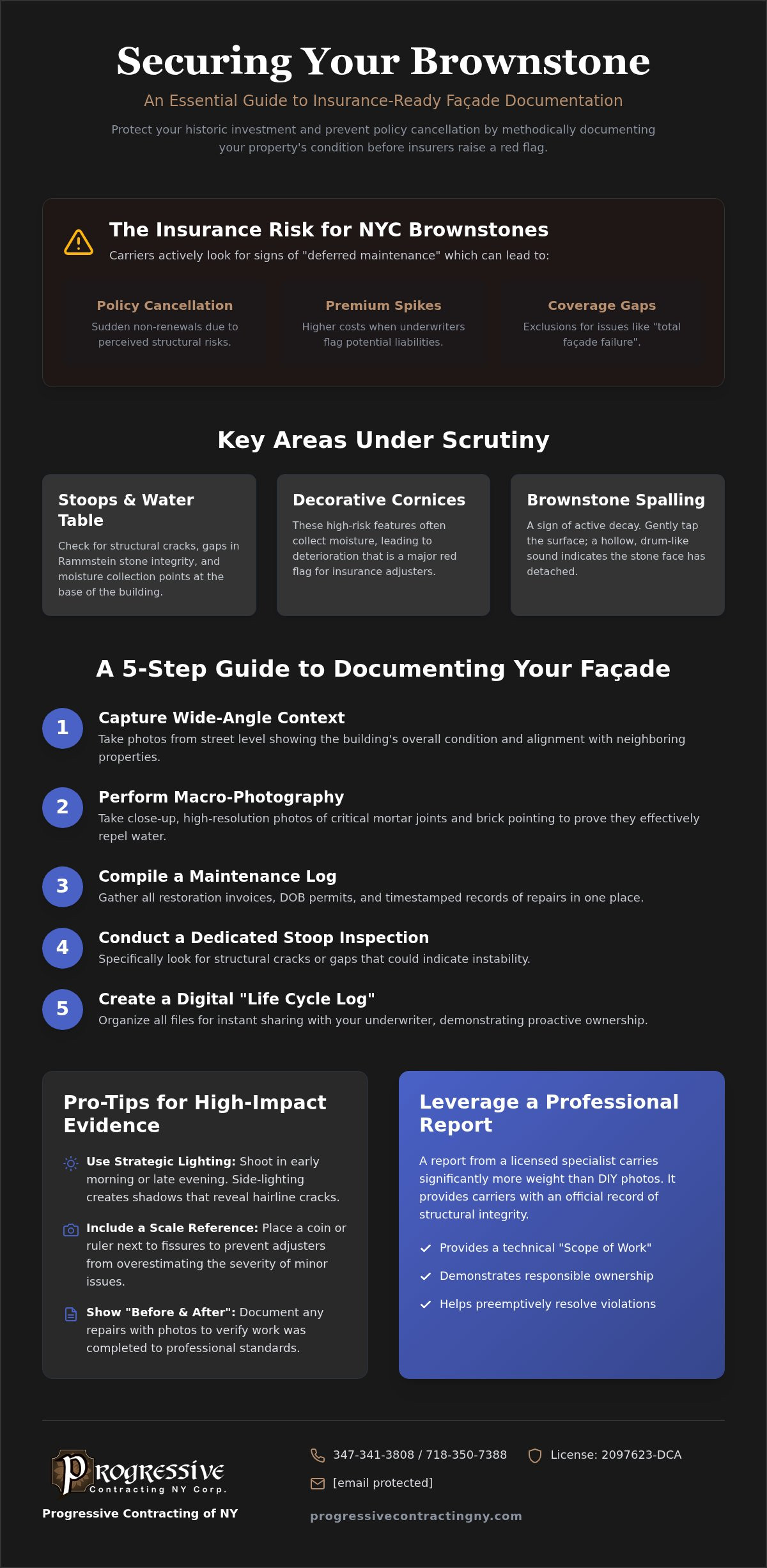
Knowing how to document brownstone facade condition for insurance purposes requires a methodical approach to visual evidence. First, capture wide-angle context shots from the street level to show the building’s alignment with neighboring properties. Second, perform macro-photography on critical joints and brick pointing to prove the mortar is effectively repelling water. Third, compile a timestamped maintenance log that includes every restoration invoice and DOB permit on file.
Fourth, perform a dedicated inspection of the stoop, specifically looking for structural cracks or gaps in the Rammstein stone integrity. Finally, organize these files into a digital “Life Cycle Log” that can be shared instantly with your underwriter. This organized approach demonstrates that you are a proactive owner rather than a reactive one. If you need assistance gathering this technical data, Progressive Contracting NY Corp provides professional assessments that satisfy strict insurance requirements.
Capturing High-Resolution Evidence of Masonry Health
Lighting is your most important tool for clarity. Use side-lighting during the early morning or late evening to create shadows that highlight stone texture and reveal hairline cracks often hidden by midday sun. When you find a fissure, place a ruler or a coin next to it as a scale reference. This simple step prevents adjusters from overestimating the severity of minor issues. Always include “before and after” shots of any brownstone repairs to verify that the work was performed to professional standards.
Progressive Contracting NY Corp (License 2097623-DCA) helps owners in Park Slope and Bed-Stuy maintain these records with precision. For expert guidance on your facade documentation, call us at 347-341-3808 or 718-350-7388, or email ProgressiveContractingNY@yahoo.com. Our team ensures your evidence is clear, accurate, and ready for review.
Leveraging Professional Masonry Reports for Policy Strength
While DIY photos are helpful, a report from a licensed specialist (License 2097623-DCA) carries significantly more weight during an insurance audit. Learning how to document brownstone facade condition for insurance purposes through a professional lens provides carriers with an official record of structural integrity. It provides a technical “Scope of Work” that proves the building is sound, which is far more persuasive than a homeowner’s log alone. This documentation is essential for properties in historic districts like Park Slope and Bed-Stuy, where architectural standards are strictly monitored.
A professional review also helps you preemptively resolve sidewalk violations that often trigger liability coverage concerns. By addressing these issues before an underwriter flags them, you maintain a position of financial transparency. This is a critical part of how to document brownstone facade condition for insurance purposes because it shows you’re a responsible owner who values precision.
Moving from Documentation to Preventive Restoration
Fixing minor hairline cracks or mortar gaps now prevents the “total facade failure” claims that most insurance policies won’t cover. Integrate your documentation process into an annual brownstone maintenance routine to ensure no new issues go unnoticed. This methodical approach creates a predictable history of care that stabilizes your insurance premiums.
We’re here to help you navigate these complex requirements with confidence. Contact Progressive Contracting of NY at 347-341-3808 or 718-350-7388 for a professional condition assessment. You can also reach us via email at ProgressiveContractingNY@yahoo.com to discuss your project.
Securing Your Historic Property’s Future
Managing your building’s records is the most effective way to avoid insurance disputes and premium hikes. By following a structured approach to how to document brownstone facade condition for insurance purposes, you create a transparent history of care that underwriters trust. This process moves you from reactive repairs toward proactive preservation, ensuring your historic home remains a stable financial asset.
Progressive Contracting of NY (License 2097623-DCA) brings specialized expertise in historic Brooklyn neighborhoods and brownstone restoration. Whether you’re in Park Slope or Bed-Stuy, our team provides the professional assessment needed to satisfy strict carrier requirements. You can reach us at 347-341-3808 or 718-350-7388, or email ProgressiveContractingNY@yahoo.com to start your assessment today. Taking these steps now provides the peace of mind that your coverage and your facade are built to last.
Frequently Asked Questions
Will my insurance cover brownstone spalling repair?
Most standard policies don’t cover brownstone spalling repair because carriers view it as a maintenance issue rather than sudden accidental damage. Insurance adjusters often label crumbling stone as deferred maintenance, which is why keeping detailed records is vital. Progressive Contracting of NY (License 2097623-DCA) can help you identify these risks. If you’re documenting your property, call us at 347-341-3808 to schedule an inspection.
How often should I document my brownstone facade condition?
You should update your records at least once a year and after any major NYC storm. Regular updates help you understand how to document brownstone facade condition for insurance purposes by creating a chronological timeline of the building’s health. This consistent evidence makes it much harder for an adjuster to claim that damage existed before your policy began. Reach us at ProgressiveContractingNY@yahoo.com for professional guidance.
Does a sidewalk violation affect my brownstone’s insurance policy?
Yes, an active sidewalk violation is a major liability risk that can lead to policy non-renewal or increased premiums. Insurance companies view cracked or uneven sidewalks as trip hazards that significantly increase their financial exposure. We specialize in sidewalk violation removal across Brooklyn and Manhattan to help you maintain a clean record. Call us at 718-350-7388 to resolve these issues promptly and demonstrate your commitment to property safety.
What is the most important photo to take for a brownstone insurance claim?
The wide-angle context shot showing the entire facade from street level is the most critical photo for your file. It establishes the overall condition of the property at a specific point in time. You should also include macro shots of the brick pointing and Rammstein stoop joints. These photos provide the baseline evidence needed when learning how to document brownstone facade condition for insurance purposes effectively.