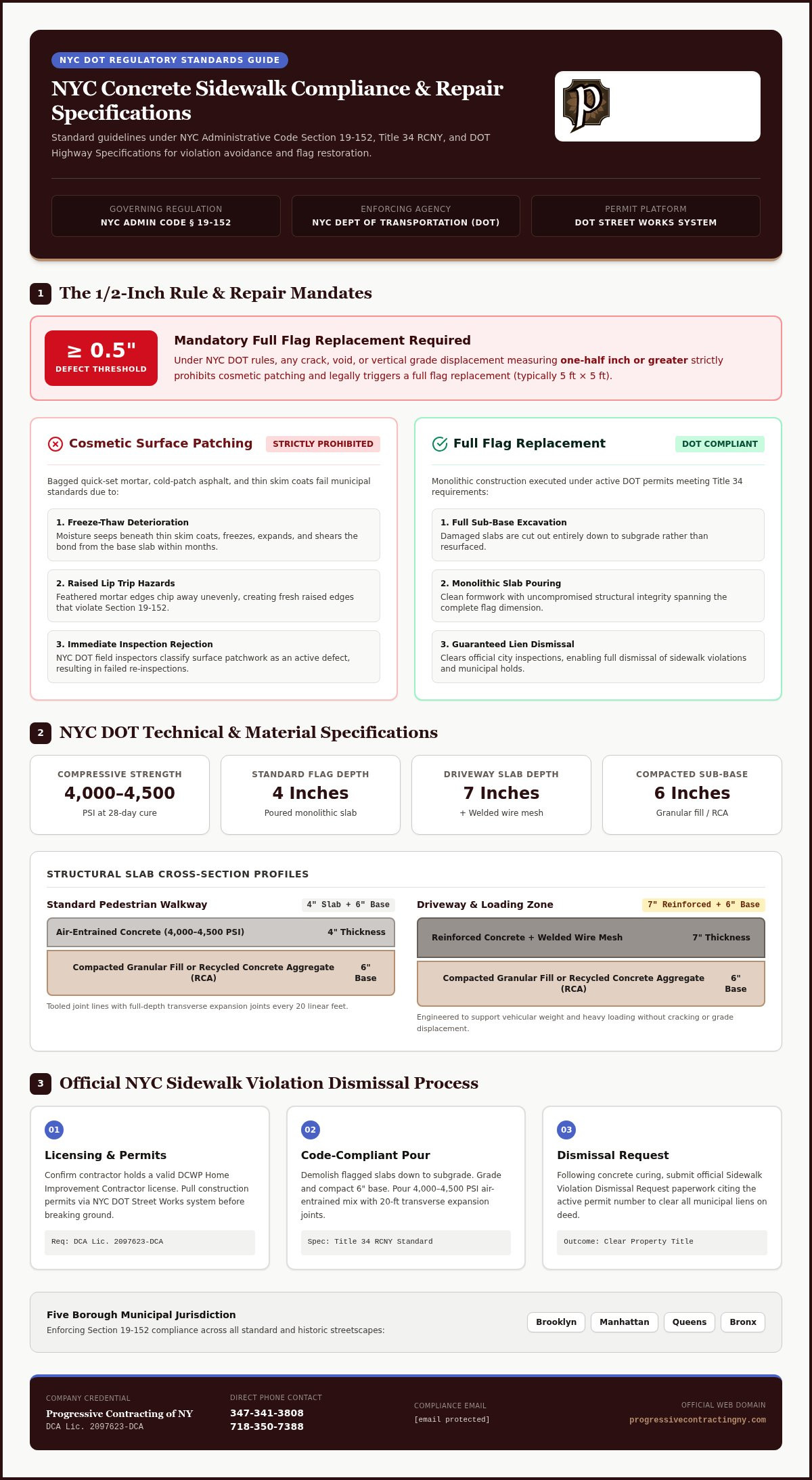
Smearing quick-set mortar over a broken walkway might feel like proactive maintenance, but under municipal law, it creates a fresh defect. Most property owners assume a cosmetic fix protects pedestrians, yet official concrete patching standards for NYC sidewalks strictly prohibit surface patchwork over cracked or displaced flags. Under NYC Department of Transportation (DOT) rules, cosmetic skimming fails inspection every time.
You shouldn’t have to worry about whether a simple repair will invite an official Notice of Violation or a municipal lien. In this guide, you’ll learn the strict NYC DOT sidewalk repair standards to avoid failed inspections and costly municipal violations. We’ll break down the city’s concrete specifications, permit protocols, and full-flag replacement mandates. Backed by DCA License 2097623-DCA, Progressive Contracting NY Corp assists owners via ProgressiveContractingNY@yahoo.com or by phone at 347-341-3808 and 718-350-7388 to secure complete compliance.
Table of Contents
NYC DOT Concrete Patching Standards vs. Full Flag Replacement Rules
Under NYC Administrative Code Section 19-152, property owners carry strict legal responsibility for keeping abutting walkways in continuous repair. When cracks or potholes develop, many building owners attempt quick fixes with bagged quick-set mortar or cold-patch asphalt. NYC DOT rules explicitly prohibit these materials on public pedestrian pathways. Established concrete sidewalk construction standards and Title 34 of the Rules of the City of New York demand complete structural integrity. Any crack, void, or vertical grade displacement measuring one-half inch or greater requires a full flag replacement, typically five feet by five feet, rather than an isolated surface fill.
Why Cosmetic Surface Patches Fail NYC Municipal Inspections
Topical repairs fail to satisfy concrete patching standards for NYC sidewalks because they cannot endure urban foot traffic or harsh Northeast weather:
- Freeze-thaw deterioration: Winter moisture seeps beneath thin cement skim coats. As temperatures drop, freezing water expands and shears the bond between the patch and the base slab, causing the repair to crumble within months.
- Increased trip hazards: Feathered mortar edges chip away unevenly, creating raised ridges that violate Section 19-152 threshold rules.
- Automatic inspection rejection: NYC DOT field inspectors classify topical patchwork as an active defect rather than an authorized repair. During formal dismissal re-inspections, inspectors fail patched flags on sight, leaving the property open to city-issued violations.
Proper compliance means cutting out the failing flag down to the sub-base, setting clean formwork, and pouring a monolithic slab that meets municipal grade.
Technical Specifications for Code-Compliant Concrete Sidewalk Construction
Meeting official concrete patching standards for NYC sidewalks requires strict adherence to material parameters established in NYC DOT Highway Specifications. A compliant pour starts beneath the surface: slabs must rest on a six-inch compacted foundation of clean granular fill or recycled concrete aggregate. Standard residential walkway flags require a minimum poured slab depth of four inches, using concrete certified at a 4,000 to 4,500 PSI compressive strength at 28 days. In addition, workers must tool crisp joint lines and insert full-depth transverse expansion joints every 20 linear feet to prevent slab crushing.
Essential Material and Structural Requirements for Urban Walkways
Sidewalks in the five boroughs endure brutal winter weather and heavy salting. DOT mandates an air-entrained concrete mix containing microscopic air bubbles, which prevents surface flaking and internal spalling during freeze-thaw shifts. Loading zones and active driveways require additional reinforcement, demanding a minimum slab thickness of seven inches lined with welded wire mesh to bear vehicular weight without cracking.
Historic streetscapes also require specialized masonry techniques to match classic architectural details without violating city codes. Property owners managing the NYC sidewalk violation and dismissal process regularly trust the dedicated masonry restoration team at Progressive Contracting NY Corp to secure complete regulatory clearance. Investing in certified concrete mixes and proper sub-base grading protects your property value and keeps pedestrians safe.
Resolving Sidewalk Violations and Securing Official DOT Clearance
Receiving an official Notice of Violation creates immediate urgency for property owners. The city grants a limited cure window to hire a contractor and initiate repairs under an active permit. Attempting cosmetic fills violates concrete patching standards for NYC sidewalks and delays clearance. You must pull construction permits directly through the NYC Department of Transportation Street Works system before breaking ground. To budget effectively and avoid surprise expenses, review our breakdown on the Cost of Sidewalk Violation Removal NYC.
Working with a Licensed Concrete Contractor for Final Dismissal
Hiring an unverified crew risks sub-standard work that fails city inspection, leaving open violations attached to your property deed. Protect your home and resolve municipal citations quickly through a methodical, three-step compliance approach:
- Verify city licensing: Confirm your concrete specialist holds a valid Home Improvement Contractor license from the Department of Consumer and Worker Protection, such as DCA License 2097623-DCA.
- Execute code pours: Licensed professionals remove damaged slabs completely, set precise forms, and pour high-strength mix to clear actionable defects.
- Submit dismissal paperwork: After the pour cures, submit an official Sidewalk Violation Dismissal Request with your permit number to remove municipal liens.
If you need accountable sidewalk repair or full sidewalk violation removal, Progressive Contracting NY Corp provides reliable service across Brooklyn, Manhattan, Queens, and the Bronx. Call 347-341-3808 or 718-350-7388, or email ProgressiveContractingNY@yahoo.com to schedule your compliance assessment.
Protect Your Property with Lasting Concrete Compliance
Navigating municipal sidewalk regulations requires zero compromise on material durability and permit protocols. Complying with concrete patching standards for NYC sidewalks means replacing compromised flags entirely with 4,000 PSI air-entrained concrete rather than relying on temporary troweled fixes. Working with an accredited contractor ensures proper sub-base preparation, full-depth expansion joints, and prompt dismissal of city citations across Brooklyn, Manhattan, Queens, and the Bronx. Progressive Contracting NY Corp delivers accountable service backed by DCA License 2097623-DCA. Direct telephone consultations are available at 347-341-3808 or 718-350-7388, and inquiries can be sent to ProgressiveContractingNY@yahoo.com.
Taking decisive action today eliminates pedestrian trip hazards, clears title clouds on your deed, and ensures your walkways remain fully compliant for years to come.
Frequently Asked Questions
Can I use hydraulic cement to patch an NYC sidewalk crack?
No, you cannot legally use hydraulic cement or quick-setting patch mortars to resolve sidewalk defects under NYC DOT rules. City inspectors classify topical mortar fills as patchwork defects under Title 34 RCNY § 2-09. Adhering to concrete patching standards for NYC sidewalks requires removing the damaged flag entirely and pouring a full-depth replacement slab to pass dismissal inspection.
What is the required concrete thickness for residential sidewalks in NYC?
Standard residential sidewalk flags require a minimum poured concrete thickness of four inches over a six-inch compacted base. If the slab crosses an active driveway, corner curb quadrant, or heavy loading area, DOT specifications mandate a minimum depth of seven inches reinforced with welded wire mesh. Walkway pours across Brooklyn and Manhattan must achieve at least 4,000 PSI compressive strength.
What happens if I ignore an NYC DOT sidewalk violation notice?
Ignoring an NYC DOT Notice of Violation allows the city to dispatch municipal contractors to replace the defective flags at your expense. Property owners receive 75 calendar days to complete work through a licensed contractor. If left unaddressed, the city bills you directly, often tacking on administrative surcharges. Unpaid balances convert into municipal tax liens that block refinancing and property sales.
Do I need a permit to repair a sidewalk flag in New York City?
Yes, you must secure an official NYC DOT Sidewalk Construction Permit before performing any repair work on the public right-of-way. Permits are mandatory for jobs over 25 square feet and for any repair aimed at clearing an existing citation. Meeting concrete patching standards for NYC sidewalks requires a licensed masonry professional holding DCWP License 2097623-DCA to file paperwork correctly.