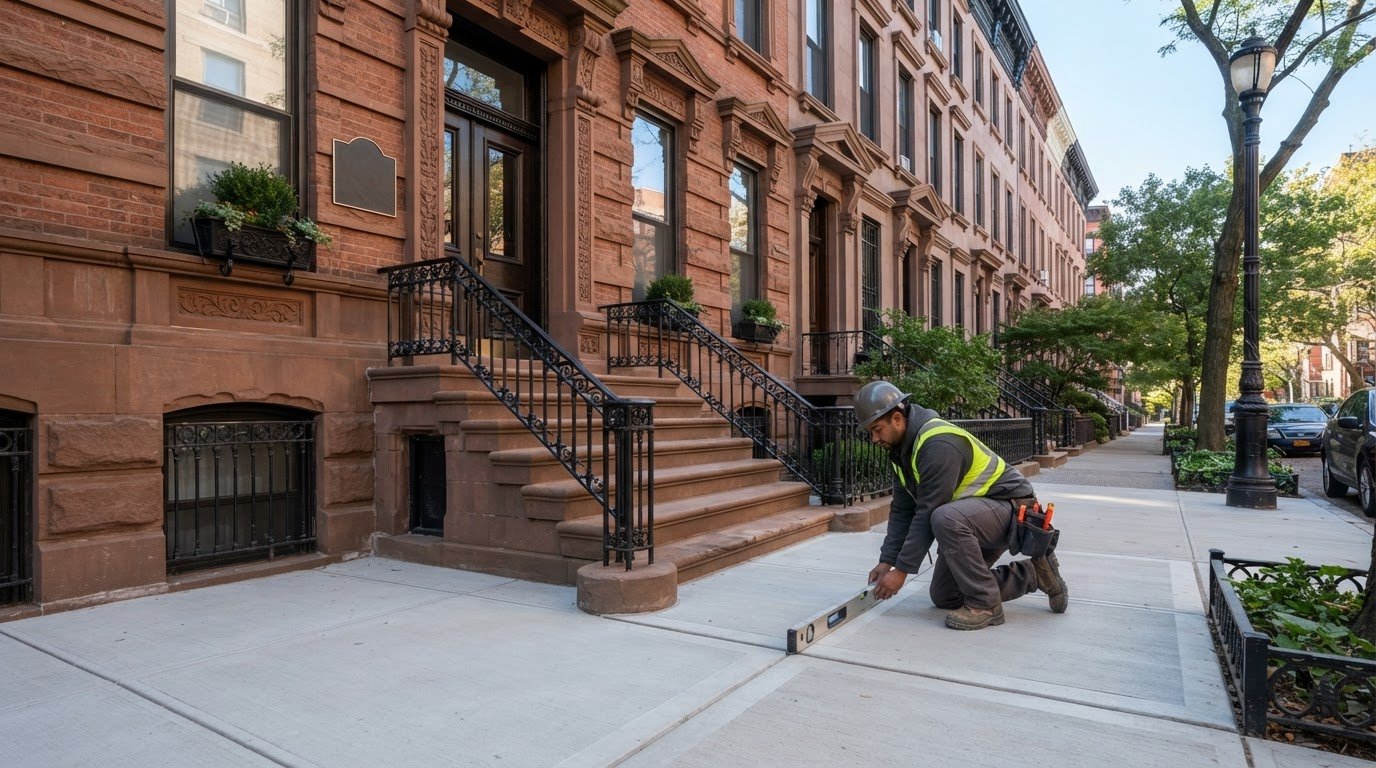
A historic marker on a New York City property does not, by itself, show which sidewalk approvals apply. Standard concrete work can affect historic paving or nearby masonry, so sidewalk repair for a property with a historic marker starts with confirming whether the building is an individual landmark, sits in a designated historic district, or has another applicable review requirement.
This guide explains how to verify a property’s status, identify approval questions before work begins, and plan repairs around sidewalk conditions and the neighboring historic façade. Progressive Contracting NY Corp provides sidewalk repair, concrete work, and historic masonry restoration in NYC, including Brooklyn and Manhattan. License number 2097623-DCA.
Table of Contents
Sidewalk Repair at a NYC Property with a Historic Marker: What to Confirm First
A plaque or other visible historic marker is not the same as an official landmark designation. It can be a useful clue, but it does not confirm whether the property is individually designated, within a historic district, or subject to review for the sidewalk work. Do not assume that approval is either required or unnecessary based on the marker alone.
NYC 311 says sidewalk work at a designated landmark site requires prior approval and a permit. The precise review depends on the property and proposed work, so check current City guidance before setting a repair schedule. Replacing a larger sidewalk area may raise different questions from repairing a limited section, particularly if the work could affect historic paving or nearby features. Confirm the requirements for the specific scope before construction begins.
How to verify the property’s historic status before planning work
Start with the property address. Use the NYC Landmarks Preservation Commission’s official designation records and maps to find out whether the building is individually landmarked or within a designated historic district. The New York City Landmarks Preservation Commission oversees landmark designations and preservation review. Rely on the Commission’s current records and guidance, rather than a marker or general overview, when assessing the property.
Next, describe the proposed sidewalk work precisely. Identify the section to be repaired or replaced, and note any historic paving, façade, or stoop nearby. Compare that scope with current LPC and NYC 311 instructions, then resolve permit and review requirements before work starts. This helps keep sidewalk repair for a property with a historic marker focused on the concrete conditions while accounting for the character of the adjoining property.
How to Plan Sidewalk Repair for a Historic NYC Property
After checking the property’s historic status, define the repair based on the conditions on site. Keep sidewalk condition and any NYC Department of Transportation notice distinct from landmark review: a defect or notice concerns the sidewalk repair, while preservation review depends on the property and proposed scope. Review current DOT procedures and responsibilities, along with applicable Landmarks Preservation Commission requirements, before scheduling the work.
- Confirm status. Search official designation records and district boundaries using the property address.
- Document conditions. Photograph damaged sections and nearby historic details before deciding where the repair should begin and end.
- Review approvals. Check current DOT instructions and preservation requirements separately.
- Define the scope. Specify which sidewalk area needs work and how it meets the façade, stoop, or other adjoining features.
- Keep completion records. Store notices, approvals, scope documents, and records of completed work together.
What to document before setting the repair scope
Take clear close-up and wider photographs of each damaged area. Capture cracks, uneven sections, or broken pavement, as well as the adjoining façade, stoop, steps, or historic paving. Mark the proposed work area on a simple site sketch or photograph. This creates a shared reference for the repair team and helps distinguish sidewalk work from nearby masonry that should remain undisturbed. Gather any DOT notices and existing permit or approval documents as well.
If a notice identifies a sidewalk violation, keep it with the project records and review the “Cost of Sidewalk Violation Removal NYC” guide for related information. NYC DOT’s Sidewalk Repair Guidelines provide current information on sidewalk procedures; review them alongside applicable preservation guidance. A clearly documented scope helps Progressive Contracting of NY plan sidewalk repair with attention to both the pavement and the adjacent historic property. See NYC sidewalk repair services for project support.
Choosing a Preservation-Conscious Sidewalk Repair Contractor in NYC
A limited repair and a broader replacement address different scopes of work. A targeted repair may address a defined damaged section while keeping work away from sound sidewalk and nearby historic features. A broader replacement may be appropriate when damage extends beyond that section, but it changes the work boundary and may involve additional review. Base the scope on documented conditions and applicable approval requirements, not simply on a preference for a smaller or larger job.
What a clear sidewalk repair scope should address
A written scope should identify the sidewalk location and work limits, describe the visible damage, and note adjoining features such as a brownstone façade, stoop, or historic paving. It should also account for applicable review conditions before the work sequence is set. Clear boundaries help distinguish concrete work from adjacent masonry and keep the project aligned with the approvals that apply.
Progressive Contracting of NY handles sidewalk and concrete work with attention to pavement conditions and the historic masonry beside it. A useful repair plan defines both what needs work and what must be protected. If the adjoining building also needs attention, brownstone facade restoration can address the broader exterior preservation needs.
For sidewalk repair for a property with a historic marker, begin with a defined scope that accounts for the pavement, nearby features, and applicable review requirements. Progressive Contracting of NY serves property owners across Brooklyn and Manhattan, including Bedford-Stuyvesant and Park Slope, as well as the Bronx and Queens. Contact the team at 347-341-3808 or 718-350-7388, or email ProgressiveContractingNY@yahoo.com.
Move Your Sidewalk Project Forward
Before work begins, bring the property-status result, photographs, proposed repair boundary, and any notices or written approvals into one project file. This gives the planning conversation a clear starting point and helps distinguish sidewalk work from nearby historic details.
For sidewalk repair for a property with a historic marker, discuss the defined scope rather than focusing only on the visible damage. A clear plan can account for the concrete conditions, adjacent features, and applicable review requirements. Keep scope documents and completion records together as the project progresses. If the proposed work changes, revisit the scope and any applicable review before proceeding.
A careful plan helps protect the character of the property while addressing the sidewalk conditions.
Frequently Asked Questions
Does a historic marker automatically mean a property is a designated landmark?
No. A marker alone does not establish a formal designation or determine which review applies. Treat it as a reason to verify the property’s status, not as a conclusion. Search official NYC landmark information using the address and check whether the property is within a designated historic district. The proposed work matters too, so note whether it affects only sidewalk concrete or nearby historic features.
Can sidewalk work at a New York City landmark site require approval before repairs begin?
Yes. NYC 311 states that construction on a designated landmark building or site, including sidewalk work, requires City pre-approval and a permit before work begins. Requirements can depend on the property and the work scope. Before setting a construction date, review current guidance with the relevant City agency and make sure the proposed work area matches the scope being reviewed.
Should I document sidewalk damage before requesting a repair?
Yes. Take both close-up and wider photographs so the damage and its position beside the property are clear. Add the address, date, and a short label for each image, such as “front stoop, left side.” Keep the photographs with any notices or approval documents. An organized record helps clarify which areas need assessment and discussion.
Can sidewalk repairs be planned to preserve the appearance of an adjoining historic property?
Yes. A repair scope can account for sidewalk conditions and nearby masonry or other historic features. For sidewalk repair for a property with a historic marker, identify those features and the work boundary before choosing materials or methods; applicable review conditions may shape the approach. This is relevant for properties in Brooklyn, Manhattan, the Bronx, and Queens, including Bedford-Stuyvesant and Park Slope.