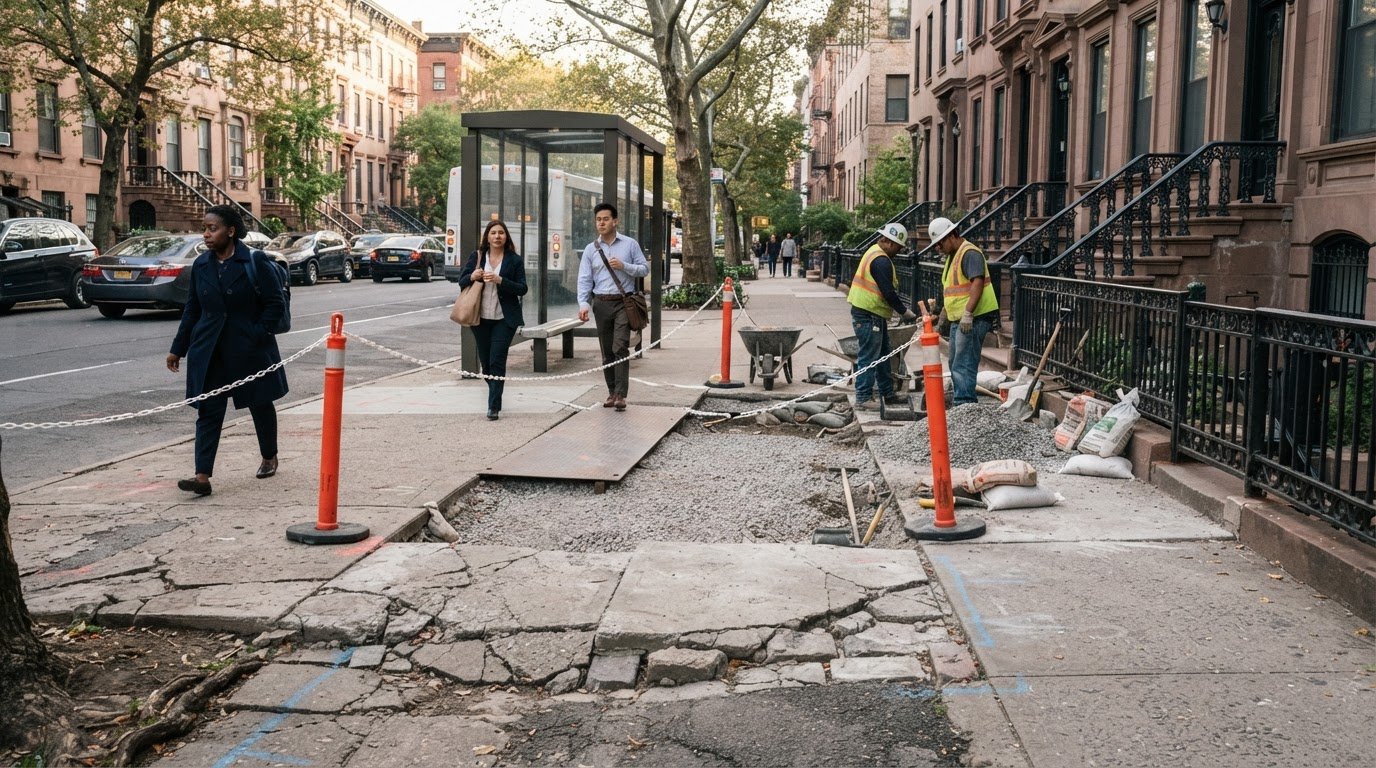
What should you consider before repairing a sidewalk beside a bus stop? Sidewalk repair for a property with a bus stop involves more than fixing damaged concrete. The repair area, pedestrian routes, and nearby transit fixtures all affect how the work can be planned. The right scope depends on the condition of the sidewalk and the layout of the frontage.
This guide explains which site details to document, how to compare repair scopes, and what to prepare before discussing the project. Progressive Contracting NY Corp provides sidewalk repair and sidewalk violation-removal services for property owners in Brooklyn, Manhattan, the Bronx, and Queens, including Bedford-Stuyvesant and Park Slope. To prepare for an assessment, note the damaged areas, any violation notice, and the locations of bus-stop fixtures and pedestrian routes. License number: 2097623-DCA. Call 347-341-3808 or 718-350-7388, or email ProgressiveContractingNY@yahoo.com.
Table of Contents
What Makes Sidewalk Repair Beside an NYC Bus Stop Different?
Sidewalk repair for a property with a bus stop involves two practical questions: which concrete needs repair, and how can the work be arranged around pedestrian access and transit activity? Cracks, lifted panels, and broken edges help define the repair area. A stop sign, shelter, boarding area, or steady flow of riders adds site-planning considerations, but does not by itself determine the condition of the concrete or the repair scope.
Because bus service and sidewalk space meet at the curb, record how the stop relates to the damaged area. The MTA Regional Bus Operations page provides background on MTA bus operations. Transit coordination is separate from identifying the concrete work. Check current NYC DOT and MTA requirements for the location when planning work near a stop.
Which site conditions should be assessed first?
Start by documenting the damage and the pedestrian layout. Photos and notes can show where the repair begins and ends, which adjoining panels may be affected, and what routes or fixtures are nearby.
- Photograph cracks, uneven panels, damaged edges, and visible drainage concerns.
- Mark the limits of the affected area, including adjoining panels that may influence the repair scope.
- Note the locations of stop signs, shelters, boarding areas, curb ramps, and pedestrian paths.
For example, a damaged panel beside a curb ramp creates different access-planning considerations than damage farther from the boarding area. Do not assume that a stop fixture must be moved or that every repair requires the same approval. Requirements depend on the work and location, so use current NYC DOT and MTA guidance when determining what applies.
How to Compare Repair Plans Without Losing Bus-Stop Access
A focused repair may fit damage contained to a limited area. A broader scope may be appropriate when defects continue across adjoining panels or site conditions point to a larger affected area. For sidewalk repair for a property with a bus stop, compare proposed work with the documented damage instead of assuming every transit-adjacent frontage needs the same treatment.
Use this framework to compare the scope and identify location-specific planning needs:
| Compare |
What to clarify |
| Repair limits |
Which damaged panels are included, and what visible conditions support that scope? |
| Pedestrian routing |
How will the work be sequenced, and what temporary access needs to be planned? |
| Nearby fixtures |
Where are the stop sign, shelter, boarding area, curb ramp, and pedestrian paths in relation to the work? |
| Coordination |
Which location-specific agency requirements apply? Use current agency guidance. |
A sidewalk repair for a property with a bus stop may also involve a violation notice. Review the notice alongside the site conditions, since its details can affect project planning. The NYC sidewalk violation removal cost guide offers related planning context. For agency information, consult the NYC Department of Transportation (NYC DOT) and current MTA guidance for the specific location.
What should a practical work plan account for?
Plan the repair sequence around the affected panels, nearby fixtures, and pedestrian access. The temporary route or work setup depends on the frontage and applicable location-specific guidance, so avoid assuming one arrangement fits every stop. Once you have documented the scope and access considerations, you can discuss a sidewalk repair assessment with Progressive Contracting of NY.
How Progressive Contracting of NY Approaches Bus-Stop Sidewalk Repair
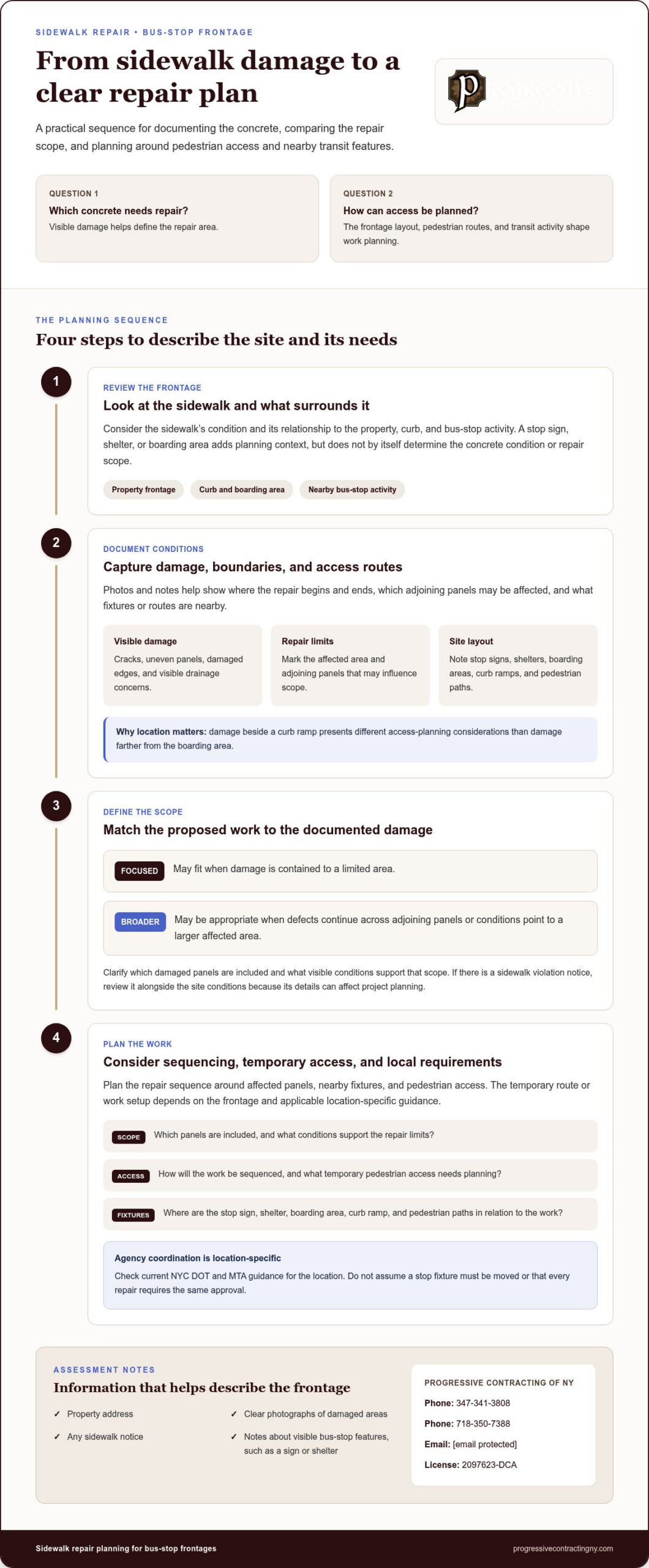
Progressive Contracting of NY approaches sidewalk repair as a concrete project shaped by the property frontage and nearby bus stop. A clear sequence helps property owners understand the visible damage, the proposed repair area, and the site details that may affect work planning.
- Review the frontage. Consider the sidewalk’s condition and its relationship to the property, curb, and bus-stop activity.
- Document conditions. Record visible damage and nearby stop features so the assessment reflects the site.
- Define the scope. Identify the repair area based on observed conditions, and include any sidewalk notice in project planning.
- Plan the work. Consider sequencing and pedestrian access alongside the concrete repair.
For sidewalk repair for a property with a bus stop, agency requirements depend on the location and work. Check current NYC DOT or MTA guidance before relying on assumptions about transit or street coordination. Progressive Contracting of NY provides sidewalk repair and sidewalk violation-removal services, with the assessment focused on the property’s conditions and nearby transit features.
What information helps start a repair assessment?
Prepare the property address, clear photographs of the damaged area, any sidewalk notice, and notes about visible bus-stop features such as a sign or shelter. This information gives the repair discussion a useful starting point and helps describe the frontage accurately.
To discuss sidewalk repair or a sidewalk violation, call 347-341-3808 or 718-350-7388, or email ProgressiveContractingNY@yahoo.com. License number: 2097623-DCA.
Move Your Sidewalk Project Toward a Clear Plan
A bus-stop frontage does not have to leave you guessing about the first step. For sidewalk repair for a property with a bus stop, gather the property address, photos, and any sidewalk notice. Those details help frame a practical project discussion and distinguish the concrete repair from location-specific coordination questions. This approach applies to properties throughout Brooklyn, Manhattan, the Bronx, and Queens, including Bedford-Stuyvesant and Park Slope.
Progressive Contracting of NY handles sidewalk repair and violation-removal needs. With your site information ready, you can discuss the sidewalk condition and the repair scope.
Gather your photos and any sidewalk notice, then contact Progressive Contracting of NY to discuss your repair project.
Frequently Asked Questions
Can sidewalk repairs be planned while a bus stop remains in use?
Yes. Sidewalk repair for a property with a bus stop can be planned around an operating stop, depending on the site and applicable requirements. The boarding area’s position may affect work sequencing and pedestrian access. For example, a repair beside the boarding point presents different access-planning considerations than work farther along the frontage. Check current guidance for the location as part of planning.
Does a bus stop change the type of sidewalk repair a property needs?
Not by itself. Sidewalk repair for a property with a bus stop depends on the concrete’s condition, including whether damage is isolated or extends across connected sections. The stop may affect work organization, but it does not automatically mean the repair scope should expand. Compare visible defects and the affected area when determining which panels belong in the project.
Who should a New York City property owner contact about sidewalk damage near a bus stop?
Contact Progressive Contracting of NY to discuss sidewalk repair or sidewalk violation-removal needs. For transit or street coordination requirements, consult current NYC DOT and MTA guidance for the specific location. Property owners in Brooklyn, Manhattan, the Bronx, and Queens, including Bedford-Stuyvesant and Park Slope, can prepare the property address and any sidewalk notice for a focused discussion.