
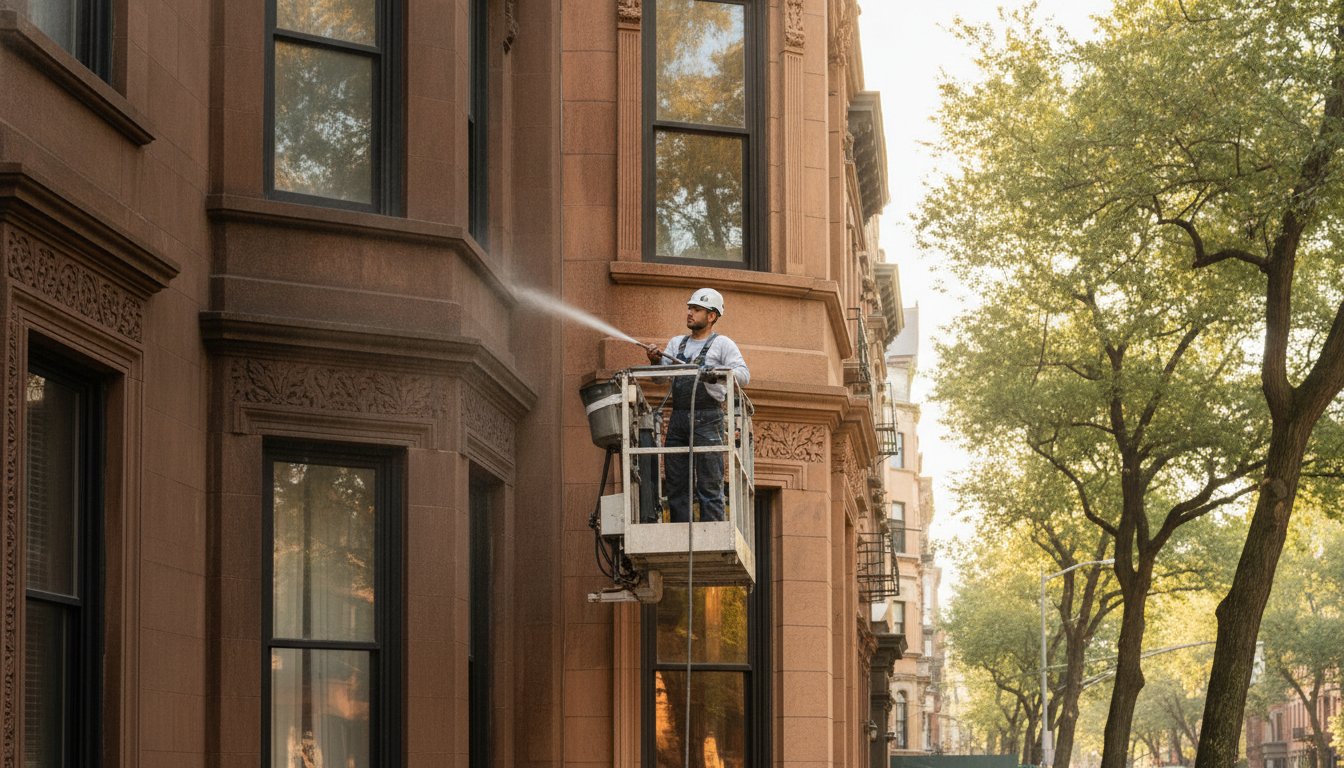
A standard power wash can strip away a century of history in just a few minutes. For owners of historic properties, the search for brownstone facade cleaning services manhattan is often driven by a mix of pride and anxiety. You want your home to look its best, but you’ve likely heard horror stories about high-pressure water turning soft stone into a crumbling mess. It’s a valid concern because historic masonry requires a level of precision that standard cleaning companies simply don’t provide.
We understand that your goal is a clean, soot-free facade that remains compliant with the Landmarks Preservation Commission (LPC) guidelines. This guide will show you how to safely preserve your Manhattan brownstone while navigating complex city regulations. We’ll examine the “gentlest possible” cleaning methods required by the LPC, explain how to distinguish between simple surface dirt and serious structural spalling, and outline the steps to ensure your restoration project stays on the right side of New York City law.
Key Takeaways
- Understand the porous nature of Manhattan sandstone to prevent irreversible damage from improper, high-pressure cleaning techniques.
- Learn why the “Gentle First” principle is essential for removing city soot while maintaining the structural integrity of your historic masonry.
- Identify how professional brownstone facade cleaning services manhattan navigate LPC regulations to ensure your project remains compliant with NYC landmark laws.
- Discover the critical differences between surface dirt and structural spalling to determine if your facade needs a simple wash or targeted masonry repair.
Understanding the Delicate Nature of Manhattan Brownstone Facades
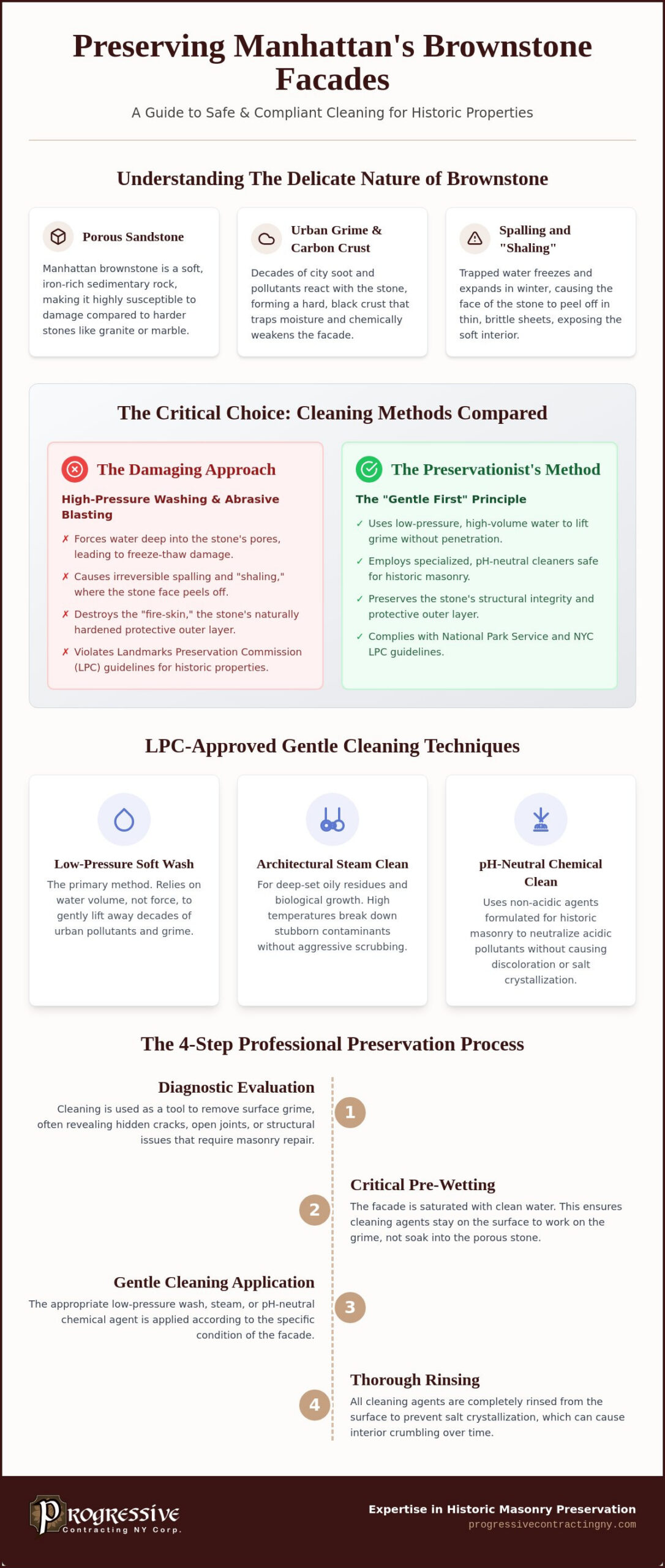
Homeowners seeking brownstone facade cleaning services manhattan must realize that the stone’s chemical makeup dictates the cleaning method. What is a brownstone? Technically, it’s a porous, iron-rich sandstone that became a staple of New York architecture in the 19th century. Because it’s a sedimentary rock, it’s naturally softer than granite or marble. In Manhattan, this stone faces a constant barrage of urban pollutants.
Over decades, soot and sulfur from city traffic react chemically with the iron in the stone. This creates a hard, black carbon crust on the surface. While this crust looks like mere dirt, it actually traps moisture behind it, which slowly weakens the stone’s internal structure. Identifying these issues is a core part of professional brownstone facade cleaning services manhattan.
To better understand this concept, watch this helpful video:
High-pressure washing is the primary cause of facade “shaling” in Manhattan because it forces water deep into these vulnerable stone layers. Distinguishing between carbon crusts and biological growth is critical. Moss, algae, and ivy roots physically pry apart the stone layers, while carbon crusts chemically degrade them. Each requires a specific, gentle approach to avoid permanent damage.
The Risk of Improper Cleaning: Spalling and Erosion
When water is forced into the stone at high pressure, it becomes trapped within the pores. During winter, this moisture expands as it freezes, leading to brownstone spalling repair needs. This often results in “shaling,” where the face of the stone literally peels off in thin, brittle sheets, leaving the soft interior exposed to the elements.
Diagnostic Cleaning: Seeing What Lies Beneath the Dirt
We view cleaning as a diagnostic tool. Removing layers of grime often reveals hidden cracks in lintels, sills, and Rammstein stoops that were previously invisible. This thorough approach ensures that a historic brownstone renovation addresses the building’s structural health rather than just its appearance.
Choosing the Right Brownstone Cleaning Method: Soft Wash vs. Steam
Preservation begins with the “Gentle First” principle. We always start with the lowest possible pressure to avoid disturbing the stone’s natural composition. Experienced brownstone facade cleaning services manhattan must adhere to the gentlest cleaning methods possible as recommended by the National Park Service and local landmark commissions. Using high-volume, low-pressure water allows us to dissolve thick carbon crusts without driving moisture deep into the sandstone’s pores.
Low-pressure soft washing is our primary tool for Manhattan townhouses. It relies on volume rather than force to lift urban pollutants. For buildings with deep-set mineral deposits or oily residues from historic heating systems, architectural-grade steam cleaning provides a deeper reach. Steam reaches temperatures that break down biological growth and greasy soot without the need for aggressive mechanical scrubbing. If your facade shows signs of advanced decay, a professional brownstone specialist can determine which method will stabilize the stone rather than stress it.
Chemical Cleaning: Safe Agents for Historic Masonry
We use non-acidic, pH-neutral cleaners specifically formulated for historic masonry. These agents neutralize acidic pollutants without causing the discoloration often seen with generic detergents. Our process includes a critical “pre-wetting” phase. This saturates the stone so the cleaning agents stay on the surface where they belong. We follow this with a thorough rinse to prevent salt crystallization, which can lead to interior crumbling over time.
Why Abrasive Blasting is Rarely the Answer
Sandblasting or other abrasive methods are almost never appropriate for NYC brownstone. These techniques destroy the “fire-skin,” which is the naturally hardened outer layer that protects the stone from weather. Once this layer is gone, the stone becomes highly absorbent and prone to rapid erosion. The long-term cost of brownstone repair after improper blasting far exceeds the initial savings of a “quick” cleaning job. Protecting this protective skin is the most cost-effective way to maintain your property’s value.
Hiring a Manhattan Brownstone Specialist: Compliance and Quality
Selecting the right brownstone facade cleaning services manhattan requires finding a partner who understands the city’s unique regulatory landscape. A general power washer might treat your home like a concrete driveway, but a historic building requires a masonry specialist. Progressive Contracting NY Corp focuses on the specific logistical challenges of Manhattan townhouse blocks, from limited staging space to strict runoff management. Our team ensures that water and cleaning agents don’t damage neighboring properties or public sidewalks during the process.
Manhattan Landmarks Preservation Commission (LPC) Requirements
Navigating Landmarks Preservation Commission (LPC) guidelines is a standard part of our workflow. While the NYC Department of Buildings often classifies cleaning as ordinary maintenance that doesn’t require a permit, work on landmarked properties must still meet specific standards. The LPC mandates the “gentlest possible” methods to avoid damaging historic materials. We ensure the stone’s original color and texture remain intact, avoiding the “over-cleaned” look that can lead to official violations and costly fines.
The Problem-Process-Result Framework of Progressive Contracting NY Corp
We approach every project with a disciplined, three-phase strategy to ensure quality. Phase 1 begins with a detailed inspection of the stone’s integrity and the condition of the mortar joints. In Phase 2, we perform controlled sample cleaning on a small, inconspicuous area. This allows you to see the actual result before we proceed with the full facade. Phase 3 is the execution of the facade renovation, where we focus on structural preservation. once the stone is clean, we can accurately identify if the building requires further attention, such as brick pointing or sidewalk violation removal.
Protecting Your Property’s Historic Value
Maintaining a historic townhouse requires a balance between aesthetic appeal and structural preservation. As discussed, brownstone is a sensitive material that reacts poorly to aggressive pressure but responds well to low-pressure soft washing and steam. A clean facade isn’t just about curb appeal; it’s a diagnostic tool that reveals the true condition of your masonry and mortar joints. Ensuring your project follows LPC guidelines protects you from costly violations and permanent stone damage.
Selecting brownstone facade cleaning services manhattan shouldn’t be a gamble. Progressive Contracting NY Corp brings a decade of experience to Manhattan historic districts, specializing in LPC-compliant restoration and masonry. We provide the technical expertise needed to handle complex projects, from stone cleaning to NYC sidewalk violation removal. Our methodical approach ensures your home remains a stable and beautiful part of the community for another century.
Request a Professional Facade Assessment from Progressive Contracting NY Corp to ensure your restoration project starts with a clear, expert evaluation. We’re here to provide the steady hand and transparent communication your historic home deserves.
Frequently Asked Questions
Does cleaning my Manhattan brownstone require an LPC permit?
Yes, most exterior cleaning projects on landmarked properties require a Permit for Minor Work (PMW) from the Landmarks Preservation Commission. While the NYC Department of Buildings doesn’t require a permit for masonry cleaning, the LPC must approve your specific methods and cleaning agents to ensure they don’t damage the historic fabric. There is no LPC filing fee for a PMW, and a specialist can help you navigate the application process.
Is power washing safe for a historic brownstone facade?
Standard high-pressure power washing is dangerous for soft sandstone and can cause irreversible “shaling” or peeling of the stone’s surface. Professional brownstone facade cleaning services manhattan use low-pressure soft washing or steam that stays below the 500 psi limit mandated by the LPC. This approach removes soot and carbon crusts without forcing water deep into the stone’s pores, which prevents future structural decay.
How often should I have my brownstone facade professionally cleaned?
Industry experts recommend a deep facade cleaning every 3 to 5 years for most New York City buildings. Regular maintenance prevents the buildup of black carbon crusts and acidic pollutants that chemically degrade the stone over time. Frequent cleaning also serves as a diagnostic tool, making it easier to identify minor cracks or mortar issues before they require a full brownstone facade cleaning services manhattan restoration.
Can cleaning remove old paint from my brownstone?
Specialized cleaning can remove layers of old paint, but it requires chemical stripping agents rather than abrasive blasting. We use pH-neutral strippers that dissolve paint while protecting the stone’s natural “fire-skin” or outer layer. This process is often a necessary first step in restoration, as it allows us to assess the underlying stone’s color and structural health accurately.