
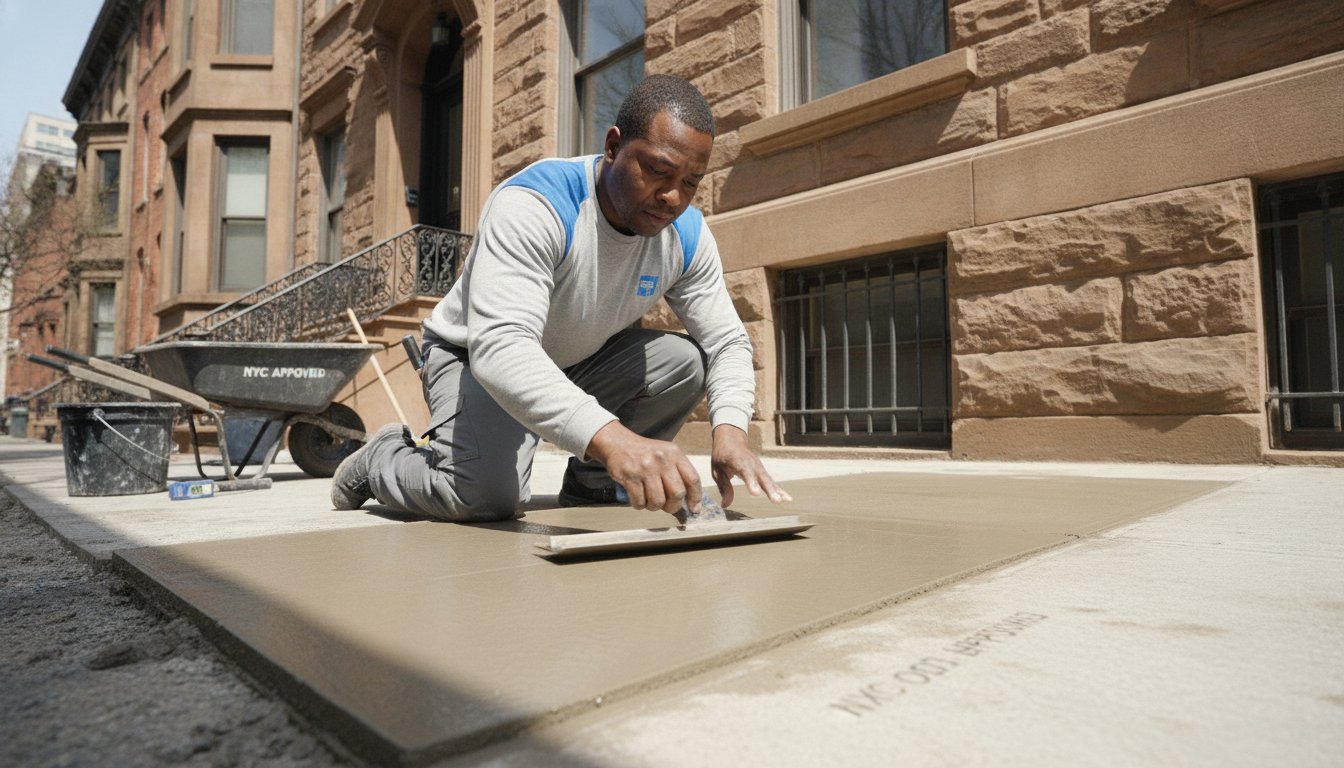
Did you know that once the NYC DOT issues a violation, you have exactly 75 days to complete the work before the city performs the repair and bills you at a much higher rate? Receiving that notice is often the start of a stressful period filled with technical confusion and the fear of heavy fines. You’re likely worried about meeting the city’s strict masonry standards while trying to find a contractor who won’t disappear halfway through the job. It’s a lot to manage, especially when your primary goal is to ensure your sidewalk crack repair for nyc compliance is handled correctly the first time.
We believe that property maintenance shouldn’t be a source of constant anxiety. This guide provides the exact steps you need to repair your sidewalk according to NYC DOT standards and successfully remove property violations from your record. We will cover the specific requirements for 4,000 PSI concrete, explain why simple patching is never an option for the city, and outline the logical progression of securing necessary permits. By following this structured path, you can protect your investment and gain the peace of mind that comes with a safe, compliant walkway.
Key Takeaways
- Understand your non-delegable legal responsibilities under NYC Administrative Code § 7-210 regarding sidewalk maintenance and liability.
- Learn the specific technical definitions the DOT uses to classify “defective” flags, including trip hazards and structural cracks.
- Discover why full-depth flag replacement is the standard for successful sidewalk crack repair for nyc compliance, as surface patching often fails inspection.
- Identify the necessary DOT permits and documentation required to ensure your masonry work is recognized as a legitimate repair.
- Master the final steps of the violation removal process, from submitting the Dismissal Request form to passing the city’s certification walkthrough.
Understanding NYC Sidewalk Compliance Standards
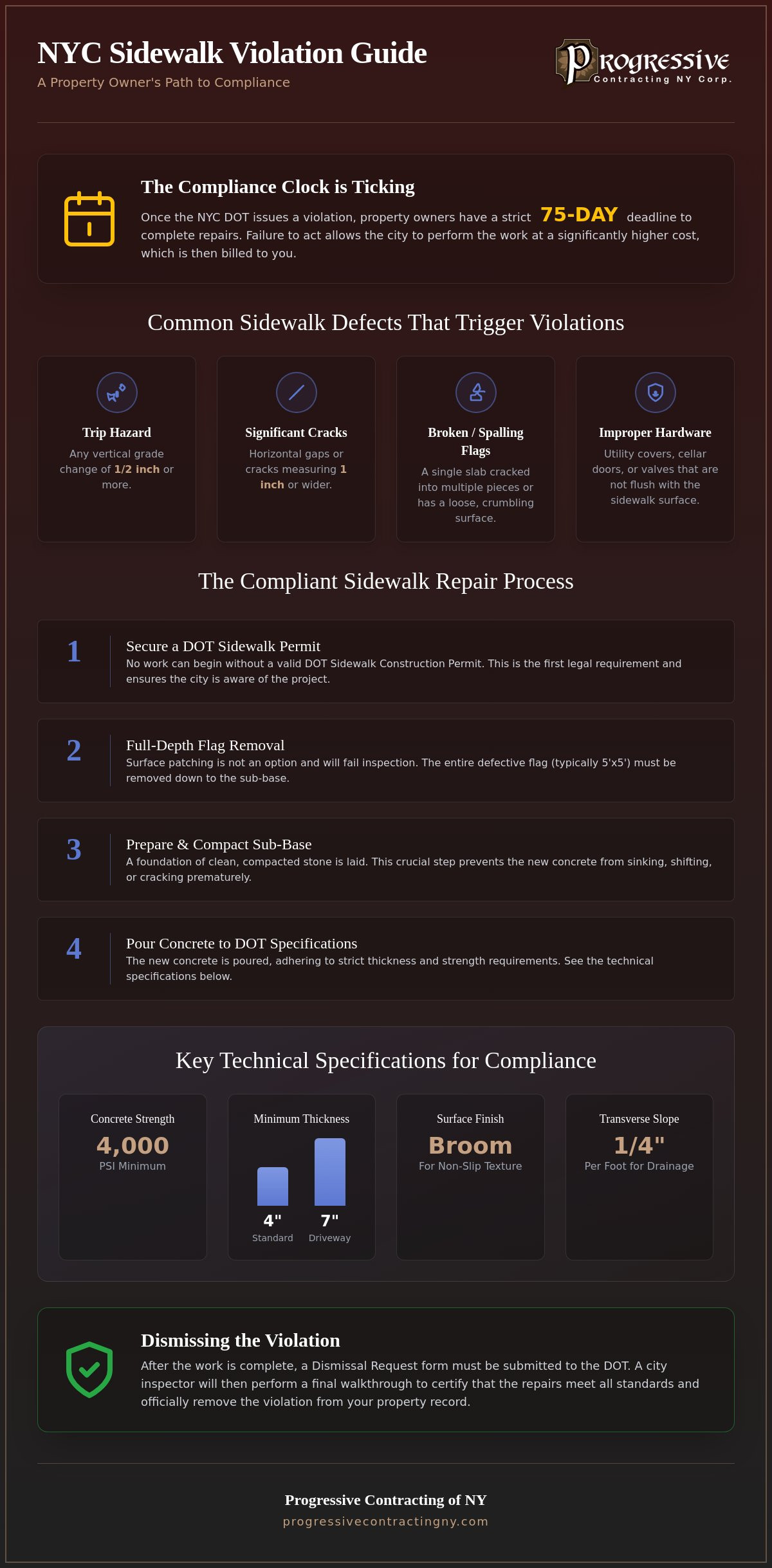
NYC Administrative Code § 7-210 places the legal burden of sidewalk maintenance squarely on the property owner. This is known as a non-delegable duty. It means you’re legally liable for any injuries that occur due to defects in the walkway adjacent to your building. If the NYC Department of Transportation (DOT) identifies a hazard, they’ll issue a notice of violation, giving you 75 days to complete the work. Failing to act within this timeframe allows the city to perform the repairs themselves, usually at a rate significantly higher than market prices.
To avoid these costs, you must understand the technical specifications that trigger a violation. The DOT defines a trip hazard as any vertical grade change of 1/2 inch or more. Additionally, any horizontal gap or crack measuring 1 inch or wider is considered a defect. These measurements are precise. Even a minor deviation can lead to a formal notice, making professional sidewalk crack repair for nyc compliance a necessity for maintaining property value and legal standing.
To better understand how the city manages these inspections and how you can respond, watch this official guide:
Common NYC Sidewalk Defects and Violations
While many owners focus on large holes, the city looks at the structural integrity of every flag. A defective flag includes any slab that’s cracked into two or more pieces or has a surface area that’s loose or spalling. Proper sidewalk construction and materials are designed to withstand heavy foot traffic, but freeze-thaw cycles and heavy loads often lead to structural failure. When these cracks compromise the flag’s stability, you’ll need to pursue sidewalk crack repair for nyc compliance to avoid a lien on your property.
Hardware issues also create compliance problems. Utility covers, water main valves, and cellar doors must be flush with the surrounding concrete. If they’re sunken or raised, they become trip hazards. Finally, tree root heaving presents a unique challenge. While the NYC Parks Department’s Trees and Sidewalks program may assist owners of one- to three-family homes, the waiting list is often long. In most cases, coordinating with a private NYC sidewalk repair contractor is the most efficient way to ensure the work meets DOT specs before the 75-day deadline expires.
The Step-by-Step Process for Compliant Sidewalk Repair
You cannot legally break ground on a public walkway without a DOT Sidewalk Construction Permit. This document serves as the first requirement for any sidewalk crack repair for nyc compliance. It ensures the city is aware of the work and that the contractor is held to specific safety standards. Without this permit, you risk immediate work stoppage and additional fines that far exceed the initial permit cost.
Once the permit is active, the process moves into full-depth removal of the defective flags. Patching a crack with a thin layer of cement is a temporary fix that rarely passes a city inspector’s scrutiny. The DOT requires the entire 5’x5′ flag to be replaced if it’s cracked or collapsed. After removal, we prepare the sub-base using clean, compacted stone. This foundation prevents the new concrete from sinking or shifting, which is the primary cause of premature cracking in urban environments.
The final stage involves pouring the concrete to exact city specifications. For residential areas, we pour 4000 PSI concrete to a minimum thickness of 4 inches. If the section includes a driveway or a corner quadrant, the thickness must increase to 7 inches to accommodate the weight of vehicles. This methodical approach ensures the repair is not just a cosmetic fix, but a structural restoration that meets every legal requirement.
Technical Specifications for 2026 Compliance
Adhering to technical details is essential for Dismissing a DOT Violation. Expansion joints must be placed at 20-foot intervals and filled with approved materials to allow for seasonal thermal movement. To meet NYC safety codes, the surface must receive a “broom finish” to ensure a non-slip texture for pedestrians. We also maintain a precise transverse slope of 1/4 inch per foot. This pitch ensures water drains toward the curb rather than pooling against your building’s foundation, making it a critical component of sidewalk crack repair for nyc compliance.
Hiring a Specialized Concrete Contractor
General handymen often fail DOT inspections because they lack the specialized metal forms and heavy-duty equipment required for a precise pour. When selecting a partner, verify they carry specific insurance and licensing for NYC street work. A properly executed sidewalk replacement using DOT-approved materials should provide at least 10 years of structural integrity against the city’s freeze-thaw cycles. If you’re facing a deadline to clear a notice, consulting an experienced Sidewalk Repair specialist is the most reliable way to ensure the job is done correctly the first time.
Dismissing the Violation: DOT Inspection and Certification
Completing the physical work is a major milestone, but the violation remains active until you file a “Dismissal Request” form with the DOT. This formal notification triggers the final inspection process. Once received, the DOT schedules a walkthrough to verify that your sidewalk crack repair for nyc compliance meets every technical specification. You don’t necessarily need to be present for this inspection, but having your contractor’s permit number and documentation ready ensures a smoother administrative transition.
A successful inspection leads to the issuance of a “Certificate of Compliance.” This document is vital. It’s the only mechanism that officially clears the violation from the NYC Department of Finance records. If you plan to sell or refinance your property, an unresolved sidewalk lien can halt the process entirely. We recommend keeping a physical copy of this certification for your permanent property records to prove the work was performed to code.
Long-term maintenance is the final step in protecting your investment. Cracks in adjacent structures can often spread to new concrete through water infiltration and soil movement. For instance, addressing brownstone stoop cracking early prevents moisture from seeping under the sidewalk flags and causing the sub-base to shift. Maintaining the seal between your sidewalk and the building line is a simple way to extend the life of your repair.
How Progressive Contracting NY Corp Ensures a 100% Pass Rate
Rejections usually stem from two specific errors: incorrect slope or poor jointing. If the pitch isn’t exactly 1/4 inch per foot, the DOT will likely fail the repair because it creates drainage issues for the block. You have the right to appeal a rejection if you believe the inspector’s measurements are inaccurate, though this requires documented proof of compliance. These administrative hurdles are why many property owners prefer a guided approach to restoration.
The most effective strategy is working with a team that understands the nuances of sidewalk violation removal nyc. At Progressive Contracting NY Corp, we maintain a 100% pass rate by performing internal inspections before the city ever arrives. This proactive approach ensures your sidewalk crack repair for nyc compliance is accepted on the first walkthrough, saving you from the frustration of costly rework or administrative delays.
Securing Your Property’s Compliance and Safety
Navigating the technical requirements of the NYC Department of Transportation doesn’t have to be a source of stress. By moving through the logical progression of permitting, full-depth replacement, and final certification, you effectively neutralize the threat of heavy city-imposed fines. A successful sidewalk crack repair for nyc compliance requires a commitment to structural integrity that matches the city’s rigorous standards. Ensuring the final walkthrough results in a Certificate of Compliance is the only way to protect your property’s title and long-term value.
We bring over a decade of masonry experience in Brooklyn and Manhattan to every project, focusing on precision and financial transparency. Our expertise in NYC DOT Administrative Code compliance and our A+ rating for sidewalk violation removal provide the stability you need for these complex restoration tasks. Clear your NYC sidewalk violation today—get a professional estimate from Progressive Contracting NY Corp. Partnering with Progressive Contracting NY Corp gives you the peace of mind that your walkway is safe, durable, and fully recognized as compliant by the city.
Frequently Asked Questions
How long do I have to fix a sidewalk violation in NYC?
You have exactly 75 days from the date the notice of violation is issued to complete the necessary repairs. If you don’t act within this timeframe, the city may perform the work themselves and bill you at a significantly higher rate. City-performed repairs are typically two to three times more expensive than hiring a private contractor, so it’s best to address the issue immediately to maintain control over the project and the final cost.
Can I repair only the cracked part of a sidewalk flag?
No, the NYC DOT doesn’t permit partial repairs or surface patching of individual sidewalk flags. Compliance standards require the full-depth removal and replacement of the entire 5’x5′ section if any part of it is deemed defective. Attempting to fill a single crack with cement won’t pass a city inspection and will likely delay the removal of your violation. Ensuring a complete sidewalk crack repair for nyc compliance is the only way to guarantee a successful dismissal.
What happens if I ignore an NYC DOT sidewalk violation?
Ignoring a violation leads to serious financial and legal consequences. The city will eventually perform the repairs and bill you at rates that are often much higher than private market costs. If you don’t pay this bill, it becomes a lien against your property, which can prevent you from selling or refinancing your home. Additionally, you remain legally liable for any personal injury lawsuits that might arise from trip hazards on your walkway while the violation remains open.
Does the city pay for sidewalk repairs caused by city tree roots?
The NYC Parks Department’s “Trees and Sidewalks” program may cover repair costs for owners of one- to three-family homes if city-owned tree roots caused the damage. This program usually has a long waiting list, so many owners handle the work themselves to mitigate legal liability in the interim. For commercial or large residential buildings, the owner is responsible for sidewalk crack repair for nyc compliance even if a city tree is the primary cause of the damage.