
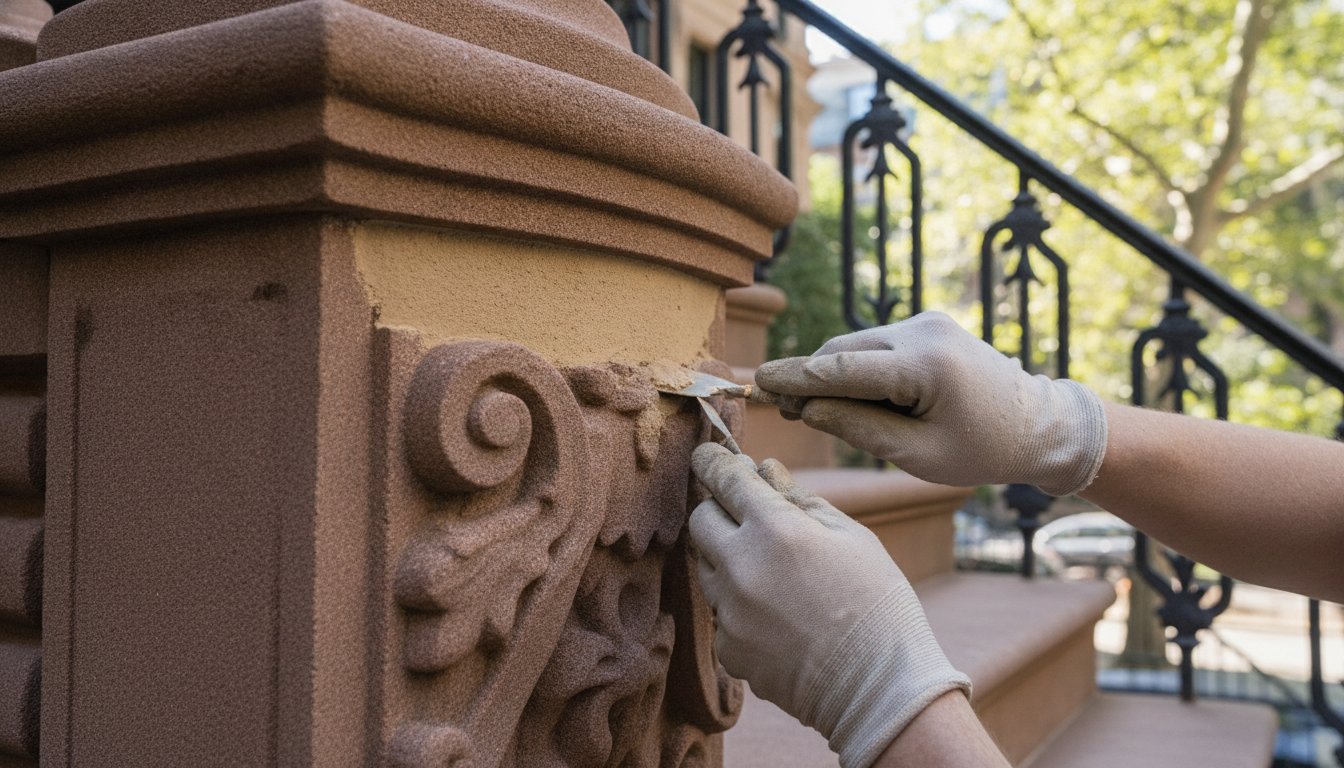
You step onto your stoop and notice a scattering of reddish-brown dust and stone fragments on the sidewalk. This spalling is more than an eyesore; it is a sign that your home’s facade is failing and a potential liability under Local Law 51 of 2025. When it comes to brownstone repair Manhattan homeowners often feel caught between the fear of crumbling masonry and the complexity of Landmarks Preservation Commission (LPC) requirements. You need a reliable guide who treats your historic property with the precision it deserves.
We recognize that the pressure to maintain historic integrity while avoiding city fines is a significant burden. This guide provides a clear path forward by teaching you how to identify deep facade damage, navigate the 2026 updates to building envelope standards, and select a specialist who uses authentic materials. We will preview the entire restoration process from the initial assessment to the final permit sign-off. To discuss your specific project needs or request an evaluation, contact our experts at 347-341-3808 or 718-350-7388, or reach us via email at ProgressiveContractingNY@yahoo.com.
Identifying Brownstone Deterioration in Manhattan Neighborhoods
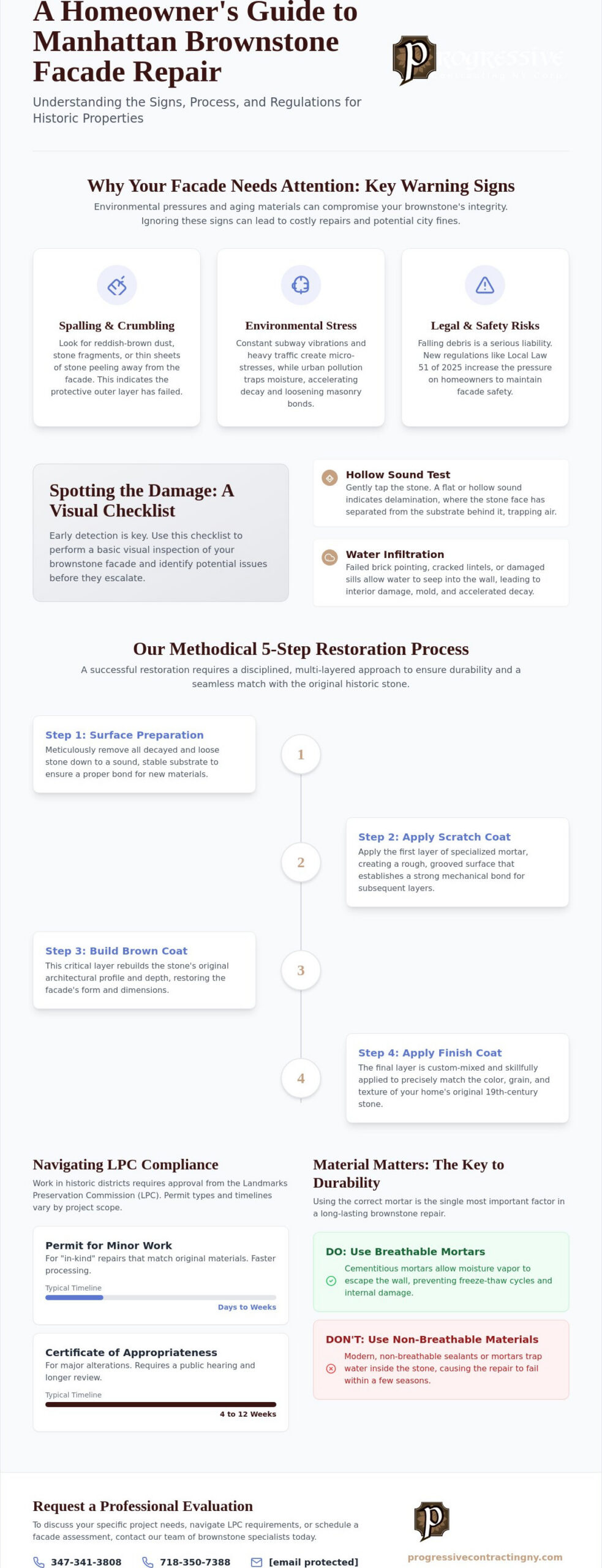
Manhattan rowhouses face unique environmental pressures that differ from those in the outer boroughs. Constant vibrations from the subway system and heavy commercial traffic create micro-stresses in the masonry. Over time, these vibrations loosen the bond between the stone’s layers. Urban pollution also plays a role. Soot and chemical deposits settle on the surface, trapping moisture and accelerating decay. This combination makes brownstone repair Manhattan projects a necessity for preserving structural integrity and safety.
To understand the repair process, it’s helpful to know What is brownstone and how it reacts to the elements. As a sedimentary rock, brownstone is naturally prone to flaking along its bedding planes. When water enters these layers and freezes, it expands, causing the stone to peel away. This process is known as spalling. While surface flaking might look like a minor aesthetic issue, it often signals that the stone’s protective “brown coat” has failed. If you notice debris on your sidewalk, contact us at 347-341-3808 or 718-350-7388 for a professional evaluation.
Common Signs of Facade Spalling and Crumbling
Look for “scaling,” where thin sheets of stone begin to separate from the facade. You might see these fragments on your sidewalk or stoop. Professionals often use a “hollow sound” test to check for deeper issues. By gently tapping the stone, we can hear if there is delamination behind the surface. If the stone sounds flat or hollow, the bond is gone. This indicates that the stone requires more than a simple patch; it likely needs a full restoration to prevent further stone from falling onto the street. For a comprehensive overview of how to address this problem, our guide on brownstone spalling repair explains the full cycle of facade crumbling and how to stop it with LPC-compliant methods.
The Impact of Water Infiltration
Water is the primary enemy of historic masonry. When brick pointing fails, moisture seeps into the wall assembly, leading to interior damage and mold. Properly functioning lintels and sills are critical because they direct water away from the face of the building. If these features are cracked, water runs down the facade instead of shedding off it. For more details on these risks, read our guide on Signs of Water Damage on Brownstone Facades. For inquiries regarding your project, email ProgressiveContractingNY@yahoo.com.
Professional Repair Techniques and LPC Compliance
Successful brownstone repair Manhattan requires a disciplined approach to both masonry and legal compliance. Most facade work in historic districts falls under a Permit for Minor Work or a Certificate of No Effect. These permits are typically processed within a few days to a few weeks, provided the repairs are in-kind. However, major alterations require a Certificate of Appropriateness. This process involves a public hearing and can take between four and twelve weeks to secure. Our team manages the filing process to ensure your project stays on schedule and meets all Landmarks Preservation Commission (LPC) standards. You can reach us at 347-341-3808 or 718-350-7388 to discuss your specific permitting needs.
Our restoration process follows a logical 5-step progression. We begin with meticulous surface preparation, removing all decayed stone until we reach a sound substrate. We then apply a scratch coat to create a mechanical bond, followed by a brown coat to rebuild the architectural profile. The final finish coat is custom-mixed to match the grain and pigment of your home’s original 19th-century stone. This methodical execution is central to our Manhattan Brownstone Repair services, ensuring the new surface is indistinguishable from the old.
Modern Patching vs. Full Facade Resurfacing
Choosing between a patch and a full resurface depends on the depth of the stone’s delamination. We use breathable cementitious mortars that allow moisture to escape the wall assembly. If a contractor uses non-breathable materials, water gets trapped behind the surface, causing the stone to fail again within a few seasons. We prioritize long-term durability by ensuring every layer is compatible with the historic stone. Understanding the dangers of improper patching materials is essential; learn more about the correct approach to fixing facade crumbling with professional brownstone spalling repair techniques. For a transparent assessment of your facade, email us at ProgressiveContractingNY@yahoo.com.
Restoring Historic Stoops and Entrances
The stoop is often the most vulnerable part of a Manhattan rowhouse due to foot traffic and salt exposure. We utilize specialized Rammstein stoop restoration techniques to reinforce the internal structure before applying the decorative finish. This ensures the entrance is safe and durable while we preserve the ornate carvings and cornices that define your home’s character. If you want to maintain your property’s historic integrity while ensuring structural safety, consulting with a specialist is the most reliable first step.
Selecting a Manhattan Brownstone Specialist
Choosing the right firm for brownstone repair manhattan requires a disciplined vetting process. You must confirm that any contractor you hire holds a current NYC Department of Buildings (DOB) license and carries comprehensive insurance. Reviewing a firm’s portfolio of historic projects is non-negotiable; you need to see evidence of successful restorations in landmark districts. A professional masonry contract should provide total transparency by detailing the specific material compositions and the projected timeline for each phase. This level of detail protects you from unexpected costs and ensures the work respects the building’s original craftsmanship.
Local references offer the most reliable proof of a contractor’s competence. A specialist with a visible track record in neighborhoods like Harlem or Chelsea understands the logistical hurdles of working in high-traffic Manhattan corridors. Direct communication is another essential factor. You should have a dedicated point of contact who manages the project and provides regular updates. This accountability is what separates a master of the craft from a general laborer. For more information on our specific approach, you can explore our Manhattan Brownstone Repair services.
Planning Your Renovation Budget
The total investment for a restoration depends on several physical variables. Building height is a primary factor because it dictates the complexity of scaffolding and the duration of required sidewalk shed permits. The depth of the stone’s delamination also impacts the labor hours required for surface preparation. Avoid the trap of the “quick fix” or cheap patch. These superficial repairs often fail within 24 months, leading to significantly higher costs when the work must be redone properly. A thorough, historic-grade restoration is an investment in your property’s long-term durability.
Get Started with Progressive Contracting NY Corp
Our team at Progressive Contracting NY Corp brings over a decade of local expertise to every project we undertake. We prioritize financial clarity and technical precision to ensure your home’s facade is restored correctly the first time. Contact us directly at 347-341-3808 or 718-350-7388 to schedule a consultation. You can also email your project details and current photos to ProgressiveContractingNY@yahoo.com for a professional review. For additional context on maintaining your home, read our Historic Masonry Restoration Guide. We are ready to provide the steady hand and reliable guidance your Manhattan property deserves.
Restore Your Manhattan Home’s Historic Integrity
Preserving a Manhattan rowhouse is a significant responsibility that requires a specialized approach to masonry. You’ve learned that addressing spalling early and adhering to LPC guidelines prevents costly city fines and structural decay. A successful restoration isn’t just about aesthetics; it’s about using breathable materials and traditional techniques that allow your home to withstand the urban environment. By prioritizing quality over temporary patches, you ensure your property remains a stable and beautiful part of the city’s history. Securing a professional brownstone repair manhattan project is the most reliable way to protect your investment for decades to come.
Progressive Contracting NY Corp offers the local expertise and transparent project management required for these complex restorations. With over 10 years of experience in historic districts, we provide a steady hand from the initial permit filing to the final finish coat. Contact Progressive Contracting NY Corp today at 347-341-3808 or 718-350-7388 to schedule your comprehensive assessment. You can also email project details and photos to ProgressiveContractingNY@yahoo.com for a professional review. We are dedicated to being your dependable partner in maintaining your home’s historic integrity.
Frequently Asked Questions
Do I need a permit for brownstone repair in Manhattan?
Yes, most brownstone repair Manhattan projects require approval from the Landmarks Preservation Commission (LPC) if the property is located within a historic district. A Certificate of No Effect or a Permit for Minor Work is usually necessary for in-kind repairs that match the original materials. We manage these filings for our clients to ensure full compliance with city regulations. For a consultation on your specific permit requirements, call us at 347-341-3808 or 718-350-7388.
How long does a typical brownstone facade restoration take?
A full facade restoration generally takes between four and eight weeks, though the exact duration depends on the building’s height and the severity of the damage. This timeline accounts for the sequential application of the scratch, brown, and finish coats, allowing each layer to cure properly. We prioritize a methodical pace to ensure the structural integrity of the masonry. You can send project photos to ProgressiveContractingNY@yahoo.com for a more accurate time estimate.
Why is my brownstone facade crumbling or spalling?
Spalling occurs when water enters the stone’s layers and expands during the freeze-thaw cycle. In Manhattan, this is often aggravated by constant vibrations from heavy traffic and subways, which weaken the stone’s natural bedding planes. Another common cause is the use of non-breathable mortars from previous repairs. These materials trap moisture behind the surface, forcing the stone to flake off as it tries to shed water.
What is the difference between brownstone repair and brick pointing?
Brownstone repair involves resurfacing the actual face of the stone using custom-tinted cementitious mixes to restore its architectural profile. Brick pointing, on the other hand, is the process of replacing failed mortar in the joints between bricks or stones. While both are essential for brownstone repair Manhattan, pointing specifically targets the gaps to prevent water infiltration, whereas restoration addresses the deterioration of the stone itself.