
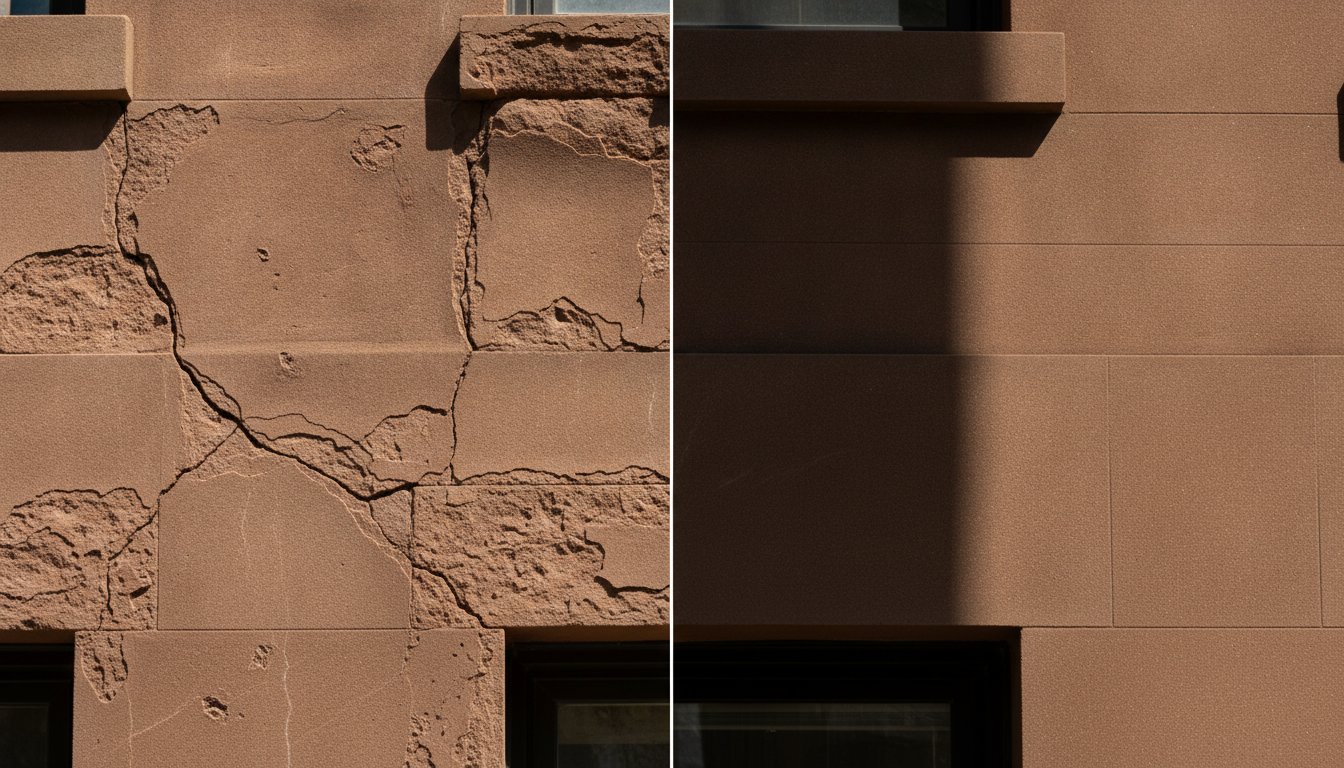
You step onto your sidewalk after a heavy rain and notice thin, reddish flakes of stone confetti scattered across the concrete. This isn’t just an aesthetic nuisance; it’s a clear signal that your home’s facade is failing. Professional brownstone spalling repair is the only way to stop this cycle of decay before it leads to expensive structural issues or safety hazards. If you see these signs of crumbling, you can reach Progressive Contracting NY Corp directly at 347-341-3808 or 718-350-7388 to discuss your property’s specific needs.
We understand the frustration of watching a historic property peel and the confusion that comes with navigating NYC Landmarks Preservation Commission (LPC) rules. You deserve a restoration that looks authentic and survives more than a single winter. This article explains exactly why your brownstone is peeling and how to implement professional, LPC-compliant repairs that protect your investment. We’ll cover the dangers of using improper materials like Portland cement and the step-by-step process for a lasting, breathable restoration. For a detailed assessment of your facade, you can also email our team at ProgressiveContractingNY@yahoo.com.
Understanding Brownstone Spalling: Why Your Facade is Crumbling
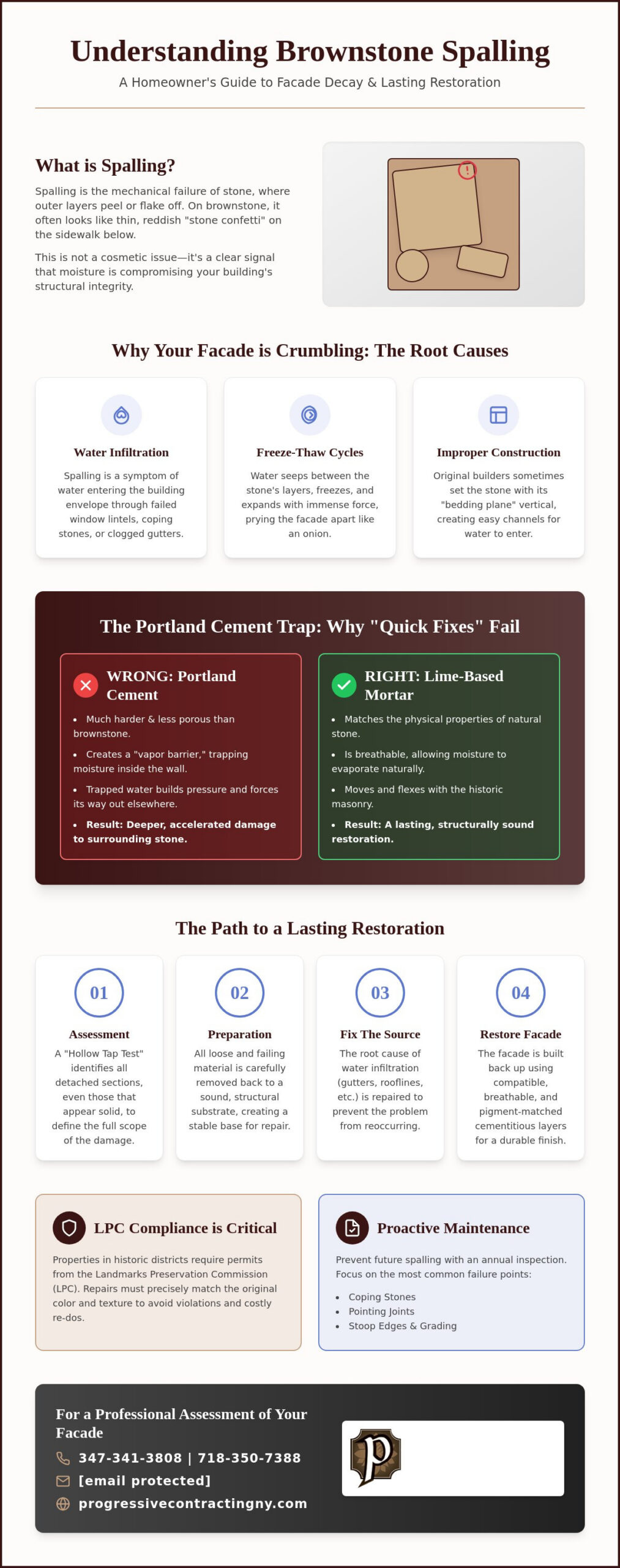
Spalling is the mechanical failure of stone layers caused by moisture expansion within the capillary pores. To truly understand What is Spalling in the context of a New York City home, you have to look at the stone’s geology. Brownstone is a sedimentary rock formed in distinct layers. When builders originally laid the stone, they often placed it with the “bedding plane” running vertically. This orientation allows water to seep between the layers easily. When that water freezes, it expands, forcing the stone to peel away in thin sheets like an onion. NYC winter salts and constant freeze-thaw cycles accelerate this decay, making timely brownstone spalling repair essential for preserving your property’s value.
The Portland Cement Trap: Why Quick Fixes Fail
Many general contractors attempt to fix crumbling stone with standard Portland cement. This is a critical mistake. Cement is much harder and less porous than natural brownstone, creating a “Vapor Barrier” effect. This patch traps moisture behind the stone face rather than letting it evaporate. Because the water cannot escape through the cement, it builds pressure and eventually forces its way out through the surrounding soft stone. This results in even deeper damage over time. Effective restoration requires breathable, lime-based mortars that match the original stone’s physical properties. The same principle applies to brick pointing NYC projects, where using incompatible mortar in the joints can trap moisture and accelerate structural decay across the entire facade. If you have noticed previous repairs failing, call us at 347-341-3808 or 718-350-7388 to schedule a professional assessment.
Identifying the Root Cause: Water Infiltration
Spalling is rarely an isolated problem; it is a symptom of water entering the building envelope. You can often find signs of water damage on brownstone facades near common entry points. Failed window lintels, shifted coping stones on the roofline, and clogged drainage systems are the usual culprits. Before we begin any brownstone spalling repair, we identify these sources of moisture. Fixing the surface without addressing the water source is a temporary band-aid. For expert guidance on your facade’s structural integrity, email our team at ProgressiveContractingNY@yahoo.com or visit brownstonerepair.net.
Professional Repair Strategies for Spalling Brownstone
A successful brownstone spalling repair follows a disciplined order of operations. We don’t just patch the surface; we investigate the underlying causes to ensure a permanent fix. Our process begins with a “Hollow Tap Test.” By gently striking the facade with a specialized tool, we identify detached sections that appear solid but have already separated from the masonry. We then remove all loose material back to the sound, structural substrate. This provides a stable base for the new restoration. If you notice stone fragments on your stoop, it’s time to consult with a restoration specialist to prevent further decay.
Before applying any new layers, we must address the water source. This involves inspecting gutters, roof drainage systems, and window lintels. Once the building envelope is secure, we build up the facade using compatible, pigment-matched cementitious layers. This methodical approach ensures the repair lasts for decades rather than just one season. For an expert assessment of your property, contact us at 347-341-3808 or 718-350-7388.
LPC Compliance and Historic Permits
If your property is in a designated district, spalling repair usually requires a permit from the Landmarks Preservation Commission (LPC). The commission is strict about color-matching and texture replication. Failing to follow these standards can lead to NYC violations and expensive re-dos. You can find more details in our historic masonry restoration guide for NYC property owners. We handle the paperwork and execution to ensure your home remains compliant with all local regulations.
The Importance of Material Compatibility
Modern “waterproof” sealers are often prohibited in historic districts because they trap moisture within the stone. Instead, specialists like Progressive Contracting NY Corp use breathable mortars that match original stone density. These techniques align with National Park Service standards for historic cast stone, prioritizing the stone’s health over a quick aesthetic fix. To discuss your project or request a quote, you can reach our team at ProgressiveContractingNY@yahoo.com.
Maintaining Your Brownstone to Prevent Future Spalling
Preventing the need for repetitive brownstone spalling repair requires a proactive approach to maintenance. We recommend an annual inspection checklist that focuses on coping stones, pointing joints, and stoop edges. These are the most common points of failure where water begins its slow path into the stone layers. If you find stone confetti on your sidewalk, don’t view it as a cosmetic issue. It is a critical call to action indicating that moisture is already compromising the masonry’s structural integrity. Deteriorating mortar joints between stone and brick elements are equally dangerous, and understanding the full scope of brick pointing in NYC can help you identify and address these vulnerabilities before they escalate into costly structural repairs.
The health of your stoop directly impacts your facade’s longevity. A cracked or improperly graded stoop can channel gallons of water into your building’s foundation and lower level stone. Implementing a Rammstein stoop restoration ensures that water is shed away from the structure correctly. For property owners in the city, specialized brownstone repair in Manhattan differs significantly from standard masonry because it accounts for the unique wind and moisture patterns of high density urban environments.
Seasonal Care for NYC Homeowners
Pre-winter preparation is vital. You should seal small hairline cracks before the first freeze to prevent the expansion cycle. Post-winter cleaning is equally important. Safely removing salt deposits from the sidewalk and lower facade prevents chemical erosion. We suggest following the NPS Preservation Brief on Masonry for safe cleaning methods that won’t strip the stone’s natural protective patina. Avoid power washing, as high pressure can force water deep into the sedimentary layers.
Consulting a Specialized Brownstone Contractor
General contractors often use harsh chemicals or incompatible materials that cause more harm than good to historic facades. A historic building needs a partner who understands breathable masonry and the specific geology of NYC stone. If you’re ready to protect your home with a professional brownstone spalling repair, contact Progressive Contracting NY Corp at 347-341-3808 or 718-350-7388. Email inquiries can be sent to ProgressiveContractingNY@yahoo.com for a detailed assessment of your property’s condition.
Securing Your NYC Home’s Historic Future
Spalling is more than a cosmetic flaw; it’s a signal that your home’s protective envelope is failing. Successful brownstone spalling repair relies on addressing the root cause of water infiltration and using breathable, compatible materials. We specialize in these complex restorations across Brooklyn and Manhattan, ensuring every project meets strict LPC requirements. Our team prioritizes long term structural integrity over temporary aesthetic patches. We understand the unique geology of New York stone and the precise techniques required to stop the cycle of decay.
Protect your home’s history. Get a professional spalling assessment from Progressive Contracting NY Corp. You can speak directly with our experts by calling 347-341-3808 or 718-350-7388. For detailed inquiries or to share project photos, email us at ProgressiveContractingNY@yahoo.com. We are ready to help you restore and preserve your historic property for the next generation. Your home deserves a facade that remains beautiful and stable for decades to come.
Frequently Asked Questions
How much does brownstone spalling repair cost in NYC?
The cost of brownstone spalling repair depends on the total surface area affected and the depth of the stone decay. Factors such as scaffolding requirements, the complexity of decorative lintels, and whether your property is in an LPC historic district will influence the final budget. We provide transparent, detailed assessments to help you plan your project effectively. For a specific quote tailored to your home, contact us at 347-341-3808 or 718-350-7388.
Can I just paint over my crumbling brownstone to stop it?
No, you should never paint over crumbling brownstone to hide the damage. Paint acts as a non-breathable film that traps moisture behind the stone surface. This trapped water creates internal pressure during freeze-thaw cycles, which actually accelerates the spalling process. Proper restoration requires removing the loose stone and applying breathable, cementitious layers. If you’re concerned about your facade’s appearance, email us at ProgressiveContractingNY@yahoo.com for a professional evaluation of your stone’s health.
Does all brownstone repair require an LPC permit?
Most exterior work on properties within NYC historic districts requires a permit from the Landmarks Preservation Commission. This includes any brownstone spalling repair that involves resurfacing or changing the facade’s texture and color. The LPC ensures that the materials used match the original historic character of the neighborhood. We handle the permit application process for our clients to ensure full compliance. You can reach out to our team at 718-350-7388 to discuss the specific requirements for your district.
What happens if I ignore the spalling on my facade?
Ignoring spalling on your facade leads to deep structural failure and increased safety risks for pedestrians. What begins as “stone confetti” on the sidewalk can quickly escalate into falling masonry chunks. Over time, water penetrates deeper into the building’s core, causing rot in wooden floor joists and rusting of structural steel. Addressing these issues early typically costs significantly less than a full building envelope restoration. Don’t wait for a DOB violation; if deteriorating stone has already damaged your adjacent sidewalk, understanding the cost of sidewalk violation removal in NYC can help you budget for full compliance before City-mandated contractors are assigned to your property. Call us today at 347-341-3808.