
Call us 347-341-3808,718-350-7388
You walk out your front door on a crisp Brooklyn morning only to find a dusting of "stone confetti" scattered across your stoop. It’s a common sight for many NYC homeowners, yet it often triggers a wave of anxiety about the structural integrity of your property. Seeing those thin flakes of stone on the sidewalk feels like watching your home’s history slowly crumble away. Understanding the nuances of brownstone facade deterioration repair is the first step toward protecting your investment and your peace of mind.
We know how overwhelming it feels to balance the need for urgent repairs with the strict requirements of the Landmarks Preservation Commission. You want to stop the decay without losing the character that makes your building unique. This article will help you identify the early warning signs of stone failure and explain the professional restoration methods that preserve these historic facades. You’ll learn the critical difference between surface spalling and structural failure, as well as how to vet a specialized contractor. We’ll also cover how to prevent water infiltration to ensure your home remains a stable, beautiful part of the neighborhood for decades to come.
Table of Contents
Identifying Common Types of Brownstone Facade Deterioration
Brownstone is a Triassic-Jurassic sandstone that gained popularity for its deep color and accessibility. To understand what is brownstone, you have to look at its sedimentary origins. It’s composed of layers, or laminae, that were deposited over millions of years. When builders laid these stones "on edge" rather than on their natural bedding planes, they inadvertently invited decay. This orientation makes the stone prone to delamination, where layers peel away like the pages of a book. Deterioration isn’t just an aesthetic flaw; it’s a loss of surface integrity driven by environmental stress.
NYC winters are particularly harsh on these historic materials. The freeze-thaw cycle is the primary catalyst for damage. Water enters the porous stone, freezes, and expands. This internal pressure exerts massive force, literally pushing the stone apart from the inside. While natural weathering is inevitable over a century, neglect or improper past repairs often accelerate this process. Effective brownstone facade deterioration repair requires reversing these mistakes by addressing the root cause of moisture entry and structural instability.
Spalling vs. Scaling: What Your Stone is Telling You
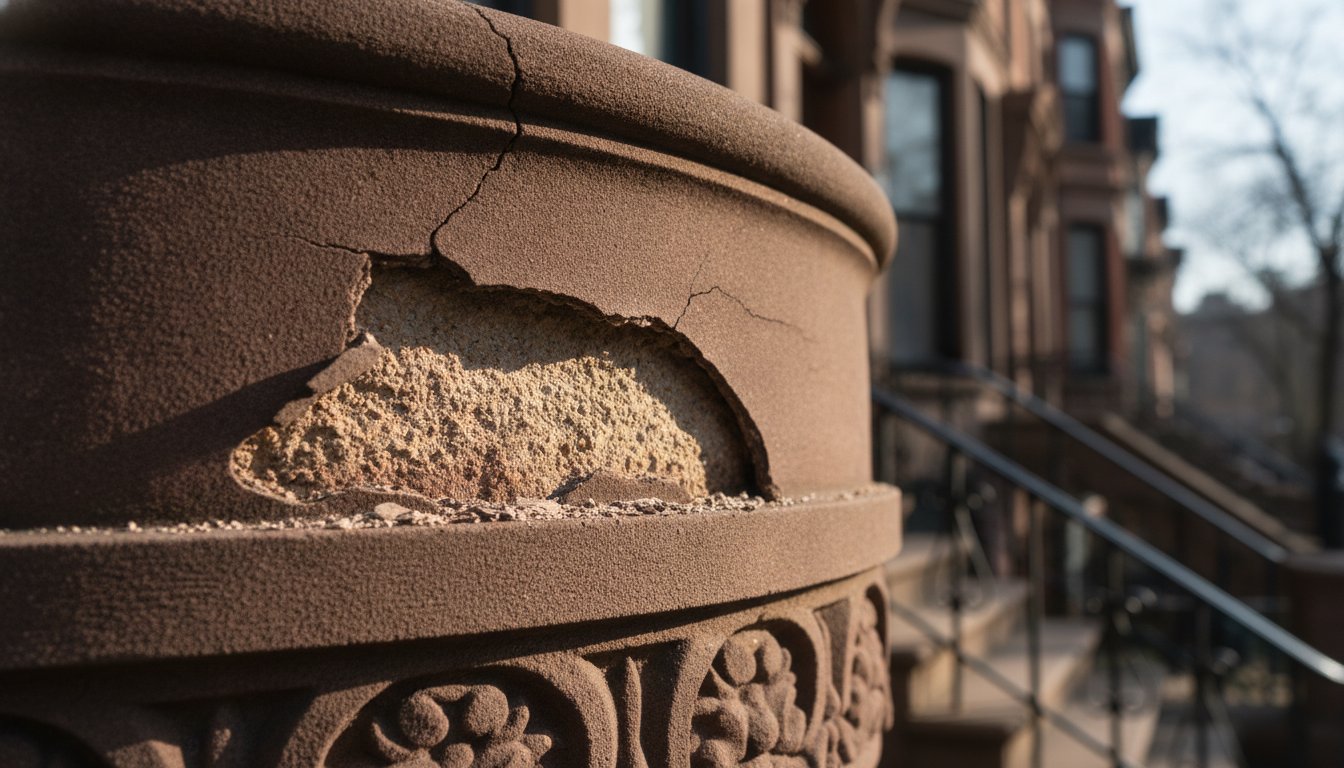
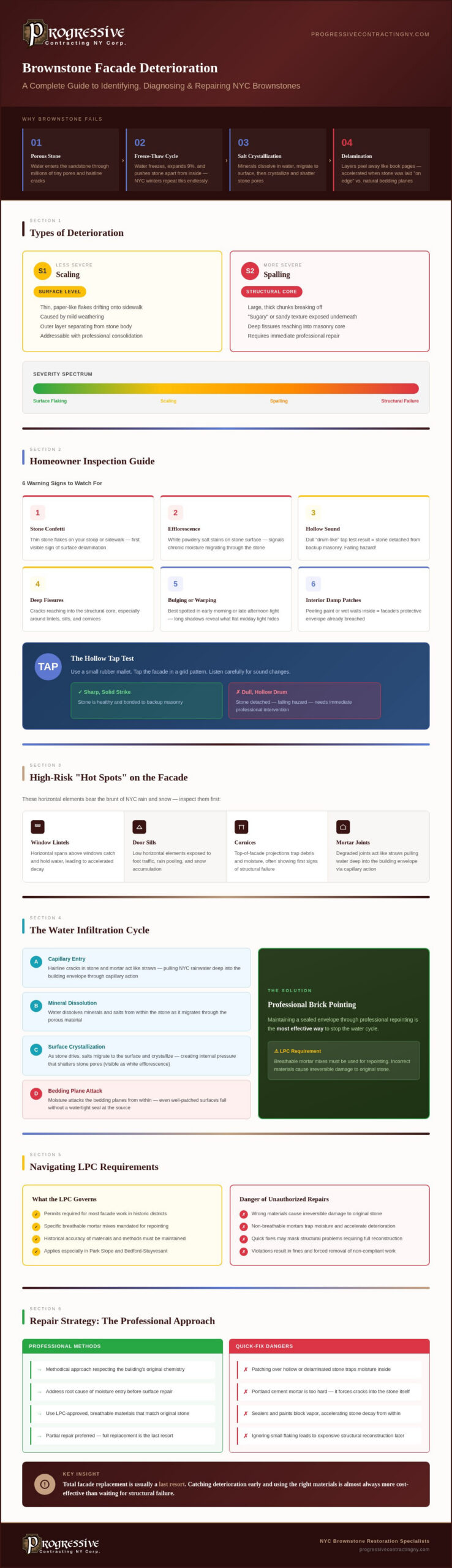
Identifying the specific type of damage is crucial for planning a brownstone facade deterioration repair. Scaling appears as thin, paper-like flakes that drift onto your sidewalk. This is often a surface-level issue caused by mild weathering. Spalling is more serious. It involves larger, thicker chunks of stone breaking off, often revealing a "sugary" or sandy texture underneath. If the stone feels soft or if you notice deep fissures reaching the underlying masonry, the damage has likely moved beyond the surface and into the structural core of the facade.
The Role of Water Infiltration in Facade Decay
Water is the primary enemy of historic masonry. Hairline cracks in the stone or mortar act like straws, pulling NYC rainwater deep into the building envelope through capillary action. Once inside, the water dissolves minerals and salts. As the stone dries, these salts migrate to the surface and crystallize. This process creates internal pressure that shatters the stone’s pores. Maintaining a sealed envelope through professional brick pointing is the most effective way to stop this cycle. Without a watertight seal, even the best stone repairs will eventually fail as moisture continues to attack the bedding planes from within.
Diagnosing Damage: A Homeowners Inspection Guide
Regular inspections are the foundation of effective brownstone facade deterioration repair. You should perform a visual sweep of your property during different times of the day to catch subtle issues. Early morning or late afternoon sun creates long shadows that reveal bulging or warping that flat mid-day light hides. Focus your attention on "hot spots" like window lintels, door sills, and cornices. These horizontal elements bear the brunt of NYC rain and snow, making them the first areas to show signs of masonry failure.
Look for white, powdery salt stains known as efflorescence on the stone surface. These marks are a clear signal that chronic moisture is migrating through the stone and evaporating. You should also check the interior of your home for warning signs. Peeling paint or damp patches on walls shared with the exterior facade often mean the stone’s protective envelope has already been breached. Catching these signs early prevents the need for a full-scale reconstruction later.
The Hollow Tap Test: Finding Hidden Spalling
Sometimes a facade looks intact but has actually detached from the structural backup masonry. You can find these hidden pockets by using a small rubber mallet to perform a tap test. Gently tap the stone in a grid pattern across the facade. A healthy stone produces a sharp, solid strike. A detached or "blown" section will emit a dull, drum-like hollow sound. If you encounter these hollow spots, the stone is a falling hazard. This condition requires immediate professional intervention to ensure pedestrian safety and prevent further water trapping.
NYC Landmarks (LPC) and Regulatory Red Flags
Owners in historic districts like Park Slope or Bedford-Stuyvesant must adhere to specific regulatory requirements. The Landmarks Preservation Commission (LPC) requires permits for most facade work to ensure historical accuracy. This includes using specific, breathable mortar mixes for repointing mortar joints. Unauthorized patches often use incorrect materials that cause irreversible damage to the original stone. You can find more details on navigating these rules in our Historic Brownstone Renovation Brooklyn Guide. If you’ve identified these red flags on your property, consulting a qualified brownstone specialist can help you develop a compliant repair plan.
Effective Repair Strategies and the Danger of Quick Fixes
Professional brownstone facade deterioration repair requires a methodical approach that respects the building’s original chemistry. Total facade replacement is usually a last resort. It’s often more practical and cost-effective to perform targeted restoration that preserves the healthy core of your masonry. This process involves custom-mixing mortar to match the original stone’s specific color, texture, and porosity. Using the wrong mix can lead to visual clashing and physical failure. For high-traffic areas, a specialized Rammstein stoop restoration ensures the entryway remains durable while maintaining its historic profile. You can find detailed guidance on material standards in the National Park Service Preservation Briefs, which serve as the industry benchmark for historic masonry care.
Why Portland Cement Destroys Historic Brownstone
Modern Portland cement is the most common mistake in NYC brownstone repair. This material is far too hard and non-breathable for soft, 19th-century sandstone. Because cement doesn’t allow moisture to escape, it traps water behind the patch. This trapped moisture causes "shaling," where the original stone rots from the inside out and eventually falls away in large chunks. Unlike cement, lime-based mortars are sacrificial. They allow the building to "breathe" and shed moisture naturally, ensuring the repair moves in harmony with the historic stone rather than fighting against it.
The Professional Restoration Workflow
A structured restoration ensures long-term stability. Following a logical progression prevents the recurrence of spalling and water infiltration. Professionals typically follow these three phases:
-
Step 1: Technicians carefully remove all friable and deteriorated material. They cut back the stone until they reach a sound, solid surface.
-
Step 2: For larger patches, we install stainless steel pins. These pins provide structural reinforcement and anchor the new stone material to the backup masonry.
-
Step 3: Artisans apply a slurry coat followed by build-up layers of custom mortar. They use specialized tools to mimic the original tooled or smooth texture of the facade.
Once the repairs are complete, proactive care is the best way to protect your investment. We encourage homeowners to review our Brownstone Facade Maintenance Checklist to catch small issues before they require major intervention.
Protecting Your Historic Investment for the Future
Maintaining an NYC brownstone requires a balance of vigilance and specialized craftsmanship. You now understand that spotting "stone confetti" early and performing a simple tap test can prevent minor scaling from turning into a major structural failure. By avoiding modern Portland cement and choosing breathable, lime-based materials, you ensure your home’s facade remains stable for another century. Navigating LPC requirements is also essential for preserving the historic value of properties in neighborhoods like Park Slope or Bed-Stuy.
Addressing brownstone facade deterioration repair is not just about aesthetics; it’s about the long-term health of your building’s envelope. Progressive Contracting brings over a decade of masonry experience to every project. We specialize in the historic districts of Brooklyn and Manhattan, with specific expertise in Rammstein stoop restoration and meticulous stone patching. Our team provides the steady hand and technical precision needed to navigate complex restoration projects with transparency and care.
Get a Professional Facade Inspection from Progressive Contracting
Take the first step toward peace of mind and ensure your home remains a landmark of durability and tradition for decades to come.
Frequently Asked Questions
How much does brownstone facade deterioration repair cost in NYC?
The cost of restoration depends on the extent of the damage, the height of the building, and whether the property sits in a landmarked district. Major factors include the amount of stone removal required and the complexity of custom-mixed mortar matching. You also need to account for sidewalk shed permits and Department of Buildings filing fees. A detailed site assessment is the only way to get an accurate estimate for your specific property.
Can I use a waterproof sealer to stop my brownstone from crumbling?
You should generally avoid using waterproof sealers on historic brownstone. These coatings often create a non-breathable barrier that traps moisture inside the stone’s pores. When water cannot evaporate, it leads to internal pressure and "shaling," where large sections of the facade eventually peel off. It’s better to use breathable, lime-based materials that allow the stone to shed moisture naturally while providing a durable finish.
How do I know if my brownstone repair needs a permit from the Landmarks Preservation Commission?
You need an LPC permit if your building is located within a designated NYC historic district and you plan to alter any exterior feature. This includes most masonry work, from minor repointing to a full brownstone facade deterioration repair. You can check the NYC Landmarks Map to confirm your building’s status. Even if you’re only repairing existing damage, the commission must approve the materials and methods to ensure they match the neighborhood’s character.
What is the best time of year to perform brownstone facade repairs?
The best time for masonry work in New York City is from late spring to early autumn. Most breathable mortars require temperatures to stay consistently above 40 degrees Fahrenheit to cure properly. If the wet mortar freezes before it dries, it will lose its structural integrity and fail prematurely. Scheduling your project during moderate weather ensures the materials bond correctly and provides a more predictable timeline for completion.