
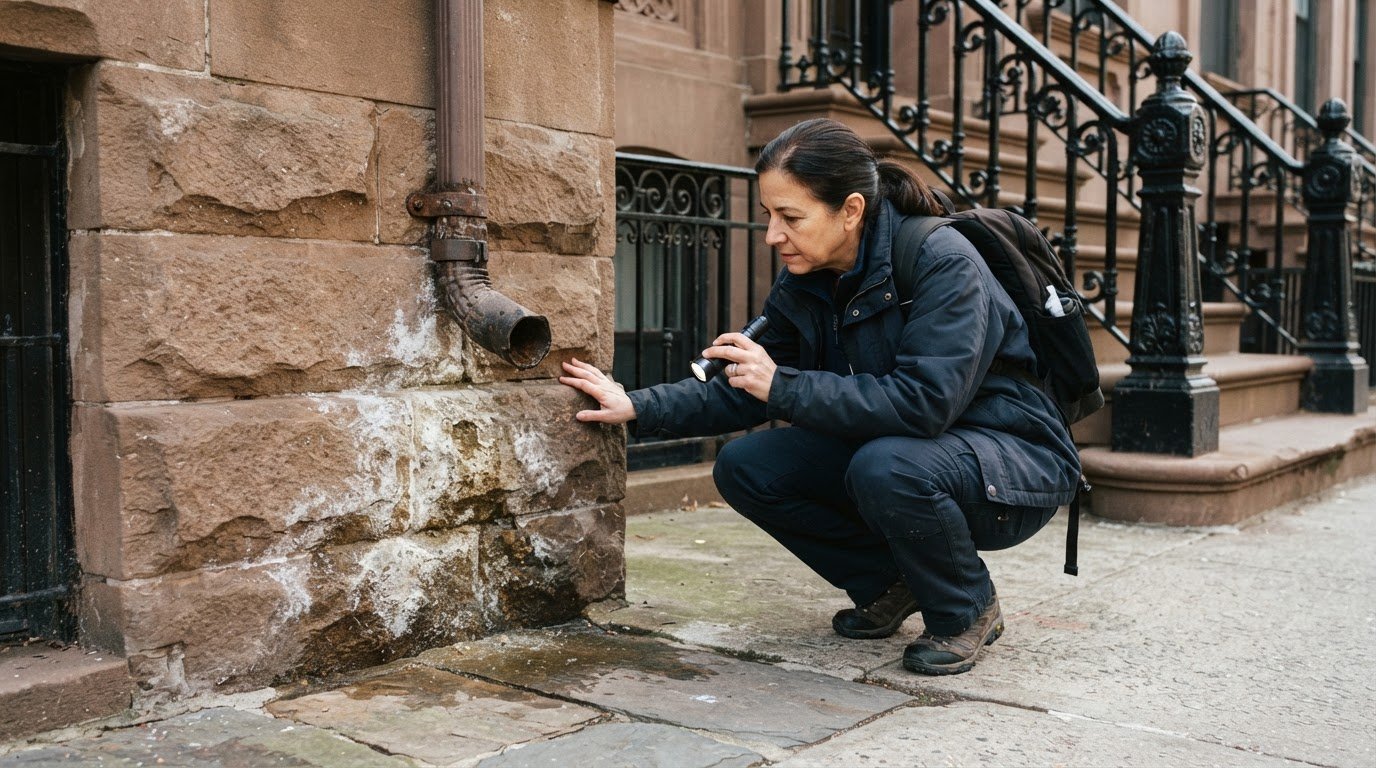
White powder on a façade often points to moisture movement, not the underlying problem. A facade inspection for determining the cause of efflorescence examines where deposits appear and how water may be reaching the surface. Efflorescence forms when moisture carries soluble salts through porous material and evaporation leaves them behind.
It’s understandable to focus first on the visible residue, but cleaning it alone may not address the moisture path. This article explains which façade materials can develop efflorescence, how an inspection can help identify likely sources such as rainwater or groundwater, and how the location and extent of defects help prioritize repairs. It also explains why widespread deposits or rust staining may signal more serious moisture-related concerns.
Table of Contents
What are Façade Inspections?
An inspection maps deposits, moisture paths, and defects before cleaning or repairs begin.
Inspection Imaging and Defect Identification
A façade inspection uses ground review, imaging, and moisture checks to connect deposits with defects. Drone imagery of 20-50 MP can reveal upper-floor efflorescence missed from ground level. The inspector records cracks, open joints, staining, and loose material, then compares these locations with moisture readings. This helps distinguish surface residue from structural concerns.
Efflorescence as a Moisture Clue
Efflorescence is soluble salt left behind when moisture carries minerals through porous masonry and evaporates. Rainwater can enter through failed joints, while groundwater can rise several feet through masonry by capillary action. A facade inspection for determining the cause of efflorescence maps recurring deposits and nearby cracks or joints. Sealants may limit water entry, but their suitability depends on the material and moisture source.
Identifying Efflorescence and Other Damage
Efflorescence is usually a pale, powdery deposit that dissolves in water; mold does not. Rust staining can signal that water is reaching reinforcement, while cracks, spalling, or loose masonry indicate other damage. Inspectors compare color, texture, and patterns with damp areas and joints to distinguish deposits from staining. Cleaning before addressing the moisture path leaves the cause active, so residue can return.
Professional Assessment and Inspection Steps
Seek a licensed professional or building-envelope consultant when deposits persist or spread, appear with rust or spalling, or extend beyond what can be safely reviewed from the ground. An inspection can map deposits, check joints and cracks, take moisture readings, and compare patterns with rain exposure or groundwater paths. U.S. inspection costs depend on access, façade area, and testing scope; a quote follows a request. Once the moisture issue is corrected, dry-brush and rinse the area. Avoid muriatic acid, which can damage masonry and requires careful handling.
Porous building materials that can develop efflorescence
Concrete, clay brick, stucco, stone, and wood can develop efflorescence when moisture moves through them. Pores in each material can carry soluble salts toward the exterior, where evaporation leaves a pale deposit. The bloom’s appearance varies: brick may show deposits across its face, while concrete or stucco may have patches near cracks and joints. Excess moisture transports salts, but the deposit alone does not identify the source.
Testing can help assess a material’s efflorescence potential before construction or during an investigation. ASTM C 67 provides laboratory methods for checking building brick, including a test that dries brick at 220 °F. That heat makes the test more severe than ordinary environmental exposure. Modified ASTM C 67 procedures can also assess concrete masonry units, grout, masonry sand, and masonry cement for water-soluble salts.
Material submittal reviews can add context to test results. Reviewing the specified brick, mortar, cement, and masonry sand helps identify which components may contribute soluble salts. The review can also consider flashing and drainage details that affect water movement through an exterior wall. In colder conditions, some impregnating sealants may contribute to material breakage during freeze-thaw cycles, so treatment choices need to account for the wall assembly.
Efflorescence is usually a surface clue, but façade deterioration can create a public-safety concern. In 2015, falling terra cotta from a New York City façade killed a two-year-old child. Loose masonry, cracking, or spalling therefore calls for attention beyond cleaning a difficult deposit. For related masonry restoration, the inspection findings can help define the repair scope.
Façade inspection reporting and defect priorities
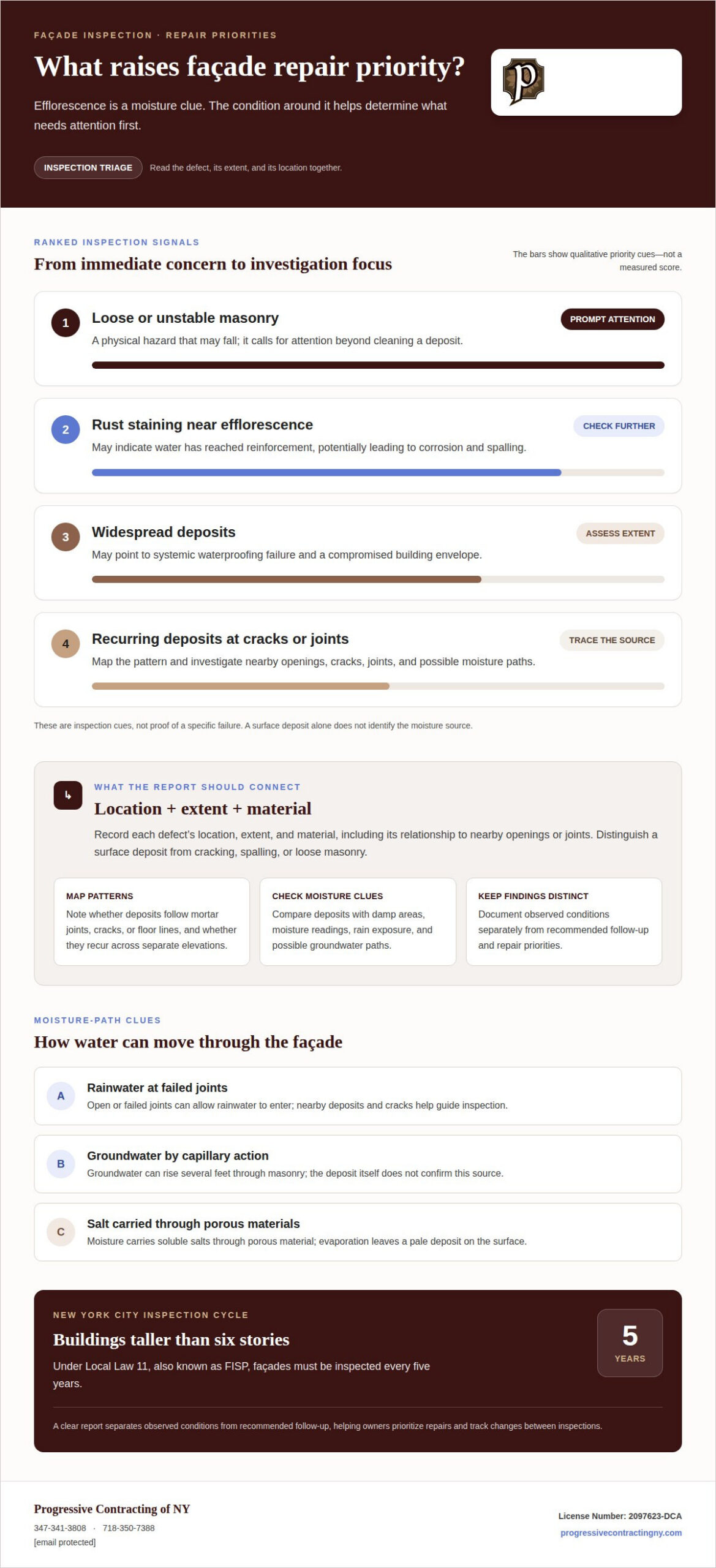
A useful façade report records each defect’s location, extent, and material, along with its relationship to nearby openings or joints. For efflorescence, it should distinguish a surface deposit from cracking, spalling, or loose masonry. This matters because soluble residue signals moisture movement, while detached material presents a separate physical hazard. Both conditions should be documented, not grouped under one broad label.
Set priorities according to the evidence. Rust staining beside efflorescence can indicate water has reached reinforcement, potentially leading to corrosion and spalling. Loose or unstable material also needs prompt attention because it may fall. Widespread deposits may point to systemic waterproofing failure and a compromised building envelope. A report can map affected areas, note whether patterns follow mortar joints or floor lines, and identify where further investigation should focus.
Good records connect visible defects to possible causes without treating a surface deposit as proof of a specific failure. For example, an inspector can note whether staining clusters at joints, cracks may admit water, or deposits recur across separate elevations. The report can also document cement or mortar conditions and the methods used to inspect accessible areas. These details help define an appropriate repair scope and show whether the available observations are sufficient.
In New York City, buildings taller than six stories must have façades inspected every five years under Local Law 11, also known as FISP. A report should distinguish observed conditions from recommended follow-up, so owners can prioritize repairs and track changes between inspections. Where findings call for masonry repair, façade restoration work can address damaged exterior materials after the moisture path has been assessed.
Progressive Contracting NY Corp
Progressive Contracting NY Corp is a natural next step when façade findings point to masonry or brownstone repairs. After the moisture source and affected areas are assessed, the company can address the repair work through brownstone façade renovation and restoration. This is especially relevant when efflorescence appears alongside deteriorated masonry, damaged joints, or other façade defects that need repair. Inspection findings help define the work to discuss, while the repair scope depends on the building’s condition.
Plan the right next step for your façade
Use inspection findings to guide the repair decision, not just the surface treatment. A facade inspection for determining the cause of efflorescence can clarify whether the next step is further assessment, correction of the moisture source, or masonry repair. Keeping these options distinct helps prevent work from focusing on visible residue while the underlying façade condition remains unresolved.
When findings point to brownstone repair or restoration, Progressive Contracting NY Corp offers brownstone façade renovation, specialized masonry restoration, and historic stoop repair. The appropriate work depends on the affected materials and defects identified at the property. A clear repair scope gives the project a practical starting point.
Contact Progressive Contracting NY Corp to discuss the façade work.
Frequently Asked Questions
What Is Efflorescence?
Efflorescence is mineral residue left on a building surface after moisture evaporates. On brick, it may look like a white, powdery bloom; on concrete or stucco, it can appear as scattered pale patches. The residue differs from paint failure or dirt, and its location can help show where water has moved through the material.
What is the difference between primary and secondary efflorescence?
Primary efflorescence develops as moisture from construction materials dries, often soon after masonry or concrete is installed. Secondary efflorescence develops later, when water enters or moves through an existing wall and dissolves salts. For example, a new masonry wall may show an early bloom, while deposits that return after wet weather may point to an ongoing moisture path.
What is efflorescence and what causes it on building facades?
Efflorescence visibly shows that moisture has carried soluble minerals toward a façade surface. Rain entering a cracked joint or groundwater moving through masonry can transport salts, and evaporation leaves the deposit behind. A recurring mark beneath a window or beside a joint gives an inspector a place to investigate, but does not prove which water source is responsible.
How do inspectors test masonry, mortar, and facade materials for moisture and soluble salts?
Inspectors combine close visual review with targeted material testing when the cause remains unclear. ASTM C 67 provides laboratory methods for evaluating brick efflorescence potential; modified procedures can assess materials such as concrete masonry units, grout, masonry sand, and masonry cement for water-soluble salts. Mortar condition can also be documented alongside nearby masonry to help interpret the pattern.
What tools and instruments are used in a facade efflorescence inspection?
Tools depend on façade access and the question being investigated. Inspectors may use ground-level visual review, moisture-detection instruments, and drone imagery to examine upper elevations. High-resolution drone imagery of 20-50 MP can capture deposits that are difficult to see from the ground. Laboratory equipment may also be used for brick testing, including controlled drying at 220 °F under ASTM C 67.