
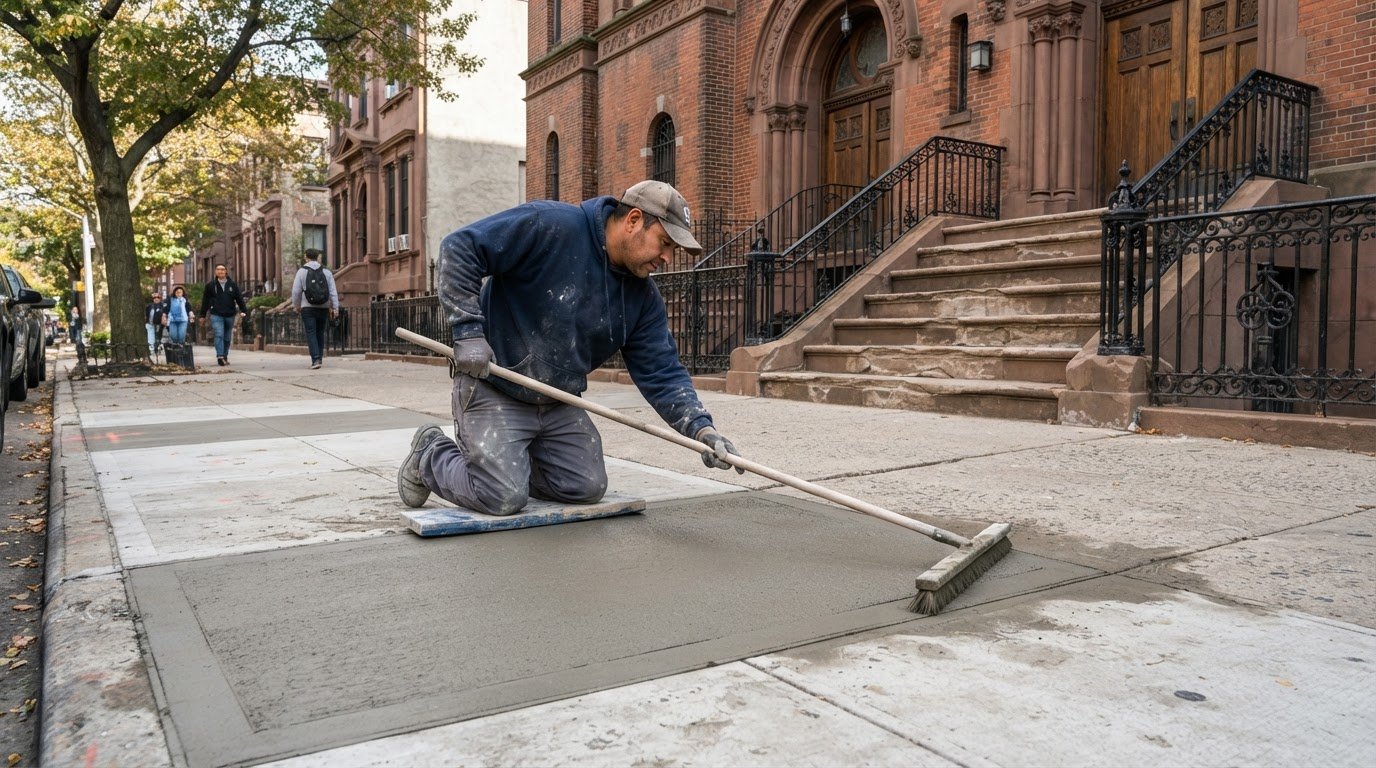
A sidewalk violation doesn’t come with one fixed repair cost. The scope of damage and work needed to bring the sidewalk into compliance matter, so sidewalk violation removal for a house of worship starts with understanding what the notice cites and what repairs are required. If defects remain unrepaired 75 days after the Sidewalk Violation Notice was issued, the New York City Department of Transportation may repair the sidewalk and bill the property owner.
It’s understandable to want a clear path before committing to repairs. This guide explains the factors that affect the work, when a property owner can manage the process and when a licensed professional is needed, and how to appeal a violation. You’ll also learn what to expect from sidewalk violation removal for a house of worship in New York City, so you can make an informed decision about the sidewalk outside your building.
Table of Contents
Can I handle sidewalk violation removal on my own, or do I need professional assistance?
Owners can submit a dismissal request, but sidewalk repairs have permit and licensing requirements. The right approach depends on who completes the work and whether it addresses the conditions cited in the notice.
Post-Repair Dismissal Requests
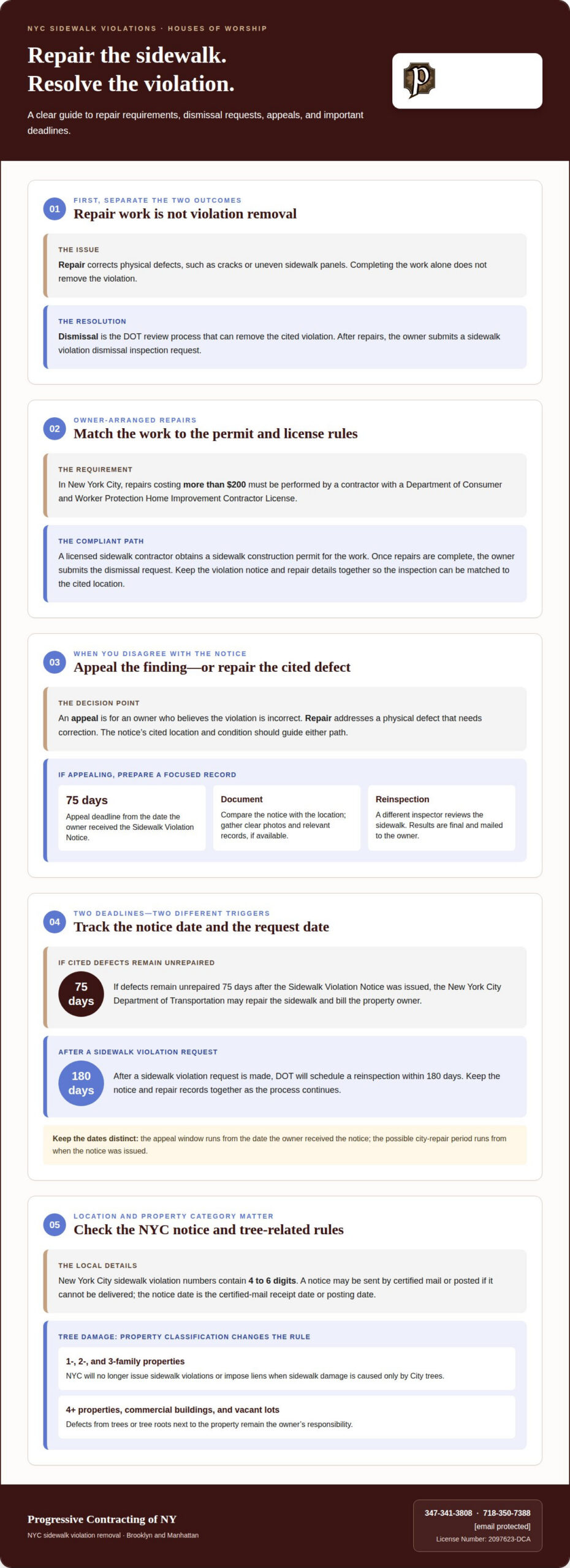
A dismissal request asks the New York City Department of Transportation (DOT) to review completed repairs and remove a sidewalk violation. After repairs arranged by the owner or a utility company, the owner submits a sidewalk violation dismissal inspection request. Owner-managed repairs must be completed by a licensed contractor with a valid sidewalk construction permit before the request is submitted. Keep the notice and repair details together so the inspection can be matched to the cited location. Completing the repair does not, by itself, remove the violation; the dismissal process follows the work.
Repair Work Versus Violation Removal
Sidewalk repair corrects physical defects, while violation removal resolves the cited issue through the dismissal process. Work may address cracks, uneven panels, or other conditions identified in the notice. In New York City, repairs costing more than $200 must be performed by a contractor with a Department of Consumer and Worker Protection (DCWP) Home Improvement Contractor License. A licensed sidewalk contractor obtains a sidewalk construction permit for the work. If defects remain unrepaired 75 days after the Sidewalk Violation Notice was issued, the New York City Department of Transportation may perform repairs and bill the owner. Professional assistance can help align the repair scope, permit, and dismissal request.
Local Variation in Sidewalk Rules
Local variation means sidewalk duties and procedures depend on the city or state where the property sits. For a New York City house of worship, use the rules and notice issued for that property, rather than assuming another jurisdiction’s process applies. NYC sidewalk violation numbers contain 4 to 6 digits. The notice identifies the cited condition and gives the owner a basis for arranging compliant work. A licensed contractor can handle the repair and permit steps; the owner remains responsible for submitting the dismissal request after owner-arranged repairs.
Appealing a sidewalk violation
An appeal asks New York City to review a sidewalk violation the property owner believes is incorrect. For a house of worship, the deadline is 75 days from the date the owner received the Sidewalk Violation Notice. The notice date matters, so record when it arrived and organize the related property records promptly. Missing the appeal window can close this review option.
To prepare an appeal, compare the condition cited in the notice with the sidewalk location it identifies. Gather clear photos of that area and relevant records, such as repair documentation, if available. Keep the notice with these materials so the appeal addresses the specific finding, not unrelated sidewalk concerns. State plainly why you disagree and focus on what the cited location shows.
For a DOT reinspection, a different inspector reviews the sidewalk and cannot access the Preliminary Inspection Report that led to the violation. This keeps the second review separate from the original inspection. The reinspection results are final and mailed to the owner. Confirm the property’s mailing details are current, and keep the notice and appeal records while awaiting the decision.
Appealing and repairing address different situations. An appeal is appropriate when the owner disputes the violation; repair work addresses a defect that needs correction. If the review confirms a condition that requires physical work, plan the sidewalk repair work around the cited location, then follow the applicable dismissal process after repairs. Keeping the appeal record and repair documents organized helps the house of worship track each step.
How do sidewalk violation rules vary by city and state?
Local sidewalk rules are the duties and procedures set by the jurisdiction where a property is located. For a house of worship in Brooklyn or Manhattan, the notice and New York City procedures govern the cited sidewalk. Property type can also affect how certain tree-related defects are treated, so classification matters alongside location.
New York City sidewalk violation numbers contain 4 to 6 digits. A notice may be sent by certified mail or posted if it cannot be delivered; the notice date is the certified-mail receipt date or posting date. Options for requesting sidewalk repairs can vary by location. After repairs, DOT will schedule a reinspection within 180 days after a sidewalk violation request is made.
Tree-related rules differ by property category. New York City will no longer issue sidewalk violations or impose liens on 1-, 2-, and 3-family properties when sidewalk damage is caused only by City trees. For 4+ properties, commercial buildings, or vacant lots, defects from trees or tree roots next to the property remain the owner’s responsibility. These distinctions matter when roots are identified near a house of worship.
If DOT completes the sidewalk repairs, it notifies the county clerk’s office to remove the records. A sidewalk dismissal inspection may be required before a County Clerk sidewalk lien can be removed. Keep the notice and repair records together so the next step follows the applicable New York City process.
Progressive Contracting NY Corp: Sidewalk violation removal
Progressive Contracting NY Corp provides sidewalk violation removal for houses of worship with cited sidewalk defects in Brooklyn and Manhattan. The work can include assessing the affected area, completing the necessary sidewalk repair, and addressing the violation process. Professional help can be useful when a congregation needs the cited condition corrected rather than managing the repair on its own.
For properties with other exterior needs, Progressive Contracting NY Corp also handles brownstone facade renovation, Rammstein stoop restoration, and brownstone contracting. The scope depends on the property and the work required. Keep sidewalk repairs distinct from facade or stoop restoration so each issue can be addressed clearly.
To discuss sidewalk violation removal, call 347-341-3808 or 718-350-7388, or email ProgressiveContractingNY@yahoo.com. License number: 2097623-DCA.
Plan the next step with confidence
For sidewalk violation removal for a house of worship, define the sidewalk work separately from any broader exterior plans. This helps the congregation focus on the cited area, coordinate decisions, and manage maintenance priorities. A plan can account for the building’s character while keeping the sidewalk issue at the center.
Progressive Contracting NY Corp also provides brownstone facade renovation, stoop restoration, and comprehensive masonry services. If a property has several exterior needs, planning sidewalk work alongside related restoration can help organize the projects while keeping each scope clear.
Choose the next step that fits the property’s needs and the congregation’s priorities. A considered plan can address the sidewalk issue while supporting the care of the building.
With a clear plan, your congregation can move forward with confidence.
Frequently Asked Questions
How much does it cost to repair a sidewalk?
Sidewalk repair cost depends on the work required at the cited location, so one figure won’t fit every property. The price depends on the specific work and is provided after a quote request. Key factors include how many sidewalk sections need repair, the type and extent of the defects, and the scope required to address the notice. A localized crack and several damaged panels call for different repair scopes.
How do I know if I have a sidewalk violation on my property?
A Sidewalk Violation Notice is the clearest indication that New York City has cited a sidewalk condition at your property. The notice may arrive by certified mail or be posted if it cannot be delivered. Match its location details to the sidewalk frontage. For example, the citation may identify a section near an entrance. Keep the notice with the property records so the cited area is easy to find.
What happens if I get a violation?
After receiving a violation, identify the cited condition and decide whether to appeal or arrange corrective work. In New York City, the Department of Transportation may repair defects and bill the owner if they remain unrepaired 75 days after the Sidewalk Violation Notice was issued. An appeal must be submitted within 75 days from the date the owner received the notice. Keep records of the notice and your next steps.
What is a sidewalk violation, and why might I receive one?
A sidewalk violation is a citation identifying a sidewalk condition that requires attention. Common cited issues include cracks, uneven surfaces, and obstructions. For example, a raised or broken section may be cited because it affects the walking surface. The notice specifies the condition and location, helping the property owner identify what the City flagged and which part of the sidewalk needs attention.
What counts as a sidewalk violation for a house of worship?
A house of worship can receive a sidewalk violation for a cited defect on its sidewalk frontage, such as a crack, uneven surface, or obstruction. The property’s religious use does not change what the notice identifies: the cited location and condition guide the response. If the notice points to a damaged section near the entrance, focus the review on that section and the defect described.