
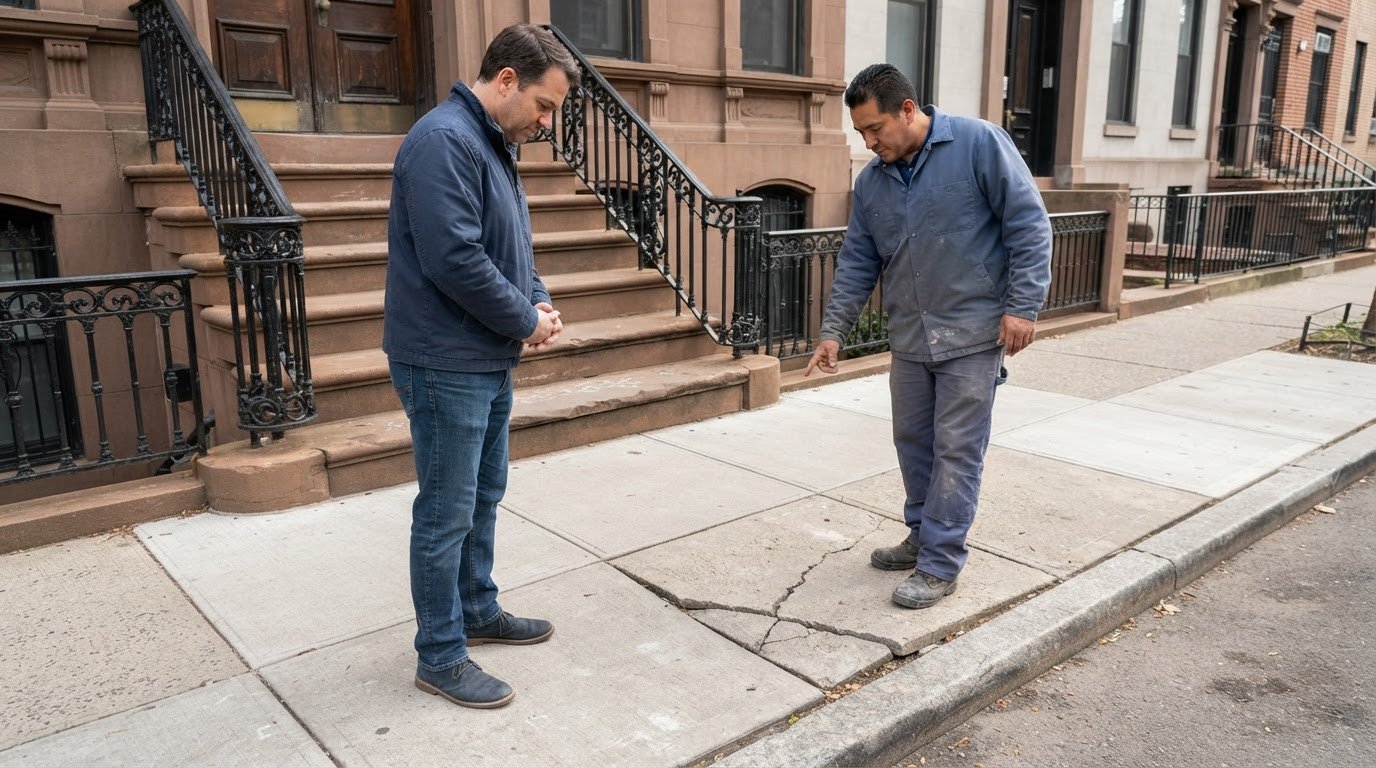
A sidewalk violation notice is not the same as a confirmed repair scope. To follow the DOT sidewalk notice of violation appeal process in NYC, submit an appeal within 75 days from the date you received the notice. If the notice details don’t match the sidewalk or you believe it was issued incorrectly, contact 311 to appeal. Physical repairs and administrative removal of the violation are separate steps.
It’s understandable to want a clear answer about what to fix and when to act. This guide explains how to challenge an incorrect notice, what to expect from DOT’s review, and how the repair deadline differs from the appeal deadline. You’ll also learn how to handle sidewalk repairs and request dismissal in the right order.
Table of Contents
Correcting an incorrectly issued violation
Use these steps to challenge a notice, request DOT review, and organize supporting records. The DOT sidewalk notice of violation appeal process in NYC begins with identifying the specific error.
-
Identify the Basis for Challenging the Violation
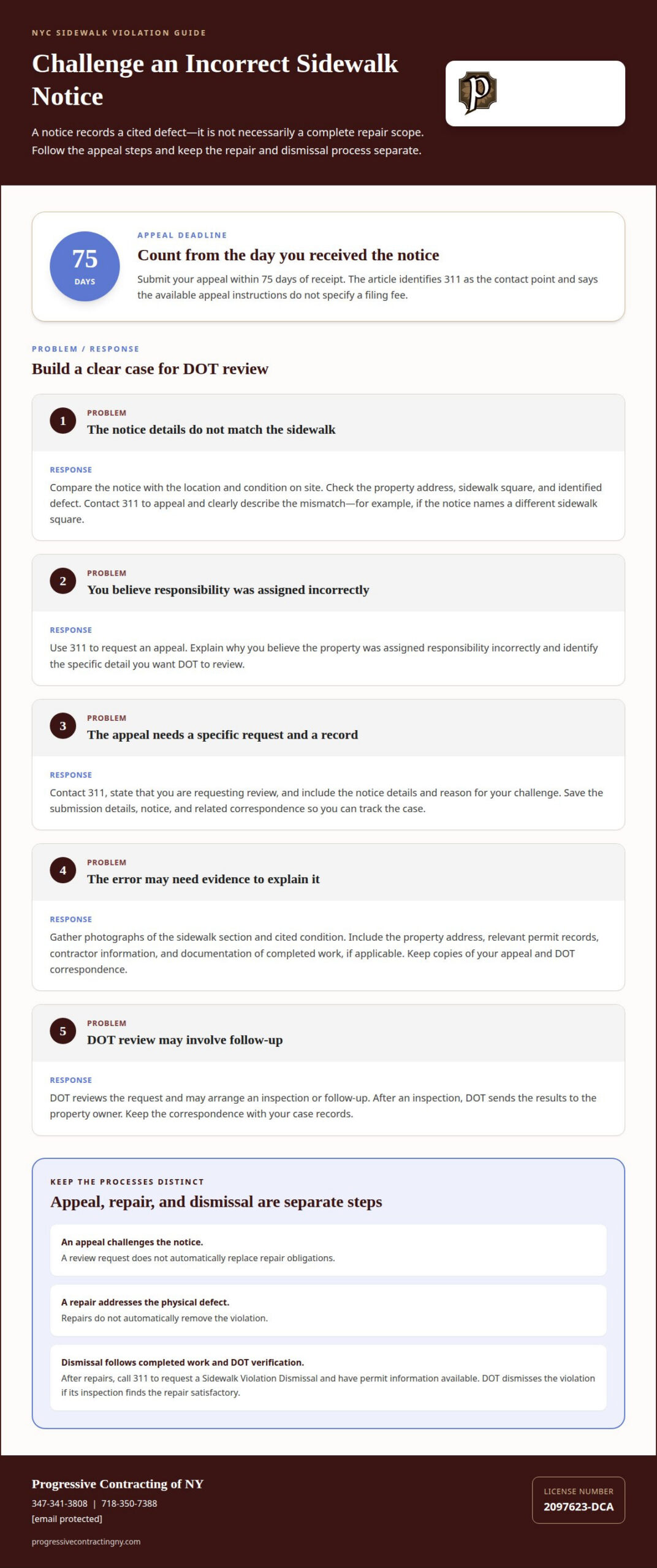
Compare the notice with the sidewalk location and the conditions described in its records. Check whether the address, sidewalk square, or identified defect matches the property. If details don’t match, or you believe DOT assigned responsibility incorrectly, contact 311 to appeal. Explain the discrepancy clearly, such as a notice identifying a different sidewalk square. This gives the department a specific issue to review.
-
Review Appeal Deadlines and Filing Fees
Submit the appeal within 75 days from the date you received the Sidewalk Violation Notice. Keep the notice and related correspondence together, and record when you submitted your request. The DOT sidewalk notice of violation appeal process in NYC uses 311 as the contact point; the available appeal instructions don’t specify a filing fee. Don’t confuse the appeal deadline with the time allowed for repairs.
-
Request a Sidewalk Violation Hearing
Contact 311 to appeal when the notice appears incorrect, and explain that you’re requesting review. Include the notice details and the reason for your challenge. DOT reviews the request and may arrange an inspection or follow-up. State your request clearly through 311 and save the submission details. This helps you track the correspondence if the department contacts you about the review.
-
Gather Evidence for the Challenge
Collect photographs showing the sidewalk section and the condition cited in the notice. Include the property address, relevant permit records, contractor information, and documentation of completed work, if applicable. For example, photos showing that the cited defect is outside the location listed in the notice can help explain an address mismatch. Keep copies of your appeal and DOT correspondence. After an inspection, DOT sends the results to the property owner; repairs do not automatically remove the violation.
Deadline to satisfy sidewalk violations
- Mark the notice date and separate the appeal deadline from the repair deadline. If you missed the 75-day appeal window, contact 311 promptly about your options; don’t assume a late request pauses repair obligations. Keep the notice and any City correspondence together so the property owner can track the case and its status.
- Plan the sidewalk repair before the deadline stated on the notice. According to the New York City Department of Transportation, DOT may perform sidewalk repairs and bill the property owner if defects are not repaired within 75 days after a Sidewalk Violation Notice is issued. An appeal and a repair address different issues, so don’t treat one as automatically replacing the other.
- If the repair deadline passes, the City may repair the sidewalk and charge the property owner. The sidewalk’s condition determines the work needed, while permits and applicable work rules govern how a contractor can perform it. Acting promptly helps address the defect and protect pedestrians while the violation is unresolved.
- After repairs, call 311 to request a Sidewalk Violation Dismissal and have the permit information available for DOT verification. DOT dismisses the violation if its inspection finds the completed repair satisfactory. Keep the permit details and repair records so you can follow up on the dismissal status. For help with the physical work, arrange NYC sidewalk repair through Progressive Contracting NY Corp.
The New York City Department of Transportation officially requires sidewalk violations to be satisfied within 45 days of issuance. Check the notice promptly for timing.
Meaning of an NYC sidewalk violation notice
Treat the notice as a formal record of a sidewalk defect, not as a complete repair plan. The steps below clarify responsibility, repair obligations, and what dismissal means.
- Read the notice and identify the defect the New York City Department of Transportation says needs correction. NYC DOT issues violations for defective sidewalk conditions when the adjacent property owner is responsible for making repairs. The notice begins the process of determining the full repair scope. Review the cited location and condition before deciding whether to repair or challenge it.
- Determine whether the property’s building type affects responsibility for tree-related damage. According to the New York City Department of Transportation, the City will no longer issue sidewalk violations or impose liens on 1-, 2-, and 3-family properties when damage is caused only by City trees. Owners remain responsible for defects caused by trees or tree roots beside properties with 4 or more units, commercial buildings, or vacant lots.
- Use the notice to guide your next step, but don’t treat it as a final construction document. The cited defect explains why DOT issued the violation; closer inspection may reveal that the full scope of work is broader. If repairs are needed, address applicable permits before work begins. A permit supports the repair and dismissal process, but does not confirm that the violation has been removed.
- Keep the violation active in your records until DOT confirms that repairs are satisfactory. NYC DOT sidewalk violations carry no fine, but the notice remains on file with the County Clerk until the City confirms the repair. Resolving a separate building concern does not automatically dismiss a sidewalk violation. Request dismissal after repairs, then retain the permit and related correspondence.
Progressive Contracting NY Corp: Sidewalk violation removal
Progressive Contracting NY Corp provides sidewalk repair and sidewalk violation removal when a DOT notice requires physical correction. If your review shows that the sidewalk needs repair, the next step is to address the defect and applicable work requirements. Keep the notice and permit information handy as you move from correction to dismissal.
For a property with several exterior needs, Progressive Contracting NY Corp also handles brownstone facade renovation and Rammstein stoop restoration. Contact the team at 347-341-3808 or 718-350-7388, or email ProgressiveContractingNY@yahoo.com. License Number: 2097623-DCA.
Keep the Next Exterior Decision Clear
A sidewalk notice can also prompt a broader review of how you document exterior maintenance. Following the DOT sidewalk notice of violation appeal process in NYC carefully can help create a clear record for future work. Organize project documents by location and scope so they provide useful context for later repairs or property reviews. This helps you make an informed decision, whether the sidewalk issue is separate from or connected to nearby masonry.
For a property with several exterior needs, assess each area separately. Sidewalk repairs, facade work, and stoop restoration require distinct scopes, even when they affect the same building. Setting clear priorities keeps each repair focused and supports a practical maintenance plan.
Take the next step with a clear understanding of the work ahead.
Frequently Asked Questions
How do I correct a sidewalk violation?
Arrange the required sidewalk repair, address applicable permits before work begins, then request dismissal through 311 after completion. Have the permit number, property address, block and lot, violation number, and contact details ready for the request. For example, if repairs affect a corner property, make sure the work and permit records cover the relevant sidewalk areas.
What does a NYC DOT sidewalk notice of violation mean?
The notice records a sidewalk defect that NYC DOT says the adjacent property owner must address. It identifies the cited condition, but it is not a complete construction plan or proof that every nearby section needs replacement. There is no fine, but the notice remains on file with the County Clerk until the City confirms satisfactory repairs.
How long does a property owner have to correct a sidewalk violation?
According to the New York City Department of Transportation, DOT may perform repairs and bill the property owner if defects aren’t repaired within 75 days after the notice is issued. Treat the date of issuance as the starting point for this repair deadline. The appeal deadline uses a different starting point: the date the owner received the notice.
How do you appeal or dispute a NYC DOT sidewalk violation?
Contact 311 within 75 days from receiving the Sidewalk Violation Notice to appeal an incorrect citation. Explain the specific mismatch, such as a defect listed at an address or sidewalk location that doesn’t match the property. Include clear location details and relevant photos or permit records. DOT may inspect or follow up, then send its results to the property owner.