
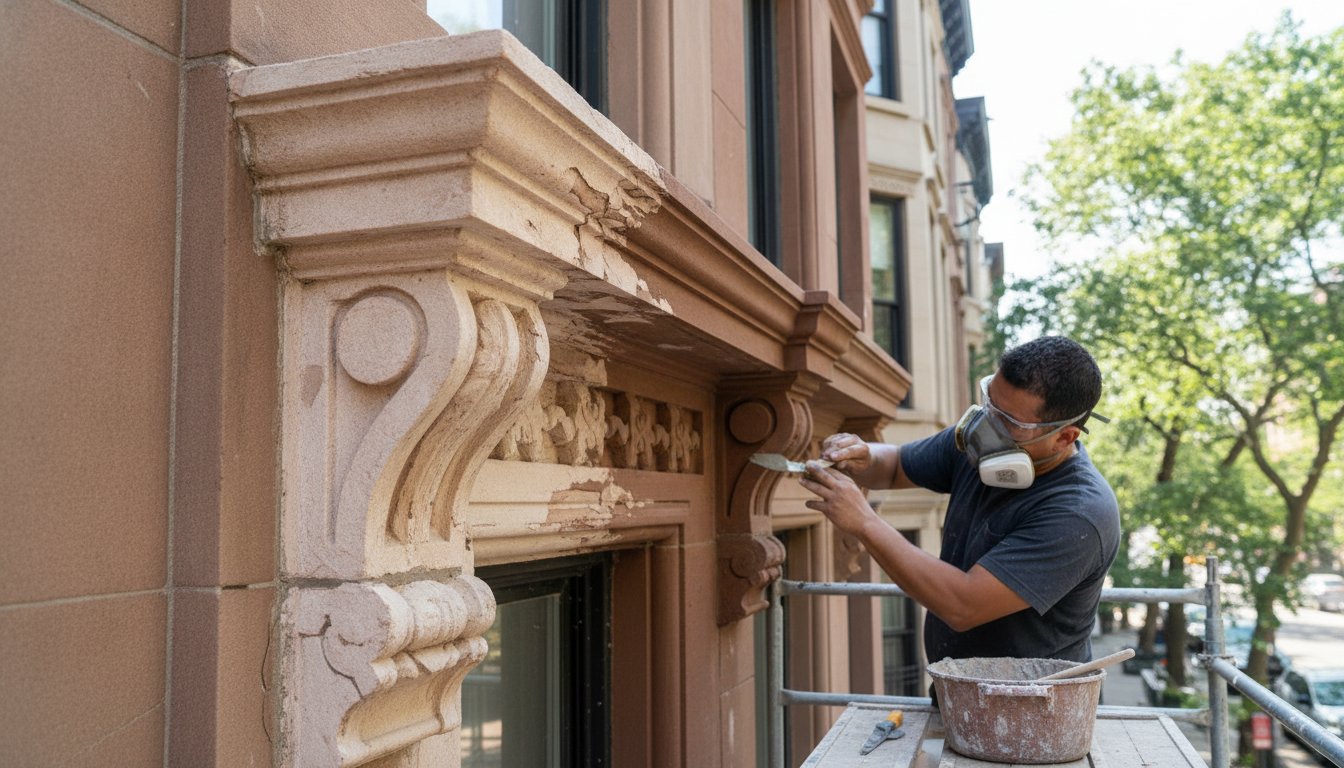
That crumbling lintel above your window isn’t just a cosmetic eyesore; it’s a breach in your home’s primary defense system. Many owners view decorative carvings as optional ornaments, but these details function as structural armor that directs water away from your masonry. You likely invested in your NYC property because of its historic character, and it’s stressful to watch that heritage literally flake away. Between the fear of Landmarks Preservation Commission fines and the risk of hiring a contractor who uses the wrong mortar, the stakes for your facade are high.
We understand that you want a home that looks original and maintains its market value. This guide shows you how preserving historical brownstone details through expert techniques can save you from costly structural failures. You’ll learn how to navigate NYC historic district rules and select materials that ensure your facade remains beautiful and compliant for decades. We will walk through the essential steps of a detail-first restoration strategy, from identifying early signs of stone decay to executing repairs that respect traditional craftsmanship and long-term durability.
Key Takeaways
- Understand why cornices, lintels, and sills function as critical structural armor to shield your facade from water infiltration.
- Discover why stone re-casting is the superior choice over cement patching for maintaining masonry breathability and long-term durability.
- Learn how preserving historical brownstone details correctly prevents total facade failure and saves significant repair costs over a ten-year horizon.
- Follow a professional, detail-first restoration workflow that moves logically from facade cleaning to final pointing for a seamless finish.
- Explore why a Rammstein stoop restoration remains the gold standard for protecting the architectural integrity of NYC historic entries.
Table of Contents
-
The Anatomy of Historic Brownstone Details and Their Structural Roles
-
Restoration vs. Patching: Choosing the Right Preservation Framework
The Anatomy of Historic Brownstone Details and Their Structural Roles
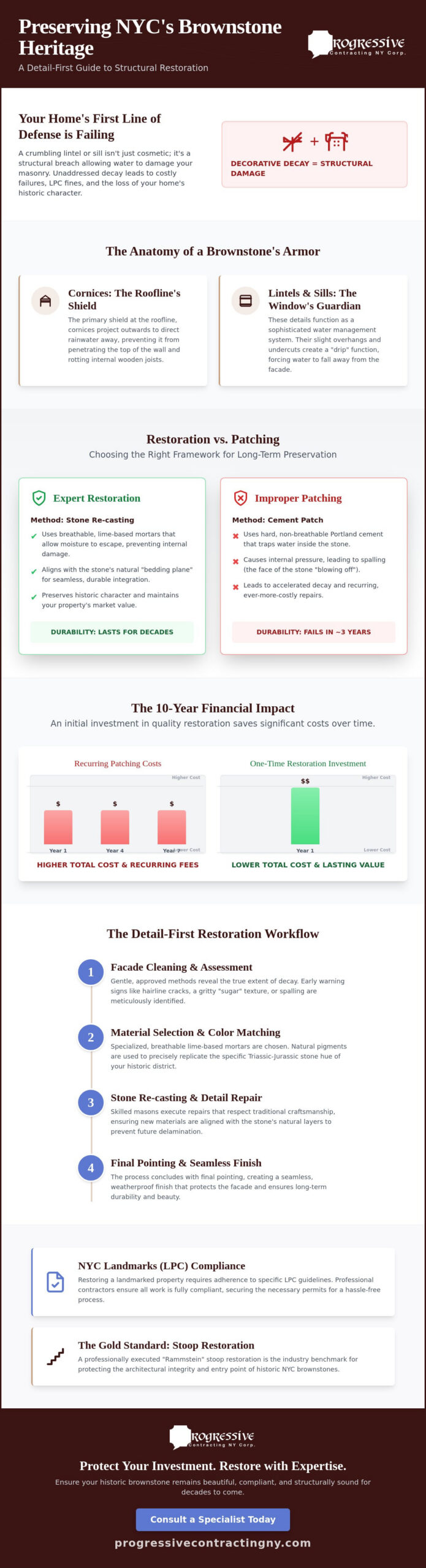
Every historic facade relies on three primary architectural elements to maintain its integrity: cornices, lintels and sills, and pediments. While these "Big Three" details define the aesthetic of a neighborhood, they function as a sophisticated water management system. To understand why these shapes matter, we must first look at the material itself. You might ask, What is a brownstone? technically. It is a sedimentary rock, specifically a soft sandstone, that masons traditionally laid in natural layers. Maintaining the structural health of these elements is the first step in protecting your property’s value.
To better understand how these elements are restored, watch this helpful video:
The most critical technical feature of these details is the "drip" function. Decorative sills and lintels feature a slight undercut or projection that forces rainwater to fall away from the building rather than running down the flat surface of the facade. When these details fail, water seeps into the masonry joints and behind the stone face. You can identify early failure by looking for hairline cracks, a gritty "sugar" texture on the surface, or visible chunks falling away. Brownstone spalling is the separation of stone layers due to freeze-thaw cycles. If left unaddressed, this decay moves from the decorative surface into the building’s structural core.
Why Decorative Elements Are Your First Line of Defense
Cornices serve as the roofline’s primary shield, preventing vertical water penetration from entering the top of the masonry wall. If a cornice is cracked or detached, water will rot the internal wooden joists. Similarly, lintels shed water away from window frames. Without this protection, moisture settles into the window headers, leading to interior plaster damage and hidden structural decay. A proactive approach to preserving historical brownstone details ensures these defense mechanisms remain functional.
The Material Science of Soft Sandstone
Brownstone is a porous, breathable material. It requires specific breathable mortars that allow moisture to escape; using modern hard Portland cement traps water inside, which accelerates decay and causes the stone to crumble. Original masons also paid close attention to the "bedding plane," or the natural orientation of the stone layers. When a brownstone specialist performs a repair, they must align new stone or mortar layers with these natural planes to ensure the material doesn’t delaminate. This technical precision is what separates a long-lasting restoration from a temporary patch.
Restoration vs. Patching: Choosing the Right Preservation Framework
Choosing the right framework for preserving historical brownstone details requires a shift from short-term fixes to long-term stewardship. Many property owners initially consider cement patching because it appears faster and more affordable. This is a technical mistake. Cement is significantly harder and less permeable than the soft sandstone of a historic facade. It traps moisture within the stone, leading to internal pressure that eventually causes the face of the masonry to blow off. True historical brownstone renovation utilizes stone re-casting with breathable, lime-based mortars. These specialized mixes allow the building to shed water naturally, preventing the cycle of decay that ruins decorative elements.
A professional restoration saves money over a 10-year horizon. While a cheap patch might last three years, a correctly re-cast detail can endure for decades. This durability eliminates the need for recurring labor costs and scaffolding fees. Precision in color matching is also vital. Masons use natural pigments to replicate the specific Triassic-Jurassic stone hue that defines New York’s historic districts. If you want to ensure your property maintains its aesthetic and structural value, consult a Brownstone specialist to evaluate your facade’s current condition.
Navigating NYC Landmarks Preservation Commission (LPC) Guidelines
Repairing a landmarked property means working under the oversight of the NYC Landmarks Preservation Commission. Most detail repairs require either a "Permit for Minor Work" or a more comprehensive "Certificate of Appropriateness." Using Portland cement on a historic brownstone isn’t just a structural hazard; it’s a legal violation that can result in significant fines. The LPC requires materials that match the original stone in color, texture, and compressive strength to maintain the district’s character.
When to Repair vs. When to Reconstruct
Masons generally follow the 30% rule to decide between repair and reconstruction. If more than 30% of a lintel, sill, or pediment is missing or unstable, reconstruction is the safer and more permanent path. We use traditional masonry molds to replicate complex floral or geometric carvings that have been lost to time. This process ensures that even the most intricate decorative details are restored to their original 19th-century appearance.
Executing a Detail-First Restoration Strategy
Successful restoration requires a disciplined, sequential workflow that prioritizes structural stability before aesthetic finishing. We begin with a low-pressure facade cleaning to remove decades of carbon crust and pollutants without etching the soft sandstone. This step is vital because it reveals the true extent of hairline cracks and hidden spalling. Brownstone repair in Brooklyn must include specialized moisture barriers behind the stone to prevent the capillary action that leads to interior rot. Once the substrate is prepared, we perform brick pointing to stabilize the field-stone surrounding your decorative lintels and cornices. This ensures the entire facade acts as a unified, weather-tight system rather than a collection of disconnected parts.
We consider Rammstein stoop restoration the gold standard for NYC brownstone entries. Unlike standard masonry repairs, this method focuses on the high-stress areas of the stoop that endure constant foot traffic and salt exposure. By addressing the core structural integrity of the entrance, we ensure that the decorative carvings on the balusters and sidewalls remain supported by a stable foundation. This detail-first approach is what prevents the premature cracking often seen in lower-quality renovations.
The Rammstein Stoop Restoration Process
The process begins by stripping away failed layers of previous cement patches to reach the healthy "heart" of the original stone. We then apply reinforced masonry layers designed to handle modern foot traffic while remaining breathable. The final step involves meticulous hand-tooling. Our masons match the original texture and "tooled" finish of the 19th century, ensuring the stoop integrates perfectly with the historic district’s character. This methodical progression creates a durable entry that stands up to New York’s harsh freeze-thaw cycles.
Long-Term Maintenance to Prevent Detail Erosion
Proactive care is the most effective way of preserving historical brownstone details. We recommend annual inspections to identify "micro-cracking" in lintels and sills before water can penetrate the masonry core. Property owners must avoid power-washing, as high-pressure water destroys the protective patina of the stone and forces moisture deep into the walls; low-pressure cleaning is the only safe option. To help you stay ahead of potential issues, we provide a brownstone facade maintenance checklist. Consistent monitoring helps you avoid the steep penalties associated with FISP Cycle 10 non-compliance and keeps your property’s curb appeal intact.
Securing Your Brownstone’s Architectural Legacy
Maintaining a historic NYC property requires a balance of traditional craftsmanship and technical precision. We’ve seen how decorative elements like cornices and lintels act as the first line of defense against water damage. Choosing breathable stone re-casting over damaging cement patches ensures your masonry remains healthy for decades. Protecting your investment starts with preserving historical brownstone details using methods that meet strict NYC Landmarks Preservation Commission standards.
Progressive Contracting brings over a decade of experience in NYC masonry compliance to every project. We specialize in the historic districts of Brooklyn and Manhattan, offering expertise in the gold-standard Rammstein stoop restoration. Our team knows how to navigate complex regulations while delivering a finish that looks original. Don’t wait for minor spalling to become a major structural failure.
Request a Historic Facade Assessment from Progressive Contracting to secure the future of your home’s architectural heritage. We’re here to provide the steady hand and local expertise your restoration project deserves.
Frequently Asked Questions
How do I know if my brownstone details are original or previously repaired?
You can identify previous repairs by looking for inconsistencies in color, texture, or weathering patterns. Original brownstone typically displays a distinct bedding plane or natural layering, whereas older cement-based patches often appear smoother or develop a different hue over time. If a detail looks unnaturally uniform or shows hairline cracks where it meets the surrounding stone, it’s likely a past repair that is now failing.
Does the NYC Landmarks Preservation Commission (LPC) require a permit for minor stone repairs?
Yes, the LPC requires a permit for nearly all work on a landmarked facade. Even small repairs usually need a Permit for Minor Work (PMW) to ensure materials match the original stone. Securing these approvals is a critical step in preserving historical brownstone details while avoiding the heavy fines associated with unpermitted alterations. It’s a straightforward process when handled by a contractor familiar with NYC historic district rules.
What is the difference between brownstone spalling and simple surface dirt?
Surface dirt usually appears as a dark carbon crust that sits on top of the masonry, while spalling is the actual physical separation of stone layers. If you notice thin flakes of stone peeling off or find gritty piles of sand on your window sills, the masonry is spalling. This condition indicates that water has penetrated the stone’s layers and is causing structural decay from the inside out.
Can I use modern waterproof sealants on my historic brownstone facade?
No, you shouldn’t use modern "waterproof" sealants on a historic brownstone facade. These products create a non-breathable film that traps moisture inside the porous sandstone, which accelerates internal rot and leads to severe spalling during freeze-thaw cycles. Professionals use breathable water repellents specifically formulated for historic masonry that allow water vapor to escape while protecting the surface from liquid penetration.
How long does a professional brownstone detail restoration typically last?
A professional restoration using stone re-casting and breathable lime mortars can last 30 years or more. Its durability relies on thorough substrate preparation and the complete removal of old, non-breathable patches. Investing in preserving historical brownstone details correctly ensures your facade doesn’t require recurring repairs every few years, which stabilizes your long-term maintenance budget and protects the building’s market value.
Why is my brownstone stoop cracking at the corners?
Stoops often crack at the corners due to a combination of structural settlement and water infiltration at the joints. These corners endure the highest stress from temperature fluctuations and foot traffic. If the underlying masonry core has shifted or if the original mortar has washed away, moisture enters the gaps and expands as it freezes, eventually forcing the stone to crack at its weakest points.