
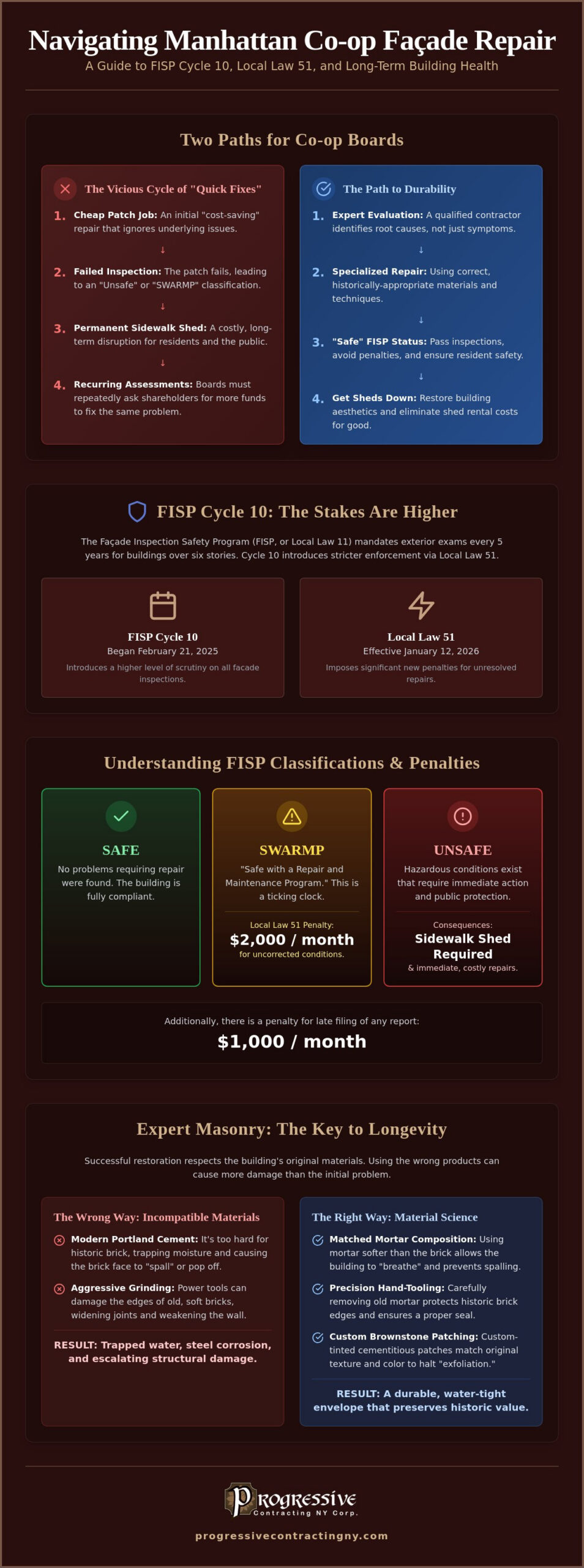
A cheap patch job on a historic exterior is often the most expensive mistake a co-op board can make. You’ve likely seen the cycle before: a quick fix leads to a failed inspection, which then leads to a sidewalk shed that remains a permanent fixture on your block for years. It’s exhausting to deal with opaque bidding processes and the constant fear of recurring assessments for repairs that should have been solved the first time. Managing facade repair for co-op buildings manhattan requires a balance of regulatory precision and high-level masonry craftsmanship.
We’ve officially entered FISP Cycle 10, and with Local Law 51 now enforcing stricter penalties for unresolved repairs, the stakes for your building’s "Safe" status are higher than ever. This guide provides a specialized contractor’s perspective on navigating these complexities with transparency and predictable timelines. You’ll learn how to move beyond temporary fixes to achieve long-term durability, preserve your building’s architectural value, and finally get those sidewalk sheds down for good.
Table of Contents
Navigating Manhattan Co-op Facade Requirements: FISP and Local Law 11
The Façade Inspection Safety Program (FISP), historically known as Local Law 11, mandates that Manhattan buildings taller than six stories undergo a professional exterior examination every five years. This process is more than a legal hurdle; it’s a critical assessment of the building’s structural health. An Architectural facade overview reveals how complex these exterior systems are, combining aesthetic masonry with vital structural components that weather New York’s harsh freeze-thaw cycles. Relying on a Qualified Exterior Wall Inspector (QEWI) ensures that your building remains compliant while identifying issues before they become hazards.
NYC is currently in FISP Cycle 10, which began on February 21, 2025. This cycle introduces a higher level of scrutiny due to Local Law 51 of 2025. Effective January 12, 2026, this law imposes stricter penalties for unresolved repairs and reclassifies neglected maintenance as "Unsafe" in subsequent cycles. For boards managing facade repair for co-op buildings manhattan, staying ahead of these deadlines is the only way to avoid the $1,000 per month late filing penalties. Proactive planning is always more cost-effective than reactive, emergency repairs forced by a Department of Buildings violation.
To see how these restoration principles are applied in the field, watch this overview of NYC facade work:
Understanding SWARMP vs. Unsafe Classifications
A QEWI will categorize your building as Safe, Unsafe, or SWARMP (Safe with a Repair and Maintenance Program). SWARMP status isn’t a pass; it’s a ticking clock. If you don’t address issues like spalling stone or failing mortar joints, Local Law 51 now mandates a $2,000 monthly penalty for uncorrected conditions. Proactive brick pointing and masonry care are essential components of facade repair for co-op buildings manhattan, preventing minor flaws from escalating into hazardous ratings that require immediate intervention.
The Logistical Reality of Sidewalk Sheds
Sidewalk sheds are often the biggest pain point for shareholders. These structures are legally required when a building is classified as Unsafe, but they don’t have to be permanent fixtures. Through the city’s "Get Sheds Down" initiative, there’s a clear push to modernize regulations and minimize shed duration. We prioritize efficient masonry scheduling to ensure that once the scaffolding goes up, the work proceeds without delay. This methodical approach reduces the time your building spends behind a "bridge to nowhere" while maintaining full compliance with NYC safety standards.
Specialized Masonry Techniques for Manhattan Co-op Restoration
Successful facade repair for co-op buildings manhattan depends on a deep understanding of historic materials. It isn’t enough to just patch a crack; the repair must respect the building’s original chemistry. For example, using modern, high-strength Portland cement on older, softer bricks causes the brick faces to "pop" or spall because the mortar is harder than the masonry it’s supposed to protect. Matching the original mortar composition ensures the building envelope can breathe and expand naturally with temperature changes.
The Importance of Expert Brick Pointing
Specialized brick pointing is your building’s first line of defense against water infiltration. In many historic Manhattan co-ops, we avoid aggressive mechanical grinding of joints, which can damage the edges of old bricks. Instead, we often utilize hand-tooling methods to remove deteriorated mortar. This precision prevents water from entering the building envelope, which is the leading cause of steel lintel corrosion. When internal steel supports rust, they expand and crack the surrounding masonry, a condition frequently flagged during the NYC Facade Inspection & Safety Program (FISP).
Addressing Brownstone and Decorative Masonry
Many co-op boards struggle with deteriorating decorative elements like cornices and stoops. Understanding what is a brownstone helps in recognizing its vulnerability to "exfoliation," where layers of the stone peel away due to trapped moisture. We address this by removing all deteriorated material and applying custom-tinted cementitious patches that match the original stone’s texture and color. This level of detail is vital for successful facade repair for co-op buildings manhattan, as it preserves the historic aesthetic while ensuring structural integrity for decades. If your board is reviewing current assessments, we can provide a transparent masonry evaluation to help you plan effectively.
Vetting a Manhattan Facade Specialist for Long-Term Value
Choosing a contractor based solely on the lowest bid is a high-risk strategy for any co-op board. In the specialized field of facade repair for co-op buildings manhattan, a "cheap" price often indicates a contractor who plans to cut corners on material quality or surface preparation. These superficial fixes frequently fail within two to three years, leaving the building vulnerable to water damage and new FISP violations. A master contractor focuses on the root cause of deterioration rather than just masking the symptoms.
High-quality work requires adherence to strict technical standards. The National Park Service provides an essential guide on Repointing Mortar Joints in Historic Masonry, which emphasizes that the physical properties of new mortar must match the old to prevent structural stress. We follow these traditional principles to ensure every repair is a permanent solution. This disciplined approach protects the building’s equity and ensures that your next inspection cycle is a routine filing rather than a financial crisis.
Financial Transparency and Bidding
A transparent bid should clearly break down labor, materials, and DOB filing fees. Boards should watch for "hidden costs" that often surface mid-project, such as permit renewals or unexpected structural discoveries like rusted wall ties. We utilize a "Problem-Process-Result" framework. We identify the specific failure, explain the sequential masonry steps required to fix it, and define the expected lifespan of the result. This clarity helps boards manage shareholder expectations and provides a predictable project timeline.
The Progressive Contracting NY Corp Approach
We position Progressive Contracting NY Corp as a stabilizing force for Manhattan boards facing complex restoration projects. Our team understands the logistical challenges of working in dense neighborhoods across Manhattan, Brooklyn, and Queens. We prioritize punctuality, local accountability, and precision masonry that satisfies both the QEWI and the Department of Buildings. Our goal is to provide a steady hand throughout the project lifecycle, ensuring your building remains safe and beautiful for decades. To get started with a transparent evaluation of your property, you can schedule a consultation for your co-op facade restoration.
Securing Your Building’s Future through Proactive Restoration
Managing a co-op means balancing immediate costs with long-term asset protection. The shift into FISP Cycle 10 and the enforcement of Local Law 51 have changed the priorities for boards across the city. You don’t have to wait for a SWARMP condition to become an Unsafe hazard. Successful facade repair for co-op buildings manhattan depends on a partner who prioritizes structural precision over quick patches. By focusing on historic masonry standards and transparent project management, you protect both the building’s aesthetic and the shareholders’ financial interests.
With over a decade of experience serving Manhattan and Brooklyn co-ops, Progressive Contracting NY Corp specializes in historic masonry restoration and expert sidewalk violation removal. We help boards navigate complex DOT compliance and NYC Landmark requirements with a steady, reliable hand. Request a Professional Facade Assessment from Progressive Contracting NY Corp to ensure your building remains safe, compliant, and beautiful for years to come.
Frequently Asked Questions
How often does a Manhattan co-op need a facade inspection?
Manhattan co-op buildings taller than six stories must undergo a facade inspection every five years. This requirement is part of the Façade Inspection Safety Program (FISP), formerly known as Local Law 11. We are currently in Cycle 10, which runs from February 21, 2025, to February 21, 2030. Your specific filing deadline depends on the last digit of your building’s block number, with sub-cycle deadlines staggered between 2027 and 2029.
What is the average cost of facade repair for a Manhattan co-op building?
The total investment for facade repair for co-op buildings manhattan depends on the findings of your Qualified Exterior Wall Inspector (QEWI). While repair costs vary by scope, the mandatory inspection and filing fees are more predictable. A QEWI inspection typically costs between $8,000 and $20,000 for small to mid-size buildings, while larger complexes may range from $20,000 to $60,000. The NYC Department of Buildings also charges a $305 fee for the initial report filing.
Can a co-op board be fined for FISP non-compliance?
Yes, the NYC Department of Buildings imposes significant penalties for missing deadlines or ignoring safety conditions. Late filing of an initial report carries a $1,000 monthly fine, while failure to file at all can result in an additional $5,000 annual penalty. Under Local Law 51 of 2025, failing to correct SWARMP conditions now triggers a $2,000 monthly fine. These costs quickly exceed the price of proactive maintenance.
How long does a typical Local Law 11 facade repair project take?
A standard masonry restoration project usually takes between three and six months to complete. This timeline includes the setup of sidewalk sheds, the actual masonry work, and the final inspection by the QEWI. Larger buildings or those requiring extensive historic stone restoration may require more time. We use a sequential workflow to ensure that once the scaffolding is up, the work moves forward every day to minimize the impact on shareholders.
What is the difference between a masonry contractor and a general contractor for facade work?
A masonry contractor is a specialized craftsman who directly performs the brick pointing and stone restoration, while a general contractor often manages multiple subcontractors. For historic Manhattan co-ops, hiring a specialist ensures that the team understands the unique material needs of older buildings. This direct expertise results in better structural integrity and more transparent communication, as you’re dealing directly with the experts responsible for the work.