
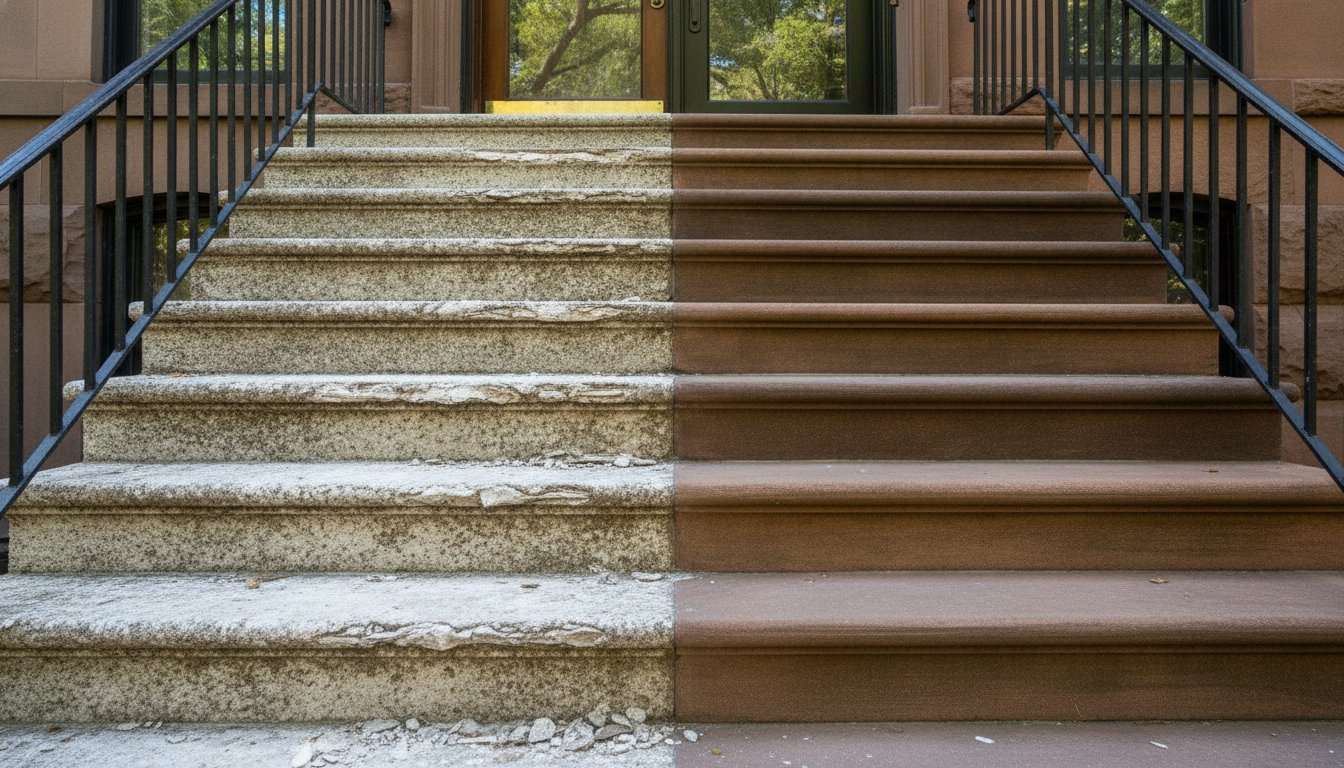
That white, powdery residue on your steps isn’t just an eyesore; it is a chemical infection that is slowly eating your home’s historic entrance from the inside out. You have likely tried scrubbing those stains away only to see the stone start flaking off in thin, brittle layers soon after. It is frustrating to watch a century-old stoop deteriorate after a single harsh winter, especially when you fear that a full, expensive replacement is the only solution. Repairing salt damage on brownstone stoop projects requires a specialized approach that addresses the underlying chemical reaction rather than just covering it up.
This guide will show you how to identify the difference between surface scaling and deep structural damage. You will learn the restoration steps necessary to stabilize the masonry and preserve your stoop for decades. We also provide clear instructions on how to de-ice safely in the future to protect your investment. If you need a professional assessment for your Brooklyn or Manhattan home, contact Progressive Contracting NY Corp at 347-341-3808 or 718-350-7388. Our team is also available via email at ProgressiveContractingNY@yahoo.com to help you navigate your historic restoration project with confidence.
Understanding Salt Damage: Why NYC Brownstone Stoops Scale and Spall
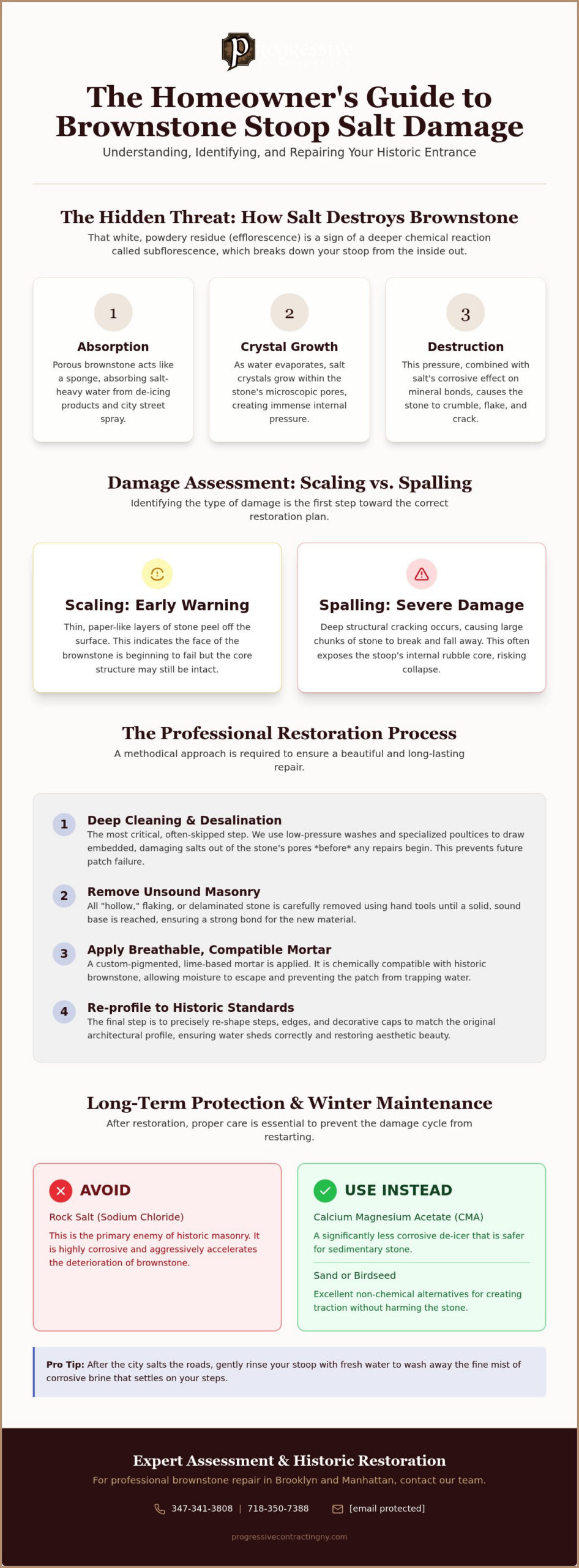
NYC brownstone stoops face a constant chemical battle every winter. When the Department of Sanitation treats city streets, road salt spray frequently lands on your steps. Because Portland Brownstone is a porous sedimentary rock, it acts like a sponge and absorbs salt-heavy water deep into its structure. This leads to a destructive process called subflorescence. As the water evaporates, salt crystals grow within the microscopic pores of the stone. These crystals exert immense internal pressure, which leads to mechanical weathering and damage from the inside out. Successfully repairing salt damage on brownstone stoop surfaces requires understanding this cycle before any new mortar is applied.
The Chemistry of a Crumbling Stoop
Brownstone is held together by a natural cement of iron oxide, which gives the stone its iconic color. Salt is highly corrosive to this mineral bond. When salt dissolves the iron oxide, the stone loses its structural integrity and begins to crumble into sand. You might notice a white, powdery film on the surface known as efflorescence. While this surface powder is often easy to clean, it usually indicates that more dangerous, embedded salt is already working deeper into the masonry. For a professional evaluation of your stone’s condition, contact Progressive Contracting NY Corp at 347-341-3808 or 718-350-7388.
Scaling vs. Spalling: Assessing the Severity
We categorize salt damage by its physical impact on the stone to determine the best path forward. Scaling occurs when thin, paper-like layers peel off the treads or cheek walls. This is an early warning sign that the stone’s face is failing. Spalling is more severe; it involves deep structural cracking where large chunks of stone fall away. In many cases, spalling exposes the internal rubble core of the stoop, which makes the structure vulnerable to rapid collapse. If you see deep cracks or missing chunks, email us at ProgressiveContractingNY@yahoo.com to discuss a restoration plan. You can also view our previous work at brownstonerepair.net to see how we stabilize these historic structures.
How to Repair Salt-Damaged Brownstone: The Professional Restoration Process
Repairing salt damage on brownstone stoop masonry requires more than just a surface-level patch. We follow a methodical four-step process to restore structural integrity and aesthetic beauty. First, we perform a deep cleaning using low-pressure washes or specialized neutralizing poultices. Second, we remove all “hollow” or delaminated stone using hand tools until we reach a solid, sound base. Third, we apply a breathable, lime-based mortar that is chemically compatible with the original stone. Finally, we re-profile the steps to meet historic Rammstein stoop restoration standards, ensuring water sheds correctly off the treads.
Desalination: The Most Overlooked Step
Most failed repairs happen because a contractor skipped the desalination phase. If you apply a new mortar patch over salt-saturated stone, the salt will eventually push the patch off. This often happens after just one winter cycle. We use distilled water soaks and poultices to draw embedded salts out of the stone’s pores before any new material is added. For a better understanding of how these minerals affect your facade, consult the NPS Glossary of Masonry Damage. You can also learn more about brownstone spalling repair to see how we stop ongoing crumbling.
Matching the Historic Profile
Repairing salt damage on brownstone stoop steps is a precision task that requires the right materials. A successful restoration must be invisible, so we use custom-pigmented mortars to match the unique shade of your 19th-century facade. This attention to detail preserves the “handshake of the home” in neighborhoods like Park Slope and Bedstuy. Our team ensures every edge and decorative cap aligns with the original architectural intent. For a deeper look at our methods, read our guide to historic stoop restoration. If you want to discuss your project, contact Progressive Contracting NY Corp at 347-341-3808 or 718-350-7388. You can also send photos of your stoop to ProgressiveContractingNY@yahoo.com for a professional assessment.
Long-Term Protection: Winter Maintenance and Salt-Free Alternatives
The work of repairing salt damage on brownstone stoop surfaces is only the first step in preserving your home. Once the restoration is complete, you must change your winter maintenance habits to prevent the cycle of decay from restarting. Rock salt is the primary enemy of historic masonry. We recommend switching to Calcium Magnesium Acetate (CMA), which is significantly less corrosive and safer for sedimentary rock. For simple traction, sand or birdseed are excellent non-chemical options that won’t compromise the stone’s integrity. You should also rinse your stoop with fresh water whenever the city salts the roads to remove the fine mist of brine that settles on your steps.
Applying a breathable silane or siloxane water repellent every few years provides a critical barrier against moisture. These specific sealants allow internal water vapor to escape while preventing salt-laden water from soaking into the pores. Monitoring your stoop throughout the year is equally important. If you notice cracks exceeding 1/8 inch or if the treads begin to feel hollow underfoot, the stone’s internal bond may be failing again. Catching these issues early prevents the need for a full-stoop replacement later.
NYC Winter Survival Kit for Brownstone Owners
Every NYC brownstone owner needs a specific set of tools to protect their masonry. Your kit should include a soft bristle broom for light dustings and a plastic shovel for heavier snow. Avoid metal shovels entirely. They create micro-scratches on the stone surface that act as entry points for corrosive brine. Keeping a bag of CMA de-icer ready before the first frost ensures you aren’t forced to use harmful rock salt in an emergency.
Expert Consultation for Historic Homes
Restoring a home in a historic district requires strict adherence to Landmarks Preservation Commission (LPC) rules. We understand these standards and ensure every repair is historically accurate and compliant. Contact Progressive Contracting of NY at 347-341-3808 or 718-350-7388 for a professional assessment of your masonry. You can also email photos of your stoop damage to ProgressiveContractingNY@yahoo.com for a preliminary review. Visit brownstonerepair.net to see how we help homeowners across Brooklyn and Manhattan maintain their historic facades.
Preserve Your Historic Stoop for the Future
Your brownstone stoop is the defining feature of your home’s facade. While salt damage can look catastrophic, a methodical restoration process reverses the decay and protects the masonry for years to come. Successfully repairing salt damage on brownstone stoop steps depends on deep desalination and the use of lime-based mortars that respect the stone’s natural composition. By switching to salt-free de-icing alternatives, you’ll ensure your investment remains secure against harsh NYC winters.
Progressive Contracting of NY has served Brooklyn and Manhattan for over a decade. We specialize in LPC-compliant historic restoration throughout Bedstuy and Park Slope. Our team understands the unique challenges of 19th-century masonry and provides the expertise needed to stabilize your entrance. You can email photos of your masonry damage to ProgressiveContractingNY@yahoo.com for a preliminary review of your project.
Taking action now prevents minor scaling from turning into deep structural spalling. We’re ready to help you restore the beauty and safety of your historic NYC home.
Frequently Asked Questions
Can I use rock salt on my brownstone stoop if I wash it off later?
No, you should never use rock salt on your brownstone, even if you plan to rinse it away later. Brownstone is a porous sedimentary rock that absorbs salt-laden water almost instantly. By the time you wash the surface, the corrosive chemical reaction is already occurring deep within the stone’s pores. This trapped salt will eventually recrystallize and cause the stone to flake or spall during the next freeze-thaw cycle.
How much does it cost to repair salt damage on a brownstone stoop in NYC?
The total cost of a project depends on whether you have surface scaling or deep structural decay. Minor repairs to individual steps are more affordable than a full stoop restoration involving cheek walls and decorative caps. In NYC historic districts, the Landmarks Preservation Commission (LPC) requirements can also influence the project scope and timeline. Contact Progressive Contracting of NY at 347-341-3808 or 718-350-7388 to receive a professional assessment for your property.
Is white powder on my brownstone always salt damage?
White powder, known as efflorescence, is a clear sign of mineral or salt deposits moving through your masonry. While it isn’t always caused by de-icing salts, it confirms that your stone is saturated with moisture. If the powder returns quickly after cleaning, it indicates a high concentration of minerals that can lead to spalling. Repairing salt damage on brownstone stoop projects often begins by identifying these early mineral deposits before they cause structural failure.
What is the best de-icer for historic brownstone stairs?
Calcium Magnesium Acetate (CMA) is the safest chemical de-icer for historic masonry. It is significantly less corrosive than rock salt and doesn’t create the internal pressure that leads to stone failure. For maximum protection, use sand or birdseed for traction instead of chemicals. If you need help repairing salt damage on brownstone stoop steps, email us at ProgressiveContractingNY@yahoo.com for a detailed review of your stone’s condition and maintenance needs.